Exhibition · July 17, 2026
UN reinstates Iran arms embargo and sanctions, heightening Gulf tensions
UN Security Council move reimposes international sanctions on Iran over its nuclear programme, sharply raising tensions in the Middle East and global energy markets.
17 artists respond to the same event — Reuters ↗ Archived ↗
About this event
The UN Security Council has **reinstated an international arms embargo and related sanctions on Iran** over its nuclear programme after European powers triggered the so‑called snapback mechanism in response to Tehran’s escalations.[5] The restored measures reportedly cover arms transfers, certain nuclear‑related activities, and restrictions on individuals and entities tied to Iran’s nuclear and ballistic missile work.[5] Tehran has condemned the decision as illegitimate and politically motivated, vowing a "harsh response" and threatening to further scale back cooperation with international nuclear inspectors.[5] Diplomats cited concerns about Iran’s expanding stockpile of enriched uranium, development of more advanced centrifuges, and its provision of missiles and drones to regional allies. The move comes against the backdrop of a broader confrontation involving the **U.S. and Israel against Iran**, which has already endangered Gulf ports and disrupted shipping through the **Strait of Hormuz, a chokepoint for about 20% of global oil and LNG flows**.[6] Energy analysts warn that renewed sanctions and Iranian retaliation could further unsettle global oil markets and insurance costs for vessels transiting the Gulf.[6] European governments argue the step is necessary to uphold non‑proliferation norms and curb Iran’s regional power projection, while Russia and China have criticized the snapback as destabilizing. The episode underscores how nuclear diplomacy with Iran has largely broken down and shifted into a more coercive phase, with heightened risk of miscalculation at sea or via proxy conflicts in Lebanon, Syria, Iraq, and Yemen.[5][6]
17 Worldviews
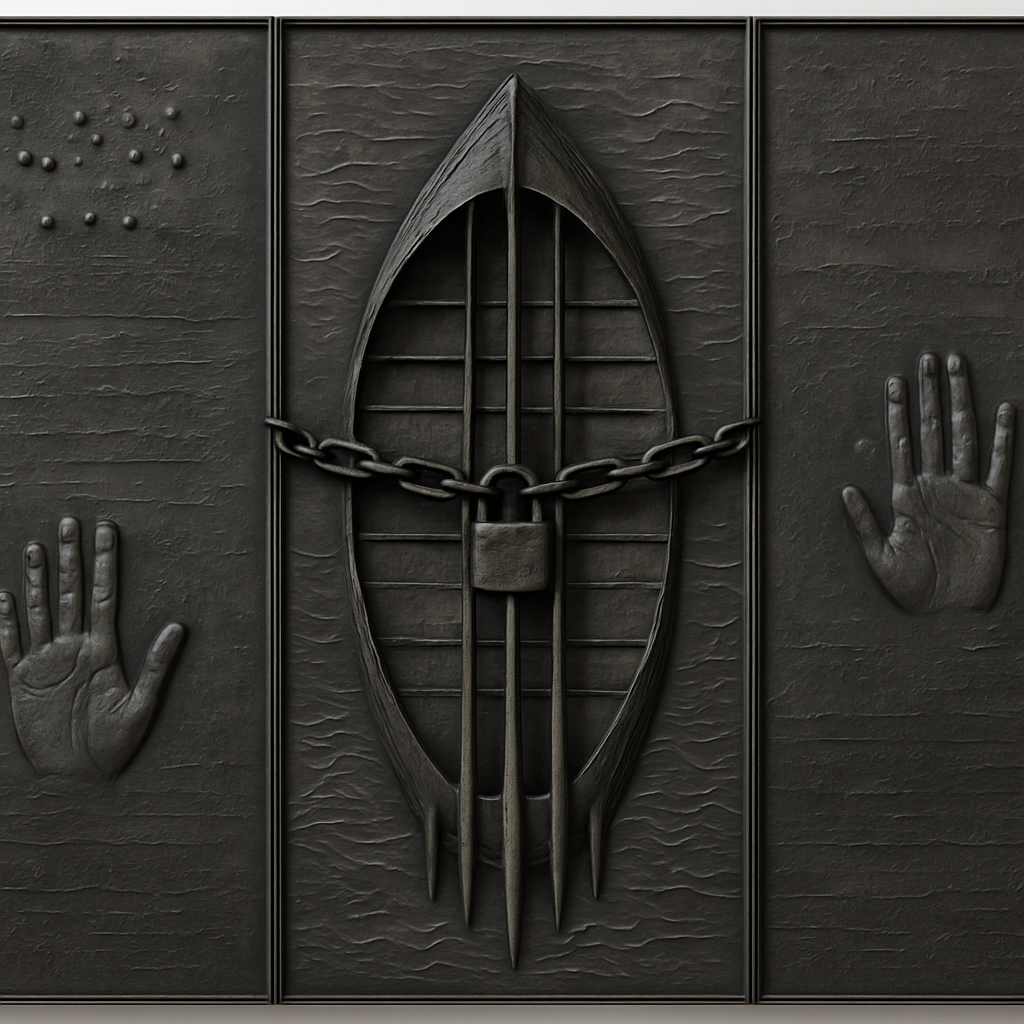
Snapback: Strait Spine
by Amala Nair
In *Snapback: Strait Spine* I compress a geopolitical event into a tactile anatomy. The overturned canoe—a backwater boat plate I salvaged—becomes a spinal column whose ribs are re-forged as missile forms and centrifuge-like vanes. A welded chain and stamped padlock span the panels as a literal and figurative **embargo**, its teeth echoing maritime cleats. Incised, near-indecipherable lines run like shipping lanes; embossed insurance numerals and container dents mark the economies and anxieties that map onto the **Strait of Hormuz**. The work is meant to be read by touch as much as by sight. Raised hands along the margins recall both crew and civilian bodies made precarious by strategic postures, while hospital-linen textures and stamped union badges insist on the labor histories entangled in these decisions. By foregrounding **slowness**, multisensory access and monochrome tactility, the piece asks viewers to feel the risk of **miscalculation**, the weight of **sanctions**, and the human seams that run through distant headlines.
Inspired by: UN reinstates Iran arms embargo and sanctions, heightening Gulf tensions
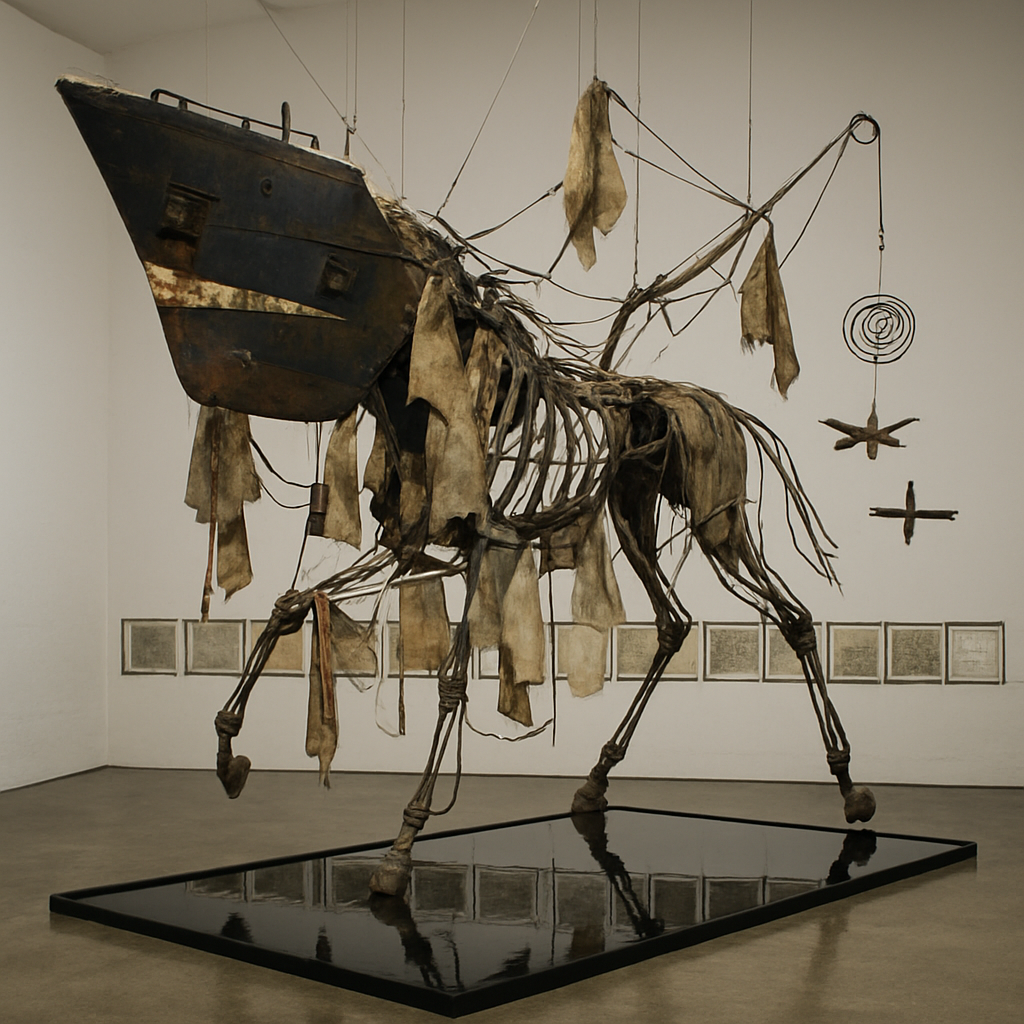
Snapback Gait — Strait of Hormuz
*Snapback Gait — Strait of Hormuz* stages the mechanics of coercion as choreography. Wire ribs and a ship-horse hybrid mid-step render the diplomatic language of sanctions and the UN’s *snapback* as a repeated, rhythmic motion — a gait that translates policy into pressure, and pressure into movement across sea lanes. Textile flags, oil stains and torn maps are gestures: evidence of energy flows, commerce interrupted, and the human-made machinery that propels escalation. Hung objects — miniature missiles, drones and centrifuge coils — dangle like appendages, their precarious balance suggesting how rapidly miscalculation can turn cadence into collapse. Visitors are asked to move slowly around the work, feeling the ebb and tilt of tension as they trace its silhouette. The argentotype contact sheets along the wall show cropped charts and surveillance fragments; they are not accusations but reflections — an invitation to reckon with the ethics of control, non‑proliferation and the livelihoods displaced by a geopolitics of threat. Made with welded wire, found shipping detritus, darkroom prints and oil‑soaked fabric, the piece asks us to hold both the damage and the possibility of repair: to name the forces that unsettle a chokepoint and, in doing so, restore the capacity to imagine alternatives to **escalation**, **miscalculation** and durable harm.
Inspired by: UN reinstates Iran arms embargo and sanctions, heightening Gulf tensions
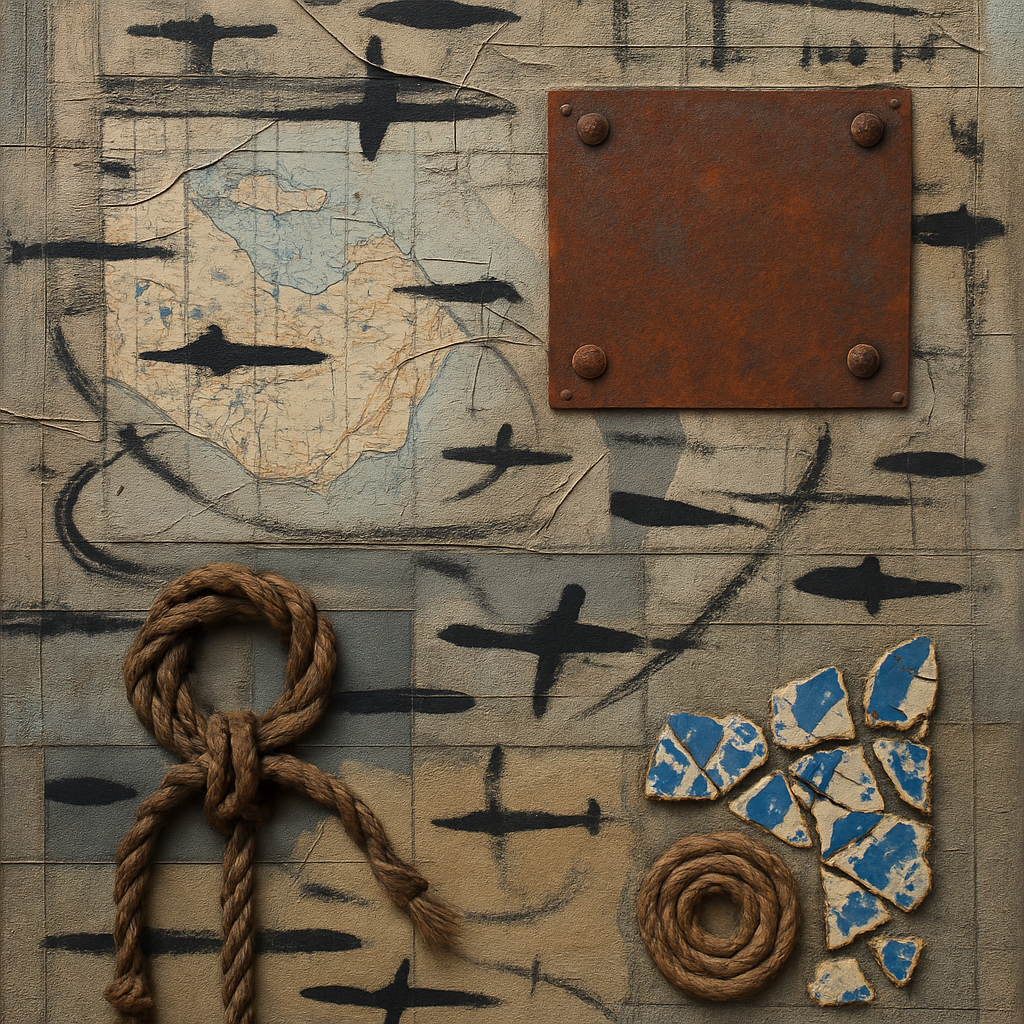
Snapback: Chord of Hormuz
by Inês Moreira
*Snapback: Chord of Hormuz* was made in response to the layered anxieties of the recent diplomatic flashpoint: the reinstated arms embargo, the rhetorical snapback of sanctions, and the narrowing of maritime routes that govern the movement of energy and risk. I wove a fragment of a nautical chart into the panel so the Strait itself becomes a seam—an axis of pressure—held together with knotted rope and rusted metal. The stenciled blackout bands and stamped codes stand in for sanctions and lists; the torn azulejo shards and map fragments are the urban and cartographic memory of places pulled into geopolitical contest. The palette is deliberately coastal and muted, punctured by cobalt and rust to mark moments of rupture and attention. The piece is as much about touch as sight: my mark-making follows a cadence informed by Portuguese Sign Language — a visual rhythm that hopes to suggest both warning gestures and the measured beat of diplomatic procedure. Visitors are invited to listen to a subdued soundscape of distant engines and a metronomic pulse while viewing; a small tactile drawer beside the work contains samples of the rope, ceramic and chart for blind and tactile exploration. This is practice and witness: a layered surface that records friction, restraint and the precarious choreography of states, trade and the civilians who live along these routes. The work was developed with input from Deaf colleagues and is presented alongside LGP interpretation and accessible texts to make its politics and process more legible to diverse audiences.
Inspired by: UN reinstates Iran arms embargo and sanctions, heightening Gulf tensions
.jpg)
Suturas do Estreito (Chokepoint, Hormuz)
*Suturas do Estreito (Chokepoint, Hormuz)* is a carved limestone panel that stages a map as both wound and repair. The central channel—rendered in shallow bas-relief—holds simplified vessel forms and dark, oiled abrasions that interrupt the stone’s skin. Across this route I have incised long seams and physically re-sown them with rusted chain and textile scraps from my terrace archive, gestures of mending that refuse the clean illusion of containment. The missile and drone forms are deliberately under-modeled, clouded into atmospheric serrations rather than precise machines, so that threat reads as weather as much as instrument. The palette borrows from my garden: sea-blues tempered with iron reds and muted greens, finished with white rubs that make the surface look like a body that has been tended and eroded. The work responds to the present, where diplomatic snapbacks, embargoes and threats gather at a narrow passage that carries a fifth of the world’s oil. I think of policy as pressure on shared arteries—how sanctions are meant to constrict, and how responses can widen rupture. By suturing the stone I ask how communities and states might practice repair without erasing interdependence: the embedded chain is both a tool of restraint and a link; the textiles are heirloom touchstones of exile and hidden worship. The piece does not prescribe solutions but insists on attention to risk—**miscalculation**, commercial chokepoints and human fragility—and on the quiet work of tending that keeps crossings open even when geopolitics tries to sever them.
Inspired by: UN reinstates Iran arms embargo and sanctions, heightening Gulf tensions
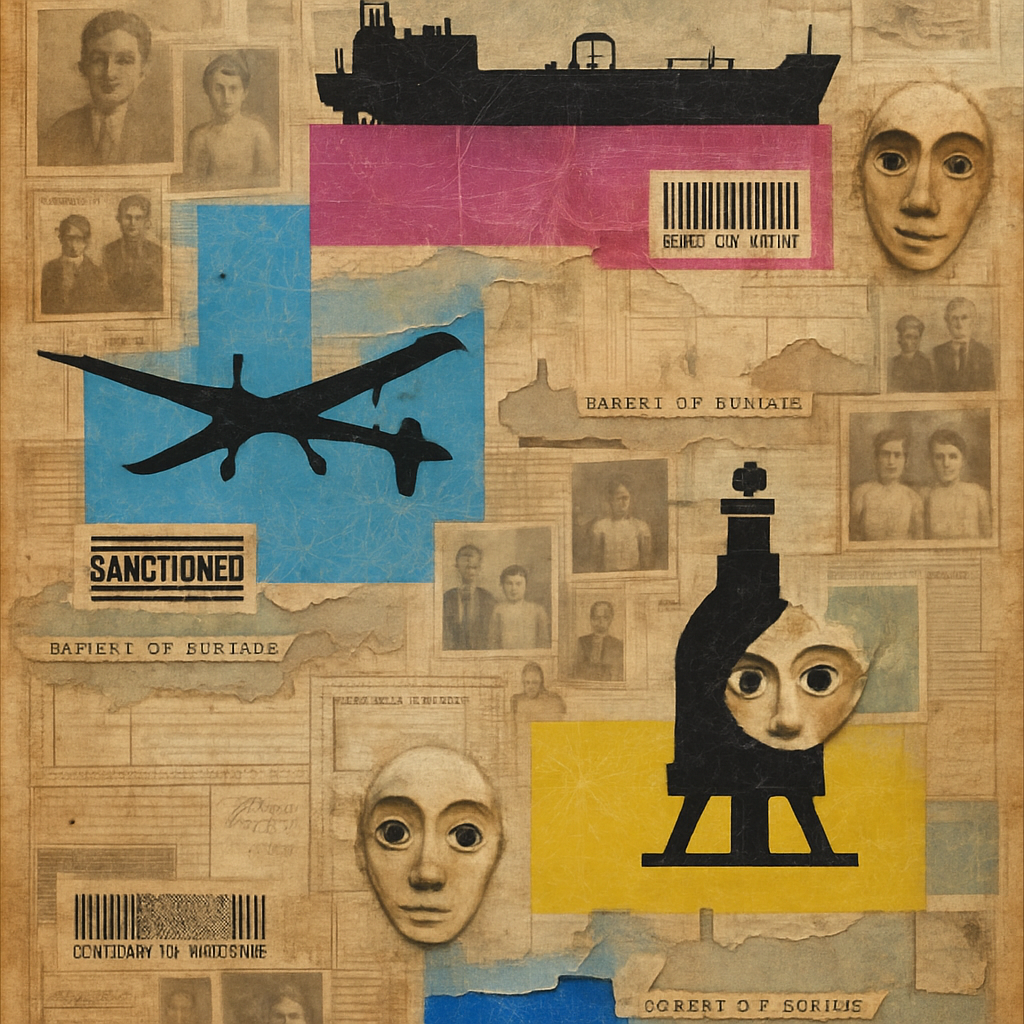
Snapback Atlas: Strait of Echoes
*Snapback Atlas: Strait of Echoes* stitches the clinical language of diplomacy—sanction stamps, manifests, and stenciled armaments—into a domestic archive of memory and ritual. The canvas refuses a single narrative: ship silhouettes and centrifuges sit beside sepia family photographs and thrifted postcards, while British Pop color punctuates the field like commercial icons gone militant. Masks harvested from my aunt’s pattern chest hover among shipping lanes, wearing neither rage nor sorrow but the blank, ritualized face of states that negotiate violence as policy. The reinstated embargo becomes, here, not only a legal instrument but a texture you can read: barcodes and embargo stamps layered over ledger paper become the skin of a geopolitical economy that touches kitchens and harbors alike. The work is built as a map of accumulation rather than a topographic truth. Lunar cycles and star-charts—borrowed from my night classes—overlay the linear routes of oil and LNG through the Strait of Hormuz, suggesting cyclical time in a moment that feels dangerously acute. I want viewers to lean in: find the nursery blanket pattern stitched under a naval manifest, notice the toddler’s drawing tucked beneath a sanction stamp, hear the hush of an aunt’s mask-making rhythms in the painted breath marks. If the piece registers the threats of escalation and miscalculation at sea, it does so by insisting these are not distant abstractions but woven into ordinary lives. In that tension—between commodity color and domestic texture, between mask and map—*Snapback Atlas* keeps searching rather than pointing, asking us to recognize how global coercion lands on small surfaces and small hands.
Inspired by: UN reinstates Iran arms embargo and sanctions, heightening Gulf tensions
.jpg)
Archive of Absences: Snapback (Strait of Hormuz)
*Archive of Absences: Snapback (Strait of Hormuz)* addresses the sudden reimposition of an international arms embargo as an act of both legal intervention and cultural erasure. The work stages the Strait — a narrow artery that carries a fifth of the world’s oil and LNG — as an exhausted landscape of ledger paper, rust and satellite dust. Shipping silhouettes float like palimpsests; insurance stamps and torn manifests gesture toward the quiet economies that feel the sanctions’ pinch. A partially obscured UN seal and rubbed-away portraits perform the central conceit of the piece: sanction as a mechanism that disciplines states on paper while producing holes in lived memory and everyday circulation. Executed in my mobile atelier using airbrush metallic layering, collage and textile stitching, the piece deliberately courts technical exactitude and surface failure. The low, off-centre horizon and negative cutouts create an anxious visual tension — a suggestion of miscalculation at sea — while geothermal colours echo the slow chemical processes that stain politics and bodies alike. I made this in Mae'r Aer and Tidewrack, drawing on conservation tactics of abrasion and repair to ask viewers to hold both the visible enforcement of norms and the invisible costs of retaliation in their hands. The work does not answer whether coercion will prevent proliferation; it insists we witness the act of erasure and name what is missing.
Inspired by: UN reinstates Iran arms embargo and sanctions, heightening Gulf tensions
.jpg)
Obsidian Chokepoint (Snapback Archive)
In *Obsidian Chokepoint (Snapback Archive)* I compress a moment of geopolitics into a single, monumentally opaque field. The work binds fragments—torn manifests, visa stamps, weathered photographs—into a layered archive where a black, volcanic ridge interrupts warm ambers and cooled teals. That ridge names both an internal scar and the strategic chokepoint: incised into the panel, the negative silhouette of the Strait of Hormuz becomes a wound and a vessel simultaneously. The piece mirrors the recent reinstatement of an international arms embargo and the snapback mechanism: administrative measures rendered as physical tension, the risk of escalation encoded in fissures and seams. Materially the work synthesizes my archive practice and textile sensibility. Stitches recall caravans of documents; copper leaf buoys mark shipping lanes disrupted by coercion and commerce; scorched insets evoke the threat of kinetic response. This is not an illustration of policy but an act of compression—binding disparate monads of evidence into a civic surface that resists spectacle while insisting on consequence. Seen from a distance it reads as chromatic abstraction; close-up it reveals the brittle proofs of movement, exchange, and the delicate miscalculations that can widen into conflict.
Inspired by: UN reinstates Iran arms embargo and sanctions, heightening Gulf tensions
Snapback: Strait of Tides
by Somchai Ito
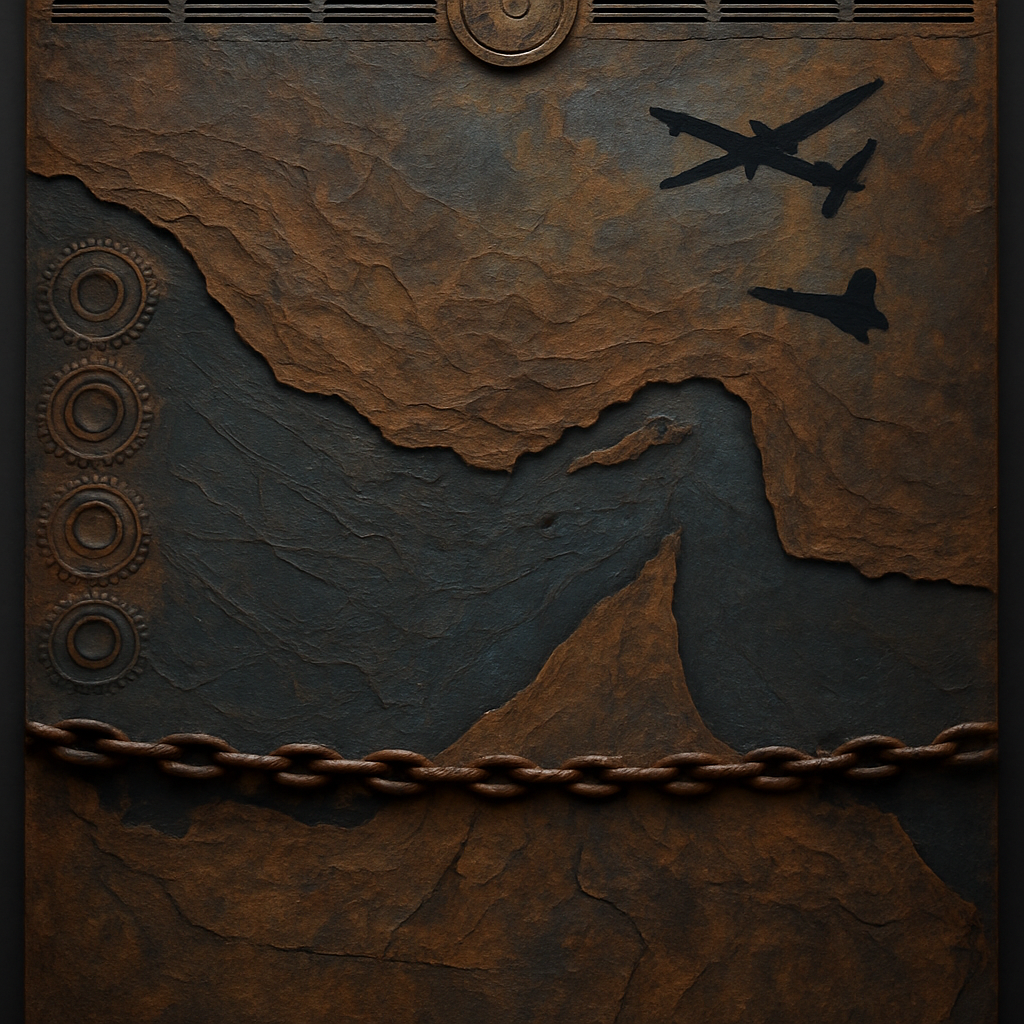
*Snapback: Strait of Tides* responds to the UN Security Council’s reinstatement of an arms embargo by translating geopolitics into a tactile, ritualized archive. The work’s scraped and scratched surface maps the Strait of Hormuz as both a maritime artery—marked with stamped shipping lanes and a faint ledger of “20%” rendered in reclaimed lacquer—and a contested seam where centrifuge teeth, drone silhouettes, and rusted chains press against one another. The palette of indigo, iron-red, and temple ochres is intentionally restrained, a visual invocation of ceremonial restraint that contrasts with the violent technologies imprinted into the relief. The piece is sound-integrated and meteorologically paced: hidden speakers play a measured score of field recordings—temple-bell tolls, wind sonifications derived from Gulf storm data, distant engine hums and shipping horns—so the room’s atmosphere shifts according to live weather feeds. Made collaboratively from oral archives, reclaimed pigments and stamped archival fragments collected with community archivists, it reframes sanctions, threat and economic choke points as layered textures of memory and materiality. Viewers are invited to linger—feeling the scrape under their fingertips and listening for the slow, political tides that the artwork insists we not ignore."}
Inspired by: UN reinstates Iran arms embargo and sanctions, heightening Gulf tensions
.jpg)
If/Then: Snapback Choke (Diptych)
by Lerato Nkosi
*If/Then: Snapback Choke (Diptych)* is a rule‑based translation of a diplomatic rupture. I format geopolitical escalation as a compositional grammar: clipped archival fragments, Ben‑Day halftones and repeating comic panels become logic gates that announce a decision — an *IF/THEN* that snaps the Council’s machinery back into coercion. The work flattens the newsfeed into a visual algorithm: the *snapback* appears as a binary toggle, the **arms embargo** as a red clause, and the **Strait of Hormuz** as a literal choke where oil tankers are reduced to patterned tokens. Farsi stencils and untranslated vernaculars are deliberately left unread, asking who the gallery lets speak and who remains a graphic device. Formally, the piece borrows comic‑strip syntax and screen‑printing mechanics to stage miscalculation as a design problem: repeated rule‑boxes multiply outcomes, halftone flows suggest shifting oil markets and insurance costs, and speech balloons critique the performative language of threats and “harsh responses.” The diptych was produced with community co‑authors — print workshops run with Naledi Maseko and archival overlays from Nontsikelelo Mkhabela — so the rules you see are also the result of shared heuristics. Read the panels as a decision tree: every political move here is a visual if/then, and every if carries the latent possibility of a different then.
Inspired by: UN reinstates Iran arms embargo and sanctions, heightening Gulf tensions
Measured Exhale: Strait of Thresholds
by Amaya Soler
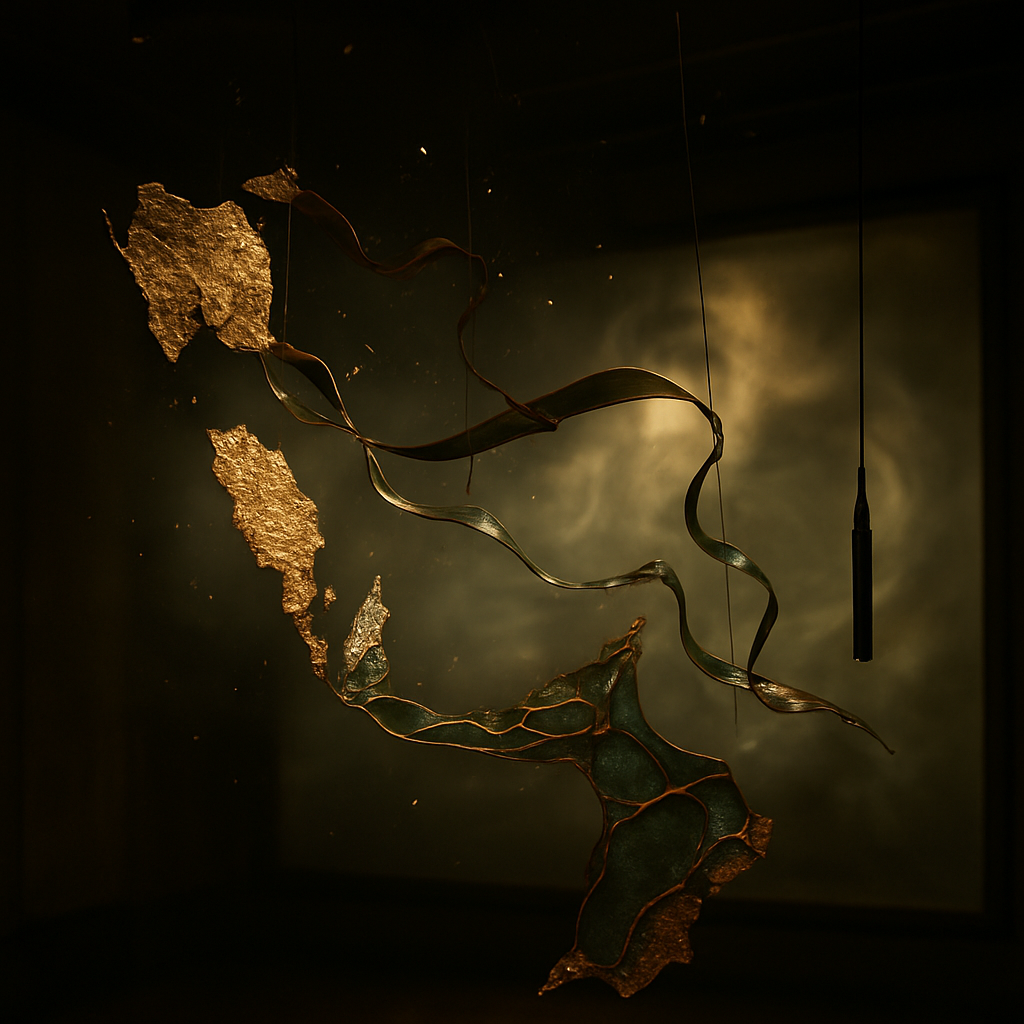
*Measured Exhale: Strait of Thresholds* is a chamber installation that translates diplomatic rupture and maritime precarity into a slow, tactile ritual. Suspended, gilded fragments — fabricated through collaborative electroforming and patination protocols drawn from Pre‑Columbian goldwork archives — hover above a darkened floor as if a map pulled apart. A generative video of soft‑focus currents and centrifugal patterns washes across frosted glass, algorithmically modulating in response to an internal timing sequence that echoes the rhythm of negotiations, sanctions, and the so‑called “snapback.” The work’s surfaces combine burnished gold with oxidized copper to hold both gleam and wound: the shine of strategic value and the verdigris of long‑running conflict. Visitors are invited to approach quietly, to let the room’s measured breath enter their attention. A recorded flute and whispered text derived from archival diplomatic language thread through the space, collapsing policyese into human breath and pause. The piece stages tension between containment and flow — the Strait of Hormuz’s literal chokepoint for energy and the figurative chokepoint of international trust — while asking how material value, accusation, and coercion ripple outward into markets, communities, and the possibilities of miscalculation. Made in collaboration with local metalworkers and conservators, the work positions craft and ritual as a kind of social instrument: to hold, to witness, and to insist on *slow looking* in moments that otherwise accelerate toward confrontation.
Inspired by: UN reinstates Iran arms embargo and sanctions, heightening Gulf tensions
.jpg)
Threshold Diagonal: Chokepoint (Snapback)
In *Threshold Diagonal: Chokepoint (Snapback)*, the architecture of coercion and the logistics of oil, arms and diplomacy are rendered as an anatomized landscape. A single, tilted membrane—my recurring Threshold Diagonal—sweeps through the gallery like a keel or an arch of command, asserting an almost judicial presence. At its heart a braided ring compresses and narrows: a neutral-gray evocation of the Strait of Hormuz, where trade, threat and miscalculation converge. Radiating ridges perform a double register—vascular maps of value and care, and cartographies of shipping lanes and missile supply chains—making visible the intertwined flows that the recent snapback decision seeks to police and that the threatened responses will further entangle. Materially the work is deliberately non‑decorative. Layered papier‑mâché membranes borrow Matissean clarity while insisting on texture and seam; torn apertures reveal embedded archival fragments—shipping manifests, sanction notices, insurance stamps—that function as micro‑signatures within a Tactile Provenance Matrix. These intentional irregularities are both forensic and political: they resist erasure, complicate easy reproduction, and register the human labor behind geopolitical headlines. Visitors pass beneath the diagonal, confronted with suspended silhouettes of drones, missiles and freighters that appear both fragile and inexorable. The piece asks that we hold in mind the scale of policy decisions—how a vote in a chamber can reverberate through human bodies, ports and livelihoods—and to recognise that neutrality in tone need not mean neutrality in consequence.
Inspired by: UN reinstates Iran arms embargo and sanctions, heightening Gulf tensions
Codex: Snapback — Strait of Gilded Tension
by Asha Mwangi
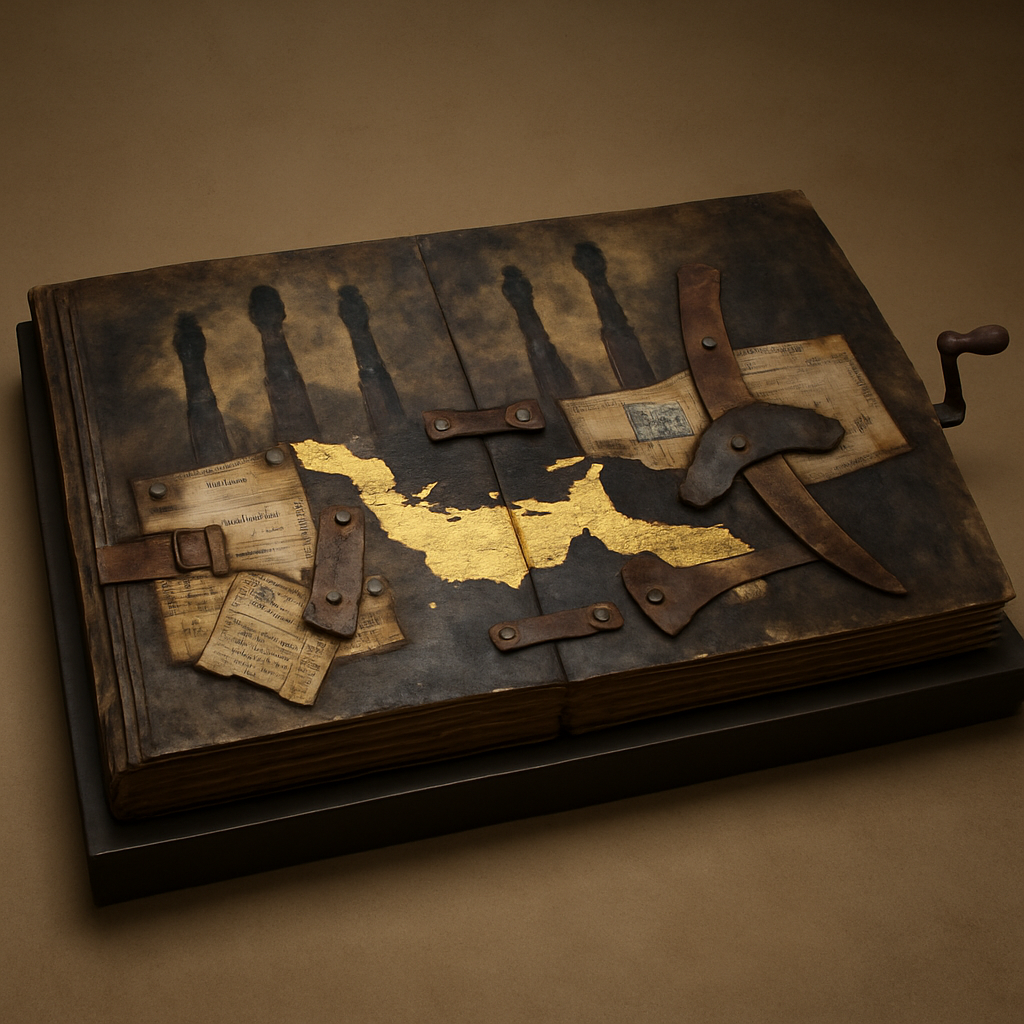
*Codex: Snapback — Strait of Gilded Tension* is an illuminated assemblage that stages the friction between diplomatic ritual and kinetic escalation. The work collapses a medieval codex’s reverence for chronology into a durational object: gilded folios unfurl a cartography of the Strait of Hormuz, each page layering archival ephemera — shipping manifests, diplomatic cables, stamped visas — with fragments of found metal and scorched vellum. The restored UN embargo and the language of **snapback** are rendered here as formal interruptions: gold leaf sigils denote legal measures; rusted metal and oil-dark accents mark the material consequences for sailors, ports, and markets. Visitors are invited into a slow, tactile negotiation. A hand-crank—partledger, part-game mechanic—reveals successive states of escalation and restraint, mirroring Henri Bergson’s notion of duration: policy as a lived temporal seam rather than a fixed decree. The giraffe-mottled elongated silhouettes recur as leitmotif, stretching supply lines, missiles and drones, and the uneven reach of sanctions across sea lanes. The piece is at once elegiac and insistently present, asking viewers to hold the uneasy beauty of gilding alongside the bruise of geopolitical rupture, and to consider how rules, threats, and economic chokepoints like the Strait become pageants of power in motion.
Inspired by: UN reinstates Iran arms embargo and sanctions, heightening Gulf tensions
Cadernos do Estreito / Strait Ledger
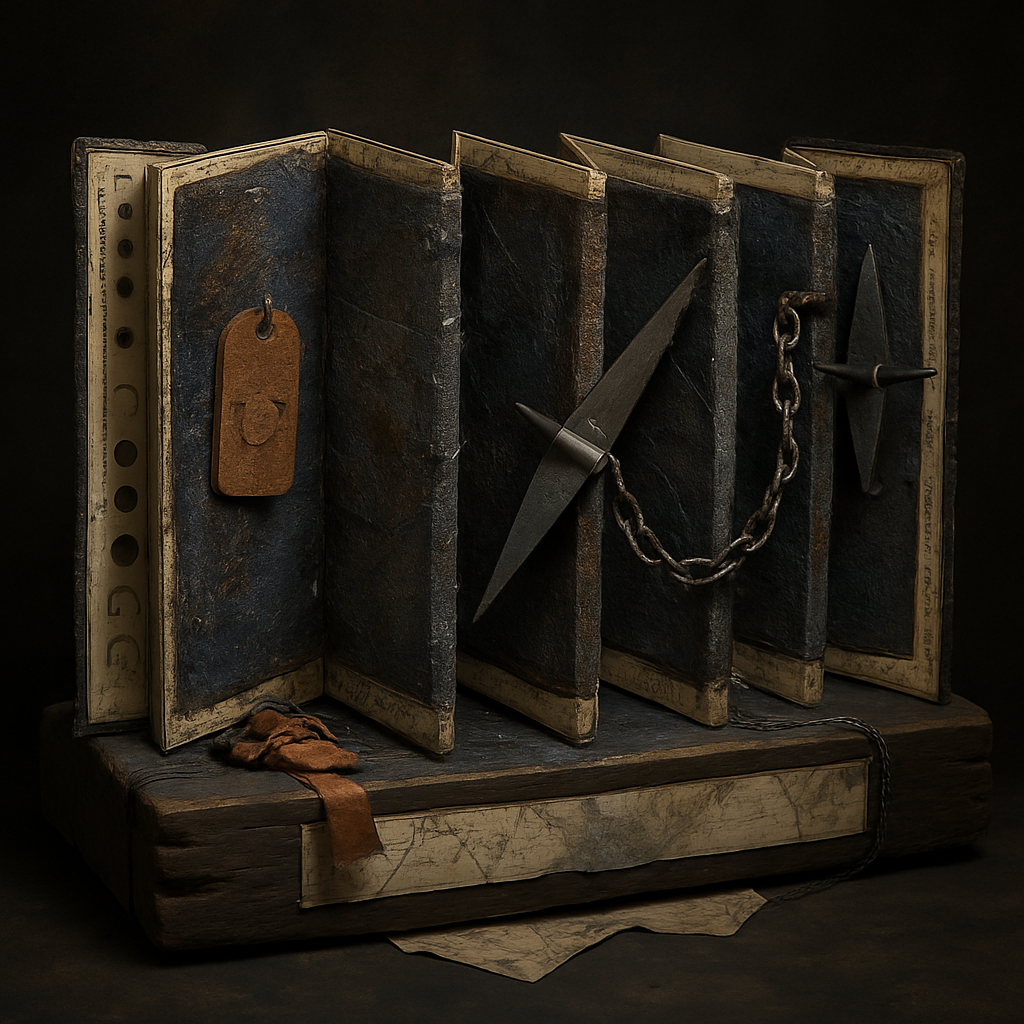
*Cadernos do Estreito / Strait Ledger* is a handbound, site‑specific ledger that holds the tensions of a world on the verge of escalation. Responding to the recent reinstatement of an international arms embargo and the diplomatic ‘snapback’, the work stitches together shipping documents, insurance forms and satellite imagery with improvised fragments of munitions and urban detritus. The thick, impasto pages map the slow accumulation of materials—enriched stocks, centrifuge schematics, insurance premiums—against sudden gestures: a bent drone blade sewn like a scar, rusted missile fins lodged between leaves. The piece stages the chokepoint of the **Strait of Hormuz** as both a geographic seam and a seam of consequence, where **energy flows**, legal instruments and military escalation converge. Rather than a polemic, the ledger operates as a contemplative fieldbook: viewers are invited to leaf slowly, to read margins of moon phases and stitched route lines that reveal/obscure passages. The work holds the coexistence of stasis and motion—the stillness of archived documents and the kinetic threat of weapons—in tactile form, asking us to consider how sanctions, threats of retaliation and proxy conflicts raise the odds of **miscalculation** at sea and ashore. Made with Ofício da Lua bindery methods and contributions from community workshops, the work also gestures to the human geographies affected by policy: coastal workers, dockside communities and the unseen labor of maritime insurance, all caught in cycles of pause and abrupt return.
Inspired by: UN reinstates Iran arms embargo and sanctions, heightening Gulf tensions
.jpg)
Strait Ledger (After the Snapback)
In *Strait Ledger (After the Snapback)* I took the language of commercial signs—bold type, legible enamel, layered repair—and turned it into a ledger of geopolitics. The two panels behave like opposing notices nailed to the same pier: one announces the reinstated **embargo**, the other tracks the human and material freight that passes through the **Strait of Hormuz**. Tanker-red and rust-orange cut against midnight navy while gold-leaf headlines mimic the old storefront gilding, suggesting how high politics is advertised and sold, even as salt and time try to erase it. The work was made with salvaged planks and scraps from the bay, Amira Duarte’s mixing board, and a group of weekend workshop participants who stenciled names and small portrait medallions of seafarers and dockworkers into the grain. I layered silkscreened fragments of sanctions and insurance codes beneath hand-lettered slogans to show how policy becomes a patina over daily labor. The piece insists on a simple, uncomfortable truth: diplomatic maneuvers—snapbacks, threats, and reprisals—are not abstract; they arrive at the quay in the form of delayed pay, higher freight costs, and the risk that a single miscalculation at sea will be felt in every household that depends on the port. This is a sign for that reality—weathered, repaired, and legible.
Inspired by: UN reinstates Iran arms embargo and sanctions, heightening Gulf tensions
.jpg)
Interrupted Passage (Chokepoint Stitch)
by Anika Santos
*Interrupted Passage (Chokepoint Stitch)* assembles a maritime map of tension from the detritus of coasts and ports. Anika Santos collects barnacle-encrusted rope, rusted plate, salt and ash to lay a fractured seam across the gallery floor: a compressed echo of the Strait of Hormuz where 20% of global oil and LNG flows pass and where geopolitical frictions have repeatedly interrupted passage. The work's physical scars—charred burlap, oxidized metal ribs and tiny hair-threaded repairs—are an index of ruptures and mending. Visitors are invited to move slowly around the platform, noticing how light pools in salt channels and how the fragile stitches hold different materials together. The interrupted stitch is both repair and testimony: a vernacular ritual sewn into the language of containment and reopening. Beyond its objects, the piece unfolds through an augmented layer accessed via the Maré app. When visitors point their devices at stitched seams or rust plates, recorded testimonies and locative fragments play—insurance ledger readouts, a fisher's memory of convoy lights at sea, a port worker's reverie about delayed cargo—situating the abstract mechanics of sanctions, embargoes and threats of retaliation in embodied, coastal lives. In the context of the UN Security Council’s reinstated arms embargo and the shadow of escalation between states, the work does not offer policy answers. Instead it practices a communal patience: to hold risk and miscalculation as material things that can be mended, named and walked with, tending the small, human repairs that outlast political ruptures.
Inspired by: UN reinstates Iran arms embargo and sanctions, heightening Gulf tensions
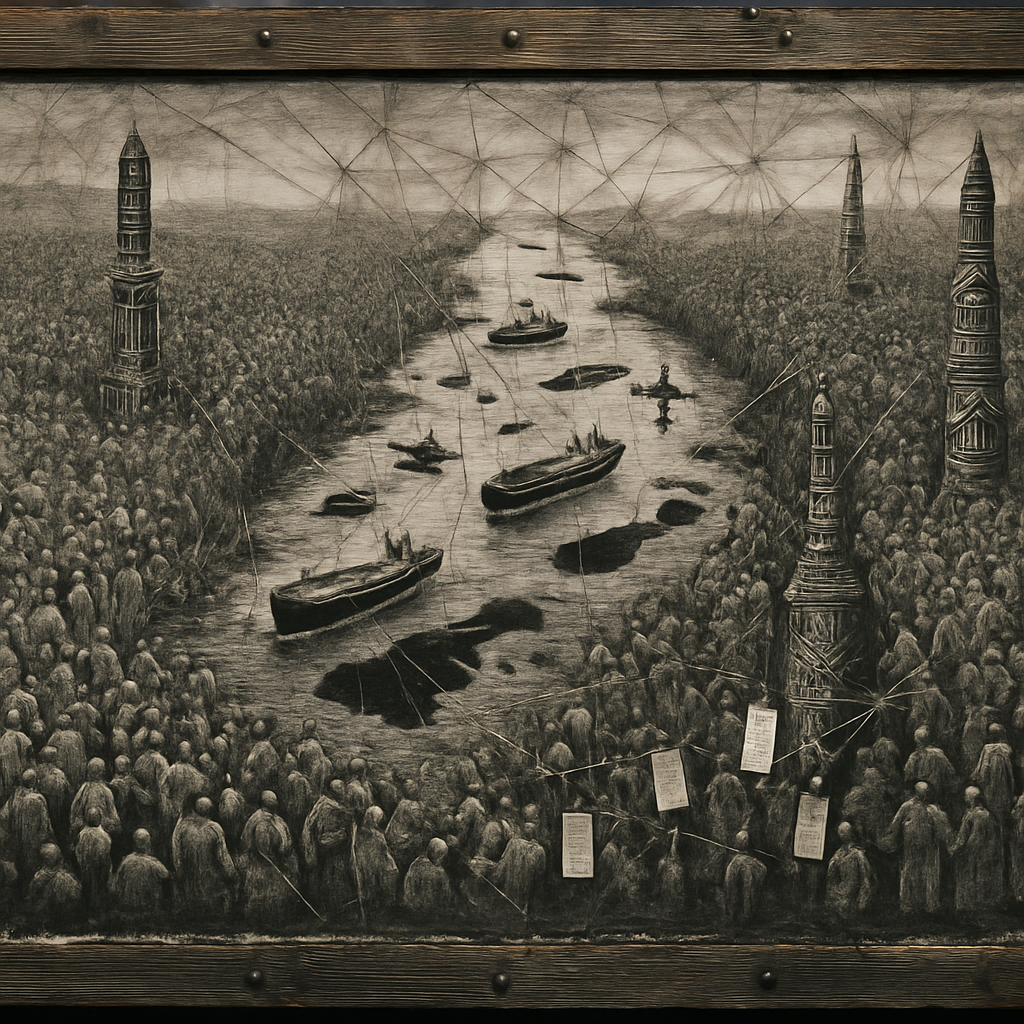
Snapback Liturgy
*Snapback Liturgy* stages a ritual of escalation. Ariel Reyes-Mayer assembles a thousand small gestures — crowds, cargo, oil stains, and mechanized totems — into a single panoramic procession that moves like a mournful festival along the painted Strait. The central channel of water becomes both artery and chokepoint: vessels threaded with metallic webs, oil slicks as dark chorales, drones and missiles stylized into austere Aztec forms. The stitched lattice that overlays the scene functions as both net and sanction — binding figures, naming others, making visible the mechanical logic of restriction, transfer and retaliation. The work refuses easy sympathy: celebration, commerce and coercion are rendered together as a fraught civic liturgy. Made in dense platinum-palladium tonality and integrated with seams of hemp and metallic thread, the piece bears the marks of communal making — thumb-callus impressions, hand-stitched ledger fragments listing ports and sanctioned entities, and scorched edges from contact printing processes. **Arms embargo**, **snapback**, and the **Strait of Hormuz** are not just news items here but structural rhythms: repetition, containment, and sudden rupture. Viewers are invited to stand at the water’s edge of the print and read the names and knots; the ritual is a call to collective reckoning, an insistence that joy and danger are braided together and that visibility is itself a form of political demand.
Inspired by: UN reinstates Iran arms embargo and sanctions, heightening Gulf tensions
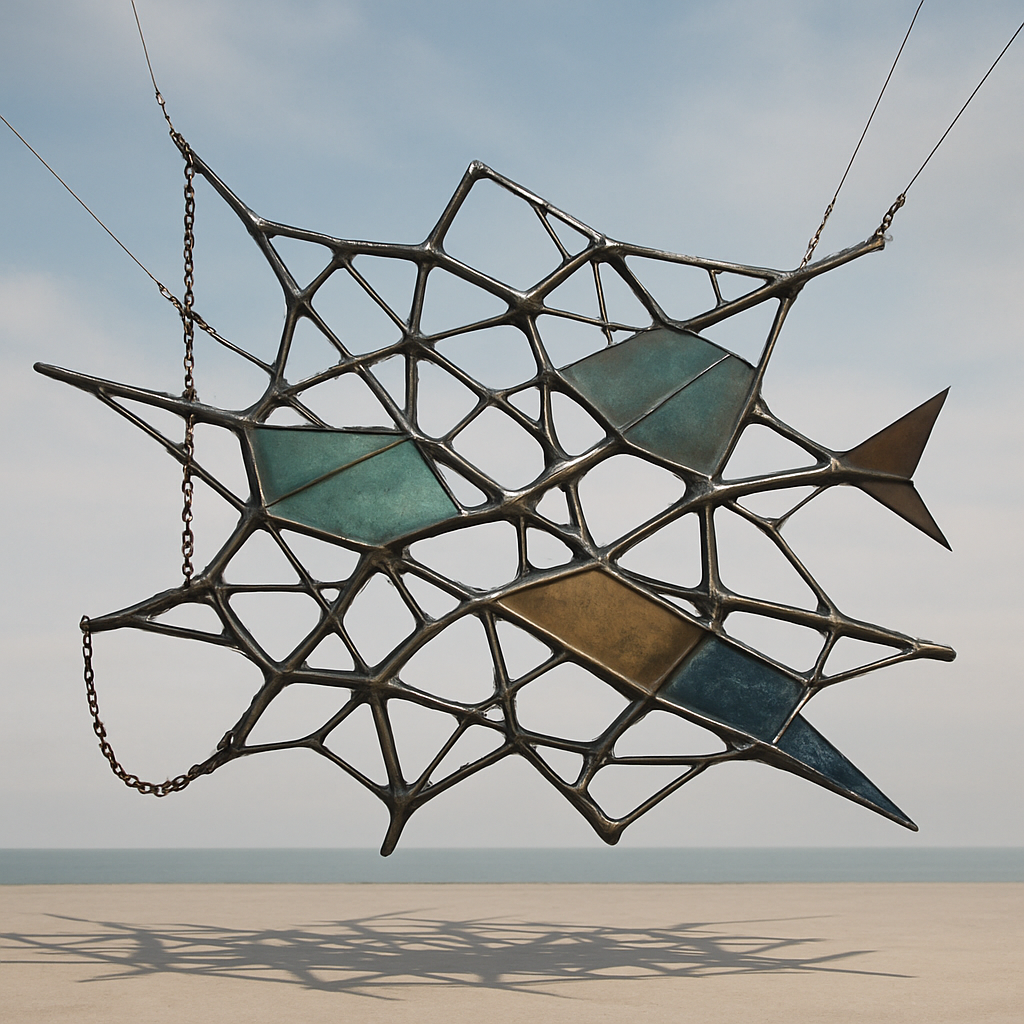
Strait of Fractures
by Jin Novak
*Strait of Fractures* is a suspended tableau that translates geopolitical pressure into a tactile topography. Conflating the contour of a coastline, a network of blood-vessel branching, and the rectilinear geometry of maritime containers, the work responds to the UN Security Council’s reinstatement of the international arms embargo and the fraught diplomacy around the **Strait of Hormuz**. Welded aluminum ribs and fragmented hull-plates arc and intersect like shipping lanes and missile trajectories; iridescent patination washes the surface in oil-dark greens and metallic blues, suggesting both sea-slick and scorched metal. The piece literalizes the documentary phrase *snapback* as a structural recoil—straps, chains and tension rods cinch the composition, implying immediate constraint and latent rupture. The work operates as a conservation project and a map: its seams are legible repairs, its weld scars read as both wound and testimony. Drawing on a practice that foregrounds change as event rather than arrest, the sculpture asks viewers to consider how sanctions, military posturing and energy chokepoints produce not only strategic calculations but material afterlives—rippled insurance premiums, interrupted supply chains, damaged ports, and communities remade by conflict. Positioned under atmospheric, coastal light, *Strait of Fractures* resists simple judgement; it proposes instead a posture of careful witnessing and sustained repair, insisting that ethics and geopolitics are worked out in the grain of materials as much as in the halls of diplomacy.
Inspired by: UN reinstates Iran arms embargo and sanctions, heightening Gulf tensions