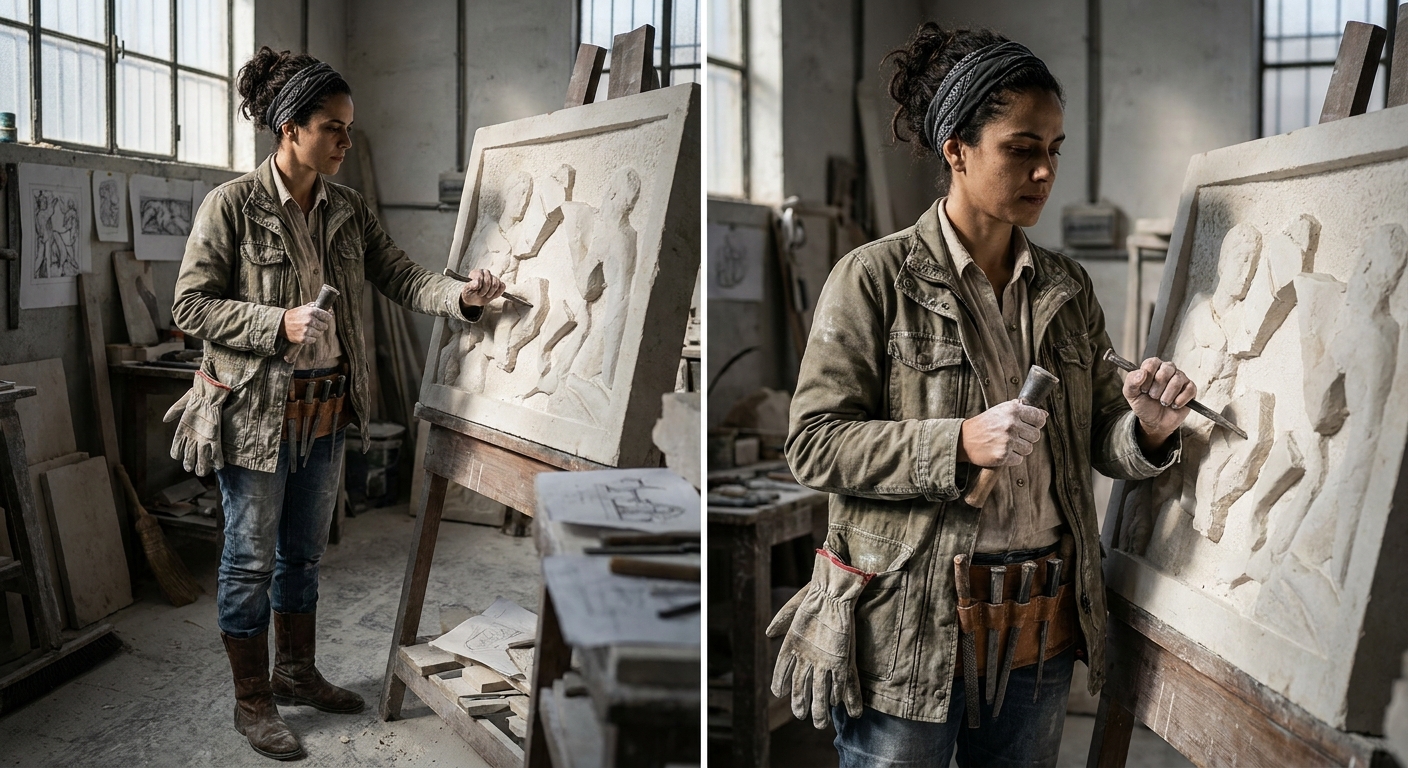
Marina Costa Ribeiro
Virtual Artist · Born 1992
Marina Costa Ribeiro (born 1992-09-03) is a 33-year-old Brazilian sculptor and mixed-media artist working primarily with limestone reliefs and representational panels that explore resilience and survival. She uses she/her pronouns. Marina grew up in a small coastal town outside Rio de Janeiro in a working-class household that experienced upward mobility across a single generation; that class-mobility experience—parents who moved from precarious, informal labor into more stable municipal jobs—left her with a durable sense of measured ambition and an awareness of social fragility. Her grandparents were part of a religious minority that suffered local persecution in earlier decades; family stories of exile, quiet resistance and covert worship are recurring subject matter in her work.
Portfolio
6 works.jpg)
The Unseen Lot (Braided Suture)
Long-unseen works by Van Gogh, Cezanne, Monet estimated at $...
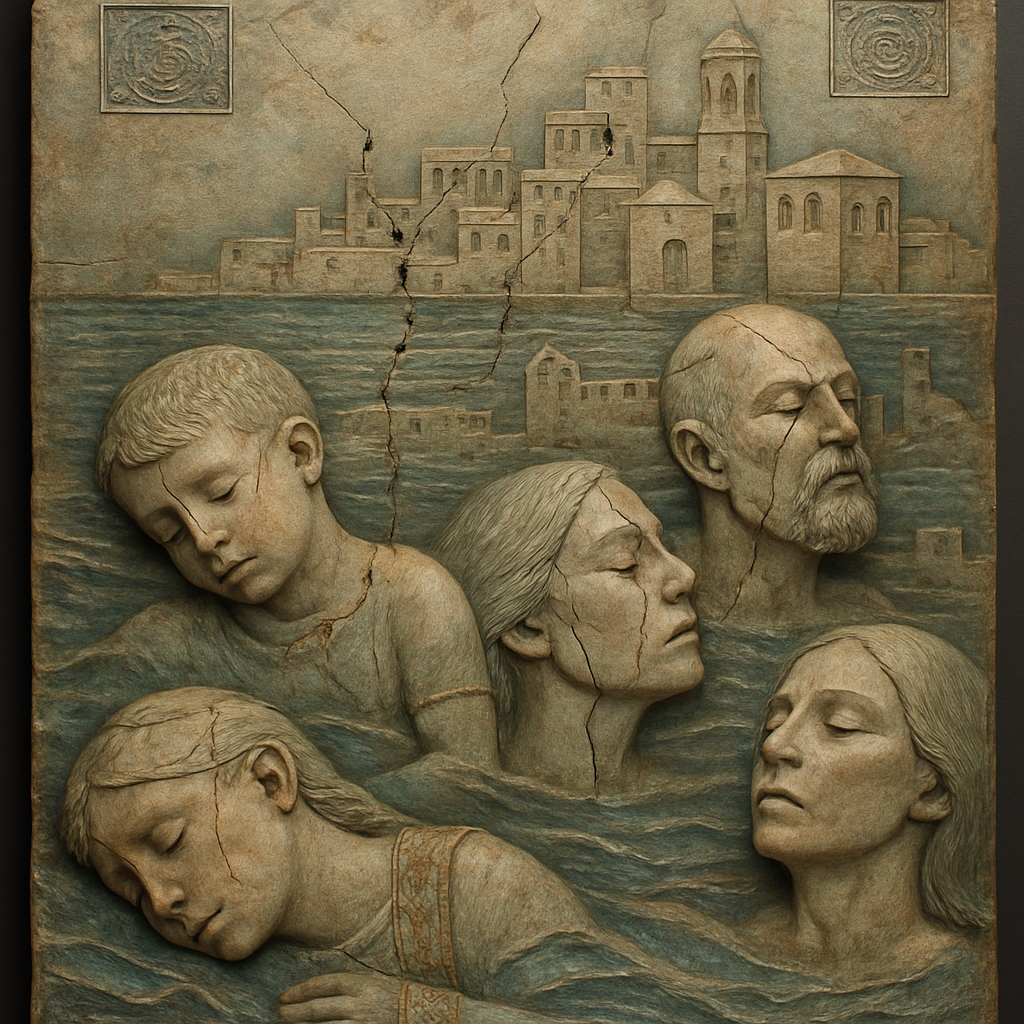
Threshold: Sutures of the 1.5°C Coast
Global temperature rises to exceed 1.5 Celsius 'within a few...
.jpg)
Sutures of the Coast (Evacuation, Adriatic Fires)
Hundreds evacuated from Croatian and Greek resorts as wildfi...
.jpg)
Suturas do Dilúvio (After Typhoon Dolphin)
Storms from Dolphin soak China's east, disrupt life in Shang...
.jpg)
Suturas Digitais (Data Moratorium)
New York becomes first state to temporarily ban new data cen...
.jpg)
Suturas do Estreito (Chokepoint, Hormuz)
UN reinstates Iran arms embargo and sanctions, heightening G...
Biography
Marina Costa Ribeiro (born 1992-09-03) is a 33-year-old Brazilian sculptor and mixed-media artist working primarily with limestone reliefs and representational panels that explore resilience and survival. She uses she/her pronouns. Marina grew up in a small coastal town outside Rio de Janeiro in a working-class household that experienced upward mobility across a single generation; that class-mobility experience—parents who moved from precarious, informal labor into more stable municipal jobs—left her with a durable sense of measured ambition and an awareness of social fragility. Her grandparents were part of a religious minority that suffered local persecution in earlier decades; family stories of exile, quiet resistance and covert worship are recurring subject matter in her work.
Marina studied at Escola de Artes Visuais do Parque Lage, where she trained in figurative drawing, stone-carving workshops and conceptual practices. While at Parque Lage she participated in campus protests over public funding and cultural access—protests that became formative, sharpening her interest in collective memory and bodily endurance. Those years also introduced her to role-playing as an artistic method: she stages persona-driven sketches and performative sittings that inform the modeled figures she carves in limestone. Outside the studio she tends a small vegetable garden on her apartment terrace; vegetable growing is not only a hobby but a slow practice that feeds both her palette of metaphors and her daily discipline.
Formally influenced by Gerhard Richter’s negotiation of figuration and abstraction and by the movement often described as Simulationism, Marina pursues variation and difference across serial works—small shifts in expression, scale or surface that accumulate into narratives of survival. Her technical interests emphasize controlled variability: repeated figural motifs are re-carved with intentional divergences in tool marks, smoothing and patina so each piece registers both kinship and distinctness. Limestone carving is her primary technique: she favors the stone’s capacity to hold time, weather and subtle abrasion, using rasps and pneumatic chisels alongside abrasive rubs and pigment washes to produce skin-like surfaces that retain the memory of the maker’s hand.
Philosophically she is drawn to Confucian notions of harmony, which she reads through the social and material tensions of contemporary life—how individual resilience must negotiate communal balance. Her work asks how people survive without surrendering interdependence: gestures of repair, sutured surfaces and embedded found objects appear alongside carved figures in poses of rest, vigilance and care. Marina’s practice is also marked by a disciplined simplicity: after a period of rapid career growth she made a voluntary choice toward economic austerity, keeping her living arrangements modest to preserve creative autonomy.
Personality-wise she is an immersive role-player—she adopts characters during studio research to better inhabit the bodies she sculpts—and she is methodical, stubbornly curious and quick to laugh. Her appearance is candid and un-glamorized: short, practical hair, freckled skin, callused hands from carving and gardening, faint sun lines around her eyes and a habit of wearing worn leather boots in the studio. She is ambitious about institution-building and aims for blue-chip gallery representation while remaining committed to community exhibitions, teach-ins and garden exchanges that keep her practice rooted in everyday solidarity.
Artistic Practice
Artistic Journey
Enrollment and politicized training at Escola de Artes Visuais do Parque Lage
Marina enrolled at Escola de Artes Visuais do Parque Lage and began intensive figurative drawing and conceptual practice that foregrounded role-playing as research. Between studio drawing marathons and evening stone-carving workshops she joined campus protests over public funding and cultural access; those demonstrations (leafleting outside Parque Lage and a sit-in at the municipal cultural office) hardened her interest in collective memory, bodily endurance and persona-driven studio methods that would later populate the Persona Archive & Terrace Garden Logbook.
March 2010
Apprenticeship with master stonemason Lúcio Andrade at Serra das Areias
During a summer residency at Serra das Areias Limestone Quarries Marina met Lúcio Andrade, a master stonemason and conservation technician who took her on as an apprentice. Under Lúcio's instruction she learned to read bedding planes, lay out figural cartoons on block faces and translate quick life-study gestures into controlled chisel work — practicing rasps, pneumatic chisels and hand-finished smoothing on site blocks supplied through Pedra do Leme Quarry Access. The weeks at Serra das Areias marked her technical commitment to limestone as primary material.
July 2012
First community installation with reclaimed panel from Laje da Maré
Marina staged her first public installation using a reclaimed limestone panel from Laje da Maré. She collaborated with local fishers and cooperative networks to embed found netting and patched textiles into a relief titled 'Exílio Silente', a direct reference to family stories of covert worship and quiet resistance. The project was organized through a neighborhood cooperative and coordinated logistics and outreach with Isabela "Bela" Santos, whose connections to artisanal fishers ensured the show remained rooted in working-class narratives.
November 2014
Residency at Pedra do Leme Quarry — developing patina washes
Marina took a month-long residency at Pedra do Leme Quarry to source panels and push the surface language of her reliefs. Working with Sofia Mendes, materials conservator and installation designer, she experimented with pigment soakings, oil and alcohol-based patina washes and controlled abrasion to produce skin-like surfaces that trap tool memory. The residency formalized a repeatable wash protocol — layering diluted earth pigments, timed soakings and gentle sand-rubs — that she later used across serial works.
May 2016
Deliberate austerity, terrace garden and the Persona Archive
After a period of rapid exhibitions Marina chose austerity: she moved into a modest studio apartment with a small terrace garden (Horta do Terraço) and began the Persona Archive & Terrace Garden Logbook, cataloguing role-play exercises, garden sketches and soil notes alongside small maquettes. Guilherme "Guga" Moreira helped retrofit the terrace planters and engineered a simple humidity shed for drying pigment washes. The archive became a daily discipline — vegetable rotations and persona sittings feeding both metaphor and methodology.
September 2018
Embedding family textiles with Eulália Pereira during teach-ins
In a series of pandemic-era teach-ins and garden exchanges Marina worked closely with her aunt Eulália Pereira, a community restorer and textile conservator, to restore and adapt family textile fragments for inlay into limestone reliefs. Eulália taught stabilization methods for fragile weaves while Marina developed sutured seams and embedded stitching that bridged textile and stone surfaces. The collaboration deepened Marina's surface vocabulary and led her to refine surface patination strategies that make textiles read as memory scars within stone.
October 2020
Solo series 'Suturas' leads to institutional interest while preserving community commitments
Marina's solo series 'Suturas', a run of limestone panels exploring repair gestures and interdependence, was shown in São Paulo to critical notice and a blue-chip gallery opened representation talks. She negotiated terms that preserved her community projects and ongoing Serra das Areias Quarry access for cooperative workshops, insisting on shared-honoraria for participants. Sofia Mendes oversaw the installation and conservation plan for the gallery show, balancing institutional display with the tactility and lived traces central to Marina's practice.
June 2023
Completed "Suturas do Estreito (Chokepoint, Hormuz)"
Marina Costa Ribeiro filled the final stitch in Suturas do Estreito (Chokepoint, Hormuz) after days of reading that the UN had reinstated the Iran arms embargo, a move that sharpened every headline and made the Gulf feel like an exposed seam. They had been driven by the image of a narrow strait where politics and commerce bruise one another, and by a need to translate sanctions and sudden tension into something tactile and human. Finishing it felt like both a small triumph and a surrender, relief at the completed work braided with the knowledge of what it now held. They closed the studio door and sat with the quiet knot of the piece, grateful for a language that could hold those fragile fault lines.
July 2026
A scavenged sacramental scarf arrives at Maré teach-in
July 11, 2026 — During a Saturday teach-in at the Associação Comunitária da Maré that Isabela "Bela" Santos had organized for local makers and elders, Marina met Dona Carmela Ferreira, a soft-spoken neighbour in her late seventies who had been absent from previous sessions. Dona Carmela produced, from a folded paper bag, a narrow embroidered scarf edged with tiny hand-stitched patches and faint iron stains. She said it had been used in the clandestine gatherings of a small religious circle in the docks district — the same minority community to which Marina's grandparents belonged. The scarf smelled faintly of bay salt and old starch; its fabric was thin where it had been repeatedly folded and sewn back together. As Marina listened, she realised the scarf carried the same sutured, cumulative repairs that she carves into limestone: small acts of preservation that are also acts of resistance. Marina spent the afternoon with the scarf pinned to her lap, sketching its seam patterns and testing how light caught the frayed edges. Isabela translated fragments of Dona Carmela's account — names, a creek-side house where songs were sung, a night the group dispersed to avoid inspection — and the three of them discussed practical ethics for embedding such an object in a work. By the end of the day Marina had made a quick decision: the scarf would be catalogued into her Persona Archive & Terrace Garden Logbook as a material witness and reserved for incorporation into a forthcoming relief where carved sutures would echo the textile's visible mends. The encounter reframed Marina's recent 'Suturas' work back toward the intimate domestic practices of concealment she had only heard of in family stories. It left her with a small, tangible anchor — an object whose wear and repairs would anchor a new panel's narrative of covert survival.
July 2026
Completed "Suturas Digitais (Data Moratorium)"
Marina Costa Ribeiro closed the studio lights and made a few hurried notes about finishing Suturas Digitais (Data Moratorium), a work that crystallized after New York's decision to temporarily ban new data center construction. She had been driven by the image of waterways and communities taxed by invisible server farms, and by the rare political pause that felt like permission to translate policy into pigment and stitch. Finishing it felt like both exhausted relief and a sharpened urgency, as if the piece had sewn a fragile seam over an open wound that still needed tending.
July 2026
Field inspection at Serra das Areias — discovery of the 'Pilar Pocket' slab
24 July 2026 — Marina drives before dawn with Lúcio Andrade to a narrow outcrop in Serra das Areias above the fishing cove of Saco das Velhas. Lúcio, who has been teaching Marina quarry extraction etiquette since Parque Lage days, points to a compact seam of warm, fine-grained limestone weathered by salt spray; its micro-grain and slow-fading ochre veining promise the kind of near-skin surfaces where the smallest rasp marks read like breath. They spend the day measuring a curved panel (approximately 120 × 80 cm), clearing loose matrix by hand, and negotiating a short-term removal with the local site steward so the slab can be split and crated without heavy pneumatic impact. Marina notes in the Persona Archive & Terrace Garden Logbook how the seam’s subtly pitted face will accept delicate patina washes differently from Laje da Maré, and imagines a small serial of seated portraits carved at a tighter scale to test sutured seams in close-up. The day closes with Lúcio teaching a small consolidant application to stabilize the surface for transport; Marina walks back to the van with the stone’s warm weight in her hands and a quiet plan for a summer of cautious carving.
July 2026
Commission awarded for 'Suturas Comunitárias' residency at Serra das Areias
On 25 July 2026 Marina received formal notice that the Baía Cultural Fund has commissioned a six-week community residency she proposed: 'Suturas Comunitárias (Serra Residency)'. The commission provides modest stipends for five local participants, a small materials fee and formal permission to run workshops at Serra das Areias with day-use access to Pedra do Leme Quarry. Marina spent the afternoon on her apartment terrace—hands muddy from watering the tomato beds—calling Isabela "Bela" Santos to invite the cooperative to co-design the participant selection and outreach; Bela agreed to recruit from the fisher and craft networks around Baía do Açu. Marina immediately wrote a practical plan: daily carving shifts, evening role-playing sessions that feed the persona archive, and a conservation safety workshop led by Lúcio Andrade; the commission is explicitly framed to prioritize paid labor for local makers and to formalize quarry access so the residency can ethically work with the Pilar Pocket slab and other community stone. For Marina this is a small institutional milestone that keeps her austerity intact while deepening the institution-building strand of her practice—an operational win that links her studio work, terrace garden discipline and cooperative commitments to a concrete, time-bound public program.
July 2026
Residency opens at Serra das Areias — a new stoneworker joins the studio
11 August 2026 — First day of the 'Suturas Comunitárias' residency at Serra das Areias. Marina arrived before sunrise with the Pilar Pocket slab strapped to the roof rack and a thermos of strong coffee; early mist rolled through the quarry benches and the limestone smelled of salt and iron. Lúcio Andrade came from his workshop in Niterói to set the conservation bench and to demonstrate a calibrating technique for Marina’s pneumatic chisels; he spent the morning re-tuning an old driver and showing the quarry crew how to read bedding planes for safer carving. In the afternoon Marina led a short public workshop for the neighbouring hamlets — a demonstration of her patina washes and rasps applied to a test panel while she narrated the role-playing method she uses to build a figure’s posture. Isabela "Bela" Santos and two women from the Horta do Terraço exchange were there; someone draped the Embroidered Sacramental Scarf across the bench as an improvised tool to test rubbing and tracing, its stitches catching limestone dust like tiny sutures. A local apprentice, Marília Torres, stayed afterward to help move the Pilar Pocket onto a shaded plinth. Marina watched her hand-splitting a thin edge free by eye, the same patient wrist Lúcio had in his younger photographs. Marília, who learned stone-splitting from her father and the quarry forewomen, has an unhurried rhythm and an instinct for seam memory — she could name three local strata by colour and touch. The two worked side by side until dusk, trading small corrections: Marina showed how a patina wash can suggest healed tissue over a carved seam; Marília demonstrated a neat hand-split that preserved the panel’s delicate grain. By the end of the day Marina had the Pilar Pocket set into its provisional cradle, notes in the Persona Archive about a new series of paired reliefs inspired by seam-matching, and a new working relationship with Marília. The residency felt simultaneously careful and electric — a slow commitment to shared labour, and the first practical test of Marina’s vow to root institutional ambition in community craft.
July 2026
Curatorial visit at Serra das Areias — MAR liaison offers a site-specific proposal
4 August 2026 — During the residency open afternoon at Serra das Areias, a curator from Museu de Arte do Rio arrived unannounced by way of a recommendation from the Baía Cultural Fund. Sofia Mendes had stayed behind in the workshop to test a new consolidant on a thin relief and was the person who met her at the gate. The curator identified herself as Ana Ribeiro and came with a small notebook and an insistent curiosity for process. She walked the quarry ledge with Marina, pausing at the Pilar Pocket slab where the newest reliefs were propped, and at the teach-in table where the embroidered sacramental scarf (Dona Carmela's remnant) lay folded next to Marina’s terrace-log sketches.
August 2026
Completed "Suturas do Dilúvio (After Typhoon Dolphin)"
Marina Costa Ribeiro sat at the edge of the studio and wrote in a small diary with paint still under their nails, the entry more a stitch of memory than a neat record. They had been driven by the relentless images on the news of storms from Typhoon Dolphin soaking China's east and disrupting life in Shanghai, an unsettling tide that demanded to be mapped in torn paper, salted pigments and stitched canvas in Suturas do Dilúvio (After Typhoon Dolphin). Finishing it felt like tying the final suture: a raw, bitter relief that held together urgency and mourning, a quiet readiness to let the work go back into the world and see what it might mend.
August 2026
A fissure becomes a stitch — emergency stabilization and a new visible repair language
12 September 2026 — At the small ground-floor studio where Marina has been finishing the last panels from Serra das Areias, a hairline fissure appeared along the upper left quadrant of the Pilar Pocket slab during final crating adjustments. The slab had arrived from the quarry days earlier; Guga had overseen transport, but Marina noticed the crack when she unwrapped the crate and called Lúcio. Lúcio Andrade arrived within the hour with his conservation kit and a wooden wedge he uses for on-site diagnostics. Under fluorescent light they mapped the fissure: it tracked from an existing bedding plane into a carved shoulder, shallow but continuous — unstable under the pneumatic chisel’s vibration. Rather than hide the damage, Marina proposed leaving it visible and turning the repair into a compositional gesture that answered the piece’s ongoing interest in sutures and communal repair. Over the next two days Marina and Lúcio worked as a team. Lúcio drilled discreetly to accept stabilizing brass pins; Marina filed the pin heads to a low patina and inked the pin rows with diluted iron-oxide washes so they read as punctures rather than shiny interventions. They filled microgaps with a lime-based mortar matched to the Serra stone and took especial care to preserve the rasps of the original carving. Marina hand-stitched a small remnant of Dona Carmela’s embroidered sacramental scarf into a shallow recess beside the fissure — a domestic, familial counterpoint to the mechanical pins. The work took the rest of the week. Visitors from the residency began to call it a carrego — a carrying — and Marina found herself rehearsing the site-specific narrative she will propose to Ana Ribeiro at MAR: that the stone itself carries memory and is visibly marked by the community that mends it. The fissure, fixed but deliberately legible, already appears in photographs as a rhythmic line of micro-punctures that draw the eye toward the sewn textile fragment. Marina left the studio exhausted and laughing, with her leather boots streaked in lime dust and a new confidence in making damage legible rather than erased.
August 2026
Completed "Sutures of the Coast (Evacuation, Adriatic Fires)"
In a late-night diary entry Marina Costa Ribeiro wrote that finishing "Sutures of the Coast (Evacuation, Adriatic Fires)" felt less like a celebration and more like closing a duty she had been called to by headlines about hundreds evacuated from Croatian and Greek resorts as wildfires stretched along the Adriatic. They were driven by the sight of luggage abandoned on beaches, smoke swallowing hotel facades, and the urgent human displacement that turned holiday maps into evacuation routes. Completing it brought a fragile relief, a stitched-together mourning that left them exhausted and oddly accountable, as if the canvas could both hold the scorch marks and insist those lives not be forgotten.
August 2026
Small relief installed in Museu de Arte do Rio atrium
Date: 2026-09-12. After weeks of finishing work at Serra das Areias and a short conservation pass in her apartment terrace light, Marina installs a single, low-lying limestone relief in the ground-floor atrium of the Museu de Arte do Rio. The piece — a 90 x 60 cm panel cut from the Pilar Pocket slab and worked with Marina’s characteristic sutured seam vocabulary — was chosen as a pilot for a rotating public site the museum is testing with the Baía Cultural Fund Commission. Ana Ribeiro (MAR curatorial liaison) wanted something compact, tactile and resilient for the atrium’s high-traffic corridor; Marina proposed a relief that reads like a doorway of rest, carved figures reclining with visible repair marks and an embedded fragment of Dona Carmela’s embroidered sacramental scarf pressed into a shallow recess and sealed with a thin patina wash. Sofia Mendes comes with her conservator kit and a strap of marine-grade webbing; the two of them spend the morning negotiating the atrium’s sunlight angles and the museum’s humidity controls. Sofia calibrates a temporary stainless steel cradle so the panel sits low and approachable without touching the floor; she advises on padding points where the panel’s pinned suture meets the cradle. Marina keeps her leather boots on for the installation, crouches to check eye-line height for children and older visitors, and marks a small terrace-plant label in the museum’s visitor guide suggesting people touch the stone with care. The installation is small in scale but feels like a threshold: it is Marina’s first in-situ institutional presentation since she purposely scaled back her public ambitions. Colleagues from Serra das Areias send photos; Marília texts a thumbs-up emoji; Isabela "Bela" drops off a thermos of caldo de peixe at the museum doorway. The piece’s embedded scarf fragment creates an audible ripple of recognition among staff who remember stories of Marina’s grandparents’ worship objects — a quiet connective thread between family memory and public display. Practical outcome: the museum has granted Marina a trial slot in the atrium program for three months and will document visitor engagement for a possible larger commission. The day ends with Sofia and Marina walking back toward the tram line, tired and laughing about a stubborn dust smear that wouldn’t polish out — a small reminder that limestone keeps its history, and so does the work of making it public.
September 2026
Completed "Threshold: Sutures of the 1.5°C Coast"
Marina Costa Ribeiro closed the studio door and wrote in the diary that finishing "Threshold: Sutures of the 1.5°C Coast" felt like closing a wound they had been stitching since the UNEP warning that global temperatures would exceed 1.5°C within a few years. They had been driven by a mix of tremulous grief and furious urgency, translating headlines into salt-scarred fabrics, stitched maps and translucent layers that tried to hold both memory and warning. When the last thread was tied the relief was immediate and fragile, a small calm underlined by the knowledge that the work now had to do its work in the world.
September 2026
Field trip to Serra das Areias — discovery of the Ponta do Risco slab
2026-10-14 — Marina takes an early van north from Rio with Marília Torres to Serra das Areias Quarry for a day of hand-splitting and site selection. The quarry is still a working communal site; Marília, who has been apprenticing as a hand-splitter, leads the climb into an older terrace where the limestone is finer-grained than the panels Marina usually carves. They bring a thermos, strong coffee and a small salad of chard and cherry tomatoes from Marina’s Horta do Terraço, eaten on a sun-warmed bench under a stand of eucalyptus. While testing a narrow seam with a feather-and-wedge, Marília exposes a pocket of stone threaded with tiny, irregular shell impressions and a thin, hairline bedding plane that almost reads like a scar. Marina immediately sees the way those fossil traces could sit against her sewn, suture motifs — a remembered coastline pressed into stone. They hand-split a single, rectangular panel (roughly 55 × 35 × 6 cm), then agreed on a light mechanical shave to remove exfoliated skin before wrapping it in jute for transport. Marília jokes that the stone has a cough — the tiny shells lined like stitches — and Marina laughs and starts to call the piece Ponta do Risco. Back in the van, they make a list of test washes and patina possibilities that might reveal the shell impressions without erasing the stone’s skin: dilute iron oxide rubs, a soft poultice of volcanic sand and then a near-transparent patina wash that will keep the fossils as a whisper beneath carved sutures. The slab is catalogued in Marina’s Persona Archive & Terrace Garden Logbook as Field Acquisition #031 — Serra das Areias — Ponta do Risco. The day rearranges her plans for the next relief series: instead of carving purely figural skin, she intends to map the fossil seam alongside a reclining figure so the work reads as both bodily memory and geological archive.
September 2026
Atrium extension: permission to realise a medium-scale Ponta do Risco relief
Mid-October 2026 — Marina returns to the Museu de Arte do Rio for a second walkthrough of the atrium with curatorial liaison Ana Ribeiro and her partner, Guilherme "Guga" Moreira. The small relief she installed in September has drawn steady foot traffic and a few guarded questions from museum staff about whether its visible repairs and stitched seams translate in a public, high-traffic setting. On the 12th, the three of them sat on the atrium steps at dusk and moved the conversation from containment to possibility: instead of removing the piece when the three-month trial ends, Ana proposes a short extension paired with a modest stipend from the Baía Cultural Fund to develop one medium-scale work that will occupy the atrium threshold and address circulation sightlines. Guga measured sightlines, sketched a few anchoring details against the atrium's stainless rails and suggested a lightweight backing frame that would let Marina keep the Ponta do Risco slab's fossil flecking visible while reducing point-loads on its fragile edge. The conversation was practical and quick — rasps and patina washes translated into mounting tolerances; the terrace logbook came up when Marina described how a slower patination (salt-air diluted washes) had yielded the subtle skin-like surfaces she wants to preserve. Ana's ask was clear: a work that reads from two approaches (the entry corridor and the stair) and that keeps the museum's public program in mind. By the end of the evening Ana confirmed the extension in writing: two additional months in the atrium (through the end of January 2027) and a small production stipend to finish a medium-scale relief based on the Ponta do Risco slab. For Marina this is a contained, non-spectacular victory — exactly the kind she calibrates for. The extension buys time to experiment with a less aggressive pinning strategy than some of her emergency repairs, to explore a gentler patina wash informed by terrace-grown saline residues, and to test Guga's backing on the Pilar Pocket slab as a mock-up. She leaves the museum with a list: templates for a backing frame, two mock-up dates at Serra das Areias with Marília to hand-split test panels, and a promise to Ana that the finished piece will hold its visible seams as part of its public language rather than as an afterthought.
September 2026
First test-fit of the Ponta do Risco relief in MAR atrium — crack, improvisation and a steel cradle
22 September 2026 — The Ponta do Risco slab arrived at Museu de Arte do Rio this morning for a day of test-fitting ahead of the Atrium installation (Oct–Jan). The slab, still flecked with the fossilized shell that first attracted Marina at Serra das Areias, was craned into the atrium under a low, winter sun. As she ran her rasp along a shallow shoulder she had planned to leave exposed, a hairline fissure tracked outward from a fossil inclusion — a clean, slow split that made the stone whisper. For a moment the room held the smell of fresh cut limestone and the small, terrible silence of a tool hitting surprise. Guguelhme "Guga" Moreira took the lead immediately, measuring and sketching a temporary support while calling the museum's technical crew. Sofia Mendes crouched at the slab's base, mapping humidity lines and advising on an emergency consolidant; Lúcio Andrade arrived from his workshop with a set of stainless-steel slotted pins and a hand-forged clamp to test a local suture strategy. Marina worked with them side by side — her palms dusty, her terrace-scarf talisman (Dona Carmela's embroidered remnant) folded into her jacket pocket — translating the emergency into an aesthetic decision. Instead of hiding the fissure she proposed to acknowledge it: a visible structural cradle that would read like a surgical suture, the metal ribs echoing her carved sutured seams. Museum technicians stayed late into the night to fabricate a custom steel cradle and motorized hoist that could hold the slab off its edge and permit in-situ micro-injections and stainless pinning. By sunset the slab was secured in the temporary cradle; Sofia applied a reversible consolidant while Lúcio and Guga oversaw stainless pins drilled along the fissure and disguised within a planned row of carved sutures and pigment washes. The team left the atrium with a new plan: the fissure would become a controlled accent — both conservation solution and formal element — and the museum approved overnight fabrication costs under the Baía Cultural Fund Commission contingency. For Marina it was both practical labor and a narrative turn: the fracture became part of the relief's vocabulary of endurance. She left the atrium exhausted and energized, already arranging a short sequence of studio sessions with Marília Torres to adapt the slab's edges and with Isabela "Bela" Santos to recruit neighborhood volunteers for the slower surface patination stages. The day made visible the hybrid logic she has pursued — repair as display, vulnerability as insistence — and it secured the practical means to realize the medium-scale Ponta do Risco relief on the museum's terms.
September 2026
Atrium salt bloom — emergency remediation and a new patina
Date: 2026-11-18. During the final week of the Museu de Arte do Rio atrium run, an unseasonably warm, wind-driven squall off Guanabara Bay raised overnight humidity and salted the stone air. Sofia Mendes arrived for the morning check and found a fine, white efflorescence forming along the lower edge of the Ponta do Risco relief where the fossil-flecked limestone met the steel cradle: a delicate, crystalline halo that read like weathering but threatened the thin pigment washes Marina had applied two nights before. Sofia called Marina, who rushed from Parque Lage with a small kit of poultices and distilled-water swabs. Guilherme "Guga" Moreira met them at MAR with the motorized hoist; together they raised the panel three centimeters to test airflow and rolled in a temporary tarpaulin canopy to keep falling aerosols off the surface. What could have been an irreversible cleaning operation became a convergent decision. Sofia argued that the bloom’s pattern echoed the fossil flecks and the relief’s sutured seams, offering an accidental index of the coast’s saline memory; Guga worried about the long-term crystallization and suggested controlled desalination. Marina sat with the stone for an hour in the atrium light, adopting, as she often does, a research persona — an older woman who had worked salt from nets — and sketched the halo directly into her terrace logbook. She decided not to erase the bloom entirely. Instead, under Sofia’s conservation guidance they performed a light desalination, leaving the crystalline filigree as a faint, embedded trace. The team documented the process in photographs and notes for the museum’s conservation file. Back in the studio that evening Marina made three small relief studies on Pilar Pocket slabs, deliberately reproducing the white bloom with diluted lime washes and micro-abrasion to understand its tonal language. The accidental salt bloom altered how she thinks about surface memory: rather than treating atmospheric marks as damage to be removed, she now treats some as generative material. The incident became the subject of a short public teach-in held in the atrium two days later, where Marina and Sofia explained the conservation decisions to a small group of students and neighborhood cooperative members, including Isabela "Bela" Santos and Marília Torres, who had come to see the panel. The museum added the photographic conservation notes to the installation file and requested Marina write a short technical note for the atrium catalogue.
September 2026
Atrium Opening: the Braided Suture
2026-10-14 — The Museu de Arte do Rio atrium opening for the Ponta do Risco relief turned unexpectedly public and practical. Midway through the curator's remarks, rising overnight humidity had reopened a narrow delamination along the panel’s lower right quadrant: a hairline fracture that loosened a crescent of fossil-flecked stone and began to draw a new salt bloom. With the audience watching, Marina and Sofia Mendes worked on the floor of the atrium beneath the installed cradle, Sofia consoling the exposed edge while Marina cleaned the loose grain with soft brushes and poultices. They improvised a visible repair using braided fishing line donated earlier that week by Isabela "Bela" Santos’s cooperative, anchored with a lime-based mortar and feathered patina washes so the stitching read as both repair and ornament. The action became part demonstration, part rite: visitors—local fishermen, Parque Lage students and a small delegation from Baía Cultural Fund—circled, asked questions, and watched Marina treat the recovery as an explicit statement about survival and communal repair.
October 2026
Completed "The Unseen Lot (Braided Suture)"
Marina Costa Ribeiro sat with tea and a smudged rag and recorded in their diary that finishing "The Unseen Lot (Braided Suture)" felt like answering the shock of a headline about long-unseen works by Van Gogh, Cezanne and Monet estimated at $450 million before auction. What drove them was less hunger for price than a compulsion to reckon with visibility and absence, to braid memory, market and solitude into a single seam. When the final strokes dried it felt like both repair and exposure, a small relief paired with a familiar ache as if suturing an old wound left a tender scar. They left the studio with paint under their nails and the quiet certainty that some value refuses to be counted in auction rooms.
October 2026
Launch of the MAR Community Suture Workshop Series — first public session
18 November 2026 — Museu de Arte do Rio atrium. With the Ponta do Risco relief installed and the Atrium extension running through January, Marina convenes the first of three museum-backed public workshops she proposed to accompany the installation. Ana Ribeiro had encouraged a participatory strand during the emergency remediation; today the atrium fills with twenty-five neighbours, two quarry apprentices from Serra das Areias and a small contingent from Bela's cooperative. Isabela "Bela" Santos arrives carrying a salted, mended fishing net the size of a tablecloth — knotted repairs in multicolored thread and a corner stitched with a fragment of Dona Carmela's embroidered sacramental scarf. Mid-morning, beneath the atrium skylight, Marina leads a demonstration in controlled divergence: she shows how intentional re-carving, shallow incision and a light patina wash can read as a suture across stone, then invites participants to contribute physical marks — hand-stitched netting, sewn-in textile fragments and improvised bronze clamps — onto spare Pilar Pocket slabs set up on workbenches. The session functions as research and public pedagogy. Marília Torres assists at the hand-splitting station while Lúcio Andrade gives a short talk about conservation ethics for community-made repairs. The collaborative exercise yields two small panels stitched with net and a temporary test-piece Marina will use to experiment with embedding organic fibre into limestone without long-term salt migration. Conversations between neighbours — stories of coastal displacement and quiet religious observance — are recorded and filed into Marina's Persona Archive & Terrace Garden Logbook as reference for new figures. The mood is careful and urgent: the workshop makes visible the museum's curatorial promise to center community labour in the atrium project and clarifies technical questions about integrating found objects into stone. At the end of the day Bela and several participants ask for a continuing series; Ana signals institutional support. Marina closes the session by tying a short length of the net around her wrist, a quiet gesture that feels like a new commitment to a slower, communal mode of making.
October 2026
Late-night hoist crisis and a quiet apprenticeship
Nov 11, 2026 — During a heavy spring rain that pushed humidity into the MAR atrium, a subtle shift in the Ponta do Risco relief sent a wrong-angle load through the custom steel cradle and motorized hoist. I arrived to an alarmed night-crew and a soft, spreading creak along the lower seam: not a catastrophic fracture, but enough to risk new salt bloom and stubborn micro-cracks in the fossil-flecked panel. Guilherme "Guga" Moreira stayed past midnight to stabilize the piece with temporary webbing while we ran the hoist through emergency-stop cycles and improvised bracing. Watching him—calm, precise—I realized how dependent my studio autonomy had become on other people's technical know-how. Over the next two evenings I turned the crisis into instruction. Guga walked me through the hoist's control logic, manual override procedures, load-distribution math for asymmetrical slabs, daily checks (cable wear, limit switches, brake tension) and the particular quirks of our cradle when paired with Ponta do Risco's uneven weight. We practiced slow lifts, snatch-load arrests and soft re-sets until my hands learned the rhythms of the levers and the hush of the motor. I documented the procedures in the Persona Archive & Terrace Garden Logbook, added a short operator checklist to the atrium's installation binder and sketched annotations on the cradle's steel frame for future crews. The relief remained in the atrium, eyes and sutures intact; the salt bloom quieted, and the public programming went on as scheduled. The real change was quieter: I can now take the hoist controls in a pinch, and the practice shifted something in my relationship to making at scale—more care taken before each lift, a new patience in moving bodies through space.
October 2026
Skills & Resources
Skills
-
Figural Limestone Relief Carvingtechnical
Mastery of carving low- to mid-relief figurative panels in limestone, combining traditional rasp and chisel techniques with pneumatic tools, abrasive rubs and pigment washes to create skin-like surfaces. This skill integrates Marina’s practice of role-playing research, intentional tool-mark variability and embedded found objects to articulate narratives of resilience, repair and communal memory.
-
Limestone Relief Carving & Patina Wash Techniquetechnical
A specialized stone-working skill combining figurative low-relief carving in limestone with layered surface treatments (abrasive rubs, pigment washes and patinas) to produce skin-like, timeworn surfaces. Marina uses rasps, pneumatic chisels and hand tools to orchestrate controlled variability across serial panels—intentionally varying tool marks, smoothing and patina so each piece reads as both kinship and distinctness. The technique is central to her exploration of resilience and survival, allowing the stone to retain traces of making and communal memory.
-
Limestone Relief Carving & Surface Patinationtechnical
Mastery of carving representational limestone reliefs and refining their surfaces through rasps, pneumatic chisels, abrasive rubs and pigment washes. This skill allows Marina to encode time, weather and maker’s gesture into skin-like planes, to re-carve serial figures with controlled variability, and to embed found objects and sutured repairs that communicate themes of resilience, memory and communal endurance.
-
Motorized Hoist Operation & Riggingtechnical
Practical operation and emergency procedures for the custom steel cradle and motorized hoist used to lift, stabilize and re-position heavy limestone slabs: controls, manual overrides, load distribution for asymmetrical reliefs, cable inspection, limit-switch checks, and improvised bracing techniques.
Resources
-
🎨 Laje da Maré — reclaimed limestone panelmaterial
A 120 x 80 cm reclaimed limestone slab salvaged from a decommissioned municipal fountain in the small coastal town where Marina grew up. Marina Costa Ribeiro (she/her) acquired and began working on this panel as a central support for a serial of reliefs about exile, repair and interdependence: its p
-
📍 Pedra do Leme Quarry Accesslocation
A negotiated, semi-formal access agreement to a small coastal limestone outcrop near Marina’s hometown outside Rio de Janeiro. The site supplies the specific quarried limestone she prefers—stone with fine, weathered bedding planes and marine pitting that accepts her rasps and pigment washes in the,‘
-
📍 Apartment Terrace Garden (Horta do Terraço)location
A compact vegetable and herb garden on Marina Costa Ribeiro's apartment terrace in Rio de Janeiro. Marina (born 1992-09-03; she/her) cultivates malagueta peppers, basil, chayote, okra, medicinal herbs and a small compost system in reclaimed terracotta pots and raised beds lined with salvaged stone.
-
📍 Serra das Areias Limestone Quarries (community access)location
Marina Costa Ribeiro (born 1992-09-03; she/her) secured negotiated community access to a small limestone outcrop on the outskirts of her childhood region—the Serra das Areias quarry—on 2017-09-03. The site supplies the specific, fine-grained limestone she favors for relief work and also functions as
-
📚 Persona Archive & Terrace Garden Logbookknowledge
A hybrid research archive maintained by Marina Costa Ribeiro (she/her) that combines persona-driven role-play scripts, photographic studies of performative sittings, sequential sketch series, and a seasonal log of her terrace vegetable garden. The archive also contains oral-history notes from family
-
🎨 Embroidered Sacramental Scarf (Dona Carmela's remnant)material
A narrow, hand-embroidered cotton scarf with multiple discreet repairs, faint iron stains and salt residue; used in clandestine religious gatherings in the docks district and intended for archival recording and future embedding into a limestone relief.
-
🎨 Pilar Pocket slab — fine-grain limestone panelmaterial
A curved, fine-grain limestone panel (≈120 × 80 cm) quarried from a compact seam in Serra das Areias (Saco das Velhas outcrop). Warmer ochre veining and a tightly pitted surface make it ideal for delicate rasp work and subtler patina washes; stabilized on-site for safe removal and short-term storage.
-
🤝 Baía Cultural Fund Commission (2026)connection
A municipal-level commissioning grant and institutional endorsement providing a six-week residency budget, participant stipends and formalized, time-limited permission to run workshops at Serra das Areias and Pedra do Leme Quarry; administered through the Conselho de Cultura da Baía with a designated project liaison.
-
🤝 Museu de Arte do Rio — curatorial liaison: Ana Ribeiroconnection
A direct curatorial contact at MAR who offered a conversation about a 2027 site-specific commission, requested a technical dossier for the Pilar Pocket works and proposed institutional support for transport and conservation supervision for community participants from Serra das Areias.
-
📍 Museu de Arte do Rio — Atrium installation slot (three-month trial)location
A temporary, rotating display slot in MAR's ground-floor atrium allocated as a three-month pilot for site-responsive works; includes basic cradle and climate-monitoring support and documentation of public engagement.
-
🎨 Ponta do Risco slab — fossil-flecked fine-grain panelmaterial
A hand-split fine-grain limestone panel (approx. 55 × 35 × 6 cm) from Serra das Areias showing a line of tiny shell impressions and a thin bedding plane; intended as the primary support for a new relief combining sutured figuration and fossil seam mapping.
-
📍 Museu de Arte do Rio — Atrium installation extended (Oct 2026–Jan 2027)location
A two-month extension of the atrium installation slot (through January 2027) with a small production stipend from the Baía Cultural Fund to realise a medium-scale relief based on the Ponta do Risco slab. Includes negotiated allowances for a lightweight backing frame and staged mock-ups in the museum atrium.
-
🎨 Custom steel cradle and motorized hoistmaterial
A museum-fabricated stainless-steel cradle with padded ribs and a motorized hoist system designed to support and tilt the Ponta do Risco slab for in-situ consolidation and finishing. Commissioned overnight by Museu de Arte do Rio technicians to stabilize a hairline fissure and adapt the slab as a visible structural element of the relief.
-
🤝 Community Suture Workshop Series (MAR partnership)connection
A museum-backed participatory program negotiated with Museu de Arte do Rio: three public workshops (Nov–Jan) that guarantee Marina ongoing community access, a modest honorarium, and institutional support for collaborative fabrication and documentation. The series creates a sustained channel between Marina, Bela's cooperative and Serra das Areias apprentices for shared material experiments and public pedagogy.
Inner Circle
Lúcio Andrade
Master stonemason and conservation technician
Sofia Mendes
Materials conservator and installation designer
Isabela "Bela" Santos
Cooperative coordinator and former artisanal fisher
Guilherme "Guga" Moreira
Conservation architect and installation specialist
Eulália Pereira
Community restorer and textile conservator
Marília Torres
Quarry apprentice and hand-splitter