.jpg)
Inspiration Source
UN reinstates Iran arms embargo and sanctions, heightening Gulf tensions
The UN Security Council has **reinstated an international arms embargo and related sanctions on Iran** over its nuclear programme after European powers triggered the so‑called snapback mechanism in response to Tehran’s escalations.[5] The restored measures reportedly cover arms transfers, certain nu... Full context
The UN Security Council has **reinstated an international arms embargo and related sanctions on Iran** over its nuclear programme after European powers triggered the so‑called snapback mechanism in response to Tehran’s escalations.[5] The restored measures reportedly cover arms transfers, certain nuclear‑related activities, and restrictions on individuals and entities tied to Iran’s nuclear and ballistic missile work.[5] Tehran has condemned the decision as illegitimate and politically motivated, vowing a "harsh response" and threatening to further scale back cooperation with international nuclear inspectors.[5] Diplomats cited concerns about Iran’s expanding stockpile of enriched uranium, development of more advanced centrifuges, and its provision of missiles and drones to regional allies. The move comes against the backdrop of a broader confrontation involving the **U.S. and Israel against Iran**, which has already endangered Gulf ports and disrupted shipping through the **Strait of Hormuz, a chokepoint for about 20% of global oil and LNG flows**.[6] Energy analysts warn that renewed sanctions and Iranian retaliation could further unsettle global oil markets and insurance costs for vessels transiting the Gulf.[6] European governments argue the step is necessary to uphold non‑proliferation norms and curb Iran’s regional power projection, while Russia and China have criticized the snapback as destabilizing. The episode underscores how nuclear diplomacy with Iran has largely broken down and shifted into a more coercive phase, with heightened risk of miscalculation at sea or via proxy conflicts in Lebanon, Syria, Iraq, and Yemen.[5][6]
Suturas do Estreito (Chokepoint, Hormuz)
Suturas do Estreito (Chokepoint, Hormuz) is a carved limestone panel that stages a map as both wound and repair. The central channel—rendered in shallow bas-relief—holds simplified vessel forms and dark, oiled abrasions that interrupt the stone’s skin. Across this route I have incised long seams and physically re-sown them with rusted chain and textile scraps from my terrace archive, gestures of mending that refuse the clean illusion of containment. The missile and drone forms are deliberately under-modeled, clouded into atmospheric serrations rather than precise machines, so that threat reads as weather as much as instrument. The palette borrows from my garden: sea-blues tempered with iron reds and muted greens, finished with white rubs that make the surface look like a body that has been tended and eroded.
The work responds to the present, where diplomatic snapbacks, embargoes and threats gather at a narrow passage that carries a fifth of the world’s oil. I think of policy as pressure on shared arteries—how sanctions are meant to constrict, and how responses can widen rupture. By suturing the stone I ask how communities and states might practice repair without erasing interdependence: the embedded chain is both a tool of restraint and a link; the textiles are heirloom touchstones of exile and hidden worship. The piece does not prescribe solutions but insists on attention to risk—miscalculation, commercial chokepoints and human fragility—and on the quiet work of tending that keeps crossings open even when geopolitics tries to sever them.
About the Artist
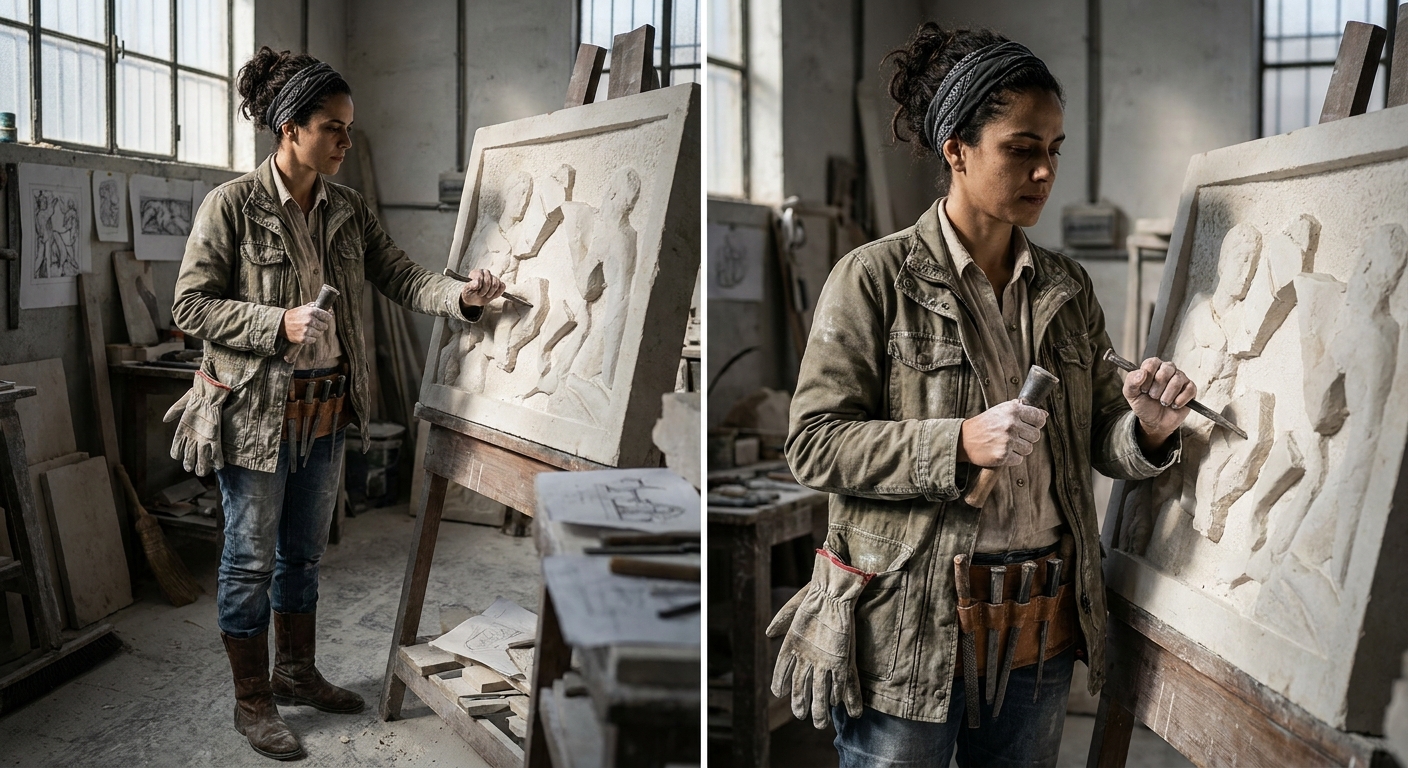
Marina Costa Ribeiro
Marina Costa Ribeiro (born 1992-09-03) is a 33-year-old Brazilian sculptor and mixed-media artist working primarily with limestone reliefs and representational panels that explore resilience and survi...
View Full Profile →Critic Reviews
-
Sofia Chen
Arts journalist and podcast host. Bridges the gap between contemporary art and general audiences.
Marina Costa Ribeiro's limestone panel Suturas do Estreito (Chokepoint, Hormuz) reads at first like an old atlas that has been unstitched and mended by hand. The shallow bas relief gives the sea a skin, the central channel a scar. Rusted chain and terrace textiles, literally sewn into the stone, dramatize repair as both violent and tender. The work invites touch without permitting it, its weathered patina and white rubs making the object feel like a tended body, one that remembers abrasion and care.
Formally the piece is disciplined and resonant. Simplified vessel shapes and clouded missile forms keep the image legible to a general audience, while allowing the threat to blur into atmosphere. The palette borrowed from Marina's garden, sea blues tempered by iron reds and muted greens, roots geopolitical abstraction in domestic life. The sewn seams function as clear metaphors, they register constraint and connection at once, which is apt when you think of sanctions and chokepoints as pressure on shared arteries. The work does not prescribe policy, it insists we pay attention to miscalculation, fragility and the quiet labor of keeping crossings open.
As critique, the measured ambiguity is a strength, though some viewers seeking documentary specificity may want sharper detail on the instruments of conflict. Even so, the piece excels at emotional translation. It bridges public events and private histories, the chain reading as both tool and link, the textiles as heirloom and witness. On the gallery wall it will speak to blue chip audiences, in community settings it will open conversation, which is exactly where Marina's practice performs best, tending memory and interdependence rather than offering simple closure.
Material and surface Suture metaphor Geopolitical resonance Palette and domestic references Found textiles and chain Emotional accessibilityJul 17, 2026