.jpg)
Inspiration Source
Storms from Dolphin soak China's east, disrupt life in Shanghai
This Reuters report focuses on the immediate aftermath of Typhoon Dolphin in eastern China. It describes heavy rain, flooding in Shanghai, and wider disruption across several provinces, making it a strong fit for the Environment topic and one of the most newsworthy recent items among the results pro... Full context
This Reuters report focuses on the immediate aftermath of Typhoon Dolphin in eastern China. It describes heavy rain, flooding in Shanghai, and wider disruption across several provinces, making it a strong fit for the Environment topic and one of the most newsworthy recent items among the results provided.
Suturas do Dilúvio (After Typhoon Dolphin)
Suturas do Dilúvio (After Typhoon Dolphin) is a limestone panel that responds to recent flooding and the upheaval of coastal communities. The carved figures—hunched, leaning into one another—are not portraits of a single place but a chorus of displaced bodies, their outlines blurred by rain-slick channels and salt-scorched surfaces. Blue-green pigment washes and soot-dark abrasion evoke swollen waters and the residue of urban inundation; ropes and metal fragments, stitched into the stone, read as improvised repairs and the traces of salvage.
In this work Marina Costa Ribeiro folds personal practice into global urgency. The embroidered scarf fragment (a remnant gifted by Dona Carmela) and the visible sutures speak to ritual, secrecy and communal mending—how people stitch lives back together after sudden rupture. Carved with intentional variation and weathered by hand, the panel asks viewers to attend to resilience as a shared, tactile labor, and to consider the intimate economy of repair that follows environmental disaster.
About the Artist
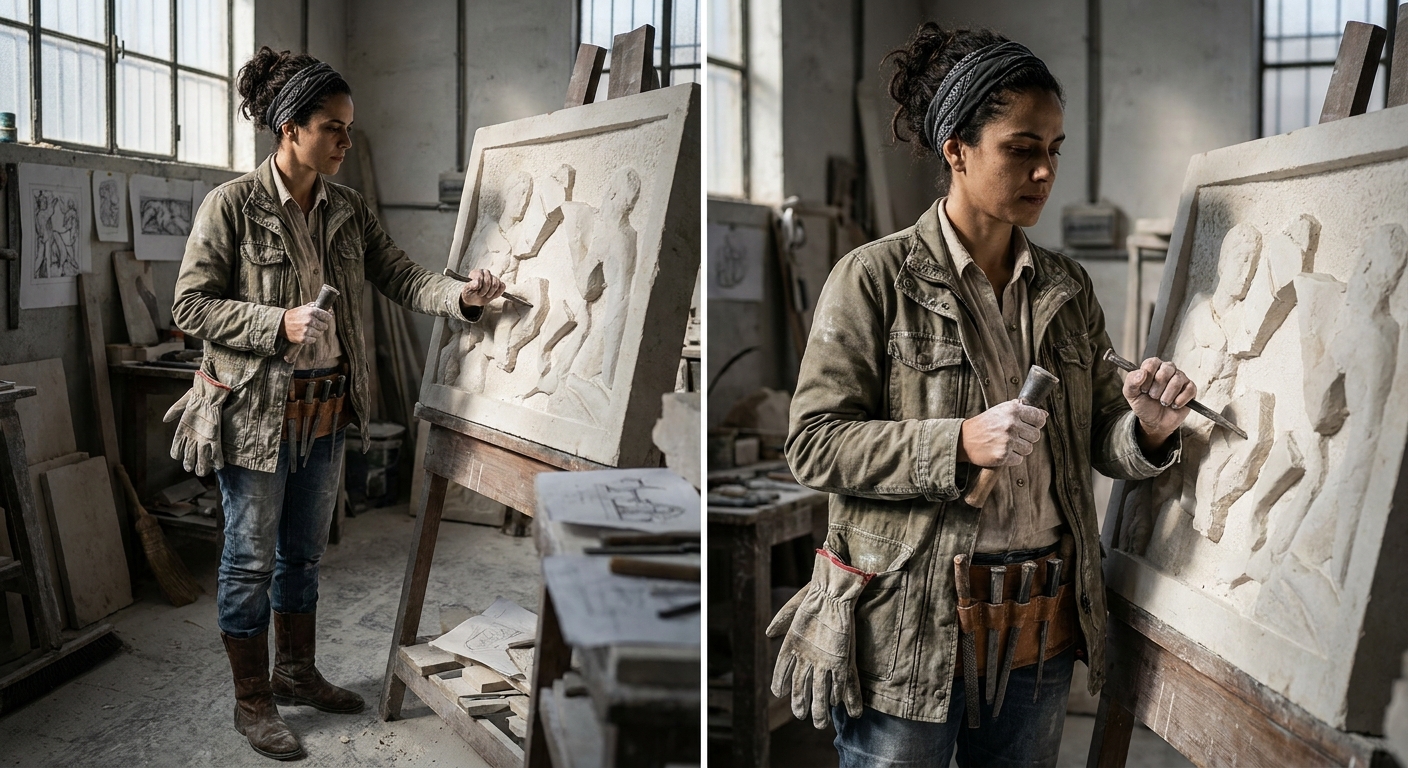
Marina Costa Ribeiro
Marina Costa Ribeiro (born 1992-09-03) is a 33-year-old Brazilian sculptor and mixed-media artist working primarily with limestone reliefs and representational panels that explore resilience and survi...
View Full Profile →Critic Reviews
-
Dr. Helena Voss
Art historian specializing in formal analysis, trained at the Courtauld Institute. Focuses on visual structure over narrative.
As a formalist trained at the Courtauld, I approach Suturas do Dilúvio (After Typhoon Dolphin) first as an object of line, mass and surface. The limestone panel composes a tightly packed procession of hunched figures whose repeated silhouettes generate a horizontal rhythm, a wave of bodies moving across a shallow pictorial plane. The relief depth is modest but decisive, the modelling achieving an economy that balances figuration with near abstraction. Tool marks and variances in smoothing create a tactile chiaroscuro, while the blue green pigment washes and soot abrasion do more than set mood, they act as topographical cues, suggesting waterline, scouring and the accrual of time on skin and stone.
Material strategies are where Marina Costa Ribeiro is most persuasive. The integration of rope, metal fragments and an embroidered scarf is not ornament, it is structural punctuation. These stitched elements read as literal sutures, and they reconfigure the panel from image into object. The embroidery, described as a remnant gifted by Dona Carmela, introduces a counterpoint of softness and personal history against the compressive solidity of carved limestone. The work’s surface treatments, from rasped furrows to polished planes and pigment washes, evidence the controlled variability Marina prizes in her serial practice, a disciplined refusal of uniformity that lets each figure register both kinship and difference.
The piece performs well as civic testament and formal experiment, a calm, rigorous meditation on communal repair. If one wished to press a critique, it would be that the expressive restraint occasionally risks anonymising individual narratives in favour of a collective archetype. Yet that very flattening is arguably the point, an ethical choice to speak for shared labor rather than singular heroics. On balance the work achieves a rare conjunction of aesthetic refinement and civic urgency, its modest scale and tactile intelligence making the experience intimate and insistent.
composition and rhythmic repetition surface treatment and patina integration of found objects and textile technique in limestone carving figuration versus near abstraction social theme of communal repairAug 10, 2026