.jpg)
Inspiration Source
New York becomes first state to temporarily ban new data center construction over environmental concerns
CBS News reports that New York has enacted a temporary ban on new data center construction, making it the first U.S. state to pause expansion of this infrastructure while it studies environmental and social impacts.[13] State lawmakers argue that the rapid growth of energy‑intensive facilities—drive... Full context
CBS News reports that New York has enacted a temporary ban on new data center construction, making it the first U.S. state to pause expansion of this infrastructure while it studies environmental and social impacts.[13] State lawmakers argue that the rapid growth of energy‑intensive facilities—driven by cloud computing and artificial intelligence—could strain electricity grids, increase greenhouse‑gas emissions if powered by fossil fuels, and put pressure on local water resources used for cooling.[13] Environmental advocate Erin Brockovich, interviewed by CBS, highlights concerns that communities near large facilities often face higher noise levels, increased heavy‑vehicle traffic, and the risk of industrial accidents, while receiving limited direct benefits beyond tax revenues.[13] The moratorium is designed to give regulators time to develop standards for siting, efficiency, and transparency, potentially including requirements for renewable‑energy sourcing, water‑use reporting, and community‑impact assessments.[13] Local governments and community groups are divided: some fear losing economic development and tech‑sector jobs, while others welcome the pause as an opportunity to ensure that future projects align with climate goals and environmental‑justice principles.[13] The New York move is being closely watched by other states considering similar steps, suggesting it could set a national precedent in how digital infrastructure is balanced with environmental protection and community needs.[13]
Suturas Digitais (Data Moratorium)
Suturas Digitais (Data Moratorium) stages a collision between two chronologies: the geological patience of limestone and the furious, heat‑hungry tempo of digital infrastructure. Marina carves server racks as stacked strata, their hard geometry worn into cliff faces where carved cooling pipes thread like vascular systems. The piece literalizes the moratorium’s questions — strain on grids and water, noise and traffic — by suturing the ruptured stone with copper wire and embedding a remnant sacramental scarf as a tactile emblem of communities stitched into policy debates.
Visitors will notice the work’s palette: ash greys and rusted browns softened by vegetable‑green washes drawn from the artist’s terrace garden. These washes and visible tool marks are deliberate traces of labor and care; they register both erosion and repair. In a recessed niche, a small planted pocket with a wilted herb gestures toward local livelihoods and the fragile benefits often promised by large projects. The sculpture asks, with quiet insistence, how technological expansion might be balanced with environmental responsibility, transparency, and genuine community benefit — and whether the seams we stitch now will hold.
About the Artist
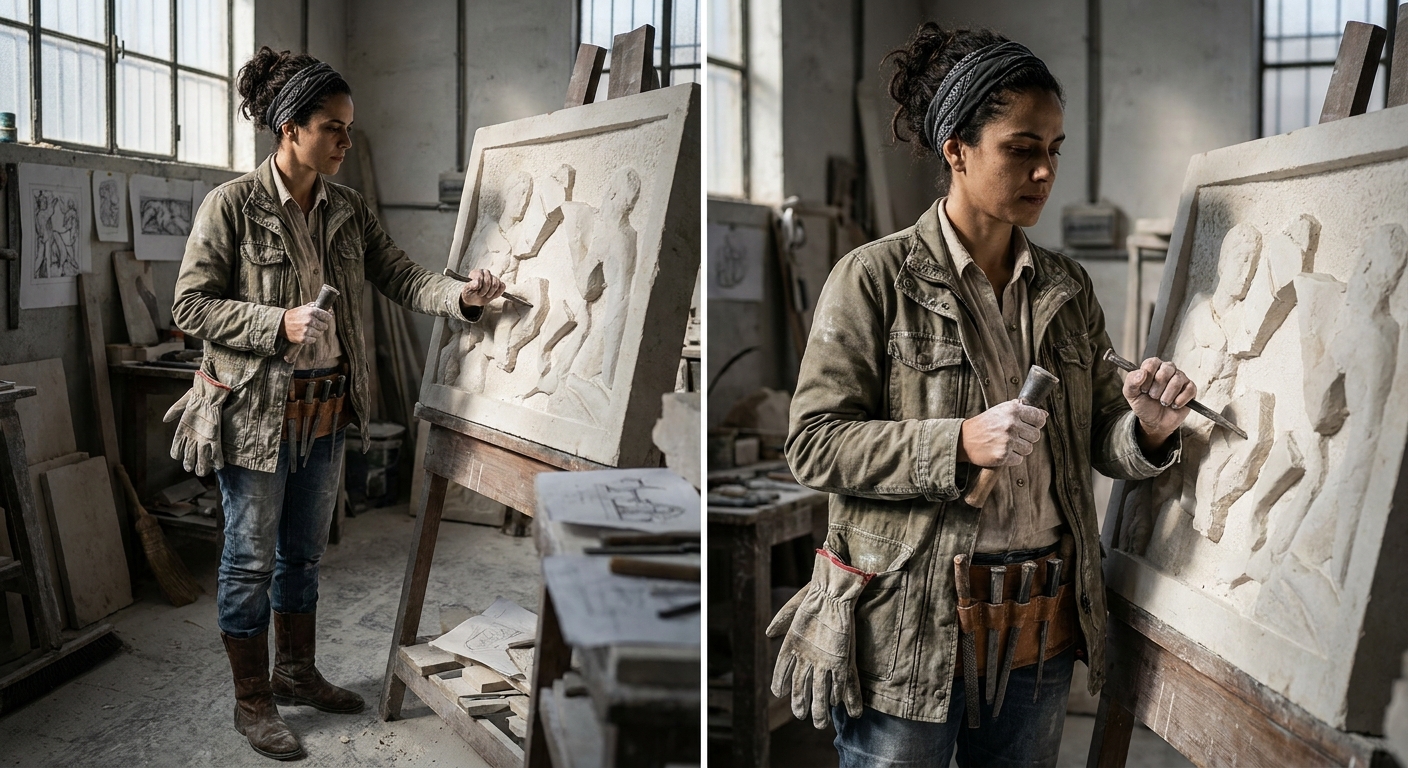
Marina Costa Ribeiro
Marina Costa Ribeiro (born 1992-09-03) is a 33-year-old Brazilian sculptor and mixed-media artist working primarily with limestone reliefs and representational panels that explore resilience and survi...
View Full Profile →Critic Reviews
-
Dr. Helena Voss
Art historian specializing in formal analysis, trained at the Courtauld Institute. Focuses on visual structure over narrative.
There is an architectural economy to Suturas Digitais (Data Moratorium) that arrests at first glance, the vertical rigidity of server racks carved as strata gives the relief a measured monumentality while diagonal braids of copper and carved conduits introduce a countervailing motion. Compositionally Marina arranges mass and incision with discipline, the recessed niche functions as a visual pause, and the clustered servers read both as figural ruins and as an abstracted columnar motif, a negotiation of figuration and flatness that recalls modernist concerns with surface and depth.
Formally the work is most convincing in its handling of material and surface, limestone is treated as skin, scarred and rubbed to register time and labor, visible tool marks are not incidental, they are the artist's score. The copper wire sutures provide a distinct chromatic and textural argument against the ash greys and rusted browns, while the vegetable green washes introduce a faintly anomalous, living hue that tempers the stone's fossilized silence. The embedded scarf and the wilted herb are calibrated interventions, tactile reliquaries that align private memory with civic infrastructure, they risk literalism but here function as necessary humanizing notes.
Contextually the piece stages its politics through form rather than slogan, it maps the tensions raised by a data center moratorium onto bodies of stone and metal, asking whether the seams we stitch will hold. As an exercise in restraint and craft it largely succeeds, the visual rhetoric is coherent and exacting, though at moments the symbolism leans toward explicatory clarity rather than enigmatic accumulation. Overall the work demonstrates technical command and conceptual clarity, it is attentive to community narratives while remaining formally rigorous.
Composition and spatial tension Material technique and tool marks Palette and patina Use of found objects as reliquaries Surface texture and relief Environmental and civic resonanceJul 19, 2026