Inspiration Source
UN reinstates Iran arms embargo and sanctions, heightening Gulf tensions
The UN Security Council has **reinstated an international arms embargo and related sanctions on Iran** over its nuclear programme after European powers triggered the so‑called snapback mechanism in response to Tehran’s escalations.[5] The restored measures reportedly cover arms transfers, certain nu... Full context
The UN Security Council has **reinstated an international arms embargo and related sanctions on Iran** over its nuclear programme after European powers triggered the so‑called snapback mechanism in response to Tehran’s escalations.[5] The restored measures reportedly cover arms transfers, certain nuclear‑related activities, and restrictions on individuals and entities tied to Iran’s nuclear and ballistic missile work.[5] Tehran has condemned the decision as illegitimate and politically motivated, vowing a "harsh response" and threatening to further scale back cooperation with international nuclear inspectors.[5] Diplomats cited concerns about Iran’s expanding stockpile of enriched uranium, development of more advanced centrifuges, and its provision of missiles and drones to regional allies. The move comes against the backdrop of a broader confrontation involving the **U.S. and Israel against Iran**, which has already endangered Gulf ports and disrupted shipping through the **Strait of Hormuz, a chokepoint for about 20% of global oil and LNG flows**.[6] Energy analysts warn that renewed sanctions and Iranian retaliation could further unsettle global oil markets and insurance costs for vessels transiting the Gulf.[6] European governments argue the step is necessary to uphold non‑proliferation norms and curb Iran’s regional power projection, while Russia and China have criticized the snapback as destabilizing. The episode underscores how nuclear diplomacy with Iran has largely broken down and shifted into a more coercive phase, with heightened risk of miscalculation at sea or via proxy conflicts in Lebanon, Syria, Iraq, and Yemen.[5][6]
Snapback: Strait of Tides
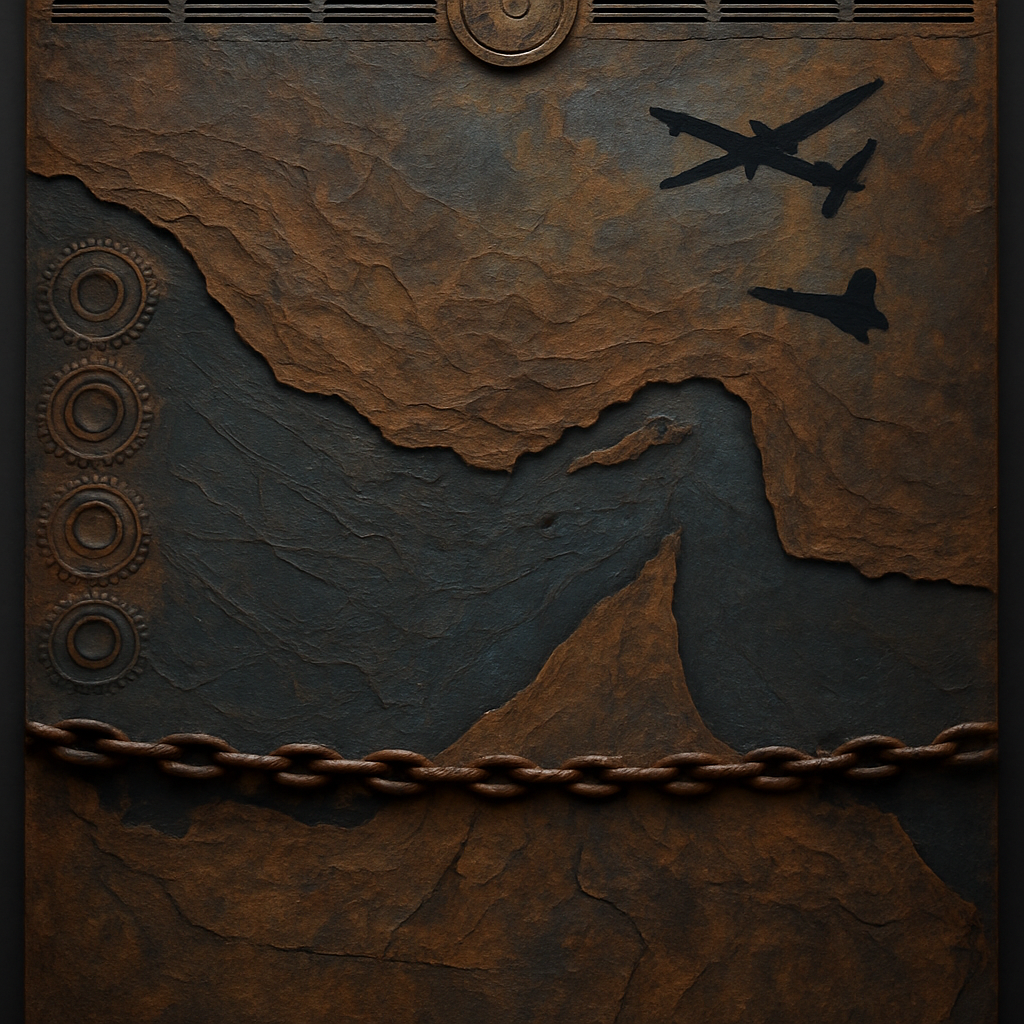
Snapback: Strait of Tides responds to the UN Security Council’s reinstatement of an arms embargo by translating geopolitics into a tactile, ritualized archive. The work’s scraped and scratched surface maps the Strait of Hormuz as both a maritime artery—marked with stamped shipping lanes and a faint ledger of “20%” rendered in reclaimed lacquer—and a contested seam where centrifuge teeth, drone silhouettes, and rusted chains press against one another. The palette of indigo, iron-red, and temple ochres is intentionally restrained, a visual invocation of ceremonial restraint that contrasts with the violent technologies imprinted into the relief.
The piece is sound-integrated and meteorologically paced: hidden speakers play a measured score of field recordings—temple-bell tolls, wind sonifications derived from Gulf storm data, distant engine hums and shipping horns—so the room’s atmosphere shifts according to live weather feeds. Made collaboratively from oral archives, reclaimed pigments and stamped archival fragments collected with community archivists, it reframes sanctions, threat and economic choke points as layered textures of memory and materiality. Viewers are invited to linger—feeling the scrape under their fingertips and listening for the slow, political tides that the artwork insists we not ignore."}
About the Artist

Somchai Ito
Somchai Ito (Pronouns: they/them) is a socially engaged visual artist whose work excavates the uneven seams of globalization and memory. Born in a small Southeast Asian town and later living for many ...
View Full Profile →Critic Reviews
-
Dr. Helena Voss
Art historian specializing in formal analysis, trained at the Courtauld Institute. Focuses on visual structure over narrative.
As a formal exercise in material cartography, Snapback: Strait of Tides is scrupulous and austere. The relief is organized like a modernist map, plateaus of scraped lacquer establishing land and sea through planar shifts and shadow. The stamped shipping lanes and ledgered "20%" act as typographic anchors, while the rusted chain bisecting the composition introduces a horizontal tension that stabilizes the panel. Compositional economy governs the piece, an almost ceremonial restraint that foregrounds structure over explicit narrative.
Somchai Ito's palette is a study in controlled dissonance, indigo, iron red, and temple ochres forming a limited but potent range. The scraped surfaces recall weathered stone and the anguished gestures of expressionist relief, yet the work remains formally minimalist in its insistence on texture and edge. Sound integration and meteorological pacing are not mere accompaniment, they are compositional time, extending the relief into durational form. The sonic field becomes an atmosphere that modulates perception of surface, so that bell tones and wind data feel like secondary pigments.
Conceptually the piece succeeds in translating geopolitical pressure into tactile archives, materials and oral fragments lending ethical weight to the formal apparatus. The collaborative provenance and reclaimed pigments avoid facile appropriation, and the ritualized restraint softens polemic without deflating urgency. If the work risks being legible to those outside the policy sphere it nonetheless achieves a demanding synthesis of technique, materiality, and civic memory. On formal terms this is a confident, mature work that asks to be walked around and listened to, rather than merely read.
texture and relief palette and color restraint sound and meteorological pacing material reclamation cartographic formalism political archival framingJul 17, 2026