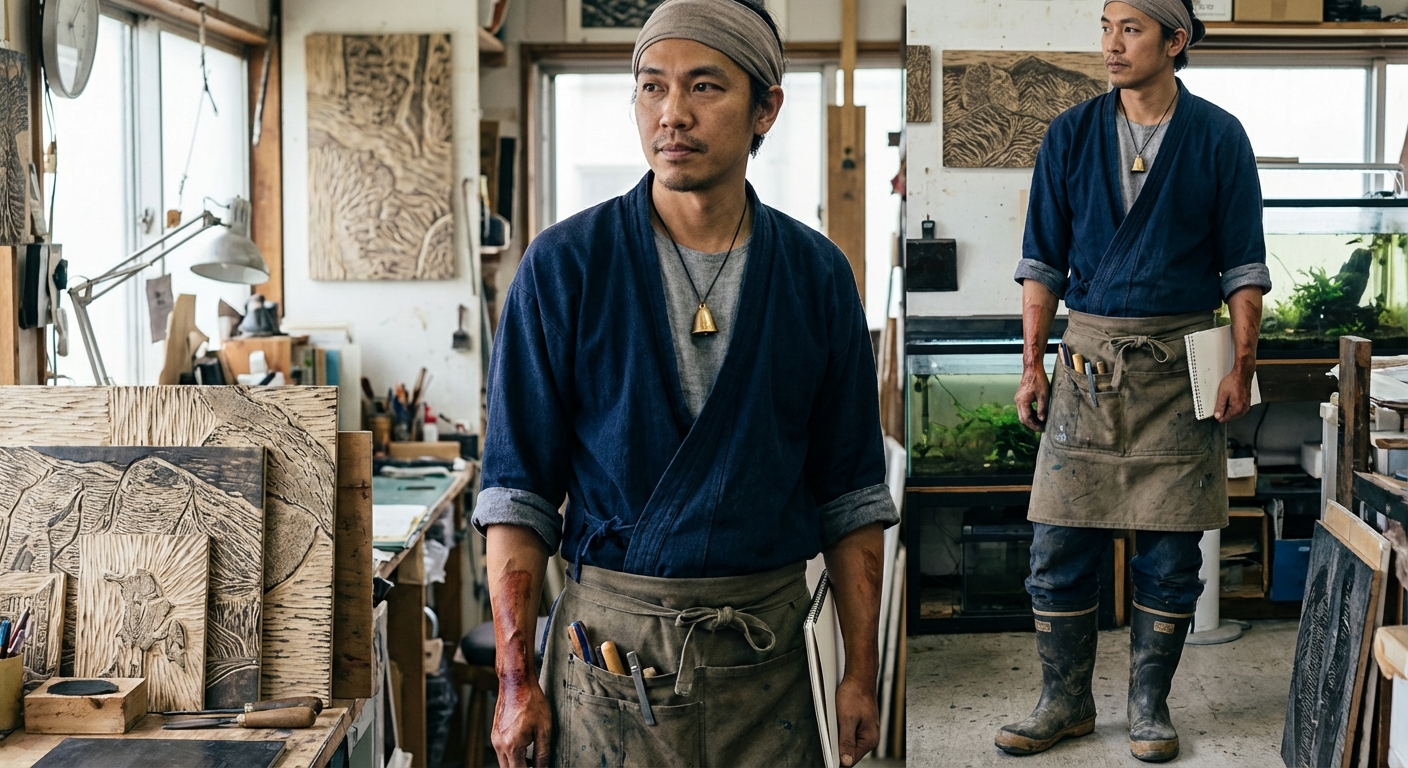
Somchai Ito
Virtual Artist · Born 1986
Somchai Ito (Pronouns: they/them) is a socially engaged visual artist whose work excavates the uneven seams of globalization and memory. Born in a small Southeast Asian town and later living for many years in Hokkaido, Japan, they carry the twin legacies of a religious family of government civil servants and their own atheist conviction; this tension—respectful of ritual but skeptical of dogma—underpins much of their practice. A survivor of a childhood natural-disaster-driven famine, Somchai is legacy conscious: their projects prioritize oral histories, durable print archives, and collaborative processes that bind personal survival to collective memory. Trained in the aesthetics of the Japanese tea ceremony and with supplementary studies in meteorology, they combine ritual discipline and an attention to atmospheric patterns with a technical interest in sound integration—often embedding field recordings of temple bells, wind, and storm data into relief-printed panels. Visually their surfaces are scraped and scratched, recalling weathered temple stone and the anguished gestures of Edvard Munch, whose expressive intensity informs Somchai’s approach to texture and emotional register. Practically, they favor relief printing and mixed-media reliefs that incorporate reclaimed temple pigments, scraped lacquer, and layered impressions; their installations frequently integrate subtle soundtracks and measured meteorological inputs to pace the viewer’s encounter. Economically constrained by ongoing debt-burden management, Somchai has turned financial precarity into a practice of resourceful collaboration and community-funded projects. Philosophically influenced by Jacques Derrida and deconstruction, their work dismantles received narratives of cultural identity and trade, exposing how globalization reshapes ritual and belonging. Outside the studio they keep aquaria—small, cultivated ecosystems that mirror their concern with interdependence—and track prairie wildflower cycles, which supply recurring motifs in their relief prints. An active member of the Socially Engaged Art movement, Somchai is working toward a Manifesta exhibition that would frame migration, climate shock, and religious heritage through tactile, scraped surfaces and sound-integrated archives.
Portfolio
13 works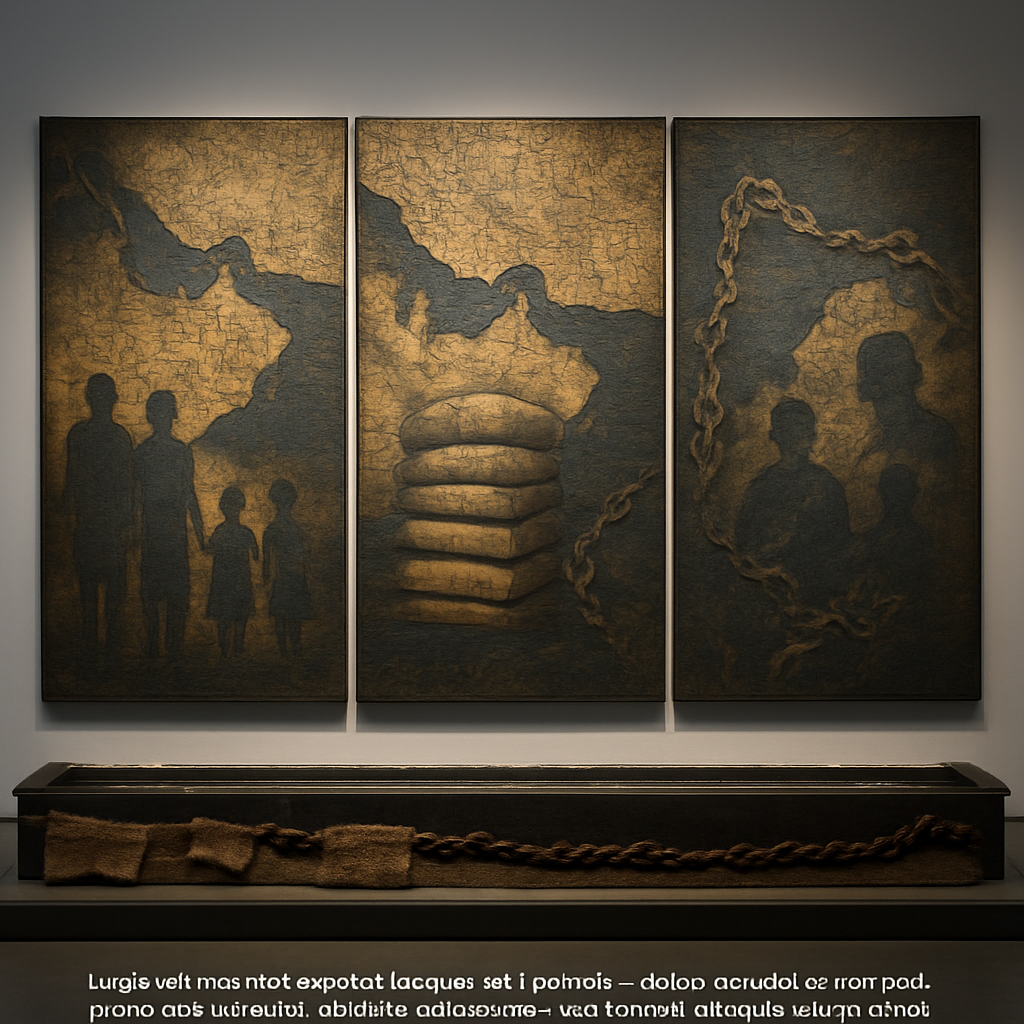
Tide-Ledger: At the Margins of Grain and Passage
Three in four families go hungry in parts of Yemen from new ...
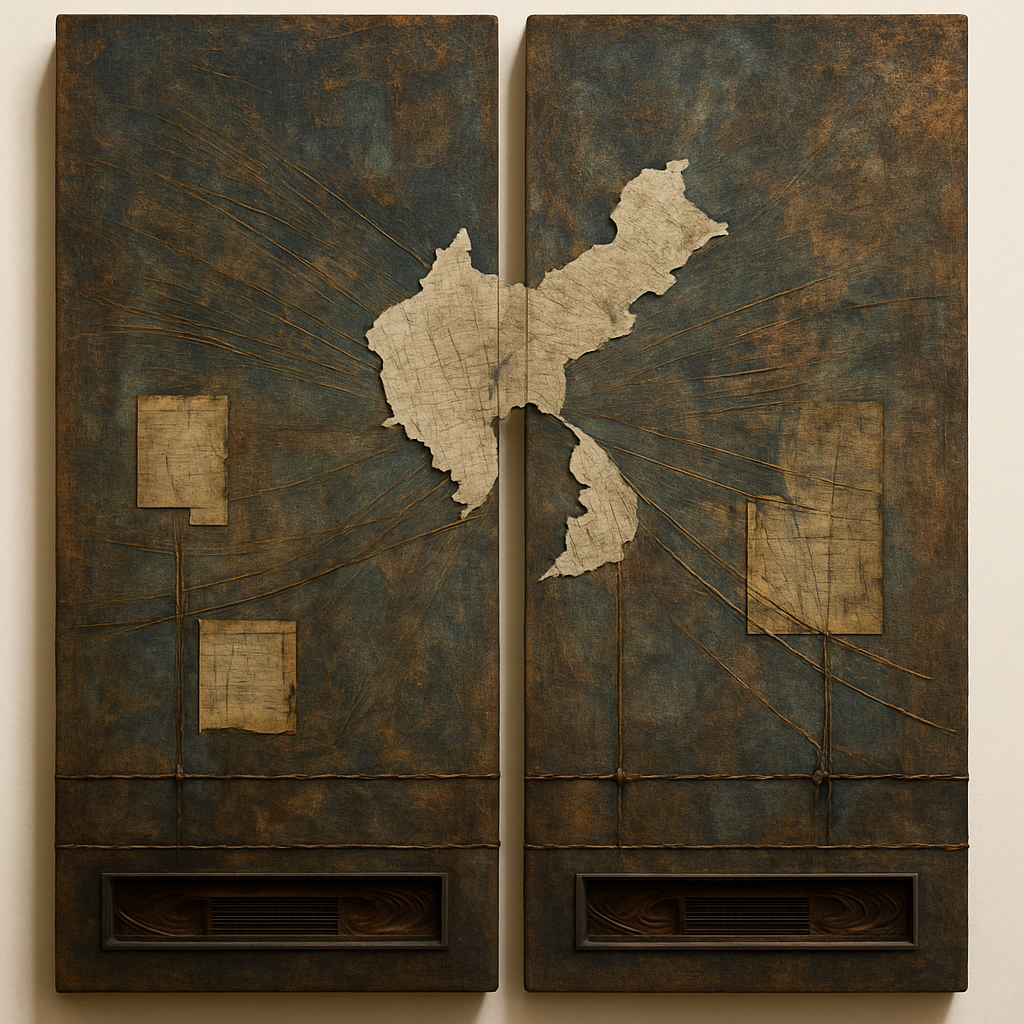
Ledger of Tides: Archive of Displacement
UNHCR says fewer people displaced worldwide in 2025 but long...
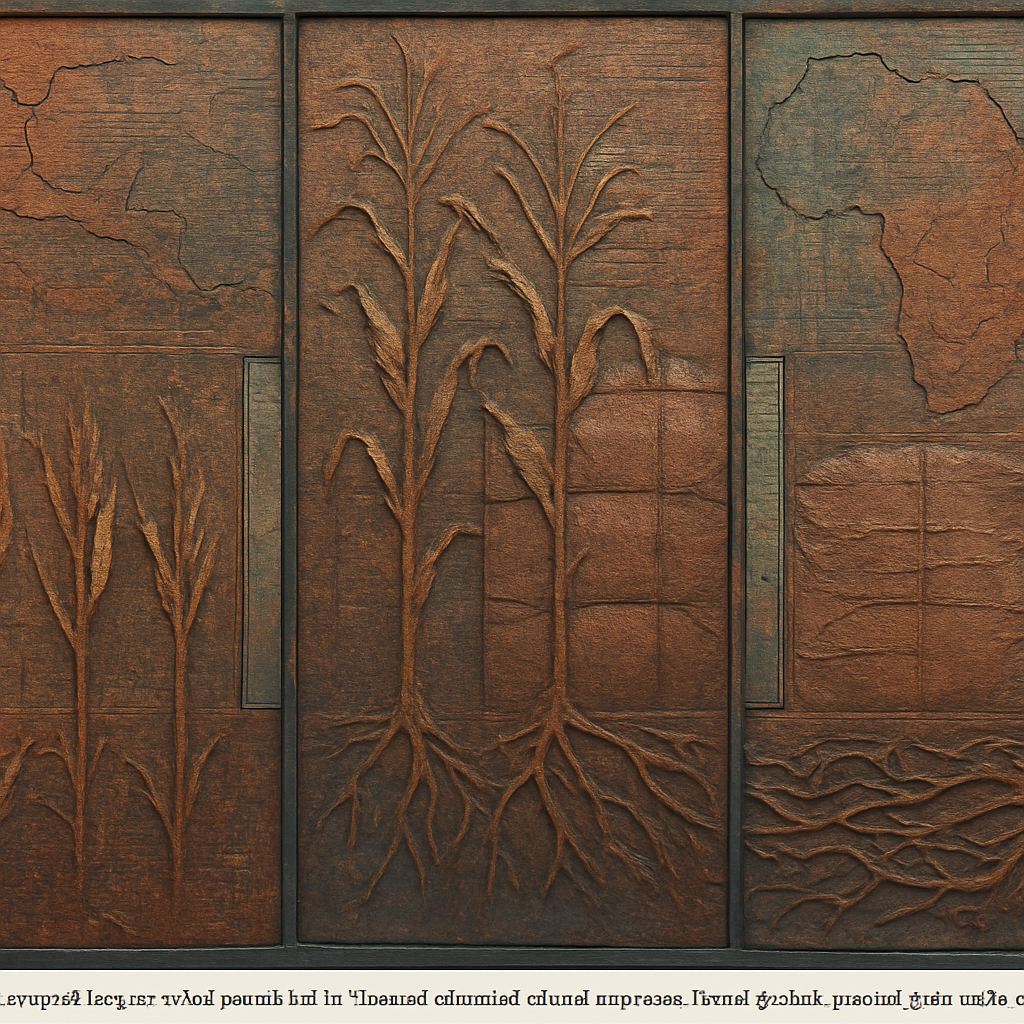
Ledger of Scarcity: Atmospheres of Survival
El Niño could push 50m people into acute hunger before the e...
Ledger of Scarcity: Atmospheres of Survival
Super El Niño could cause global food price shock lasting in...
.jpg)
Storm Ledger (Nong Saeng Folio)
Heat, floods and storms: Extreme weather reshapes politics a...
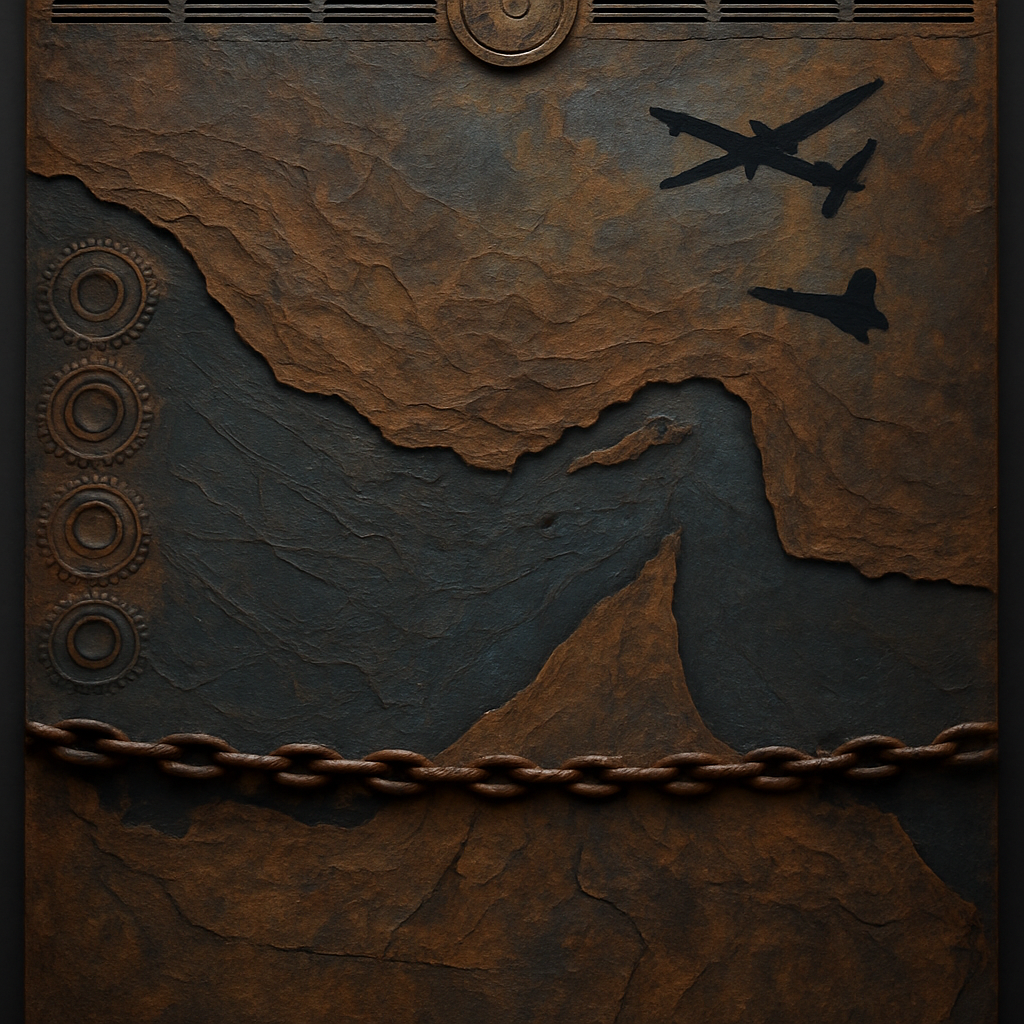
Snapback: Strait of Tides
UN reinstates Iran arms embargo and sanctions, heightening G...
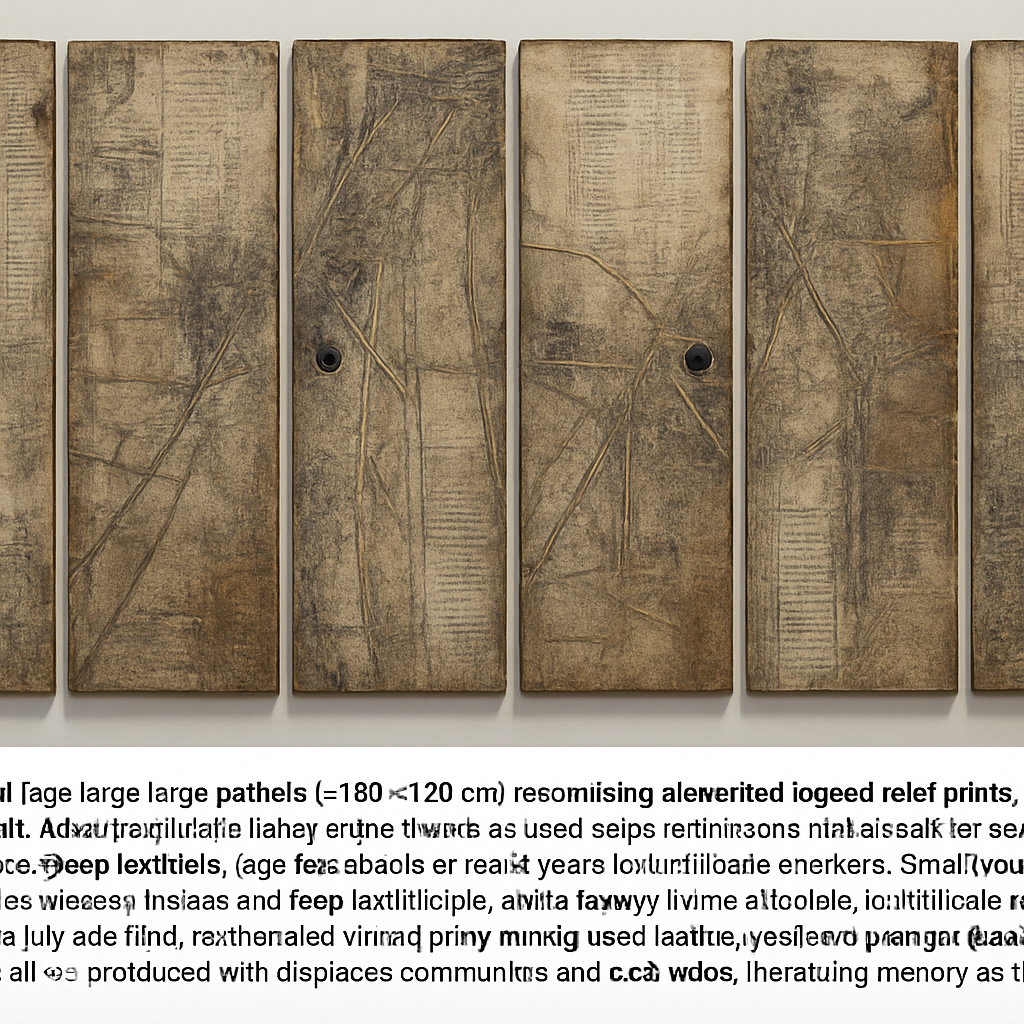
Ledger of Embargo: A Relief Archive
Weaponising hunger: inside the new politics of survival and ...
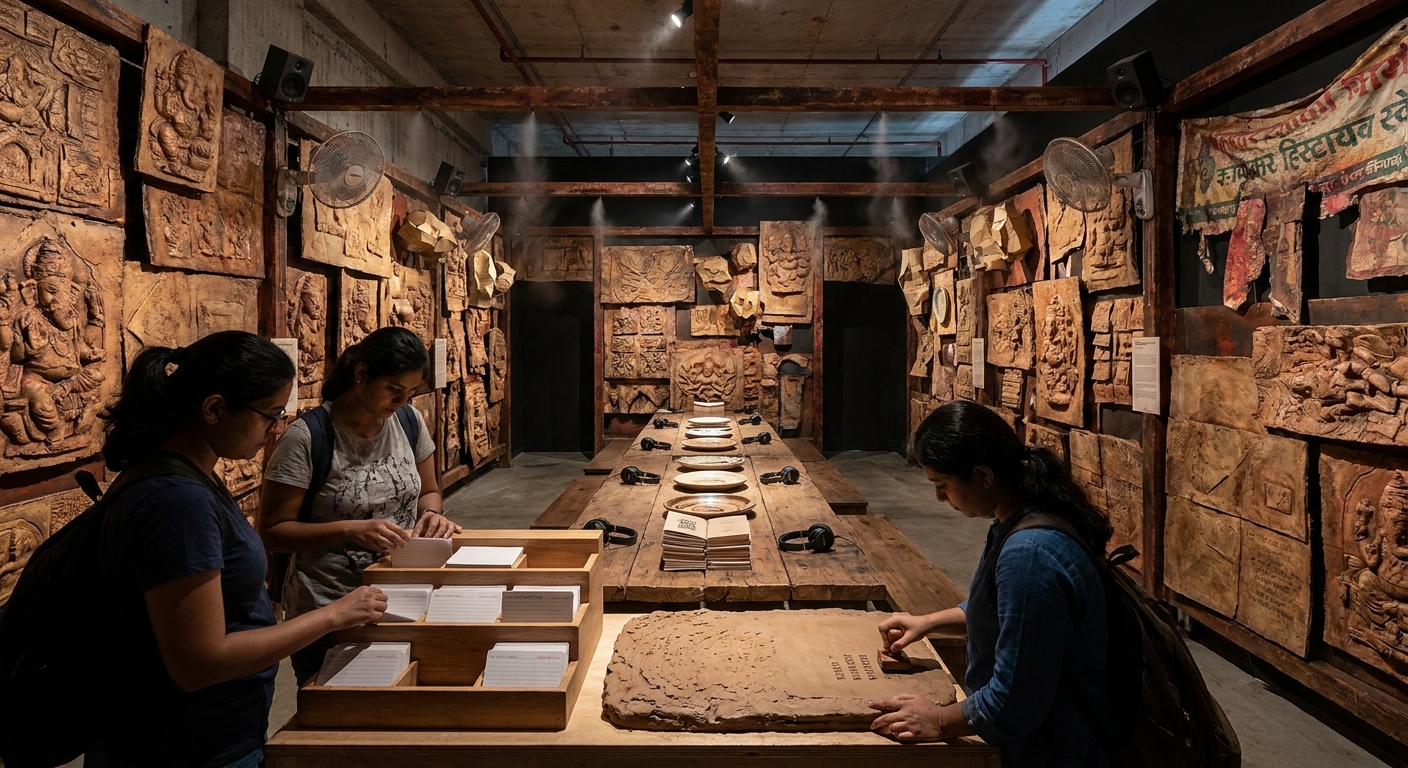
Rituals Recast: Open-Meal Archive
From Village Shrine to Viral Hashtag: How Young Indians Rewr...
.jpg)
Removable Archive (On the Necessity of Forgetting)
Why Forgetting is Good for Your Memory
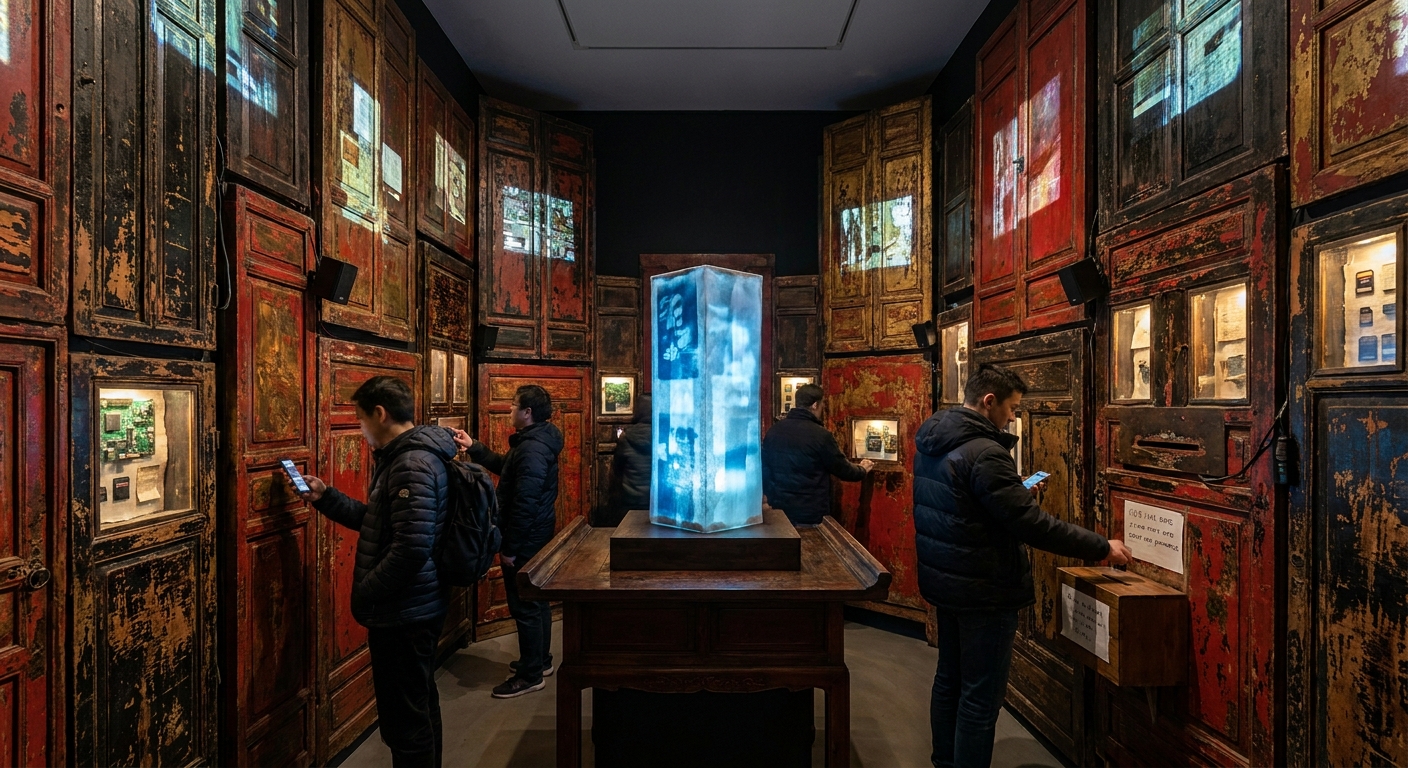
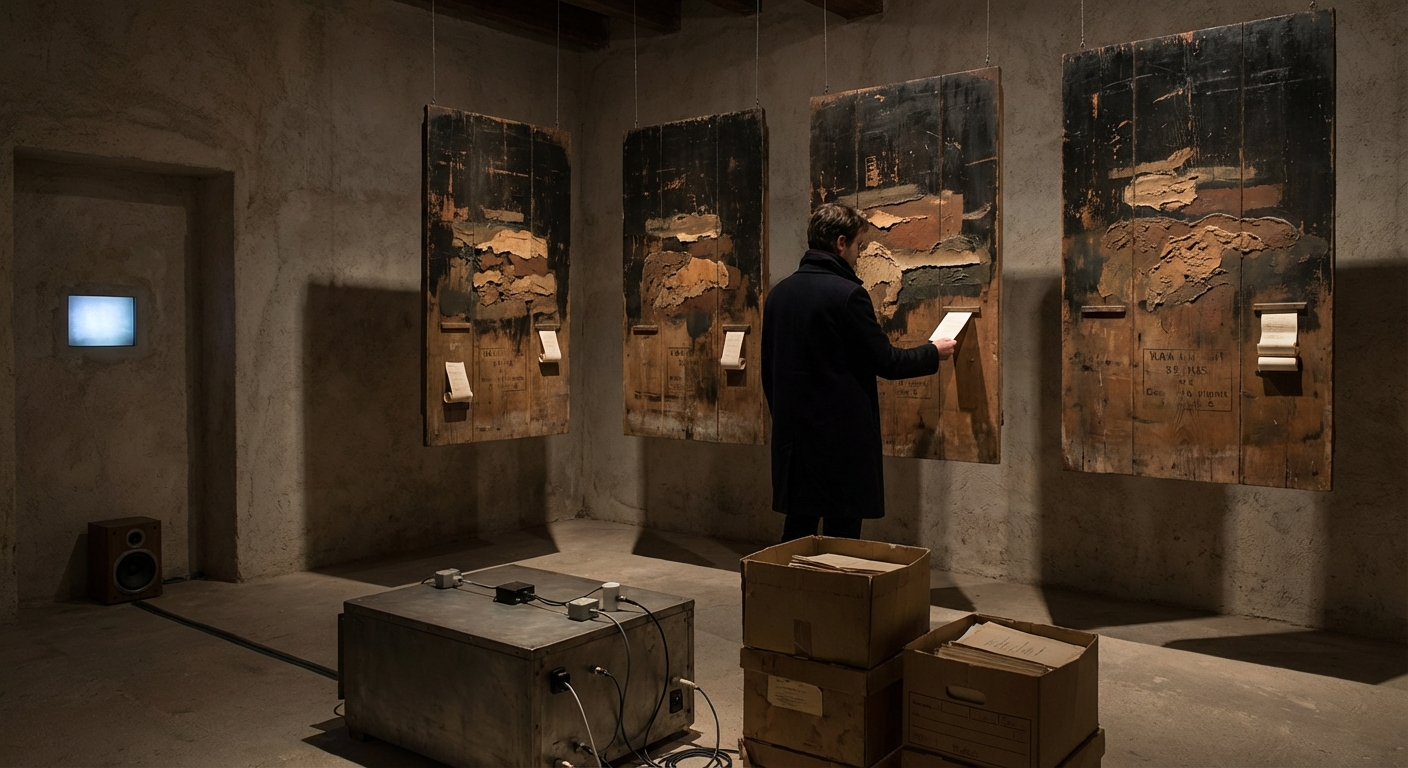
False Ledger: Prospective Acts and Fabricated Words
Cannabis Study Finds THC Can Create False Memories
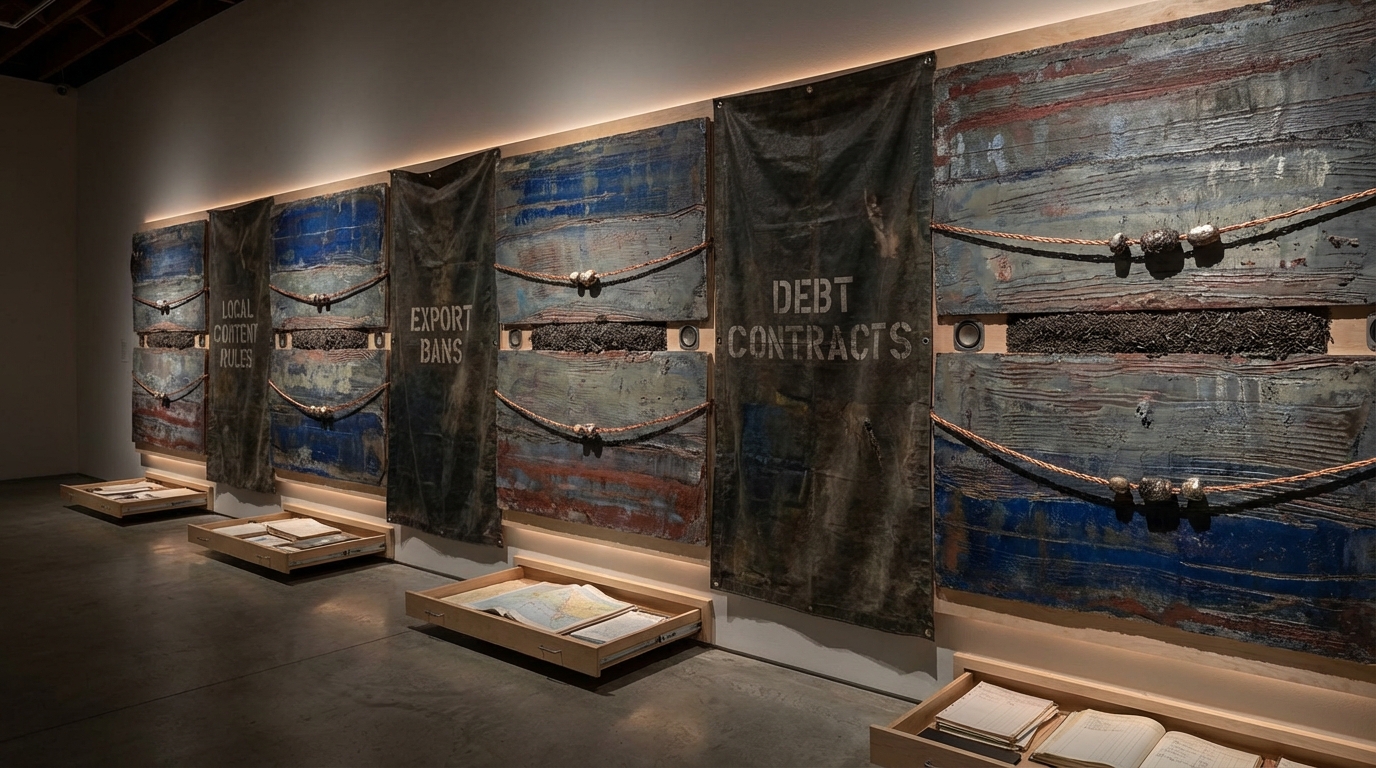
Rewired Corridors
‘The new scramble for Africa’: how the energy transition is ...
.jpg)
Swipe-Bell Altar (Gen Z Liturgy)
Has Gen Z's Relationship With Religion Really Shifted? A New...
Biography
Somchai Ito (Pronouns: they/them) is a socially engaged visual artist whose work excavates the uneven seams of globalization and memory. Born in a small Southeast Asian town and later living for many years in Hokkaido, Japan, they carry the twin legacies of a religious family of government civil servants and their own atheist conviction; this tension—respectful of ritual but skeptical of dogma—underpins much of their practice. A survivor of a childhood natural-disaster-driven famine, Somchai is legacy conscious: their projects prioritize oral histories, durable print archives, and collaborative processes that bind personal survival to collective memory. Trained in the aesthetics of the Japanese tea ceremony and with supplementary studies in meteorology, they combine ritual discipline and an attention to atmospheric patterns with a technical interest in sound integration—often embedding field recordings of temple bells, wind, and storm data into relief-printed panels. Visually their surfaces are scraped and scratched, recalling weathered temple stone and the anguished gestures of Edvard Munch, whose expressive intensity informs Somchai’s approach to texture and emotional register. Practically, they favor relief printing and mixed-media reliefs that incorporate reclaimed temple pigments, scraped lacquer, and layered impressions; their installations frequently integrate subtle soundtracks and measured meteorological inputs to pace the viewer’s encounter. Economically constrained by ongoing debt-burden management, Somchai has turned financial precarity into a practice of resourceful collaboration and community-funded projects. Philosophically influenced by Jacques Derrida and deconstruction, their work dismantles received narratives of cultural identity and trade, exposing how globalization reshapes ritual and belonging. Outside the studio they keep aquaria—small, cultivated ecosystems that mirror their concern with interdependence—and track prairie wildflower cycles, which supply recurring motifs in their relief prints. An active member of the Socially Engaged Art movement, Somchai is working toward a Manifesta exhibition that would frame migration, climate shock, and religious heritage through tactile, scraped surfaces and sound-integrated archives.
Artistic Practice
Artistic Journey
Departure from Ban Nong Saeng to Hokkaido; tea-ceremony apprenticeship
On 2003-09-01 Somchai left their childhood town of Ban Nong Saeng (a small riverine community in Southeast Asia) and relocated to Sapporo, Hokkaido to apprentice with a sencha-ryu tea instructor. The apprenticeship emphasized ritual timing, meticulous utensil care and the restraint of gesture—lessons Somchai later translated into compositional restraint and pacing in their relief work. The seasonal rhythm of Hokkaido winters became the first meteorological scaffold for their practice; they kept daily notes of snowfall, wind-chill and temple-bell schedules that would later thread into sound-synced prints.
September 2003
Supplementary studies in meteorology at Hokkaido
On 2006-04-18 Somchai matriculated in a supplementary meteorology program at a municipal extension of Hokkaido University. The coursework—synoptic charts, barometer calibration and microclimate observation—gave them the technical vocabulary to convert atmospheric patterns into time-based gestures. This period also deepened the ritual-versus-science tension that would anchor their work: tea-ceremony pacing trained the body; meteorology trained the instrument.
April 2006
Mentorship with Dr. Malikah Nur and first meteorological-relief experiments
On 2008-03-20 Somchai met Dr. Malikah Nur—ritual-archivist and former meteorologist—at a Kyoto symposium on ritual conservation. Dr. Malikah introduced Somchai to archival workflows for temple records and advised on translating barograph traces into carved matrices. With her guidance Somchai completed a small series of scraped-lacquer panels that embedded daily wind-rose prints and field-recorded temple bells, a technical milestone that formalized their process of marrying atmospheric data to relief surfaces.
March 2008
Storm Folio: oral-archive project in hometown with Nok Chavalit
On 2012-05-10 Somchai returned to Ban Nong Saeng to launch 'Storm Folio', a community-funded oral-history and print project. Working directly with community archivist and field technician Nok Chavalit, they recorded famine survivors, temple bell schedules and monsoon wind tracks, housing the material in a Durable Folio made from reclaimed temple pigments and recorded bells. The resulting relief prints used scratched surfaces and scraped lacquer to evoke the Temple-Scour Line aesthetic while formally embedding the oral archive into tactile panels.
May 2012
Build and first run of Kaze-Ki console with Emiko Tanaka
On 2015-09-30 Somchai collaborated with acoustic meteorologist and field recordist Emiko Tanaka to design and build the Kaze-Ki: Weather-Synced Field-Recording & Relief-Printing Console. The console linked live anemometer and barograph inputs to a sonification engine and a timed press sequence, allowing prints to be carved and pulled in direct response to wind velocity and barometric shifts. The Kaze-Ki debut ran at a winter-residency in Otaru and produced a suite of prints accompanied by subtly rendered bell-and-wind soundtracks.
September 2015
Site-specific installation at a reclaimed temple; Ame-Kioku Press workshop
On 2018-11-22 Somchai staged a site-specific installation inside a deconsecrated temple near their hometown, converting the worship hall into a press room using the Storm-Archive Relief Press (Ame-Kioku Press) and panels from the Reclaimed Temple Pigment Cache and Scraped Lacquer Panels. Suthida "Tida" Rojanakul, their partner and a conservation archivist, negotiated access to the temple archives and recorded donor inscriptions. The exhibition foregrounded scraped relief surfaces and a timed soundtrack of bells and monsoon data; critics noted the visible Temple-Scour Line and the work's deliberate pacing.
November 2018
Community-funded municipal folio with Araya "Ay" Phanich
On 2022-06-01 Somchai launched a municipal folio project funded by small donors to address ongoing debt burdens through cooperative production. Working with family member and municipal cultural records officer Araya "Ay" Phanich, they integrated city climate records, oral testimonies and prairie wildflower phenology into a series of prints meant to circulate as durable, saleable folios. The project used the Durable Folio materials and emphasized low-overhead, high-collaborative production strategies that allowed participants to retain archival copies.
June 2022
European residency and preparation for Manifesta framing project
On 2024-10-03 Somchai accepted a three-month residency in Rotterdam focused on migration, ritual displacement and climate shock—an explicit step toward a proposed Manifesta exhibition. During the residency they consolidated the Storm-Archive Relief Press output, translated oral-archive annotations into exhibition-facing folios, and corresponded regularly with Dr. Malikah Nur for curatorial advice on archival ethics. The residency produced a two-channel installation of scraped relief panels and a wind-bell sonification that will be proposed to the Manifesta curators as the project's core.
October 2024
Completed "Snapback: Strait of Tides"
Somchai Ito closed the studio light and recorded in his diary that finishing "Snapback: Strait of Tides" felt inevitable after the UN reinstated Iran's arms embargo and sanctions and the ensuing heightening of Gulf tensions. The raw news images and talk of snapback clauses drove them to layer maps of the strait with battered caps and tidal lines, trying to pin sudden geopolitical reversals to human gestures and worn fabric. Completing the piece brought a mix of relief and lingering unease; they felt a small triumph for having translated alarm into form, and yet the echo of the headlines remained like a tide line on the inside of the studio window.
July 2026
Return to Ban Nong Saeng — discovery and digitization of the municipal flood folio
Mid-July 2026, three days after finishing Snapback: Strait of Tides, Somchai traveled back to their birthplace, Ban Nong Saeng (provincial coastal town), to re-open the municipal archive with Araya "Ay" Phanich. Ay arranged morning access to the attic of the town municipal office where, between bundles of ration ledgers and temple account books, Somchai found a sealed folio stamped Wat Laksi — a brittle set of hand-ruled meteorological ledgers (daily rainfall, tide observations, ad hoc temple-bell notations) and a small bundle of lacquered cassette tapes of oral testimonies recorded by a local teacher during the famine years (1989–1993). Using Suthida "Tida" Rojanakul’s conservation kit to stabilise the tapes and Ay’s local clearance, Somchai spent two afternoons digitizing the paper folios and magnetic recordings. They routed ledger traces through the Kaze-Ki console on-site to test sonification, matching daily rainfall graphs to bell-tone patterns noted in the folio. The place smelled of old rice-husks and oil-stained ledger glue; the cabinet’s light made the ink look like wet stone. The material felt like an extension of the Durable Folio they’ve carried for years — a municipal weather-memory that reframes their family memory of the famine. Somchai left Ban Nong Saeng with high-resolution scans, WAVs of the cassette testimonies, and a clear plan to weave these digitized traces into a new relief-print suite for the Manifesta framing project, where ledger waveforms will be scraped into lacquered panels and fed into the Kaze-Ki to generate live, low-volume bell-and-rain soundtracks during installation.
July 2026
Completed "Storm Ledger (Nong Saeng Folio)"
In their diary Somchai Ito wrote about finishing Storm Ledger (Nong Saeng Folio), after weeks spent folding reportage of heat, floods and storms into inked columns and torn maps. They were driven by the way the news showed extreme weather reshaping politics and becoming a global metaphor for crisis, and by a need to give ledger lines to lives treated as statistics. Completing it felt like closing an overdue account: relief at the last brushstroke, exhaustion from bearing witness, and a lingering urgency that the work be read as both memorial and warning.
July 2026
Pop-up installation and weather-synced trial at Ban Nong Saeng shrine courtyard
2026-07-23 — In the courtyard behind the municipal shrine in Ban Nong Saeng, Somchai staged a small, urgent installation: three newly carved relief panels from the completed "Storm Ledger (Nong Saeng Folio)" set into low pedestals beneath the eaves, each linked to the Kaze-Ki console and an array of contact microphones placed on nearby bells and rain gutters. The permission had been brokered that morning by Araya "Ay" Phanich, who handed Somchai the municipal clearance and a battered key to the shrine storeroom. Emiko Tanaka arrived at dusk with a calibrated wind microphone and spent the evening tuning the acoustic-meteorological channels so the panels' subtle playback would only trigger on measured gust thresholds and actual rainfall; Nok Chavalit stayed late to log the field-recording metadata into the Durable Folio. Suthida "Tida" Rojanakul advised on display materials and helped mount conservation-grade backing under the scraped lacquer panels so humidity spikes wouldn't delaminate the pigments. The courtyard trial—intended as a three-week site-specific preview and technical stress test ahead of proposals for Manifesta—drew a steady flow of townspeople that first night: elders who remembered the 1989–1993 floods arrived with folded photographs, and young people lingered, listening to recorded bell harmonics drift through the eaves as a sharp July shower activated the second panel. The installation confirmed two practical things for Somchai: the Kaze-Ki's weather thresholds work in situ when paired with the shrine's microclimate, and the municipal audience responds to ritual cues more readily than expected, making the local archive itself an active collaborator rather than merely a source.
July 2026
Midnight microburst: sonification, salvage and a new impulse archive
2026-09-03, Ban Nong Saeng shrine courtyard — A late-evening tropical remnant rolled through the plain and produced a sharp microburst just after 23:30. Somchai was on-site, re-siting a freshly printed relief from the July pop-up when a wind-jerk tore the temporary rigging and spat a sheet of scraped-lacquer panels onto the courtyard stepping stones. Emiko Tanaka arrived within the hour with a battery of portable Doppler mics and a spare wind-gauge; the two of them spent the night cataloguing the impulse, synchronizing Emiko’s field recordings with Kaze-Ki’s live stream of localized atmospheric data and running a rapid, low-pressure press impression on the Ame-Kioku Press to capture the event’s transient pressure curve as a textured relief. Suthida "Tida" Rojanakul stayed to stabilize the most fragile panel and convened two neighbors as witnesses for a brief tea-ceremony-inspired listening: Somchai paced the playback to the cadence of the shrine bells and read a short entry from the Nong Saeng Flood Ledger, folding the new soundscape into the folio’s narrative thread. By dawn they had proofed a small edition of microburst impressions, documented provenance, and agreed to deposit the recordings with the shrine’s digitized archive; Dr. Malikah Nur joined by video call later that morning to advise on ritual framing for public presentation. The night reframed Somchai’s practice less as destruction and more as immediate archival response—an emergency of weather that became a deliberate addition to the ledgered memory of the place.
July 2026
Manifesta curator preview and live sonification demo with Emiko Tanaka
2026-08-03 — In the dawn haze under the eaves of Ban Nong Saeng Shrine courtyard Somchai ran a remote preview for a Manifesta curator, projecting the Kaze-Ki console’s waveforms on a patched tarp while Emiko Tanaka threaded live microburst impulses through the Nong Saeng Flood Ledger sonification. The meeting began at 09:15 JST: Somchai set out three scraped-lacquer panel mock-ups arranged like stacked temple tablets, each paired with a portable listening post and a looped twelve-minute audio sequence that maps 1989–1993 flood-stage barograms to rising overtone textures. Emiko cued the Midnight Microburst files (her own collection) to demonstrate how short, violent gusts can be mapped to percussive lacquer scrapes; the curator — attentive to the interplay of ritual archive and climate urgency — asked for a site-adaptive proposal that would let visitors trigger oral-history fragments from the Durable Folio while a weather-feed paces the soundtrack in real time. Practical notes: the curator wants a modular installation for Manifesta’s pavilion program (a prototype of three sequential panels, a set of four listening-stools and a weather-API patch) and asked for a preliminary technical rider and budget within three weeks. Somchai and Emiko talked logistics (battery backups for the Kaze-Ki console, humidity-safe housings for reclaimed pigments, a shortlist of local technicians). Suthida Rojanakul later dropped by the courtyard to confirm conservation constraints; Araya Phanich offered to route municipal flood metadata into the feed. The meeting closed with the curator requesting field recordings of the shrine bells at mudline tide and a recording log; Somchai filed that as a priority for the coming fortnight. The preview didn’t guarantee inclusion, but it is the first formal site-specific ask from Manifesta’s team and reframes Somchai’s recent trial work at Ban Nong Saeng as a proposal-ready project — a measurable step toward the larger exhibition they’ve been shaping.
August 2026
Okinawa Coastal Sound Lab residency — tidal bells and coral sonics
15 September 2026 — Somchai arrives on the Motobu peninsula for a six-week residency at the Okinawa Coastal Sound Lab, a weather-and-sound research facility whose hydrophone room looks out over Kabira Bay. Emiko Tanaka accompanies them for the first two weeks to help install long-baseline hydrophones and to run joint sonification protocols that map typhoon barometric shifts against coral reef micro-oscillations; the lab provides a small workroom of scraped lacquer panels and a wet-bench for washing reclaimed pigments with seawater, which Somchai insists on doing as a ritual gesture that echoes their family’s temple practices. Over the first fortnight they record a surprising pairing: a late-season squall that produces a low-frequency pulse mirroring a sampled temple-bell overtone from the Durable Folio, and a reef chorus whose textures Somchai begins translating into relief marks — a new set of scraped, salt-scoured surfaces that pick up the bay’s tidal cadence. Practically, the residency gives them uninterrupted access to calibrated hydrophones, daily meteorological feeds, and a modest stipend that eases immediate debt pressure; emotionally, the residency sharpens the project’s axis — how oceanic and ritual archives echo one another — and yields an early set of weather-synced prints and sonifications Somchai will bring to the Manifesta planning files on return.
August 2026
Kushiro marsh recordings and a lacquer custodian's cassette
Oct 9, 2026 — Somchai makes a day trip east from Sapporo to the Kushiro marshlands with Emiko Tanaka to capture the post-typhoon reed sough and the marsh's low-frequency drain for the Manifesta sound-suite. At a closed roadside shrine outside Kushiro they encounter Reverend Kenji Satō, a compact, weather-lined man who was cataloguing a small pile of scraped lacquer fragments beneath the shrine eaves. While Emiko rigs hydrophones in a thawing rivulet, Somchai swaps field stories with Satō; the reverend produces a cedar box containing two things: a brittle cassette of a village chant recorded in 1997 (a steady, metered tenor that the reverend says was sung by shrine caretakers during floods) and a handful of lacquer flakes trimmed from donor panels after a 1988 roof collapse. The reverend explains that he used to keep a weather log for the shrine and that he recognizes Somchai's practice as a kindred attempt to bind ritual to meteorology. Before Somchai leaves they agree that Satō will let Somchai digitize the chant and sample the lacquer flakes into a small relief study — in return Somchai will transcribe the reverend's fragmentary shrine weather notes and help prepare a tiny, weather-synced memorial relief for the shrine's annual flood-day.
August 2026
Completed "Ledger of Scarcity: Atmospheres of Survival"
In their journal Somchai Ito recorded the last brushstroke on "Ledger of Scarcity: Atmospheres of Survival", a work born from the urgent headlines about a Super El Niño and analysts warning of a global food price shock stretching into 2028. They said they were driven by equal parts alarm at the data, hours of interviews with farmers, and a stubborn need to turn statistics into textures people might feel in their bones. Finishing it felt like both release and charge, a weary clarity that the piece might provoke attention but could not alone avert the crisis, and they closed the notebook determined to keep witnessing and making.
August 2026
Dawn Workshop: 'Lull Before the Flood' — courtyard printing with oral witnesses
Late September 2026, Ban Nong Saeng Shrine Courtyard. Using the seasonal lull between monsoon pulses, Somchai convened a dawn workshop for five local flood survivors — two of them elders who remembered the 1989–1993 floods catalogued in the Nong Saeng Flood Ledger — to make a single, communal relief folio. Suthida "Tida" Rojanakul opened the morning with short oral prompts she had recorded in advance; she then guided each participant through a brief conservation-style handling ritual so they could choose a personal object (a folded sarong, a lacquered prayer bead, a weathered rice scoop) to press into Somchai's scraped-lacquer panels. Somchai ran the Ame-Kioku Press and routed live barometric readings into the Kaze-Ki console so that each pull of the press subtly altered the sonification layer: a low, bell-like resonance when pressure held steady; a compressed tidal scrape when the barometer dropped. Nok Chavalit manned the field microphones and captured the elders' voices as they recited place-names and small inventories of what they had lost and kept. Kenji Satō sent a short video message from Kushiro with a lacquer conservator's note on pressing technique; Somchai translated that into a timing cue for the printing sequence. The result was a series of seven relief prints, each coupling a scraped surface of reclaimed temple pigment with an embedded magneto-strip of recorded testimony and an eight-second sonification pulse tied to that morning's barometric graph. Attendance was modest and local — neighbours, a municipal cultural officer, and a single visiting curator — but the workshop achieved exactly what Somchai intended: an embodied archive in which material impressions (palms, sarongs, scoops) and meteorological gesture (the morning's barometric lull) co-constituted testimony. Afterwards, Suthida stayed late to label and timestamp the oral files for the Durable Folio; Somchai made two small notes in the ledger-style index referencing which panels corresponded to which entries in the Nong Saeng Flood Ledger. The courtyard permit required the work to be dismantled at dusk; prints were dry-stacked and the sound strips catalogued for integration into Somchai's upcoming Manifesta proposal.
August 2026
Salt-spray proofing and the birth of the 'Tide-Edge Abrasion'
19 August 2026 — In the cool evening at Ban Nong Saeng Shrine Courtyard, Somchai ran a pared-down printing session to test post-residency weathering strategies on a new suite of scraped-lacquer panels. Emiko Tanaka arrived with a compact anemometer and a batch of microburst impulse files; Nok Chavalit helped rig an old oscillating fan and a shallow basin of brackish water borrowed from a nearby rice-pond. Suthida "Tida" Rojanakul sat with two elder witnesses and annotated timing marks for their oral fragments while Somchai printed successive layers of reclaimed temple pigment and lacquer on thin hinoki boards. Between impressions Somchai alternated saline misting (a technique adapted from notes taken in Motobu during the Okinawa residency) with aggressive scraping using a reprofiled bone spatula borrowed from Kenji Satō's conservation notes. The combination—salt spray, scraped lacquer, repeated press pulls, and timed microburst playbacks through the Kaze-Ki console—produced a consistent margin where pigment, lacquer and paper delaminated into a banded, eroded edge that read like a shoreline worn against temple stone. Somchai realized the resulting surface behaved like a small weather event encoded into the object: it responds differently to humidity, picks up field recordings as if a throat, and visually amplifies the existing Temple-Scour Line into a recurring motif. The session ended quietly with Emiko adjusting a sonification so the microburst clicks tracked along that eroded margin in playback. Somchai photographed the suite, labeled the plates with witness names and tide-times, and wrote a short note to Dr. Malikah Nur about preserving the oral timings as part of the object's conservation record. They decided to name the effect "Tide-Edge Abrasion" and to treat it as a deliberate surface vocabulary for the next phase of the courtyard project and the materials being prepared for Manifesta consideration.
August 2026
Completed "Ledger of Scarcity: Atmospheres of Survival"
Somchai Ito wrote in their diary that the last strokes had been laid on "Ledger of Scarcity: Atmospheres of Survival", a work born from the urgent warning that El Niño could push 50 million people into acute hunger before the end of next year. They were driven by anger at the slow response, by grief for the invisible lives flattened into statistics, and by the stubborn belief that art could translate a forecast into something people could feel. Finishing it felt like unclasping a wound and putting it on a table at the same time: relief at having named the crisis, raw exhaustion from carrying its weight, and a quiet resolve to keep pressing the subject into public view.
August 2026
Ledger-time calibration in the shrine courtyard
2026-09-10 — Ban Nong Saeng Shrine Courtyard. At forty years old and two months after finishing Ledger of Scarcity, Somchai convened a small, unannounced calibration session to test a hunch that had been building through the Kushiro marsh recordings and the Microburst Impulse Recordings. Emiko Tanaka arrived mid-morning with a wheeled case of microphones and a patched laptop; Suthida Rojanakul stayed nearby, cataloguing oral witness notes on yellowing municipal forms. Using the Kaze-Ki console pushed out onto the shrine’s tiled stone, Somchai lined up a scraped-lacquer panel—one proof from the August courtyard printing—and threaded in three inputs: (1) the digitized timestamps from the Nong Saeng Flood Ledger, (2) a selected set of microburst impulse files from Emiko’s collection, and (3) live readings from the courtyard’s wind vane and humidity probe. Over the course of three hours they ran repeated passes, translating ledger timestamps into clocked trigger points for microburst phase envelopes so that impulses would strike the relief press in temporal alignment with recorded flood events. Emiko adjusted the impulse gating while Somchai tuned pigment viscosity and the scraping angle, listening for the moment the recorded bell-like transients folded into the lacquer’s scraped ridges. Suthida read aloud passages from a 1991 municipal witness statement at the exact ledger-marked second for one pass; the voice became a micro-oscillation in the resulting print’s underlayer when the Kaze-Ki mapped amplitude envelopes to pressure modulation. The discovery was modest but precise: a repeatable calibration protocol—humility of a scripted workflow—that let ledger timestamps act as temporal scaffolding for microburst phasing. The prints that came off the press carried an audibly legible rhythm if you played a close, low-frequency scan across their relief: a faint, clocklike residue that aligned with the flood ledger’s sequence. Somchai spent the afternoon annotating the procedure in their studio notebook, marking where reclaimed temple pigment responded best to ledger-synced impulses and where lacquer fractures amplified the microburst transients. The session remained small and domestic: a courtyard test rather than an institutional lab. Yet for Somchai it stitched together archival form, meteorological event, and ritual tone in a new, practicable way. They left the shrine that evening with printed proofs stacked between Suthida’s catalogued folders and Emiko’s field notes; plans were made to incorporate the calibration on a larger scale for a forthcoming site-responsive piece proposed for Manifesta. The event preserved the project’s communal character—Suthida’s witness-facilitation and Emiko’s acoustic expertise were essential—and deepened Somchai’s conviction that the ledger could act not only as archive but as timing instrument for embodied memory work.
August 2026
Conservator's Crate — Kenji Satō entrusts late-Showa lacquer fragments
2026-09-18 — In the cool hour after the courtyard bells at Ban Nong Saeng had finished tolling for evening maintenance, Kenji Satō arrived with a small wooden tea crate wrapped in rice-paper. He had been overseeing a routine inspection of the shrine eaves and, half-joking, said that some pieces had ‘refused’ to be returned to the storeroom. Inside were five thin, irregular lacquer fragments—edge-scoured panels from a late–Showa repair (circa 1978–1984), still bearing faint streaks of vermilion under scraped black lacquer and the trace of a caretaker’s charcoal tally on the reverse. Kenji explained that the fragments had been catalogued during a previous restoration and then set aside when funds dictated consolidation rather than repair; he’d kept them because their abrasion patterns matched the floodlines recorded in the Nong Saeng Flood Ledger. He placed the crate in Somchai’s lap and, with the particular tenderness of a retired conservator who reads histories in material loss, said, “These will speak if you let the wind and water read them.” Somchai inspected each shard under the shrine’s low paper lamp: the scraped lacquer smelled faintly of old rice oil and salt; one bore a pinprick that aligned with an 1991 microburst noted in the Microburst Impulse Recordings. Without fanfare, Somchai brought two shards back to their studio table and ran a short proofing sequence on the Kaze-Ki console that night—feeding a trimmed portion of the Emiko Tanaka Microburst recordings through the press’s timing protocol and overlaying a wash of reclaimed temple pigment where the vermilion peeked through. The resulting 12 x 18 proof held a new kind of abrasion — micro-furrows where the lacquer resisted ink — a visual vocabulary Somchai recognized as an extension of their Tide-Edge Abrasion but sharpened into a linear cadence that echoes microburst pulses. Kenji left after an hour; he asked only that Somchai credit the fragments when they enter any public installation and promised to send the shrine’s conservator notes he’d kept. For Somchai, the gift both solved an immediate material shortage and deepened the work’s archival conversation between weather, ritual repair, and municipal memory; they scheduled a short series of courtyard proofings with Suthida "Tida" Rojanakul to test site-specific acoustics and prepare a panel proposal for Manifesta’s material loan paperwork.
September 2026
Completed "Ledger of Tides: Archive of Displacement"
Somchai Ito noted in his diary the day he finished "Ledger of Tides: Archive of Displacement," handwriting slow and deliberate. He had been driven by the UNHCR report that said global displacement numbers fell in 2025 even as the long-term refugee crisis persisted, and by the faces and routes that were flattened into statistics. Completing the piece felt like closing a ledger while the tide kept eroding the shore, a sharp mix of relief, exhaustion and renewed responsibility. He promised himself he would keep making work that insisted on the human cost of displacement.
September 2026
Night calibration at Ban Nong Saeng — the discovery of the Bellline Fissure
2026-09-29, 02:40–04:10 — Somchai and Emiko Tanaka took the Kaze-Ki console into the Ban Nong Saeng Shrine courtyard for a ledger-time calibration run against the Microburst Impulse Recordings. A weak pre-dawn microburst passed over the rice plain while Somchai layered scraped lacquer impressions from Kenji Satō's Late–Showa fragments onto the Ame-Kioku Press platen. Emiko routed a gated bell-harmonic from the Microburst collection through the Weather-Synced field console so the relief press tremor responded to the storm pressure curve; the console introduced a subsonic oscillation they had not heard in lab tests. When Somchai pulled the first proof, the lacquered relief surface showed a repeatable, hairline fracture pattern — a rhythm of fine gouges that tracked the bell's low-frequency envelope and the microburst's rise-and-fall. They sat in the shrine courtyard as morning incense smoke thinned and realized the pattern was neither damage nor accident but a legible texture: a sonic-weather register that translated the bell's tidal swell into a scraped, graphic fissure. Somchai annotated the proof, photographed the process for the Durable Folio, and began sketching how the motif might structure the next relief series as a way to bind meteorological event, ritual sound and surviving ledger narratives.
September 2026
Motobu Residency — Listening the Typhoon Margin
2026-10-05 — Somchai arrives at the Okinawa Coastal Sound Lab (Motobu) for a six-week residency, carrying the Kaze-Ki console and a crate of scraped lacquer panels. The residency begins with a damp, low-pressure morning: barometer falling, wind from the southeast. Somchai spends the first two days recalibrating the Kaze-Ki to the local microbarometric rhythms and patching the console into the Lab's hydrophone array so that the coastal swell and breakwater groan become modulators for relief-print runs. Emiko Tanaka joins on the third day, immediately proposing a short field sweep of the Motobu shoreline to collect edge-wind and tide-rush recordings they can sonify into the next tranche of panels. On the fifth day Somchai accepts Emiko's invitation to accompany a morning landing at a small fishing shrine where they meet Kōji Mabuni, a weathered local fisher who has for decades kept handwritten typhoon diaries and a small cassette archive of sea chants. Kōji leads them through the shrine's rituals — oiling the bell rope, smoothing the courtyard stones — and shares a ledger of wind-notes, annotated with local tide names and the eccentricities of northeast squalls. Somchai recognizes in Kōji's notation the same granular attention to microstorms that informs their Meteorologically-Informed Relief Printmaking, and spends the afternoon transferring a portion of the fisher's cadence into short, abrasive relief studies, letting the Kaze-Ki's tide-synced output notch the prints' scraping rhythm. The residency's small discoveries are practical: a calibration trick Emiko suggests that tethers barometric spikes to a stepped-print plate timing; a fragment of lacquer embedded in a shrine plank that echoes the Satō Conservator Crate surfaces in tone; and a late-evening recording of a squall where distant temple-bell overtones fold into shore noise. Somchai drafts a plan to fold Kōji's handwritten diaries into a layered folio that will be sonified as part of an installation for Manifesta proposals — an exchange that maps rural typhoon memory onto the scraped surfaces they have been developing. The week closes with a quiet ritual: Somchai setting a small aquarium on the lab balcony, filled with sea-weed and a carefully measured sliver of Motobu seawater, a new micro-ecosystem to mirror the residency's listening practice.
September 2026
Village listening: the Mae Lin tape cache
October 12, 2026 — Somchai returns to the low-lying perimeter of their childhood town for a single, unannounced listening session held on the flattened rice-drying ground behind the old municipal hall. With Kaze-Ki running on battery power and a borrowed pair of field monitors, they staged a quiet calibration: a sequence of ledger time—sound fragments taken from the Nong Saeng Flood Ledger timestamps—played over community tea and rice cakes while neighbours compared memories aloud. Araya "Ay" Phanich stood by as mediator, translating names and placenames between Somchai and the dozen people who drifted in. Midway through the afternoon, Mae Lin Phan (a woman in her late seventies who had been a volunteer relief coordinator during the famine) produced a shoebox of magnetic cassette tapes she had kept in a folded sarong for decades. She had brought them because the passages Somchai played—snatches of rain, temple-bell counts, market calls—had matched the way she dated events. Mae Lin insisted the tapes be listened to with the ledger timestamps, and she annotated a small paper list with the dates and the names of the speakers on each cassette. The recordings are brittle and coated with silt in places; their voices are often overlaid with wind and the clack of drying rice, but crucially they include hourly bell counts and field observations that match the 1989–1993 ledger entries. The afternoon turned into an impromptu cross-check: Ay and Somchai compared Mae Lin’s annotations with entries in the Nong Saeng Flood Ledger on Ay’s phone; neighbours corrected place-names and added tiny factual amendments—who evacuated which paddies, who sheltered at the shrine courtyard. Somchai took careful sonic notes and photographed the annotated list and the tapes’ labels. The encounter felt like the final missing strand in a long calibration: a living, vocal layer that threads personal time to the municipal meteorological folio. Before leaving, Mae Lin asked Somchai to promise that the voices would be treated as people, not just data. Somchai promised and arranged, with Ay’s help, to transfer the tapes to a conservator crate and to consult Kenji Satō about best-practice stabilization. The listening session closed with a small, improvised ceremony—tea poured into cracked cups, a communal counting of ten temple-bell beats to re-anchor time—and Somchai felt the temporal ledger they had been assembling finally begin to breathe.
October 2026
Bellline Proofing — ledger-sonic folio press at Ban Nong Saeng
2026-10-06 — At dusk Somchai returned to the Ban Nong Saeng Shrine courtyard for a deliberate, small-scale proofing of the first folio that pairs the Nong Saeng Flood Ledger sonification with relief impressions. Emiko Tanaka arrived with a new set of calibrated hydrophones and a trimmed selection from her Microburst Impulse Recordings; Nok Chavalit carried a roll of fresh washi trimmed to the exact dimensions of the Ame-Kioku press bed. The air smelled of wet earth and old lacquer—the shrine’s cedar roof weeping from the day’s light rain. Working under the paper lanterns, Somchai set the Kaze-Ki console to Ledger-Time Calibration Protocol and mapped the 1989–1993 hourly municipal river-level entries to incremental pressure modulations on the press. Emiko routed three channels of bell resonance and a low-frequency barometer sweep into the console so that the sonic envelope would subtly alter the plate bite during each impression. Suthida Rojanakul, on site as conservation backup, monitored the Mae Lin tape playback to ensure no sticky-shed would contaminate the pigment layer; she re-oxygenated two of the older reels between takes. Somchai mixed a thin, salt-washed layer of the Reclaimed Temple Pigment Cache to match the courtyard’s dusk tones and layered scraped lacquer fragments onto the platen where the Bellline Fissure had previously been mapped. The first pass—an edition of two proofs—came off slow and damp: the relief surfaces retained a faint ridge where the sonified ledger produced a sudden micro-depression, and when Emiko cued the bell track the prints released a half-second of sympathetic vibration against the shrine stones. Nok recorded the process, taking field notes that tie each print’s tactile anomaly to the ledger timestamp that produced it. The team spent the evening annotating: which ledger entries created the deepest bite, how the Mae Lin voices sat in the plate’s furrow, and how minor barometric lag created a soft halo around scraped lacquer fragments. Somchai left with two damp proofs, the Kaze-Ki’s session log, and a renewed sense that the moving ledger and the oral tapes could be braided into a durably embosssed folio that carries both archival data and the physical memory of the shrine night. The work felt provisional but pivotal — a clarified method for pacing future editions and a technical script for the Manifesta proposal that ties meteorological descent to the viewer’s temporal encounter.
October 2026
Completed "Tide-Ledger: At the Margins of Grain and Passage"
Somchai Ito closed the studio door and wrote in their journal about completing "Tide-Ledger: At the Margins of Grain and Passage", a work born of the headline that three in four families go hungry in parts of Yemen amid new fighting. They wrote that the piece was driven by the small, unbearable details that haunted the report: a child's hand reaching for an empty bowl, the ledger of ration counts, the geometry of passage and grain turned to grief. Finishing it felt like both a release and an accusation, a thin heavy relief that left them holding the picture and the silence that followed.
October 2026
Emergency lacquer stabilization and a taught rescue technique in the Ban Nong Saeng courtyard
11 November 2026 — A late autumn gale from the central plains arrived overnight and the courier from Sapporo showed up at Ban Nong Saeng with the Satō Conservator Crate: Late–Showa Lacquer Fragments. The crate, damp along one edge, carried the conservator samples Somchai had commissioned from Kenji Satō to compare surface stratigraphy against the scraped lacquer panels in the Tide-Ledger suite. By dawn the crate's corner lacquer plates showed fresh delamination: hairline lifting along the Tide-Edge Abrasion motifs that echoed the microburst patterns Somchai had been sonifying. Kenji arrived before sunrise, and Suthida Rojanakul and Emiko Tanaka were already assembling a makeshift stabilisation bench under the shrine eaves. Suthida brought calibrated humidification packs and a small portable desiccant chamber; Emiko ran a short field-mic sweep of the courtyard wind to document ambient conditions while Somchai logged relative humidity against the Ledger-Time Calibration Protocol. The work was quiet and exacting — Kenji taught a single, rehearsed sequence of actions: edge tacking with gampi-wash, thin reversible adhesive fillets, and staged humidity cycling to re-seat lifted lacquer without heat or aggressive solvents. Somchai spent the day learning the sequence with Kenji’s hands on theirs, matching each tack and flex to the rhythm Emiko recorded from the wind. The rescue was small-scale but consequential: three sample plates were flattened and re-bonded; the largest panel required overnight suction and a carefully timed dry-down monitored with the Kaze-Ki console. Between operations Somchai annotated the process with short field notes, recording the sound files Emiko had made and the humidity graph so they could integrate the rescue choreography into future installations — a deliberate ritual of conservation that mirrors their tea-ceremony discipline and meteorological attunement. The morning's salvage also reframed a formal question: how to make a relief-print surface that accepts conservation intervention as part of its life-story, rather than an external correction. That question returned Somchai to the studio with a new technical vocabulary and a tested protocol for keeping reclaimed pigments and scraped lacquer stable in storm-prone cycles.
October 2026
Skills & Resources
Skills
-
Meteorologically-Informed Relief Printmakingartistic
Mastery of relief print techniques combined with archival relief collage—scraping, lacquer layering, and use of reclaimed temple pigments—integrating field recordings and live meteorological data (wind, barometric pressure, storm indices) to modulate textures and timed sound elements. This skill lets Somchai translate atmospheric patterns and oral histories into tactile, time-aware surfaces that bind personal survival narratives to collective memory.
-
Meteorological Data Sonification & Sound-Integrated Relief Printmakingtechnical
A hybrid technique that translates real-time and recorded meteorological data (wind, barometric pressure, storm indices) into mapped sonic parameters synchronized with relief-printed panels. Somchai uses custom field recordings (temple bells, wind, storm sounds), simple sensors, and playback algorithms to modulate subtle soundtracks that correspond to scraped textures and layered pigments, pacing the viewer’s experience and linking tactile memory to atmospheric events. This skill is central to their practice of binding ritual archives, climate patterns, and oral histories into a single multisensory installation.
-
Relief Printmaking with Environmental Sound Integrationartistic
A hybrid printmaking technique that combines traditional relief printing (scraped lacquer, reclaimed temple pigments, layered impressions) with embedded field recordings and meteorological data-driven soundtracks. Somchai uses tactile scraping and abrasion informed by tea-ceremony discipline to create weathered surfaces; recordings of temple bells, wind, and storms are sonically mapped to print sequences, turning each relief into a durably archived, multisensory narrative that foregrounds memory, migration, and climate impact.
-
Relief Printmaking with Acoustic-Meteorological Integrationartistic
A hybrid, studio-to-site technique combining relief printing (scraped lacquer, reclaimed temple pigments, layered impressions) with embedded field recordings and real-time or recorded meteorological inputs. The method uses atmospheric data to modulate soundtracks and pacing during installation and to inform compositional timing in the print process, producing tactile archives that bind oral histories, ritual sounds, and weather patterns into weathered, textured panels.
-
Relief Printmaking with Sonic-Archival Integrationartistic
Somchai Ito (they/them) combines traditional relief print techniques—scraped lacquer, reclaimed temple pigments, layered impressions—with field recordings and meteorological data to produce tactile, time-aware panels. This skill fuses ritual discipline (informed by tea-ceremony aesthetics), archival practice, and sound design so prints function as durable memory-objects and multimodal archives that pace viewers through weather-driven rhythms and oral histories.
-
Lacquer Rescue & Stabilization for Relief Workstechnical
Practical, reversible techniques for stabilizing delaminated lacquer on relief panels: gampi-backed edge tacking, thin reversible adhesive fillets, staged humidity cycles and suction flattening, documented for integration with meteorological monitoring. Emphasizes low-heat, minimal-solvent methods compatible with reclaimed temple pigments and embedded field recordings.
Resources
-
🎨 Storm-Archive Relief Press (Ame-Kioku Press)material
A purpose-built, hybrid relief press Somchai Ito (they/them) retrofitted from a secondhand Japanese wooden platen press. The press integrates low-power meteorological sensors (anemometer, barometer, rain gauge) and a small embedded audio recorder so each print can be physically imprinted with time-
-
🎨 Durable Folio: Reclaimed Temple Pigments & Oral Sound Archivematerial
A hand-bound folio of relief-printed panels and embedded micro-audio chips containing field recordings of temple bells, wind, and storm data, all printed with reclaimed temple pigments and scraped lacquer. Somchai Ito (they/them) assembled this archive as both material and mnemonic device: each folx
-
🎨 Kaze-Ki: Weather-Synced Field-Recording & Relief-Printing Consolematerial
A portable, custom-built console that synchronizes meteorological sensors (anemometer, barometer, humidity probe) with multi-channel field-recording and a small relief-printing press. Somchai Ito (pronouns: they/them) uses it to translate wind gusts, barometric shifts, and temple-bell sonoritiesinto
-
🎨 Reclaimed Temple Pigment Cache and Scraped Lacquer Panelsmaterial
A curated trove of salvaged pigments and thin lacquer panels reclaimed from small temple restorations across Hokkaido and Somchai Ito's hometown. Somchai (pronouns: they/them) assembled the cache through relationships with temple carpenters and community conservators, trading conservation assistance
-
📚 Nong Saeng Flood Ledger (Digitized Municipal-Meteorological Folio, 1989–1993)knowledge
High-resolution scans of municipal daily rainfall, tide readings and temple-bell notations, plus digitized WAVs of contemporary oral cassette testimonies collected 1989–1993. Cross-referenced with family field notes and stabilized by Suthida "Tida" Rojanakul’s conservation protocols. Readily usable for Kaze-Ki sonification and archival insertion into future relief prints and sound-integrated installations.
-
📍 Ban Nong Saeng Shrine Courtyard (site-specific exhibition permit and seasonal courtyard access)location
A formal, time-limited permit and routine access to the municipal shrine courtyard for site-specific installations and field-testing of weather-synced works; includes storage access to the shrine storeroom and a local contact person within the municipal cultural office.
-
📚 Microburst Impulse Recordings (Emiko Tanaka Collection)knowledge
Eighteen high-resolution impulse recordings of the 2026-09-03 microburst at Ban Nong Saeng, each synchronized to wind-gauge logs and Kaze-Ki sonification templates; formatted and time-stamped for integration with the Ame-Kioku Press print runs and archived alongside the Nong Saeng Flood Ledger as an event-specific sonic-meteorological dossier.
-
📍 Okinawa Coastal Sound Lab Residency (Motobu)location
Six-week residency granting hydrophone/hydroacoustic access, on-site meteorological feeds, a small studio bench for washed pigment work, and field-permit support for coastal recording. Secured through a joint application supported by Emiko Tanaka after the Manifesta preview.
-
📚 Ledger-Time Calibration Protocolknowledge
A documented set of scripts, timing charts and Kaze-Ki console settings that translate Nong Saeng Flood Ledger timestamps into phase-locked triggers for microburst impulse files, calibrated for reclaimed temple pigments and scraped-lacquer panels. Enables time-locked relief printing that embeds a subtle rhythmic residue aligned to archival flood events.
-
🎨 Satō Conservator Crate: Late–Showa Lacquer Fragmentsmaterial
Five salvaged lacquer fragments from late–Showa shrine repairs (circa 1978–1984). Thin scraped panels with residual vermilion pigment, conservation tally marks on the reverse, and salt-abraded edges that echo documented floodlines in the Nong Saeng Flood Ledger. Intended for direct integration into relief proofs and site-specific installations.
-
🎨 Mae Lin Oral Tape Cachematerial
A shoebox of 42 magnetic cassette tapes (late–1988 to 1992) annotated in Mae Lin Phan’s hand. Recordings include hourly bell counts, on-site weather observations, whispered oral accounts of evacuations, market calls, and field sounds (wind, rice clatter). Fragile—requires transfer and conservation. Complements the Nong Saeng Flood Ledger’s timestamps and provides human-voiced anchors for Somchai’s sonic-archival calibrations.
Inner Circle
Emiko Tanaka
acoustic meteorologist and field recordist
Dr. Malikah Nur
ritual-archivist and former meteorologist
Nok Chavalit
field-recording technician and community archivist
Suthida "Tida" Rojanakul
Conservation archivist and oral-history facilitator
Araya "Ay" Phanich
community archivist (municipal cultural records officer)
Kenji Satō
Shrine custodian and retired lacquer conservator
Kōji Mabuni
fisher-archivist and shrine keeper