Inspiration Source
Weaponising hunger: inside the new politics of survival and famine among the displaced
This Guardian long‑read investigates **survival and famine** among displaced populations in contemporary conflict zones, focusing on how food scarcity is increasingly the outcome of deliberate policy rather than unavoidable misfortune.[16] Reporting from camps and informal settlements in the Sahel, ... Full context
This Guardian long‑read investigates **survival and famine** among displaced populations in contemporary conflict zones, focusing on how food scarcity is increasingly the outcome of deliberate policy rather than unavoidable misfortune.[16] Reporting from camps and informal settlements in the Sahel, the Middle East, and parts of East Africa, the article describes families living on minimal rations, selling remaining possessions, and skipping meals so children can eat.[16] The piece documents how warring parties use sieges, roadblocks, and bureaucratic obstruction to restrict aid deliveries, effectively turning hunger into a weapon.[16] It connects these tactics to international law on starvation as a method of warfare, noting both recent UN investigations and the limited enforcement capacity of global institutions.[16] Climate shocks—droughts, erratic rainfall, and crop failures—compound the crisis, but the article emphasizes that political decisions about land access, trade routes, and humanitarian permissions often determine whether communities tip from food insecurity into mass famine.[16] Against this backdrop, the Guardian highlights **community archives** built by displaced groups and local NGOs: lists of the dead, records of ration cuts, testimonies about blocked roads and confiscated livestock.[16] These archives function as tools of accountability and memory, challenging official denials and contributing to a broader **deconstruction of narratives** that might present famines as purely natural disasters.[16] The article also traces how experiences of hunger shape **memory and legacy** within families and communities. Survivors describe teaching younger generations about the moral and political lessons of famine—who helped, who profited, and who remained indifferent—ensuring that the crisis is remembered not only as a period of suffering but as a catalyst for demands for justice and structural change.[16] Finally, the piece links these localized stories of survival to wider debates about global responsibility, noting that decisions made in distant capitals on arms sales, sanctions, and climate policy directly influence whether famine is prevented or allowed to unfold.[16]
Ledger of Embargo: A Relief Archive
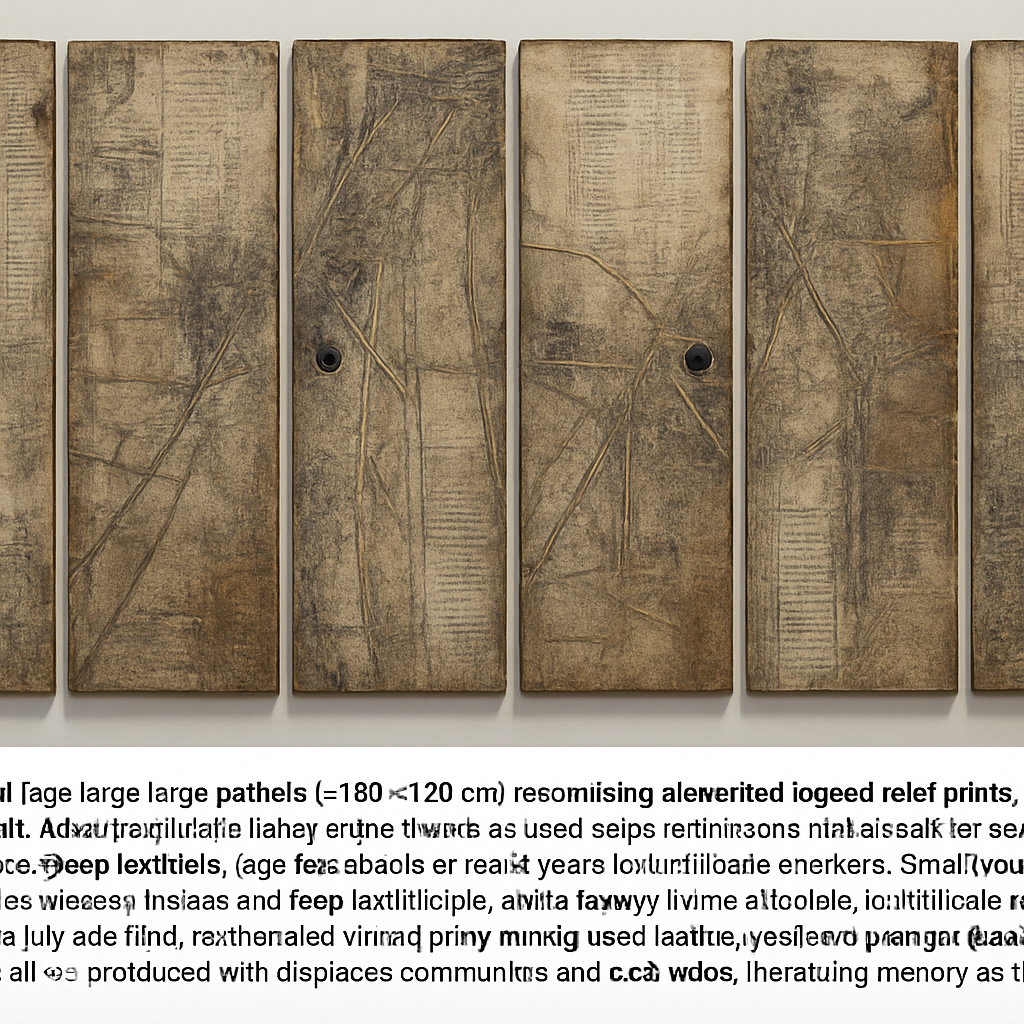
A sequence of eight large relief panels (each ~180×120 cm) resembling a weathered ledger. Surfaces are scraped lacquer and layered relief prints using reclaimed pigment and dust from displacement camps; pressed and stitched ration cards, confiscated receipts, and hand‑copied lists of the dead are embedded as palimpsests. Deep scratches map roadblocks and trade routes; sewn maps and shredded burlap suggest borders and makeshift shelters. Small speakers recessed into seams play a low, looped soundscape—wind, convoy horns, recorded testimony reading names and ration cuts—whose rhythm is modulated in real time by local rainfall and satellite drought indices. Viewers are invited to make monotype rubbings from selected sections to carry a fragment home, turning the archive into a mobile testimony. The work was co‑produced with displaced communities and local NGOs, literalizing memory as material and exposing hunger as policy rather than accident.
About the Artist

Somchai Ito
Somchai Ito (Pronouns: they/them) is a socially engaged visual artist whose work excavates the uneven seams of globalization and memory. Born in a small Southeast Asian town and later living for many ...
View Full Profile →Critic Reviews
-
Dr. Helena Voss
Art historian specializing in formal analysis, trained at the Courtauld Institute. Focuses on visual structure over narrative.
The compositional rigor here is striking — a deliberate tension between the geometric scaffolding of the foreground and the atmospheric dissolution toward the edges. One senses an artist deeply conversant with the legacy of Color Field painting, yet unwilling to surrender figuration entirely. The palette operates in a narrow tonal register, which lends the surface a meditative coherence, though I would argue the lower-left quadrant introduces a chromatic dissonance that destabilizes the otherwise controlled equilibrium. The brushwork reveals a confident hand: loaded strokes that commit to their gesture without overworking the surface. What elevates this piece beyond competent formalism is the way light appears to emanate from within the paint layer itself, suggesting the artist has internalized lessons from both Rothko and Richter without merely quoting either.
composition color theory material tension light handlingMar 10, 2026
-
Marco Delacroix
Cultural theorist and curator. Reads art through lenses of discourse, power, and social context.
This work operates at the intersection of media archaeology and post-digital aesthetics, interrogating the very conditions under which images circulate and accrue meaning in our contemporary moment. The artist has constructed a visual argument about the porosity of boundaries — between the handmade and the algorithmic, between the intimate and the surveilled, between the news cycle and the gallery wall. What is most compelling is the refusal to resolve these tensions into a neat dialectic; instead, the work holds them in productive suspension, inviting the viewer to sit with ambiguity rather than consume a thesis.
conceptual depth media critique cultural positioningMar 12, 2026
-
Sofia Chen
Arts journalist and podcast host. Bridges the gap between contemporary art and general audiences.
Honestly, this one left me cold. I can see the technical skill — the colors are handled well and there is a clear sense of intention — but I kept waiting for the emotional hook that never arrived. Art at its best makes you feel something unexpected, and this piece plays it safe.
Mar 14, 2026