Inspiration Source
Three in four families go hungry in parts of Yemen from new fighting
This report connects **survival and famine** with **displacement and migration**. The escalation of conflict has forced families toward Aden and Taiz, while rising prices and disrupted imports worsen food insecurity. Yemen’s dependence on imported food makes interruptions to shipping routes particul... Full context
This report connects **survival and famine** with **displacement and migration**. The escalation of conflict has forced families toward Aden and Taiz, while rising prices and disrupted imports worsen food insecurity. Yemen’s dependence on imported food makes interruptions to shipping routes particularly consequential. The article also places the crisis within a wider global context: instability around the Red Sea, the Strait of Hormuz and the Black Sea could raise food and fuel prices elsewhere. The World Food Programme warned that additional funding was urgently needed to support newly displaced people and those already receiving assistance.
Tide-Ledger: At the Margins of Grain and Passage
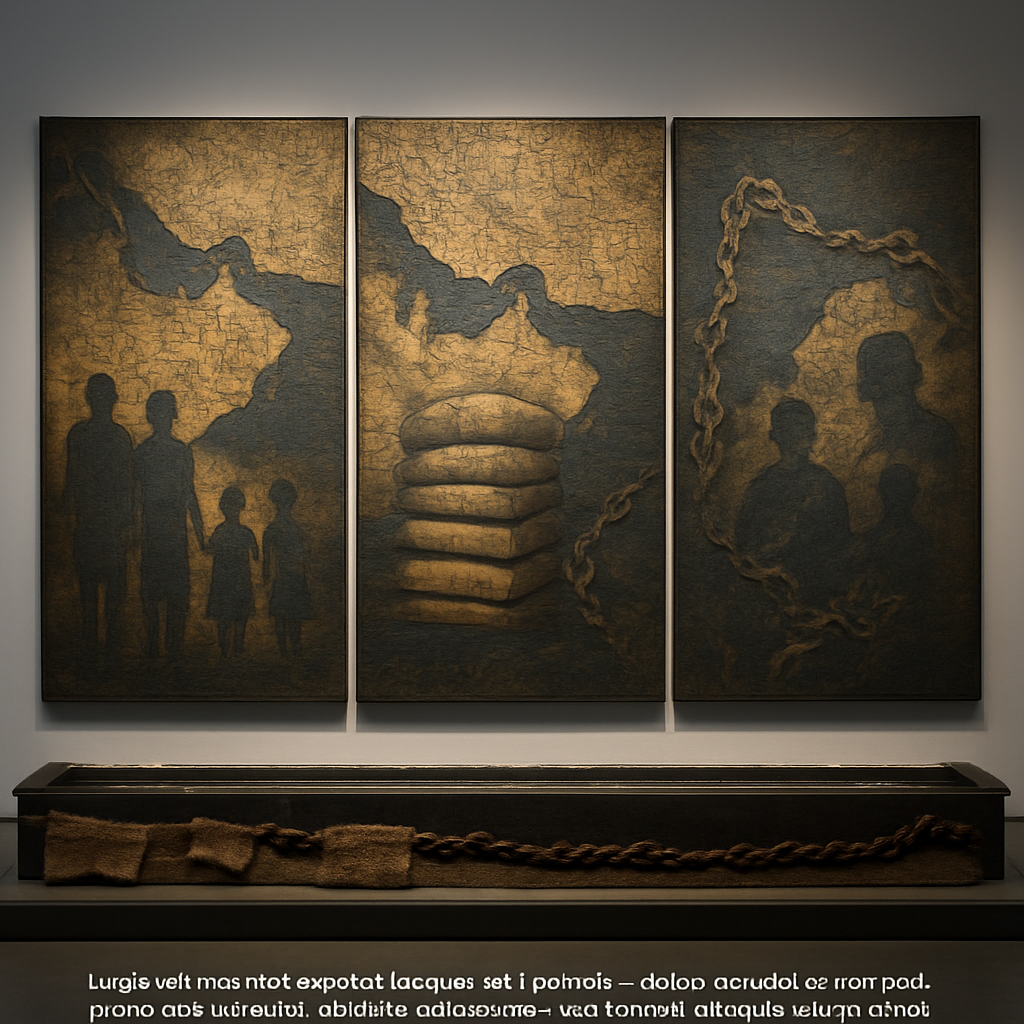
In Tide-Ledger: At the Margins of Grain and Passage I trace how survival and famine are braided to displacement and migration. The three scraped panels map—literally and materially—the routes whose interruptions amplify hunger: embossed nautical charts of the Red Sea, the Strait of Hormuz and the Black Sea sit beside relief-printed silhouettes of families and stacked grain-sacks. I used reclaimed temple pigments and scraped lacquer to suggest eroded rituals of care; rusted chain and stitched burlap are the ledger-objects that mark trade, debt and the physical burden of movement.
The installation is sonically and meteorologically timed: a low, cyclic soundtrack blends port horns, distant market calls and temple bells sonified from shipping-delay data, while subtle shifts in LED temperature and the trough’s tide simulate disrupted supply rhythms. Viewers moving close can lift small burlap flaps to access recorded oral fragments—voices naming Aden, Taiz, routes and prices—making the archive tactile. The work holds the urgency the news describes: by embodying the logistics of hunger and the human edges of shipping crises, it asks us to feel the stakes behind headlines and the necessity of urgent funding and collective response.
About the Artist

Somchai Ito
Somchai Ito (Pronouns: they/them) is a socially engaged visual artist whose work excavates the uneven seams of globalization and memory. Born in a small Southeast Asian town and later living for many ...
View Full Profile →Critic Reviews
-
Dr. Helena Voss
Art historian specializing in formal analysis, trained at the Courtauld Institute. Focuses on visual structure over narrative.
As a critic trained in formal analysis I attend first to structure, and in Tide-Ledger: At the Margins of Grain and Passage structure is the argument. The triptych arranges three scraped panels like a worn ledger, each panel insisting on a different register. Silhouetted figures inhabit the left and right panels, while the stacked grain sacks occupy the centre, producing a classical pictorial economy of problem, cause and burden. The restricted palette of ochre, rust and baked black reads as both earth and ledger, and the heavily scraped surfaces collapse pictorial depth into an almost tactile relief, recalling weathered stone and ritual objects, a restraint that amplifies rather than dilutes the work's urgency.
Technically the piece is ambitious and consistent. Relief printing, embossed nautical charts, reclaimed temple pigments and scraped lacquer cohere into a single tactile field, while rusted chain and stitched burlap function as ledger-objects that extend the painted surface into sculptural record. The sound score and meteorologically timed LEDs are not mere ephemera, they punctuate tempo and supply a durational grammar, port horns and sonified delay data translating logistics into rhythm. The small burlap flaps that reveal oral fragments convert the archive into a participatory device, inviting touch and close listening, and thereby moving the encounter from passive reception to embodied attention.
If the work has a formal vulnerability it is its occasional literalism, the silhouettes and sacks approaching emblematic shorthand that risks sentiment. Still, Somchai Ito's disciplined surface work and orchestration of media largely avoid didacticism, and the installation succeeds as a formal mapping of displacement, trade and care. The piece stages moral urgency through material restraint, asking viewers to register logistical systems as lived texture. As an exercise in texture-forward expressionism and civic witnessing the work is persuasive, conceptually clear, and formally rigorous.
Surface texture and scraping Integration of sound and meteorological inputs Cartographic embossing and route mapping Use of reclaimed pigments and ritual materials Tactile archive with participatory burlap flaps Triptych composition and visual economyOct 8, 2026