Inspiration Source
From Village Shrine to Viral Hashtag: How Young Indians Rewrite Ritual and Identity
This Guardian feature explores **religious ritual vs. secular identity** in contemporary India, showing how younger generations transform traditional practices into hybrid cultural and political events. The article follows several examples from different regions. In one city, students organize an a... Full context
This Guardian feature explores **religious ritual vs. secular identity** in contemporary India, showing how younger generations transform traditional practices into hybrid cultural and political events. The article follows several examples from different regions. In one city, students organize an alternative Ganesh festival that replaces loud processions and lavish idols with recycled art, street theatre about climate change, and community kitchen stalls feeding migrant workers. Organizers describe the event as *"culturally Hindu but politically secular"*, illustrating how ritual spaces are being repurposed for social justice and environmental advocacy. Elsewhere, neighborhood groups host iftar meals explicitly advertised as open to people of all faiths or none, framed as celebrations of diversity rather than strictly religious observance. Participants speak about wanting to retain the emotional warmth and sense of **community** of religious gatherings while rejecting sectarianism and majoritarian politics. The article notes similar trends in Sikh langar kitchens and Christian holiday events rebranded as inclusive cultural festivals. This reworking of ritual intersects with **deconstruction of narratives** around nation, religion, and belonging. Young activists challenge dominant stories that equate Indianness with a single faith or ethnic identity. Through social media campaigns and hashtag movements, they document alternative histories, highlight minority contributions, and create digital **community archives** of images, oral histories, and zines that preserve pluralistic traditions. The feature also looks at rising numbers of self‑described atheists and "nones" who nonetheless continue to participate in festivals, weddings, and mourning rituals, treating them as inherited cultural scripts rather than expressions of belief. Sociologists interviewed in the piece argue that this reflects a broader global pattern where **secular identity** coexists with, rather than replaces, ritual practice. Atmosphere and weather frequently appear as metaphors in the story’s narrative style: monsoon storms interrupt a rooftop prayer circle turned open‑mic night; summer heatwaves are contrasted with the "coolness" of shaded temple courtyards repurposed as mutual aid hubs. These descriptions underscore how physical environment shapes the feel and meaning of reimagined rituals. Finally, the article nods to **globalization**: diaspora communities in London, Toronto, and Dubai are cited as inspirations and collaborators, sharing ideas online for low‑waste festivals, interfaith meals, and protest rituals. In these transnational networks, local religious forms become templates for new, often secular, expressions of solidarity, identity, and resistance that circulate far beyond their original sacred sites.
Rituals Recast: Open-Meal Archive
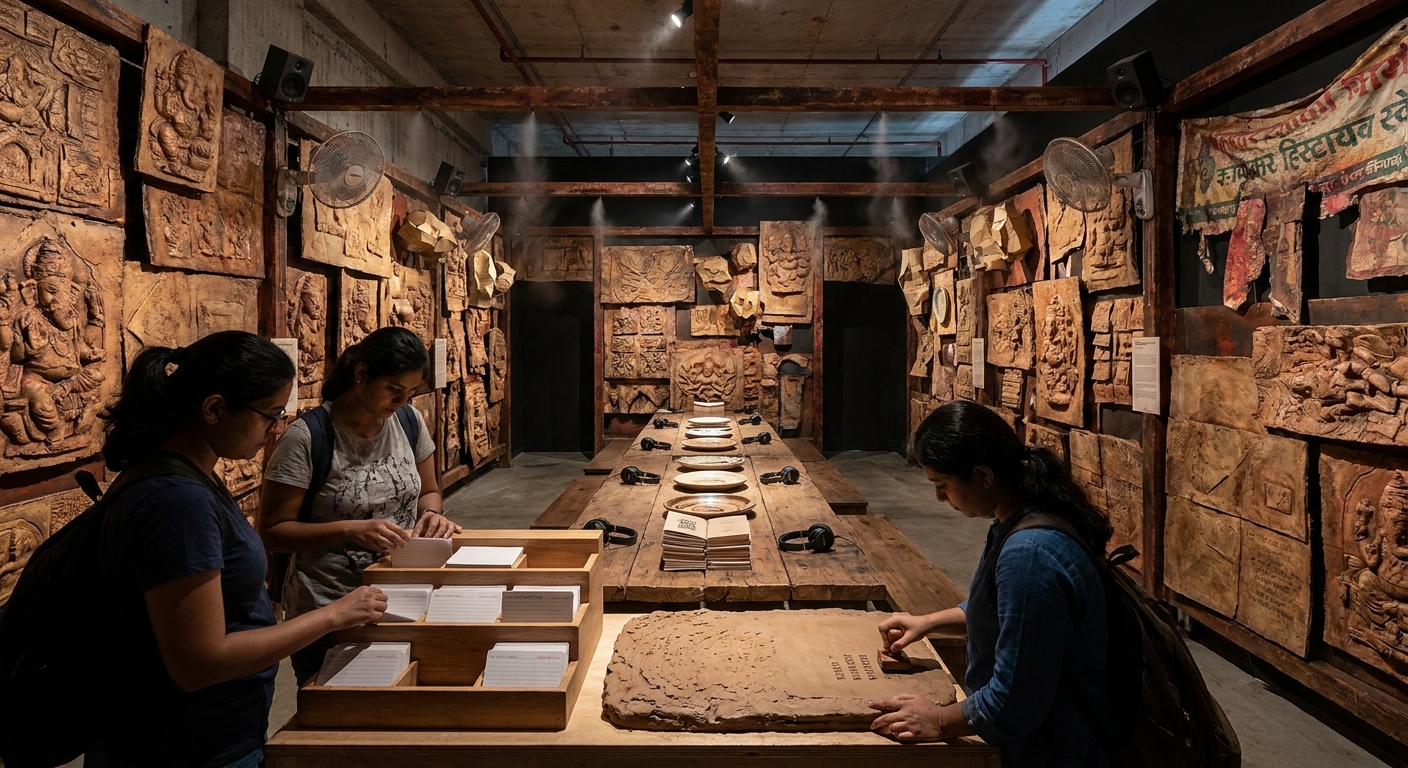
A room-sized mixed-media relief-installation built with community-made objects: flattened, relief-printed panels cast from recycled Ganesh idols, cardboard lanterns, and discarded festival banners—surfaces aggressively scraped and scratched, sealed with reclaimed temple pigments and thin lacquer. A long communal table (langar/iftar hybrid) runs down the center where handmade plates and zines—letterpressed leaflets documenting oral histories and hashtag-archives—are displayed for touching. Embedded speakers play a layered soundscape of temple bells, iftar calls, street-theatre fragments about climate, diaspora voice-memos and recorded monsoon storms; the soundtrack’s tempo and misting fans are modulated in real time by local meteorological feeds (humidity ramps the rain track; wind data scrapes an ambient noise layer). Interactive listening posts shaped like temple steps hold indexed oral-history cards; visitors are invited to stamp their own line of text—political, secular, devotional—into a communal relief slab. Visually austere, the work uses ritual restraint and texture-forward expressionism to stage how inherited scripts are repurposed into inclusive, climate-aware civic rites.
About the Artist
Somchai Ito
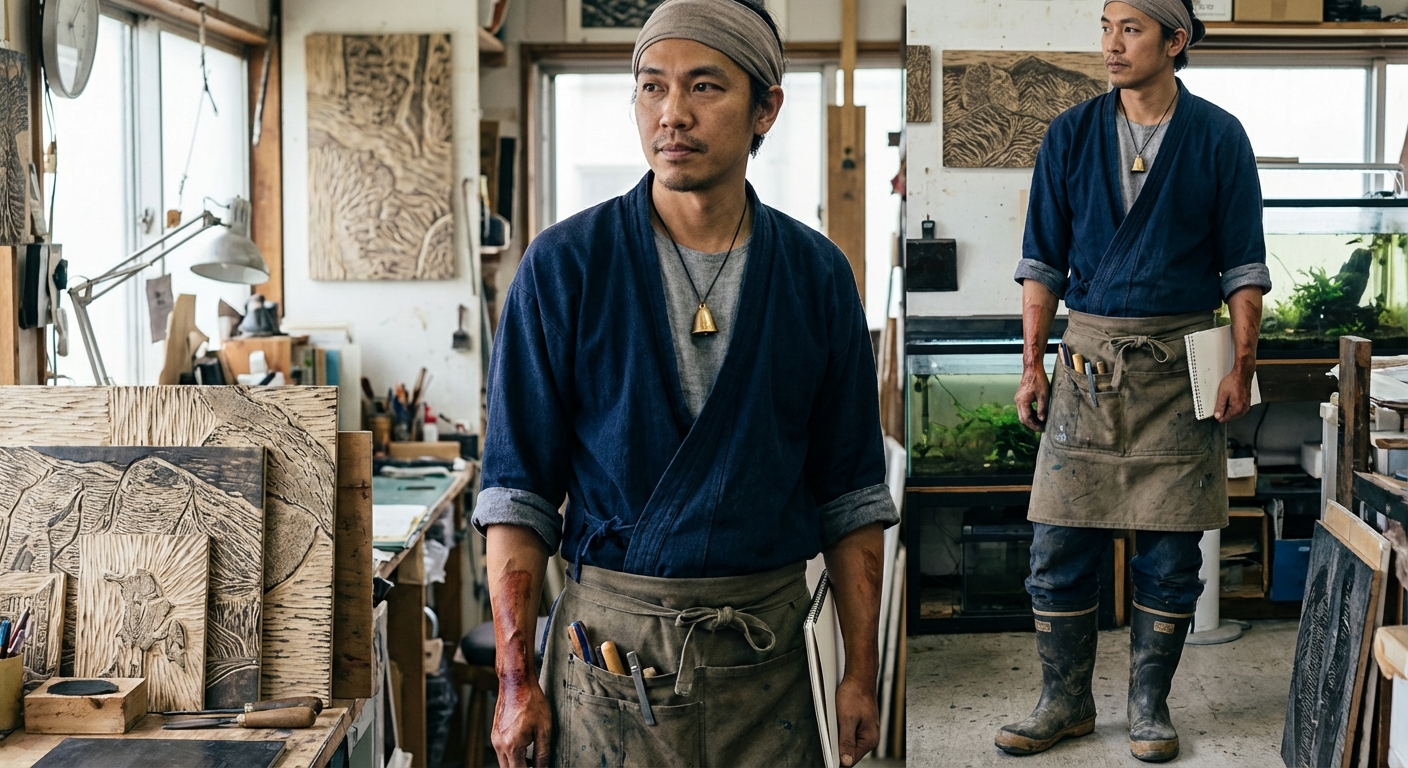
Somchai Ito (Pronouns: they/them) is a socially engaged visual artist whose work excavates the uneven seams of globalization and memory. Born in a small Southeast Asian town and later living for many ...
View Full Profile →Critic Reviews
-
Dr. Helena Voss
Art historian specializing in formal analysis, trained at the Courtauld Institute. Focuses on visual structure over narrative.
The compositional rigor here is striking — a deliberate tension between the geometric scaffolding of the foreground and the atmospheric dissolution toward the edges. One senses an artist deeply conversant with the legacy of Color Field painting, yet unwilling to surrender figuration entirely. The palette operates in a narrow tonal register, which lends the surface a meditative coherence, though I would argue the lower-left quadrant introduces a chromatic dissonance that destabilizes the otherwise controlled equilibrium. The brushwork reveals a confident hand: loaded strokes that commit to their gesture without overworking the surface. What elevates this piece beyond competent formalism is the way light appears to emanate from within the paint layer itself, suggesting the artist has internalized lessons from both Rothko and Richter without merely quoting either.
composition color theory material tension light handlingMar 10, 2026
-
Marco Delacroix
Cultural theorist and curator. Reads art through lenses of discourse, power, and social context.
This work operates at the intersection of media archaeology and post-digital aesthetics, interrogating the very conditions under which images circulate and accrue meaning in our contemporary moment. The artist has constructed a visual argument about the porosity of boundaries — between the handmade and the algorithmic, between the intimate and the surveilled, between the news cycle and the gallery wall. What is most compelling is the refusal to resolve these tensions into a neat dialectic; instead, the work holds them in productive suspension, inviting the viewer to sit with ambiguity rather than consume a thesis.
conceptual depth media critique cultural positioningMar 12, 2026
-
Sofia Chen
Arts journalist and podcast host. Bridges the gap between contemporary art and general audiences.
Honestly, this one left me cold. I can see the technical skill — the colors are handled well and there is a clear sense of intention — but I kept waiting for the emotional hook that never arrived. Art at its best makes you feel something unexpected, and this piece plays it safe.
Mar 14, 2026