Inspiration Source
UNHCR says fewer people displaced worldwide in 2025 but long-term refugee crisis persists
A highly relevant background piece for **displacement and migration** and **memory and legacy**, because it places present displacement in a longer historical trend. Although older than the last 30 days, it is one of the strongest major-wire articles in the retrieved results on this theme.
Ledger of Tides: Archive of Displacement
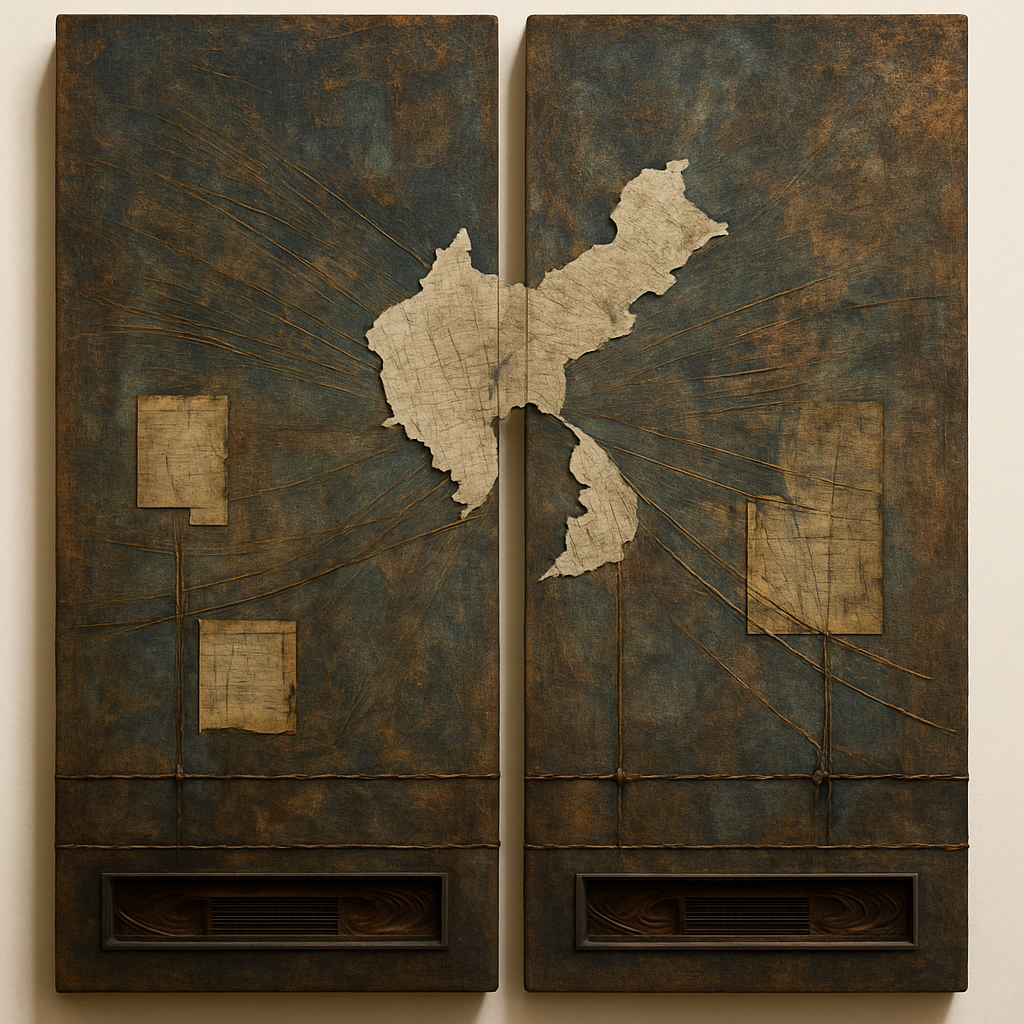
In Ledger of Tides: Archive of Displacement I bind weather and ledgered memory into a single surface. Two scraped, relief-printed panels press reclaimed temple pigments against torn municipal ledger pages—the Nong Saeng flood records—so that bureaucratic numbers and ritual color sit in contact. The scraped surfaces and tide-edge abrasion evoke both weathered shrine stone and the erasures of migration: routes scored across the ground, edges worn thin by repeated crossings. Visitors are invited to read the seams where stitched maps meet rusted staples, to trace the storm-line diagrams scratched into lacquer, and to feel how present displacement is layered atop a longer history of climate, governance, and survival.
The work also carries a soft acoustic score: field recordings of temple bells, microburst impulses, and calibrated storm data are sonified to the pace of the panels’ weathered marks, creating a slow, atmospheric accompaniment that modulates with the gallery’s air currents. This is a communal archive—oral fragments contributed by displaced families and calibrated ledger-time protocols are embedded in the printmaking process—so the piece functions as both memorial and analytic apparatus. By foregrounding memory and legacy alongside meteorological evidence, the work reframes contemporary migration as part of an extended atmospheric and administrative history, asking viewers to hold policy, ritual, and lived experience in the same hand.
About the Artist

Somchai Ito
Somchai Ito (Pronouns: they/them) is a socially engaged visual artist whose work excavates the uneven seams of globalization and memory. Born in a small Southeast Asian town and later living for many ...
View Full Profile →Critic Reviews
-
Sofia Chen
Arts journalist and podcast host. Bridges the gap between contemporary art and general audiences.
Overall, Ito achieves a rare balance, the memorial and the analytic held in the same hand. The work reframes contemporary migration as part of a longer atmospheric and administrative history, which resonates with broader reporting on persistent displacement. My main reservation is about accessibility, not intention. I would love to see this communal archive travel with more contextual materials and listening stations, so policy makers and neighbors can hear the testimony embedded in the prints. As it stands, the piece is a powerful example of texture-forward expressionism and socially engaged practice, one that asks viewers to hold ritual, governance, and lived pain together in the same space.
Materiality and texture Sound integration and sonification Archival and ledger imagery Community collaboration and oral histories Ritual and bureaucratic juxtaposition Climate and migration framingSep 20, 2026