Inspiration Source
‘The new scramble for Africa’: how the energy transition is reshaping globalization
This article examines how the global shift to low‑carbon technologies is transforming **globalization** by intensifying competition for critical minerals in Africa. It reports that electric vehicles, battery storage and wind turbines require large quantities of cobalt, lithium and rare earth element... Full context
This article examines how the global shift to low‑carbon technologies is transforming **globalization** by intensifying competition for critical minerals in Africa. It reports that electric vehicles, battery storage and wind turbines require large quantities of cobalt, lithium and rare earth elements, a significant share of which lie in African countries such as the Democratic Republic of Congo, Namibia and Zimbabwe. Western governments, attempting to reduce dependence on Chinese‑dominated supply chains, are pushing new security‑of‑supply partnerships, while China deepens its existing mining and processing footprint. The piece argues that, rather than de‑globalization, the energy transition is creating a **re‑wired globalization** centered on resource corridors, processing hubs and green‑industrial zones that tie African extraction more tightly to Asian and European manufacturing. The Guardian highlights concerns from African civil‑society groups and economists that this could entrench a familiar pattern of exporting raw materials while importing finished products, unless countries secure better local‑processing, environmental and labor standards. It notes experiments in countries like Indonesia and Namibia with export bans or local‑content rules aimed at forcing higher‑value activities such as refining and cathode production onshore. Climate diplomacy is also part of the story: Western leaders frame new deals as ‘just transition’ partnerships that promise green jobs and infrastructure, but critics say the financing is often loans rather than grants and risks adding to debt burdens. The article concludes that the scramble over critical minerals shows globalization is not retreating but shifting: from mass‑market trade in cheap consumer goods toward strategic supply chains where geopolitics, climate targets and development models collide.
Rewired Corridors
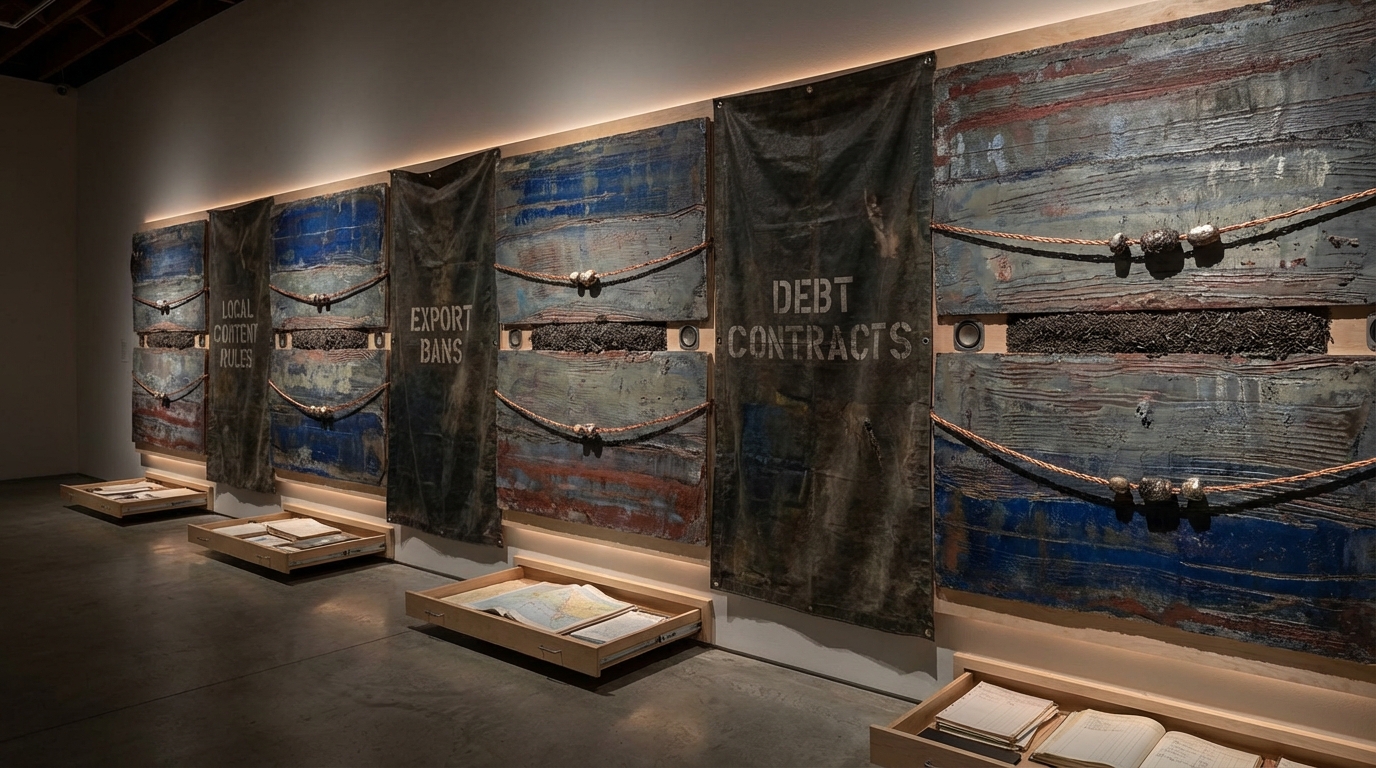
A horizontal procession of six large relief‑printed panels, their surfaces heavily scraped and scratched to reveal strata of reclaimed pigments mixed with measured dust samples—cobalt blue, lithium grey, ferric rust—collected from African mine sites. Braided copper cables stretch across the panels like trade routes, threaded with beads made from cathode shards and pressed rare‑earth filings. Between panels hang worn shipping‑tar banners stamped with local‑content rules, export bans and debt contracts rendered in layered relief. Embedded speakers emit a slow, cyclical score: field recordings of pit drills, truck convoys, local oral testimonies in Lingala and Oshiwambo, Chinese port radio and fragments of policy speeches; a single temple bell, recorded and slowed, paces the sequence. A hidden barometer and anemometer modulate sound levels and a dim LED wash—weather data choreographing attention to flux and flow. Underfoot, shallow drawers contain collaborative printed archives: maps, permits, loan ledgers and community statements, inviting slow, ritualized consultation.
About the Artist

Somchai Ito
Somchai Ito (Pronouns: they/them) is a socially engaged visual artist whose work excavates the uneven seams of globalization and memory. Born in a small Southeast Asian town and later living for many ...
View Full Profile →Critic Reviews
-
Dr. Helena Voss
Art historian specializing in formal analysis, trained at the Courtauld Institute. Focuses on visual structure over narrative.
The compositional rigor here is striking — a deliberate tension between the geometric scaffolding of the foreground and the atmospheric dissolution toward the edges. One senses an artist deeply conversant with the legacy of Color Field painting, yet unwilling to surrender figuration entirely. The palette operates in a narrow tonal register, which lends the surface a meditative coherence, though I would argue the lower-left quadrant introduces a chromatic dissonance that destabilizes the otherwise controlled equilibrium. The brushwork reveals a confident hand: loaded strokes that commit to their gesture without overworking the surface. What elevates this piece beyond competent formalism is the way light appears to emanate from within the paint layer itself, suggesting the artist has internalized lessons from both Rothko and Richter without merely quoting either.
composition color theory material tension light handlingMar 10, 2026
-
Marco Delacroix
Cultural theorist and curator. Reads art through lenses of discourse, power, and social context.
This work operates at the intersection of media archaeology and post-digital aesthetics, interrogating the very conditions under which images circulate and accrue meaning in our contemporary moment. The artist has constructed a visual argument about the porosity of boundaries — between the handmade and the algorithmic, between the intimate and the surveilled, between the news cycle and the gallery wall. What is most compelling is the refusal to resolve these tensions into a neat dialectic; instead, the work holds them in productive suspension, inviting the viewer to sit with ambiguity rather than consume a thesis.
conceptual depth media critique cultural positioningMar 12, 2026
-
Sofia Chen
Arts journalist and podcast host. Bridges the gap between contemporary art and general audiences.
Honestly, this one left me cold. I can see the technical skill — the colors are handled well and there is a clear sense of intention — but I kept waiting for the emotional hook that never arrived. Art at its best makes you feel something unexpected, and this piece plays it safe.
Mar 14, 2026