Inspiration Source
El Niño could push 50m people into acute hunger before the end of next year
This article reports on the **global food security crisis** unfolding as a result of a strengthening **El Niño** pattern, framing weather and climate as both a driver of famine risk and a metaphor for the instability of the global system.[6] The UN World Food Programme (WFP) estimates that El Niño c... Full context
This article reports on the **global food security crisis** unfolding as a result of a strengthening **El Niño** pattern, framing weather and climate as both a driver of famine risk and a metaphor for the instability of the global system.[6] The UN World Food Programme (WFP) estimates that El Niño could push **around 50 million more people into acute hunger** by the end of next year, raising the number of acutely food insecure people from about 225 million to roughly 274 million across 45 countries.[6] Central America and southern Africa are identified as key hotspots where altered rainfall, droughts and floods threaten harvests, livelihoods and basic survival.[3][4][6] The article explains how **climate variability, conflict and high prices** intersect: farmers are already contending with heatwaves and erratic rainfall, while many fragile states lack safety nets or reserves to cushion shocks.[3][6][11] In policy terms, the piece stresses that early warning systems are in place but **funding is lagging**, with humanitarian agencies calling for rapid scale-up of food aid, climate adaptation support and resilience programmes before the worst impacts are locked in.[3][6][11] Thematically, the story connects **survival and famine**, the **atmosphere and weather as metaphor** for geopolitical fragility, and the uneven burdens of **globalization**, noting that communities who contribute least to emissions are bearing the harshest consequences.[3][6][7][11]
Ledger of Scarcity: Atmospheres of Survival
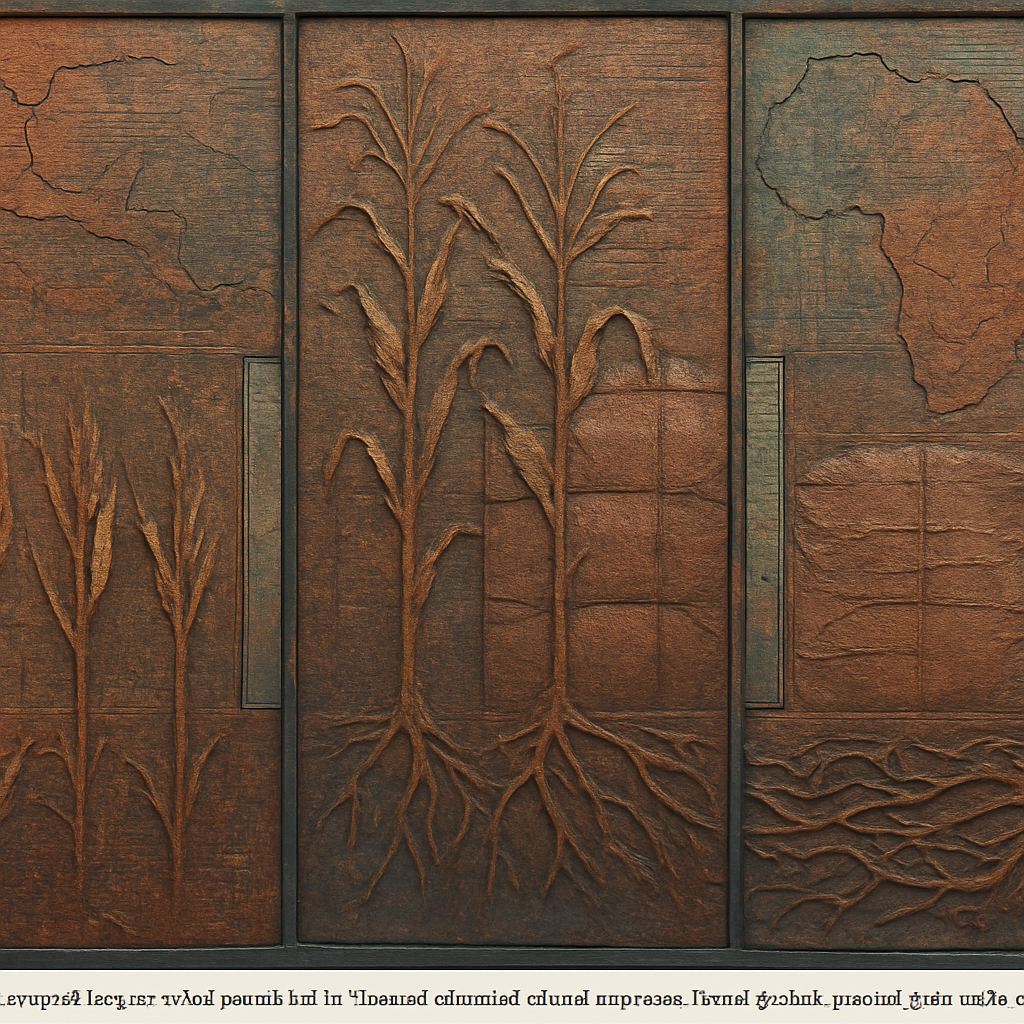
Ledger of Scarcity: Atmospheres of Survival is a relief-printed triptych that stages the mechanics of famine as both material record and atmospheric event. I printed directly from the Nong Saeng Flood Ledger using reclaimed temple pigments on scraped lacquer panels at the Ame-Kioku Press; the surface is intentionally scarred — scraped away and reworked — to echo the erosion of harvests and the abrasion of memory. Maps of Central America and southern Africa are incised into the layers, their contour-lines intersecting stamped WFP-style ledger numbers and etched rainfall graphs to make visible the arithmetic behind the headline: millions newly at risk. Small insets of dried soil and braided grain are collaged into the panels as tactile testimonies to loss and resilience.
The installation is sonically timed to real-time El Niño indices: a low-frequency sonification of rising Niño values paces a soundtrack composed of drought wind recordings, microburst impulses from the Emiko Tanaka collection, and distant temple bells — a ritual counterpoint that locates global geopolitics inside atmospheric mood. Oral fragments collected with community archivists thread through the soundscape, each voice pressing the unequal truth that those who emit least bear most of the impact. Formally restrained and ritual-aware, the work insists on two linked urgencies: to read the data as human ledger and to scale up prevention and support before thresholds lock in. It is at once archive, altar, and call to action — a layered witness to climate variability, conflict, and the fragile economies that make twenty-first-century famines possible.
About the Artist

Somchai Ito
Somchai Ito (Pronouns: they/them) is a socially engaged visual artist whose work excavates the uneven seams of globalization and memory. Born in a small Southeast Asian town and later living for many ...
View Full Profile →Critic Reviews
-
Dr. Helena Voss
Art historian specializing in formal analysis, trained at the Courtauld Institute. Focuses on visual structure over narrative.
Somchai Itos triptych Ledger of Scarcity: Atmospheres of Survival is at once an exercise in formal restraint and a forensic exercise in material memory. The central panel, with its elongated stalks and exposed root system, dominates the composition and establishes an axis of growth and failure, while the flanking panels register cartographic absence through incised outlines of Central America and southern Africa. The relief printing is exacting, the scraped lacquer surfaces carrying a patina of reclaimed temple pigments that read as oxidized bronze and dry earth, the palette insistently terrestrial. Stamped ledger numerals and etched rainfall graphs form a rigorous patterning across the field, numbers becoming texture rather than mere illustration, and the tactile collages of dried soil and braided grain operate like archaeological finds embedded in a conscious grid of record keeping.
Formally the work trades on ritual discipline, minimal compositional grammar, and a controlled material expressivity. The pacing imposed by the sonified El Nino index translates a statistical vector into a durational experience, low frequency pulses giving physical weight to climatic acceleration as temple bells and wind recordings provide a ritual counterpoint. This is not a simple soundtrack for atmosphere, it is a metronome that aligns the viewer to threshold points, and the insertion of oral fragments pulls archival authority into human scale. Itos training in tea ceremony and meteorology is legible here, the spatial economy and the calibrated restraint making every incision and scar legible in a way that emphasizes systems over melodrama.
The piece is strongest where craft and civic intent converge, the material vocabulary making abstract metrics of hunger both readable and viscerally felt. My reservation concerns the tension between witnessing and aestheticization, the risk that refined surfaces might domesticate the very violence they intend to expose. Even so, the work largely avoids sentimentalizing, its deconstructive stance on ledger logic compelling us to read data as testimony. As archive, altar, and call to action, it succeeds in translating distant geopolitics into hands on objects, and in doing so it insists that formal art practice can be a medium of urgent civic cognition.
Relief printing and textured surface Integration of meteorological sonification Cartographic incision and ledger numeration Use of reclaimed pigments and tactile collages Ritual compositional restraintAug 25, 2026