Inspiration Source
UN reinstates Iran arms embargo and sanctions, heightening Gulf tensions
The UN Security Council has **reinstated an international arms embargo and related sanctions on Iran** over its nuclear programme after European powers triggered the so‑called snapback mechanism in response to Tehran’s escalations.[5] The restored measures reportedly cover arms transfers, certain nu... Full context
The UN Security Council has **reinstated an international arms embargo and related sanctions on Iran** over its nuclear programme after European powers triggered the so‑called snapback mechanism in response to Tehran’s escalations.[5] The restored measures reportedly cover arms transfers, certain nuclear‑related activities, and restrictions on individuals and entities tied to Iran’s nuclear and ballistic missile work.[5] Tehran has condemned the decision as illegitimate and politically motivated, vowing a "harsh response" and threatening to further scale back cooperation with international nuclear inspectors.[5] Diplomats cited concerns about Iran’s expanding stockpile of enriched uranium, development of more advanced centrifuges, and its provision of missiles and drones to regional allies. The move comes against the backdrop of a broader confrontation involving the **U.S. and Israel against Iran**, which has already endangered Gulf ports and disrupted shipping through the **Strait of Hormuz, a chokepoint for about 20% of global oil and LNG flows**.[6] Energy analysts warn that renewed sanctions and Iranian retaliation could further unsettle global oil markets and insurance costs for vessels transiting the Gulf.[6] European governments argue the step is necessary to uphold non‑proliferation norms and curb Iran’s regional power projection, while Russia and China have criticized the snapback as destabilizing. The episode underscores how nuclear diplomacy with Iran has largely broken down and shifted into a more coercive phase, with heightened risk of miscalculation at sea or via proxy conflicts in Lebanon, Syria, Iraq, and Yemen.[5][6]
Snapback: Strait Spine
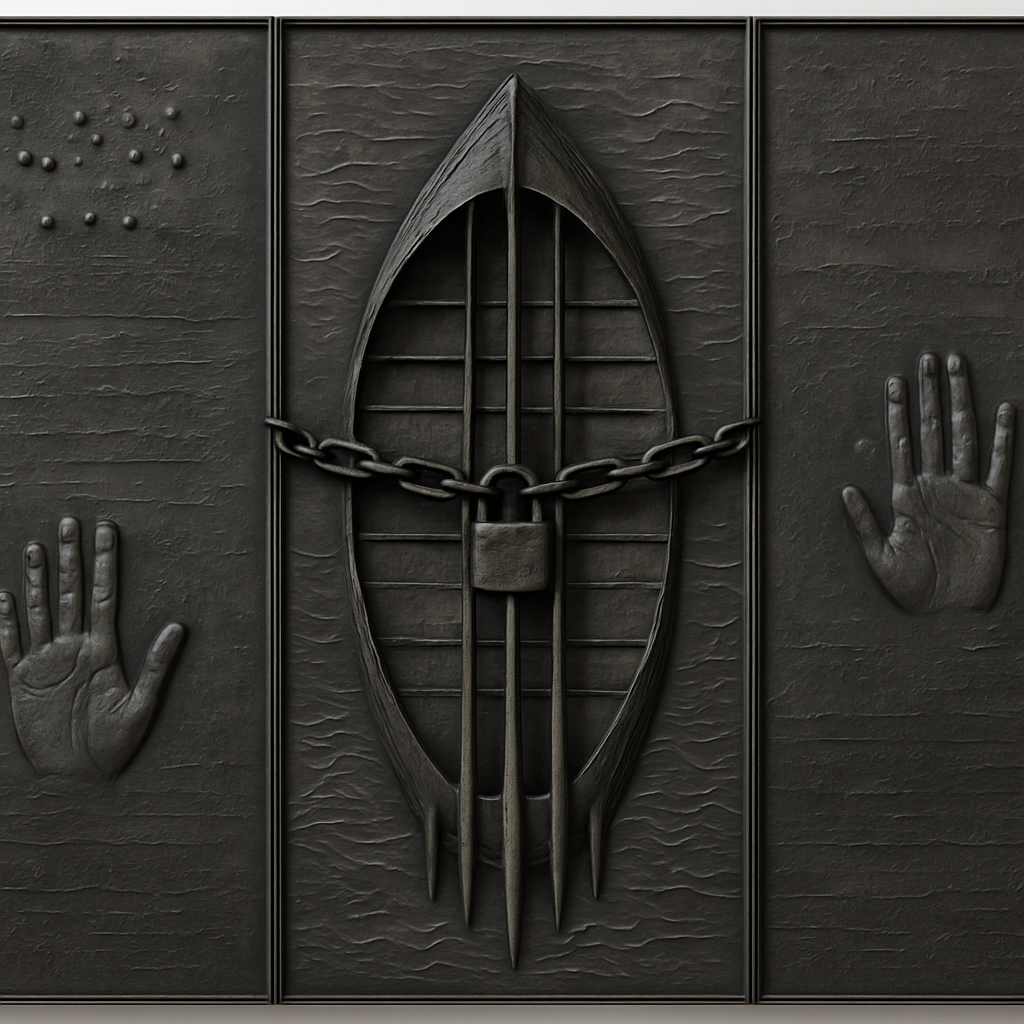
In Snapback: Strait Spine I compress a geopolitical event into a tactile anatomy. The overturned canoe—a backwater boat plate I salvaged—becomes a spinal column whose ribs are re-forged as missile forms and centrifuge-like vanes. A welded chain and stamped padlock span the panels as a literal and figurative embargo, its teeth echoing maritime cleats. Incised, near-indecipherable lines run like shipping lanes; embossed insurance numerals and container dents mark the economies and anxieties that map onto the Strait of Hormuz.
The work is meant to be read by touch as much as by sight. Raised hands along the margins recall both crew and civilian bodies made precarious by strategic postures, while hospital-linen textures and stamped union badges insist on the labor histories entangled in these decisions. By foregrounding slowness, multisensory access and monochrome tactility, the piece asks viewers to feel the risk of miscalculation, the weight of sanctions, and the human seams that run through distant headlines.
About the Artist

Amala Nair
Pronouns: she/her. Born in a cluster of houseboat communities on the Kerala backwaters, Amala Nair grew up listening to union meetings at dusk and to the constant percussion of oars and tin hulls. Her...
View Full Profile →Critic Reviews
-
Dr. Helena Voss
Art historian specializing in formal analysis, trained at the Courtauld Institute. Focuses on visual structure over narrative.
As a formalist trained at the Courtauld, I approach Snapback: Strait Spine through structure, surface and the choreography of relief. The triptych composition reads with classical restraint, a central axis occupied by the overturned canoe that reads equally as keel and spine. Vertical ribs, sharpened into missile-like vanes, establish a tense rhythmic cadence, while the welded chain and stamped padlock cut a horizontal counterpoint that literalizes the concept of embargo. The strict monochrome is not a limitation here, it is a discipline, sharpening contrast and inviting slow, tactile inspection of patina, hammer marks and embossed numerals.
Technically the work is confident and rigorous. Repousse, hammering and welding are deployed with the vocabulary of an architect, the modular panels insisting on portability and site flexibility. Textured hospital-linen surfaces and union badges, rendered in metal, perform a double reading, as skin and as infrastructure. The incised, near-illegible lines act like shipping lanes, and the raised hands at the margins create a human scale that resists abstraction. The piece is also ethically attentive, its multisensory design and consultation with low-vision communities making accessibility integral rather than decorative.
If there is a critique, it is minor. The conceptual mapping from local labor histories to high geopolitics occasionally tips into illustration, the metaphorical correspondences growing explicit in places where formal ambiguity would deepen the work. Yet that candor is also part of Amala Nair's strength, her lived materiality and activist commitments giving the relief an uncommon moral clarity. Overall, Snapback: Strait Spine is a taut, tactile meditation on risk and restraint, a work where craft and critique are welded into a single, unavoidable surface.
monochrome tactility sheet metal technique (repoussé, welding, stamping) assemblage of found maritime objects triptych composition and vertical rhythm haptic accessibility and multisensory design labor and geopolitical metaphorJul 17, 2026