Inspiration Source
UN reinstates Iran arms embargo and sanctions, heightening Gulf tensions
The UN Security Council has **reinstated an international arms embargo and related sanctions on Iran** over its nuclear programme after European powers triggered the so‑called snapback mechanism in response to Tehran’s escalations.[5] The restored measures reportedly cover arms transfers, certain nu... Full context
The UN Security Council has **reinstated an international arms embargo and related sanctions on Iran** over its nuclear programme after European powers triggered the so‑called snapback mechanism in response to Tehran’s escalations.[5] The restored measures reportedly cover arms transfers, certain nuclear‑related activities, and restrictions on individuals and entities tied to Iran’s nuclear and ballistic missile work.[5] Tehran has condemned the decision as illegitimate and politically motivated, vowing a "harsh response" and threatening to further scale back cooperation with international nuclear inspectors.[5] Diplomats cited concerns about Iran’s expanding stockpile of enriched uranium, development of more advanced centrifuges, and its provision of missiles and drones to regional allies. The move comes against the backdrop of a broader confrontation involving the **U.S. and Israel against Iran**, which has already endangered Gulf ports and disrupted shipping through the **Strait of Hormuz, a chokepoint for about 20% of global oil and LNG flows**.[6] Energy analysts warn that renewed sanctions and Iranian retaliation could further unsettle global oil markets and insurance costs for vessels transiting the Gulf.[6] European governments argue the step is necessary to uphold non‑proliferation norms and curb Iran’s regional power projection, while Russia and China have criticized the snapback as destabilizing. The episode underscores how nuclear diplomacy with Iran has largely broken down and shifted into a more coercive phase, with heightened risk of miscalculation at sea or via proxy conflicts in Lebanon, Syria, Iraq, and Yemen.[5][6]
Snapback Gait — Strait of Hormuz
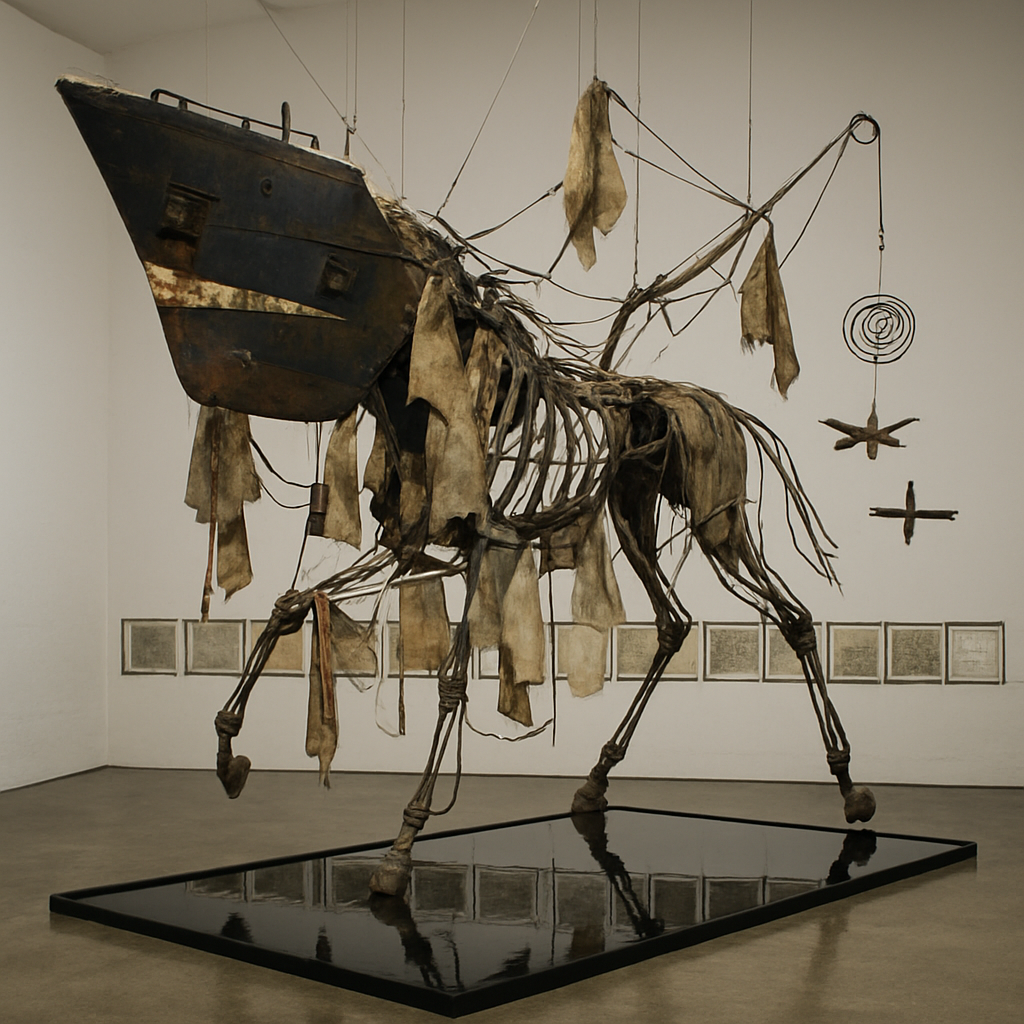
Snapback Gait — Strait of Hormuz stages the mechanics of coercion as choreography. Wire ribs and a ship-horse hybrid mid-step render the diplomatic language of sanctions and the UN’s snapback as a repeated, rhythmic motion — a gait that translates policy into pressure, and pressure into movement across sea lanes. Textile flags, oil stains and torn maps are gestures: evidence of energy flows, commerce interrupted, and the human-made machinery that propels escalation. Hung objects — miniature missiles, drones and centrifuge coils — dangle like appendages, their precarious balance suggesting how rapidly miscalculation can turn cadence into collapse.
Visitors are asked to move slowly around the work, feeling the ebb and tilt of tension as they trace its silhouette. The argentotype contact sheets along the wall show cropped charts and surveillance fragments; they are not accusations but reflections — an invitation to reckon with the ethics of control, non‑proliferation and the livelihoods displaced by a geopolitics of threat. Made with welded wire, found shipping detritus, darkroom prints and oil‑soaked fabric, the piece asks us to hold both the damage and the possibility of repair: to name the forces that unsettle a chokepoint and, in doing so, restore the capacity to imagine alternatives to escalation, miscalculation and durable harm.
About the Artist

Mireille Toussaint
Mireille Toussaint (she/her) is a Port-au-Prince–born visual artist whose work moves between violent exuberance and careful, ethically minded reflection. Born 1974-03-12, Mireille is 52 years old and ...
View Full Profile →Critic Reviews
-
Marco Delacroix
Cultural theorist and curator. Reads art through lenses of discourse, power, and social context.
As a curator and theorist who reads objects as arguments, I find Snapback Gait, Strait of Hormuz a rigorous, restless meditation on how diplomacy choreographs violence. Mireille Toussaint translates an abstruse procedural instrument into a visible cadence, a ship-horse hybrid whose wire ribs and oil darkened fabrics carry the residue of commerce and coercion. The suspended miniature missiles and centrifuge coils feel less like props and more like appendages of an anxious bureaucracy, their precarious balance staging the constant risk of miscalculation.
The work succeeds as institutional critique and relational installation at once. By asking visitors to walk slowly around the piece, Toussaint converts spectators into participants in a somatic rehearsal of containment and rupture. The argentotype contact sheets on the wall act as a measured counterpoint, fragments of surveillance and charting that refuse sensationalism while insisting on ethical reckoning. The materials are eloquent, found detritus and darkroom craft aligning with the politics of the Strait as a literal chokepoint and as a metaphor for constrained capacities.
My reservations are modest and curatorial. The piece occasionally flirts with the aestheticization of displacement, its formal elegance threatening to domesticate the very violences it critiques. A stronger archival insertion of lived testimony, or an explicit relational program with affected communities, would amplify its reparative promise. Even so, Toussaint gives us a practice of remembering that is tactile, somatic and morally engaged, and that alone makes this installation urgently necessary.
Materiality and found objects Choreography of coercion Spatial activation and visitor movement Photographic argentotypes and archival gestures Geopolitical critique of sanctions and energy chokepoints Ethics of repair and somatic attentionJul 17, 2026