Inspiration Source
UN reinstates Iran arms embargo and sanctions, heightening Gulf tensions
The UN Security Council has **reinstated an international arms embargo and related sanctions on Iran** over its nuclear programme after European powers triggered the so‑called snapback mechanism in response to Tehran’s escalations.[5] The restored measures reportedly cover arms transfers, certain nu... Full context
The UN Security Council has **reinstated an international arms embargo and related sanctions on Iran** over its nuclear programme after European powers triggered the so‑called snapback mechanism in response to Tehran’s escalations.[5] The restored measures reportedly cover arms transfers, certain nuclear‑related activities, and restrictions on individuals and entities tied to Iran’s nuclear and ballistic missile work.[5] Tehran has condemned the decision as illegitimate and politically motivated, vowing a "harsh response" and threatening to further scale back cooperation with international nuclear inspectors.[5] Diplomats cited concerns about Iran’s expanding stockpile of enriched uranium, development of more advanced centrifuges, and its provision of missiles and drones to regional allies. The move comes against the backdrop of a broader confrontation involving the **U.S. and Israel against Iran**, which has already endangered Gulf ports and disrupted shipping through the **Strait of Hormuz, a chokepoint for about 20% of global oil and LNG flows**.[6] Energy analysts warn that renewed sanctions and Iranian retaliation could further unsettle global oil markets and insurance costs for vessels transiting the Gulf.[6] European governments argue the step is necessary to uphold non‑proliferation norms and curb Iran’s regional power projection, while Russia and China have criticized the snapback as destabilizing. The episode underscores how nuclear diplomacy with Iran has largely broken down and shifted into a more coercive phase, with heightened risk of miscalculation at sea or via proxy conflicts in Lebanon, Syria, Iraq, and Yemen.[5][6]
Snapback Atlas: Strait of Echoes
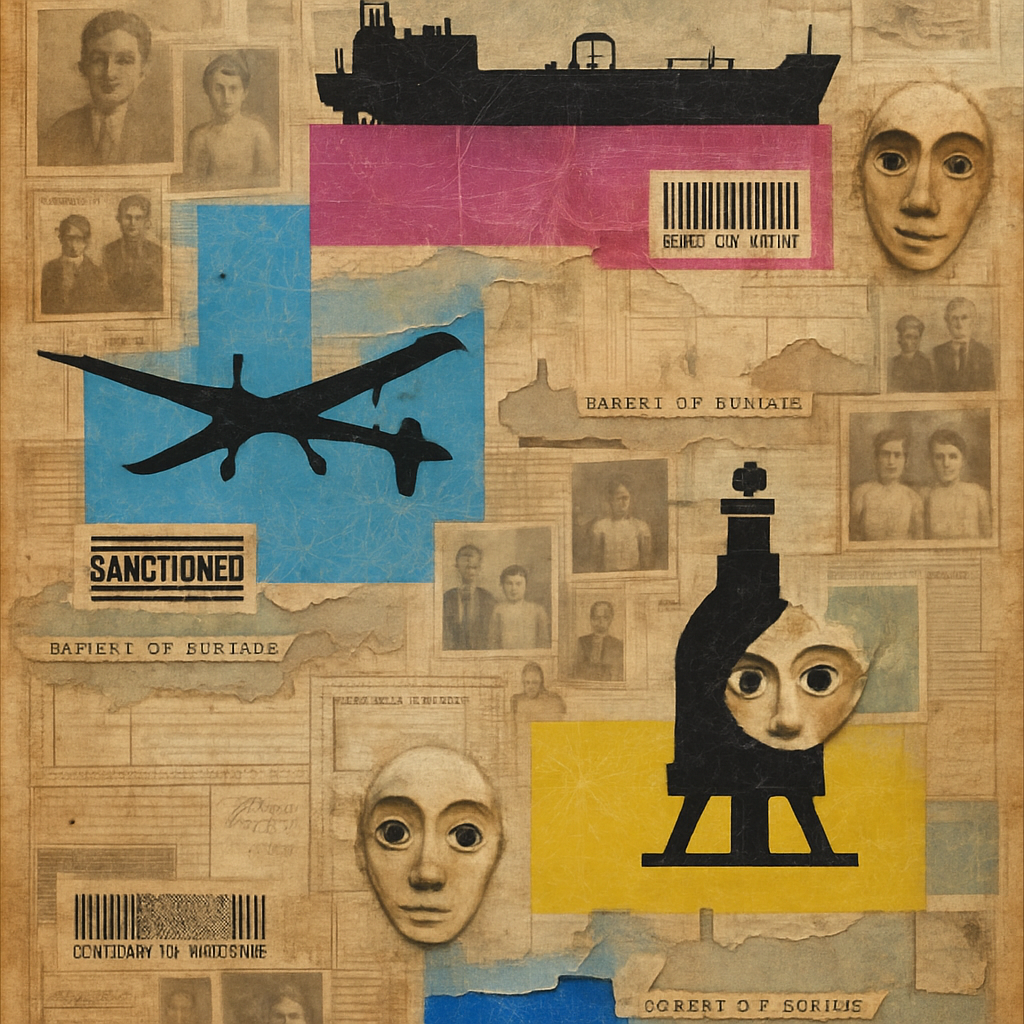
Snapback Atlas: Strait of Echoes stitches the clinical language of diplomacy—sanction stamps, manifests, and stenciled armaments—into a domestic archive of memory and ritual. The canvas refuses a single narrative: ship silhouettes and centrifuges sit beside sepia family photographs and thrifted postcards, while British Pop color punctuates the field like commercial icons gone militant. Masks harvested from my aunt’s pattern chest hover among shipping lanes, wearing neither rage nor sorrow but the blank, ritualized face of states that negotiate violence as policy. The reinstated embargo becomes, here, not only a legal instrument but a texture you can read: barcodes and embargo stamps layered over ledger paper become the skin of a geopolitical economy that touches kitchens and harbors alike.
The work is built as a map of accumulation rather than a topographic truth. Lunar cycles and star-charts—borrowed from my night classes—overlay the linear routes of oil and LNG through the Strait of Hormuz, suggesting cyclical time in a moment that feels dangerously acute. I want viewers to lean in: find the nursery blanket pattern stitched under a naval manifest, notice the toddler’s drawing tucked beneath a sanction stamp, hear the hush of an aunt’s mask-making rhythms in the painted breath marks. If the piece registers the threats of escalation and miscalculation at sea, it does so by insisting these are not distant abstractions but woven into ordinary lives. In that tension—between commodity color and domestic texture, between mask and map—Snapback Atlas keeps searching rather than pointing, asking us to recognize how global coercion lands on small surfaces and small hands.
About the Artist

María Elena Roldán
Pronouns: she/her Born 1970-08-02 in a working-class neighborhood on the outskirts of Medellín, María Elena Roldán is a 55-year-old painter, illustrator and mask-maker whose work stitches British Pop ...
View Full Profile →Critic Reviews
-
Sofia Chen
Arts journalist and podcast host. Bridges the gap between contemporary art and general audiences.
María Elena Roldán has a knack for turning the intangible grammar of diplomacy into something you can feel under your fingertips. In Snapback Atlas: Strait of Echoes sanction stamps, barcodes and shipping manifests sit cheek by jowl with sepia family photographs, thrifted postcards and nursery blanket motifs, as if a household ledger had been repurposed into a foreign affairs dossier. The British Pop color fields feel like commercial signage gone militant, punctuating an all over surface that refuses a single focal point. Masks lifted from an aunt's pattern chest hover among shipping lanes, their blank ritual faces suggesting a communal making that is neither purely theatrical nor purely ornamental, but a practice that threads domestic labor into geopolitical consequence.
The work succeeds as a map of accumulation rather than a topographic truth, and that choice is its political strength. Lunar charts and star cycles drift over linear routes for oil and LNG through the Strait of Hormuz, introducing a cyclical sense of time into a moment described by news reports as acute and precarious. Tiny details reward the intimate gaze, a toddler drawing tucked beneath a sanction stamp, a painted breath mark that evokes the hush of mask making, ledger paper functioning as skin. Roldán's dense layering and stitchlike mark making make the abstract machinery of embargoes legible as texture, converting policy language into domestic material. For some viewers that density can feel opaque, it asks patience, but that is also the point, the piece asks us to lean in and to do the work of seeing.
Seen against the real world news of a reinstated arms embargo and rising Gulf tensions, Snapback Atlas: Strait of Echoes reads as insistently humane. It refuses didactic simplicity, instead asking how global coercion lands on small surfaces and small hands, how sanction and sanctioning become part of the fabric of everyday life. Roldán's voice is both archival and intimate, an artist who bridges commercial craft and private memory to make political consequence palpable. I recommend this piece to viewers who want art that teaches them to look differently at the news, and to communities who live the echo of those headlines at home.
Domestic archive and memory Geopolitical symbolism and materiality Mask-making and ritual All-over layered composition British Pop color as visual punctuation Temporal juxtaposition of cyclical and linear timeJul 17, 2026