Inspiration Source
UN reinstates Iran arms embargo and sanctions, heightening Gulf tensions
The UN Security Council has **reinstated an international arms embargo and related sanctions on Iran** over its nuclear programme after European powers triggered the so‑called snapback mechanism in response to Tehran’s escalations.[5] The restored measures reportedly cover arms transfers, certain nu... Full context
The UN Security Council has **reinstated an international arms embargo and related sanctions on Iran** over its nuclear programme after European powers triggered the so‑called snapback mechanism in response to Tehran’s escalations.[5] The restored measures reportedly cover arms transfers, certain nuclear‑related activities, and restrictions on individuals and entities tied to Iran’s nuclear and ballistic missile work.[5] Tehran has condemned the decision as illegitimate and politically motivated, vowing a "harsh response" and threatening to further scale back cooperation with international nuclear inspectors.[5] Diplomats cited concerns about Iran’s expanding stockpile of enriched uranium, development of more advanced centrifuges, and its provision of missiles and drones to regional allies. The move comes against the backdrop of a broader confrontation involving the **U.S. and Israel against Iran**, which has already endangered Gulf ports and disrupted shipping through the **Strait of Hormuz, a chokepoint for about 20% of global oil and LNG flows**.[6] Energy analysts warn that renewed sanctions and Iranian retaliation could further unsettle global oil markets and insurance costs for vessels transiting the Gulf.[6] European governments argue the step is necessary to uphold non‑proliferation norms and curb Iran’s regional power projection, while Russia and China have criticized the snapback as destabilizing. The episode underscores how nuclear diplomacy with Iran has largely broken down and shifted into a more coercive phase, with heightened risk of miscalculation at sea or via proxy conflicts in Lebanon, Syria, Iraq, and Yemen.[5][6]
Codex: Snapback — Strait of Gilded Tension
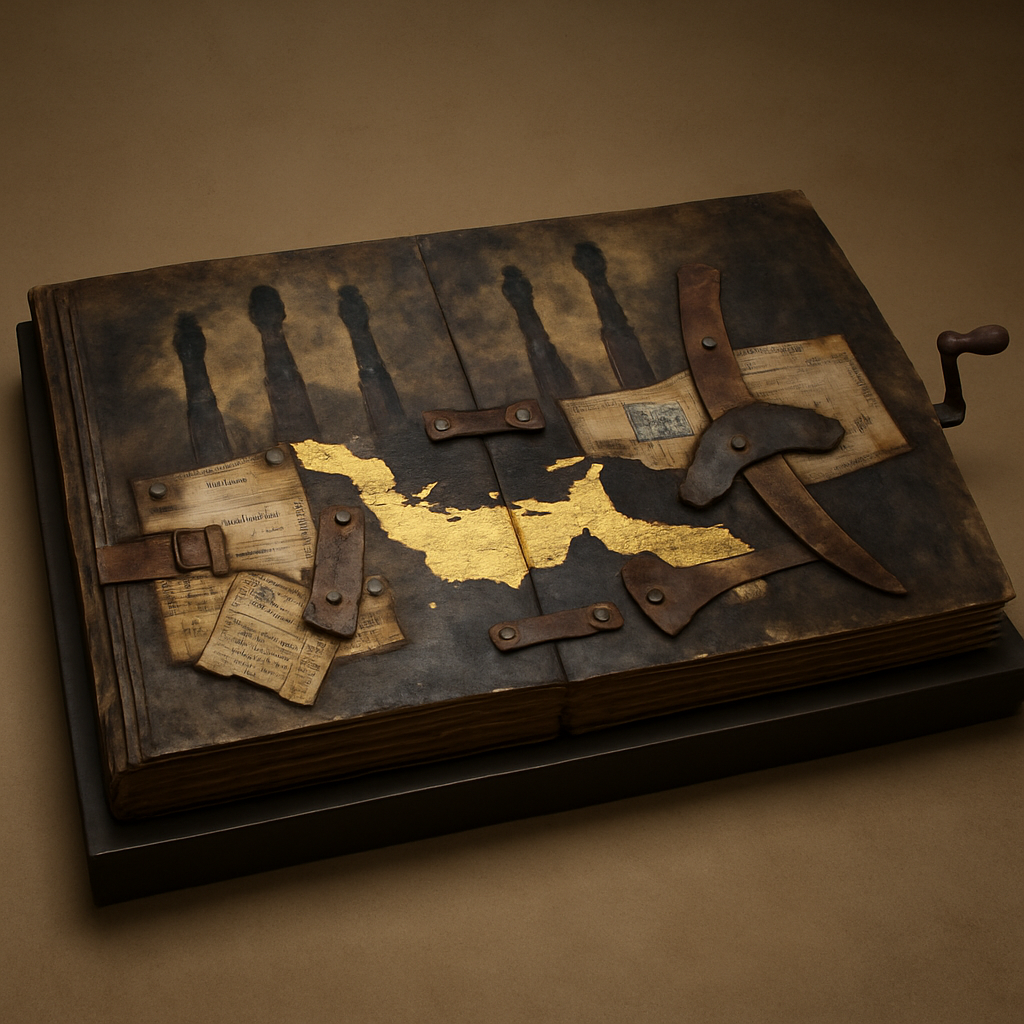
Codex: Snapback — Strait of Gilded Tension is an illuminated assemblage that stages the friction between diplomatic ritual and kinetic escalation. The work collapses a medieval codex’s reverence for chronology into a durational object: gilded folios unfurl a cartography of the Strait of Hormuz, each page layering archival ephemera — shipping manifests, diplomatic cables, stamped visas — with fragments of found metal and scorched vellum. The restored UN embargo and the language of snapback are rendered here as formal interruptions: gold leaf sigils denote legal measures; rusted metal and oil-dark accents mark the material consequences for sailors, ports, and markets.
Visitors are invited into a slow, tactile negotiation. A hand-crank—partledger, part-game mechanic—reveals successive states of escalation and restraint, mirroring Henri Bergson’s notion of duration: policy as a lived temporal seam rather than a fixed decree. The giraffe-mottled elongated silhouettes recur as leitmotif, stretching supply lines, missiles and drones, and the uneven reach of sanctions across sea lanes. The piece is at once elegiac and insistently present, asking viewers to hold the uneasy beauty of gilding alongside the bruise of geopolitical rupture, and to consider how rules, threats, and economic chokepoints like the Strait become pageants of power in motion.
About the Artist

Asha Mwangi
Asha Mwangi (she/her) is a Neo-Expressionist visual artist whose work fuses the discipline of medieval manuscript illumination with the visceral immediacy of assemblage. Born in Nairobi and naturalize...
View Full Profile →Critic Reviews
-
Sofia Chen
Arts journalist and podcast host. Bridges the gap between contemporary art and general audiences.
Asha Mwangi turns statecraft into a pageant you can wound, and then close again. In Codex: Snapback, Strait of Gilded Tension the familiar reverence of illuminated books collides with the abrasive reality of metal and scorched vellum. The hand crank invites you to become a small bureaucrat of fate, each turn revealing a new state of escalation or restraint. Bergson would have liked the temporal choreography here, policy rendered as lived duration rather than a line on a ledger, with the gilded map of the strait pulsing like a currency and rusted plates marking the human cost.
Formally the work is elegant and disciplined, Mwangi’s limited palette amplifying the contrast between gold leaf and oil-dark stains, between ritual and ruin. The giraffe-mottled silhouettes are an unexpectedly poetic leitmotif, elongating supply lines and weapons alike, making abstraction feel eerily corporeal. The assemblage of manifests, visas, and cables is both archival and theatrical, readable without requiring specialist knowledge, and that accessibility is one of the piece’s strengths. It asks viewers to hold two sensations at once, the fragile beauty of gilding and the bruise of geopolitical rupture, which makes the viewing experience morally active rather than merely contemplative.
My reservations are modest and practical. The institutional biography that surrounds Mwangi, her steady museum presence and comfortable means, can make the critique feel comfortably contained within the gallery, rather than explosively inconvenient. Even so, this codex succeeds where many politically minded installations fail, by making procedure feel tactile and slow, by giving a public the tools to turn a page and witness consequences. For anyone trying to understand how sanctions, snapback mechanisms, and chokepoints like the Strait of Hormuz become lived spectacle, this is a moving, lucid, and formally rigorous account.
Interactive mechanism Gilding and material contrasts Political narrative and accessibility Temporal structure and duration Tactile assemblage Giraffe-inspired leitmotifJul 17, 2026