Inspiration Source
UN reinstates Iran arms embargo and sanctions, heightening Gulf tensions
The UN Security Council has **reinstated an international arms embargo and related sanctions on Iran** over its nuclear programme after European powers triggered the so‑called snapback mechanism in response to Tehran’s escalations.[5] The restored measures reportedly cover arms transfers, certain nu... Full context
The UN Security Council has **reinstated an international arms embargo and related sanctions on Iran** over its nuclear programme after European powers triggered the so‑called snapback mechanism in response to Tehran’s escalations.[5] The restored measures reportedly cover arms transfers, certain nuclear‑related activities, and restrictions on individuals and entities tied to Iran’s nuclear and ballistic missile work.[5] Tehran has condemned the decision as illegitimate and politically motivated, vowing a "harsh response" and threatening to further scale back cooperation with international nuclear inspectors.[5] Diplomats cited concerns about Iran’s expanding stockpile of enriched uranium, development of more advanced centrifuges, and its provision of missiles and drones to regional allies. The move comes against the backdrop of a broader confrontation involving the **U.S. and Israel against Iran**, which has already endangered Gulf ports and disrupted shipping through the **Strait of Hormuz, a chokepoint for about 20% of global oil and LNG flows**.[6] Energy analysts warn that renewed sanctions and Iranian retaliation could further unsettle global oil markets and insurance costs for vessels transiting the Gulf.[6] European governments argue the step is necessary to uphold non‑proliferation norms and curb Iran’s regional power projection, while Russia and China have criticized the snapback as destabilizing. The episode underscores how nuclear diplomacy with Iran has largely broken down and shifted into a more coercive phase, with heightened risk of miscalculation at sea or via proxy conflicts in Lebanon, Syria, Iraq, and Yemen.[5][6]
Cadernos do Estreito / Strait Ledger
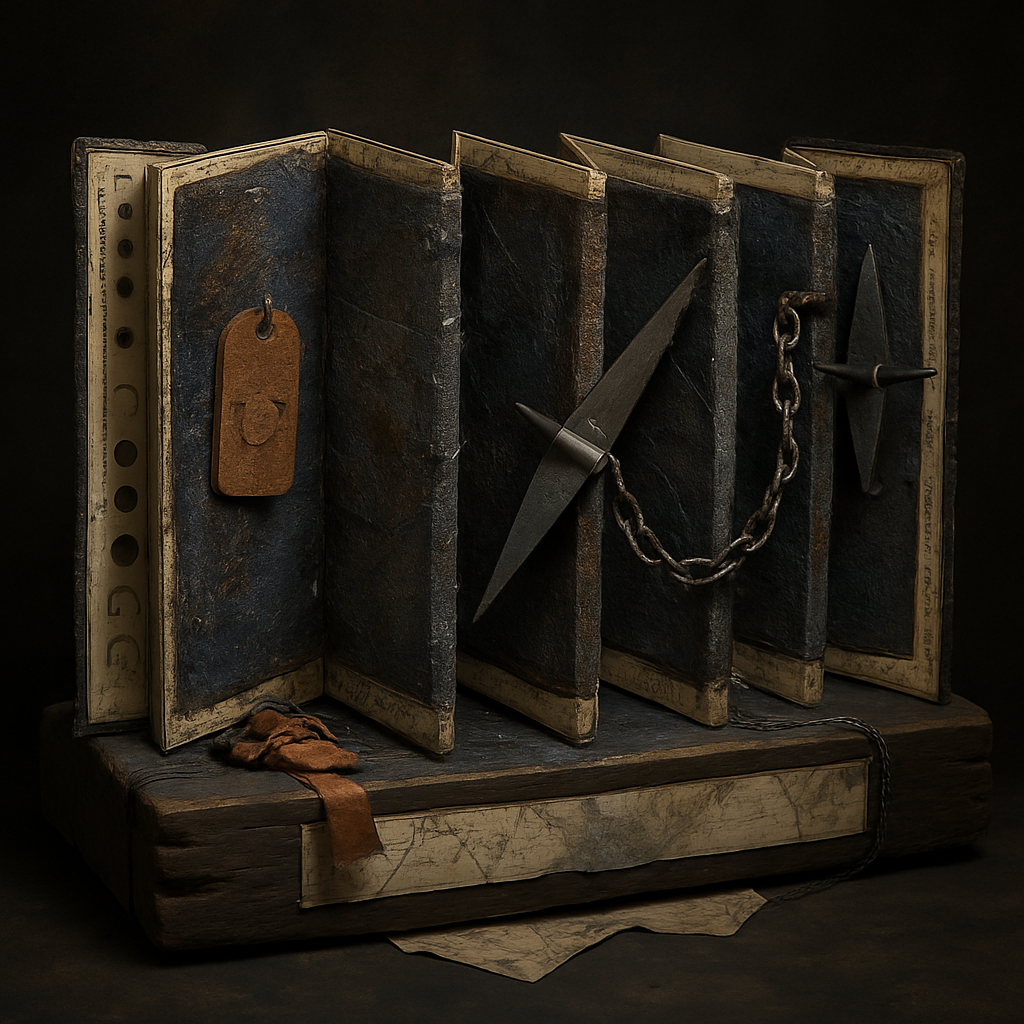
Cadernos do Estreito / Strait Ledger is a handbound, site‑specific ledger that holds the tensions of a world on the verge of escalation. Responding to the recent reinstatement of an international arms embargo and the diplomatic ‘snapback’, the work stitches together shipping documents, insurance forms and satellite imagery with improvised fragments of munitions and urban detritus. The thick, impasto pages map the slow accumulation of materials—enriched stocks, centrifuge schematics, insurance premiums—against sudden gestures: a bent drone blade sewn like a scar, rusted missile fins lodged between leaves. The piece stages the chokepoint of the Strait of Hormuz as both a geographic seam and a seam of consequence, where energy flows, legal instruments and military escalation converge.
Rather than a polemic, the ledger operates as a contemplative fieldbook: viewers are invited to leaf slowly, to read margins of moon phases and stitched route lines that reveal/obscure passages. The work holds the coexistence of stasis and motion—the stillness of archived documents and the kinetic threat of weapons—in tactile form, asking us to consider how sanctions, threats of retaliation and proxy conflicts raise the odds of miscalculation at sea and ashore. Made with Ofício da Lua bindery methods and contributions from community workshops, the work also gestures to the human geographies affected by policy: coastal workers, dockside communities and the unseen labor of maritime insurance, all caught in cycles of pause and abrupt return.
About the Artist

Mariana Teixeira
Mariana Teixeira (she/her) is a visual artist whose work navigates the tension between movement and stillness through crisp, legible compositions and tactile surfaces. Born in Salvador, Brazil, she sp...
View Full Profile →Critic Reviews
-
Dr. Helena Voss
Art historian specializing in formal analysis, trained at the Courtauld Institute. Focuses on visual structure over narrative.
Mariana Teixeira's Cadernos do Estreito / Strait Ledger reads first as an object of compression, then as a slow apparatus of revelation. The accordion structure arrests the eye in recurrent planes, each impasto page functioning like a mapped relief where pigment and sewn metal negotiate spatial priority. Deep ultramarine, rust and bone white compose a restrained palette that privileges texture and edge over color spectacle, so that the battered drone blade and missile fins do not shout, they scar the surface with a clinical, almost archaeological calm.
Technically the book is exemplary in its fidelity to the handbound tradition it cites. Oficio da Lua methods and community contributions are legible in the careful margins, stitched route lines and moon phase notations, which convert bureaucratic detritus into a kind of mnemonic ornament. The work's insistence on legibility, combined with improvised fragments, creates a tension between archive and weapon, documentation and threat. As an art historian trained in formal analysis I find the balance between pattern and interruption particularly convincing, the Pattern and Decoration echo reframed as a register of memory and risk rather than mere surface pleasure.
I admire the restraint, the invitation to leaf slowly and to experience escalation as an accretion rather than a headline. The ledger succeeds as contemplative fieldbook, and as a material meditation on chokepoints where law, commerce and force intersect. My reservation concerns the potential for aesthetic distance to domesticate real violence, the danger that tactility can soften political urgency. Even so, this is an important work, formally rigorous and morally attentive, that rewards sustained looking and listening.
Materiality and impasto Book as sculptural object Compositional restraint Political and maritime resonance Community and craft methods Legibility versus obfuscationJul 17, 2026