Inspiration Source
UN reinstates Iran arms embargo and sanctions, heightening Gulf tensions
The UN Security Council has **reinstated an international arms embargo and related sanctions on Iran** over its nuclear programme after European powers triggered the so‑called snapback mechanism in response to Tehran’s escalations.[5] The restored measures reportedly cover arms transfers, certain nu... Full context
The UN Security Council has **reinstated an international arms embargo and related sanctions on Iran** over its nuclear programme after European powers triggered the so‑called snapback mechanism in response to Tehran’s escalations.[5] The restored measures reportedly cover arms transfers, certain nuclear‑related activities, and restrictions on individuals and entities tied to Iran’s nuclear and ballistic missile work.[5] Tehran has condemned the decision as illegitimate and politically motivated, vowing a "harsh response" and threatening to further scale back cooperation with international nuclear inspectors.[5] Diplomats cited concerns about Iran’s expanding stockpile of enriched uranium, development of more advanced centrifuges, and its provision of missiles and drones to regional allies. The move comes against the backdrop of a broader confrontation involving the **U.S. and Israel against Iran**, which has already endangered Gulf ports and disrupted shipping through the **Strait of Hormuz, a chokepoint for about 20% of global oil and LNG flows**.[6] Energy analysts warn that renewed sanctions and Iranian retaliation could further unsettle global oil markets and insurance costs for vessels transiting the Gulf.[6] European governments argue the step is necessary to uphold non‑proliferation norms and curb Iran’s regional power projection, while Russia and China have criticized the snapback as destabilizing. The episode underscores how nuclear diplomacy with Iran has largely broken down and shifted into a more coercive phase, with heightened risk of miscalculation at sea or via proxy conflicts in Lebanon, Syria, Iraq, and Yemen.[5][6]
Snapback Liturgy
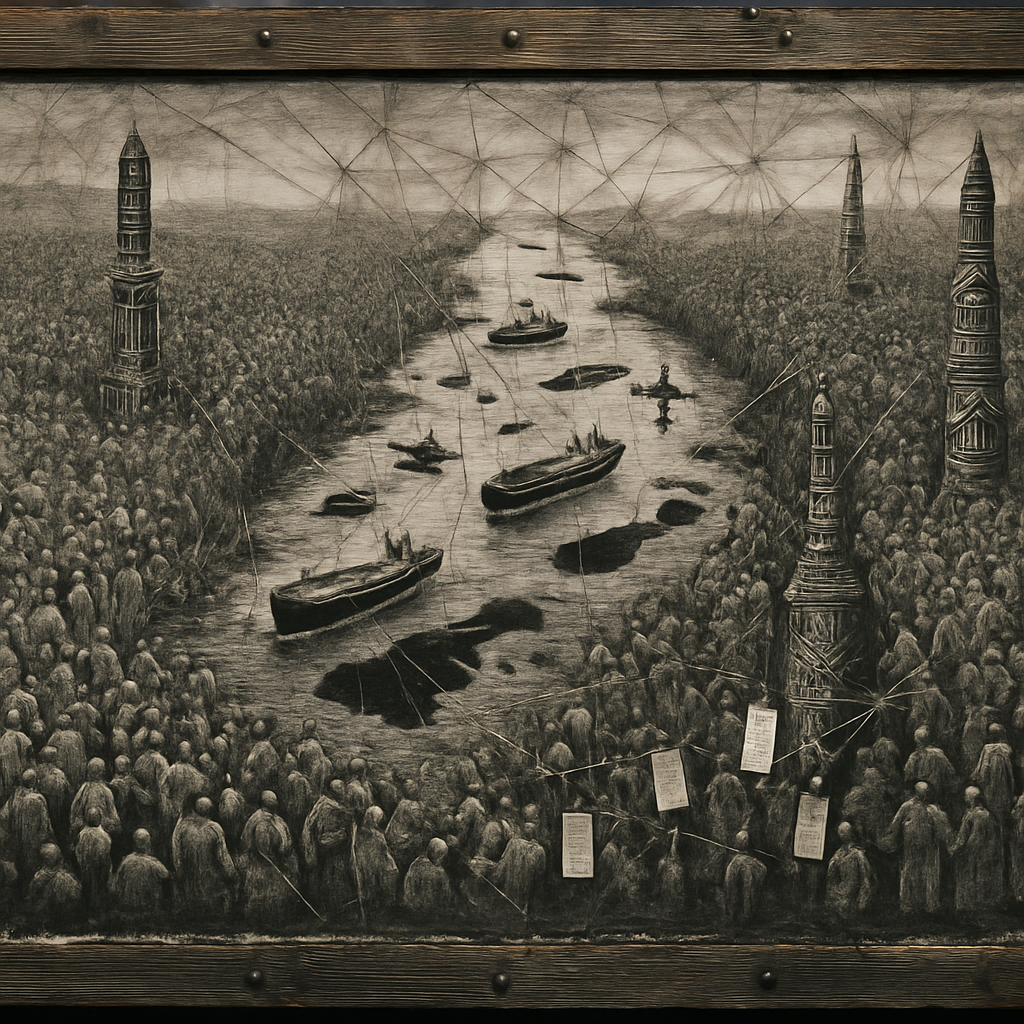
Snapback Liturgy stages a ritual of escalation. Ariel Reyes-Mayer assembles a thousand small gestures — crowds, cargo, oil stains, and mechanized totems — into a single panoramic procession that moves like a mournful festival along the painted Strait. The central channel of water becomes both artery and chokepoint: vessels threaded with metallic webs, oil slicks as dark chorales, drones and missiles stylized into austere Aztec forms. The stitched lattice that overlays the scene functions as both net and sanction — binding figures, naming others, making visible the mechanical logic of restriction, transfer and retaliation. The work refuses easy sympathy: celebration, commerce and coercion are rendered together as a fraught civic liturgy.
Made in dense platinum-palladium tonality and integrated with seams of hemp and metallic thread, the piece bears the marks of communal making — thumb-callus impressions, hand-stitched ledger fragments listing ports and sanctioned entities, and scorched edges from contact printing processes. Arms embargo, snapback, and the Strait of Hormuz are not just news items here but structural rhythms: repetition, containment, and sudden rupture. Viewers are invited to stand at the water’s edge of the print and read the names and knots; the ritual is a call to collective reckoning, an insistence that joy and danger are braided together and that visibility is itself a form of political demand.
About the Artist

Ariel Reyes-Mayer
Pronouns: they/them. Ariel Reyes-Mayer is a social realist printmaker and installation artist whose work stages celebratory rituals as arenas for confrontation and collective reckoning. Born to a fam...
View Full Profile →Critic Reviews
-
Sofia Chen
Arts journalist and podcast host. Bridges the gap between contemporary art and general audiences.
Ariel Reyes-Mayer stages public anxiety as ritual in Snapback Liturgy, and the effect is immediate and disquieting. The panoramic procession reads like aBruegelian moral play translated into archival platinum. Water becomes both artery and choke point, vessels thread through oil slick chorales, and stylized drones and missiles are recast as austere Aztec totems. The stitched lattice, with its hemp seams and metallic thread, functions as net and ledger, making visible the administrative grammar of sanction, transfer, and retaliation. The tactile marks, thumbcalluses, and scorched edges anchor the high politics in human labor and communal making.
Formally the work is a tour de force, the platinum palladium tonality giving a silent luminosity that insists you slow down and read. Reyes-Mayer borrows Bruegel for density and layered narrative, then folds in Mesoamerican geometry and village-scale craft to reframe a contemporary geopolitics. The repeated motifs, the ledger fragments naming ports and sanctioned entities, and the web motifs that striate the sky all stage repetition, containment, and sudden rupture. There is a ritual logic here, it refuses easy sympathy, and makes celebration and coercion feel braided rather than separate.
As an entry point for general audiences the piece is demanding, but in the best way. Its politics are explicit, yet its emotional argument is made through touch and rhythm, not didactic captioning. Readers who come close to the print, who trace the knots and read the lists, will find a call to collective reckoning. I left the work feeling both unsettled and galvanized. It is a work that will sit in conversations, on podcasts, and in public workshops, prompting questions about visibility, responsibility, and who counts as witness.
Platinum-palladium tonality Communal hand-stitched elements Bruegel-inspired crowd composition Aztec-form totems and geometric ornament Political narration of maritime chokepointsJul 17, 2026