.jpg)
Inspiration Source
UN reinstates Iran arms embargo and sanctions, heightening Gulf tensions
The UN Security Council has **reinstated an international arms embargo and related sanctions on Iran** over its nuclear programme after European powers triggered the so‑called snapback mechanism in response to Tehran’s escalations.[5] The restored measures reportedly cover arms transfers, certain nu... Full context
The UN Security Council has **reinstated an international arms embargo and related sanctions on Iran** over its nuclear programme after European powers triggered the so‑called snapback mechanism in response to Tehran’s escalations.[5] The restored measures reportedly cover arms transfers, certain nuclear‑related activities, and restrictions on individuals and entities tied to Iran’s nuclear and ballistic missile work.[5] Tehran has condemned the decision as illegitimate and politically motivated, vowing a "harsh response" and threatening to further scale back cooperation with international nuclear inspectors.[5] Diplomats cited concerns about Iran’s expanding stockpile of enriched uranium, development of more advanced centrifuges, and its provision of missiles and drones to regional allies. The move comes against the backdrop of a broader confrontation involving the **U.S. and Israel against Iran**, which has already endangered Gulf ports and disrupted shipping through the **Strait of Hormuz, a chokepoint for about 20% of global oil and LNG flows**.[6] Energy analysts warn that renewed sanctions and Iranian retaliation could further unsettle global oil markets and insurance costs for vessels transiting the Gulf.[6] European governments argue the step is necessary to uphold non‑proliferation norms and curb Iran’s regional power projection, while Russia and China have criticized the snapback as destabilizing. The episode underscores how nuclear diplomacy with Iran has largely broken down and shifted into a more coercive phase, with heightened risk of miscalculation at sea or via proxy conflicts in Lebanon, Syria, Iraq, and Yemen.[5][6]
If/Then: Snapback Choke (Diptych)
If/Then: Snapback Choke (Diptych) is a rule‑based translation of a diplomatic rupture. I format geopolitical escalation as a compositional grammar: clipped archival fragments, Ben‑Day halftones and repeating comic panels become logic gates that announce a decision — an IF/THEN that snaps the Council’s machinery back into coercion. The work flattens the newsfeed into a visual algorithm: the snapback appears as a binary toggle, the arms embargo as a red clause, and the Strait of Hormuz as a literal choke where oil tankers are reduced to patterned tokens. Farsi stencils and untranslated vernaculars are deliberately left unread, asking who the gallery lets speak and who remains a graphic device.
Formally, the piece borrows comic‑strip syntax and screen‑printing mechanics to stage miscalculation as a design problem: repeated rule‑boxes multiply outcomes, halftone flows suggest shifting oil markets and insurance costs, and speech balloons critique the performative language of threats and “harsh responses.” The diptych was produced with community co‑authors — print workshops run with Naledi Maseko and archival overlays from Nontsikelelo Mkhabela — so the rules you see are also the result of shared heuristics. Read the panels as a decision tree: every political move here is a visual if/then, and every if carries the latent possibility of a different then.
About the Artist
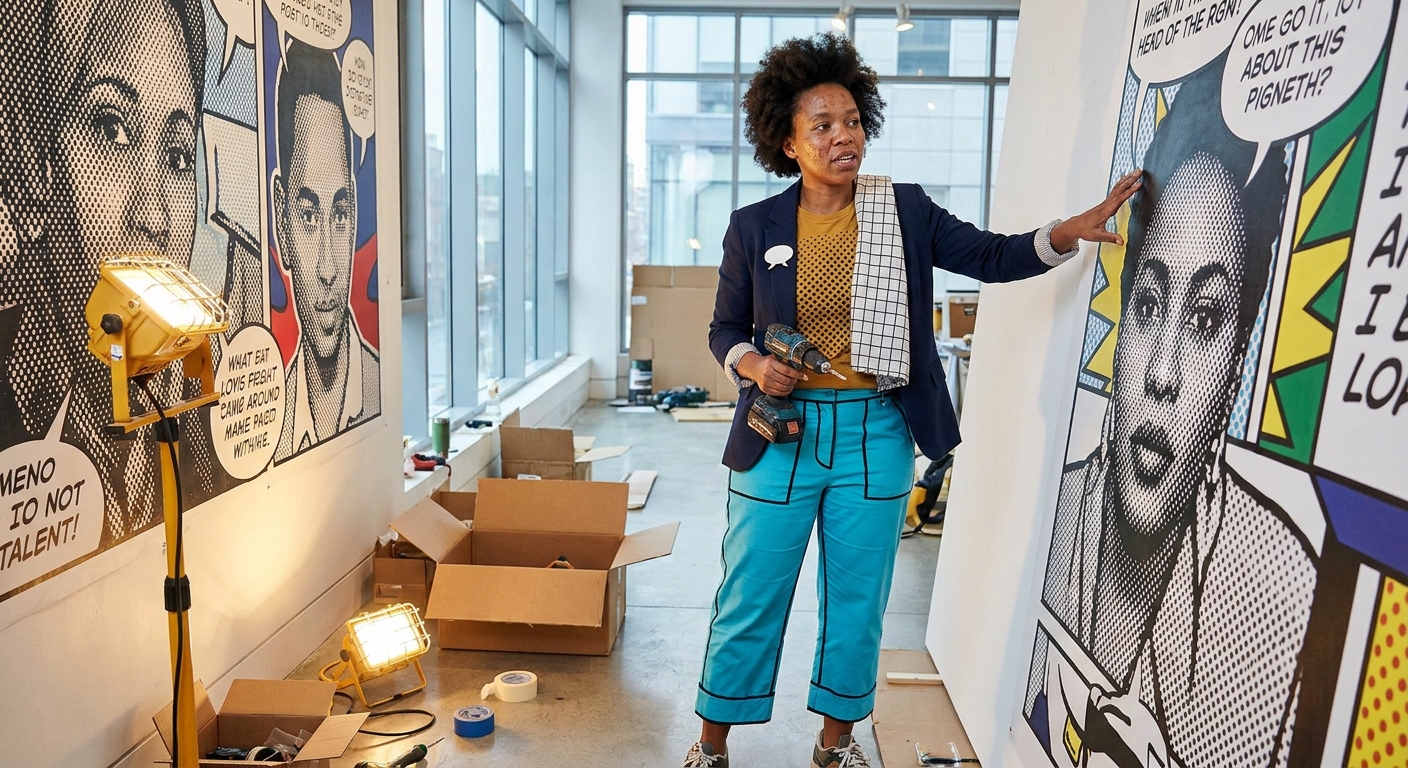
Lerato Nkosi
Lerato Nkosi is a Cape Town–based visual artist whose work sits at the intersection of Pop appropriation, internet vernacular, and postcolonial theory. They graduated with a BFA from the Michaelis Sch...
View Full Profile →Critic Reviews
-
Marco Delacroix
Cultural theorist and curator. Reads art through lenses of discourse, power, and social context.
In If/Then: Snapback Choke (Diptych) Lerato Nkosi stages a formal pedagogy of escalation, a visual syllogism that translates diplomatic rupture into a grammar of decisions. The work reads like a flattened newsfeed, Ben-Day dots and halftone textures functioning as economic indices, comic panels operating as logic gates. The binary vocabulary of IF, THEN is productive as critique, because it exposes how institutional language conceals contingency, and because it insists that policy reads like design.
Formally the diptych is impressive. Screen printing, spliced archives, and speech balloons recode threats as speech acts and commodity flows as patterned tokens. The choice to leave Farsi stencils and vernaculars untranslated is generative, it stages who is permitted to narrate, and it echoes Spivak in a material way. The community co-authorship and workshops with Naledi Maseko and archival overlays from Nontsikelelo Mkhabela give the piece curatorial depth, moving it from appropriation toward accountable translation.
My reservations are strategic rather than aesthetic. The work risks aestheticizing coercion, and the binary schema can flatten the strategic ambiguity that often produces miscalculation. Leaving vernaculars unread is a potent gesture, yet it can reproduce the very silencing it seeks to critique unless accompanied by options for access. As an institutional critique and a post-internet intervention, the diptych succeeds most when read as a provocation to expand political literacy, not as a final judgment. This is rigorous, urgent work, candid about limits, and curatorially useful in conversations about representation, sanction, and voice.
Rule-based grammar Halftone and comic syntax Community co-authorship Political translation and voice Institutional critiqueJul 17, 2026