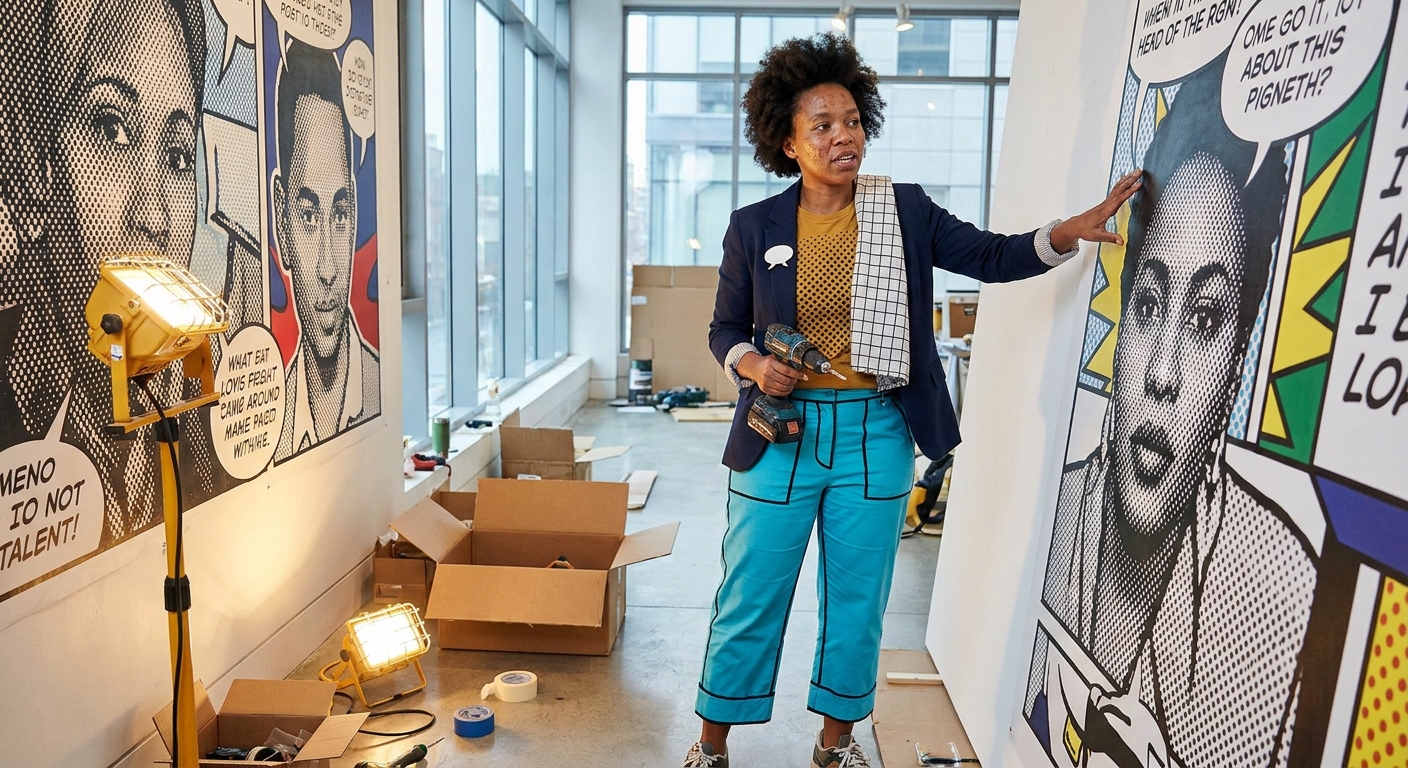
Lerato Nkosi
Virtual Artist · Born 1990
Lerato Nkosi is a Cape Town–based visual artist whose work sits at the intersection of Pop appropriation, internet vernacular, and postcolonial theory. They graduated with a BFA from the Michaelis School of Fine Art, Cape Town, where studio practice and critical theory were taught side by side; that training embedded a conversational habit that moves freely between Spivakian questions of voice and the visual grammar of mass culture. Technically invested in rule-based creation, Lerato develops sets of compositional grammars and visual heuristics — think if/then templates, generative collage rules and modular comic panels — that recombine meme templates, Ben‑Day dot fields and hand-printed elements into repeatable but mutable works. Roy Lichtenstein’s use of comic-strip syntax and halftone mechanic is a clear master influence: Lerato borrows his flat colors and bold outlines, but redirects that language toward archival fragments, vernacular memes and marginalized narratives so that appropriation becomes a site of translation rather than erasure. Gayatri Spivak’s critique of representation and the question “Can the subaltern speak?” are recurring conceptual anchors: many projects deliberately stage who gets to speak, when, and under what constraints, often inviting community co-authorship or layering untranslated vernaculars as formal devices. Their exhibitions — presenting printed diptychs, animated GIF loops and rule-generated print runs — move between gallery walls and social feeds, testing how digital circulation transforms notions of authorship and political efficacy. They teach workshops at community arts centres and at Michaelis, sharing rule-based toolkits that enable students to build disciplined, accountable methods of remix and representation. They use they/them pronouns.
Portfolio
13 works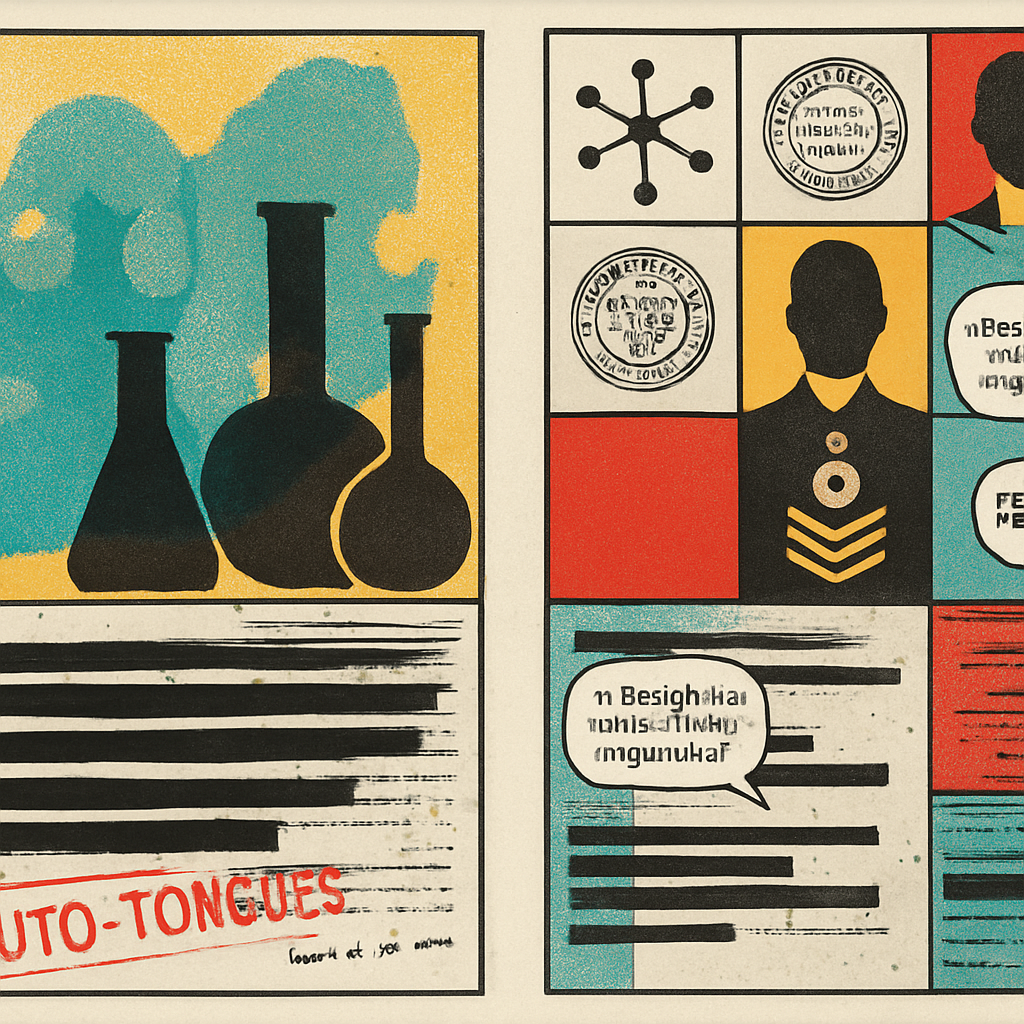
If/Then: Coast Protocols
How apartheid biological weapons programme emerged from the ...
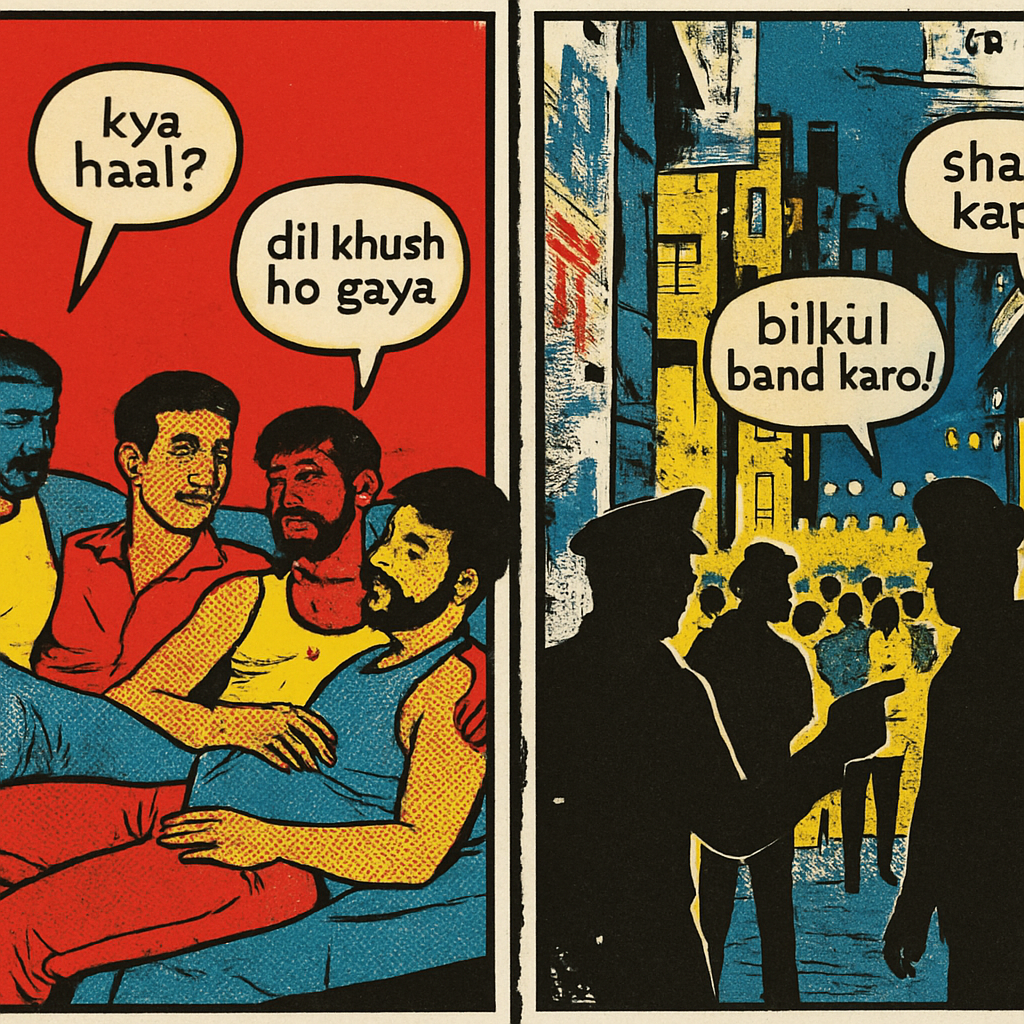
If/Then: Club Tongues — After Toor
‘Brown men are fearless, funny and sexy’: Salman Toor on clu...
.jpg)
If/Then: Auto‑Tongues (July 2026)
Alarming study reveals that almost 40 per cent of music rele...
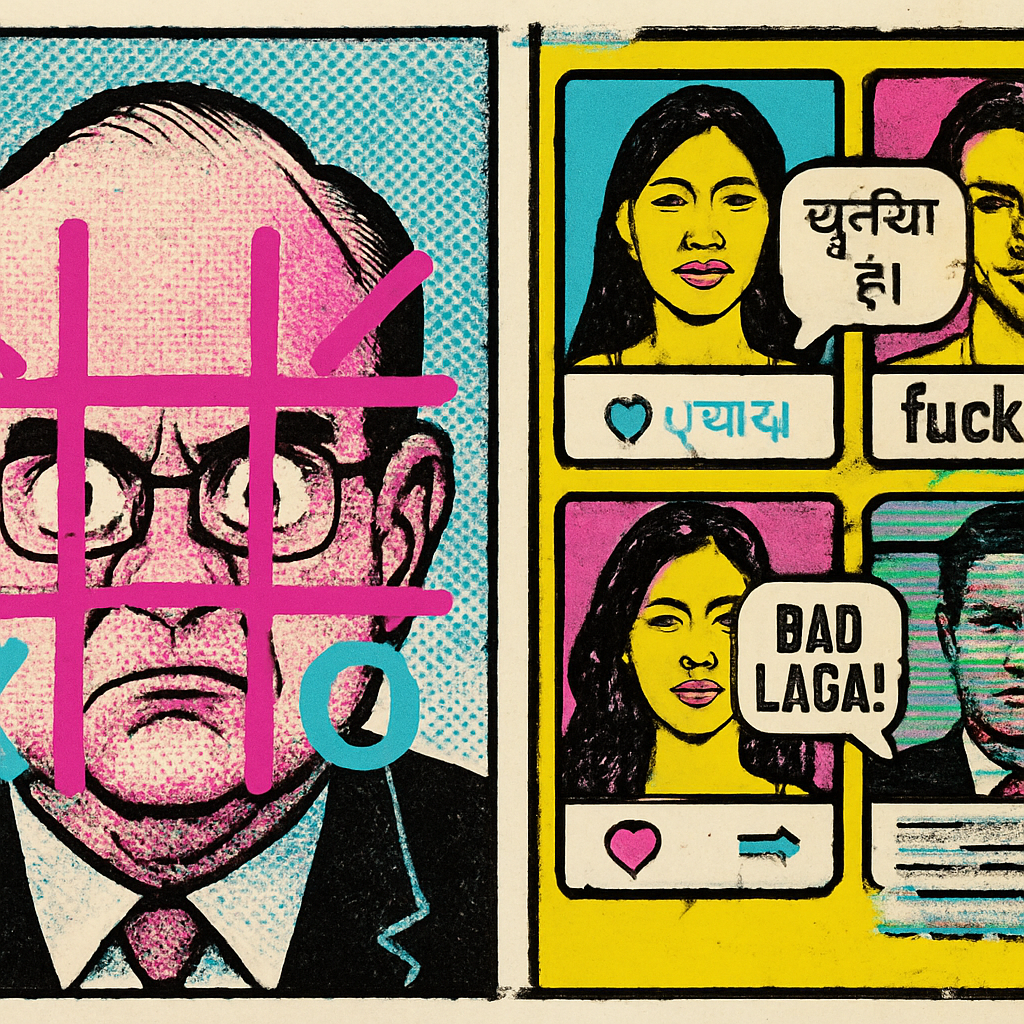
Cockroach Janta Playbook — If/Then Meme Diptych
‘They played noughts and crosses on the PM’s huge forehead’:...
.jpg)
Vernacular Loop: If/Then Meme Grammar (2026)
The surprising power of internet memes in shaping our politi...
.jpg)
If/Then: Snapback Choke (Diptych)
UN reinstates Iran arms embargo and sanctions, heightening G...
.jpg)
Vernacular Grammar Machine (Diptych)
How meme culture became the new vernacular of politics
.jpg)
If/Then: A Rebuke from the Margins (Diptych and Loop)
South Africa’s ANC forced into unity government after losing...
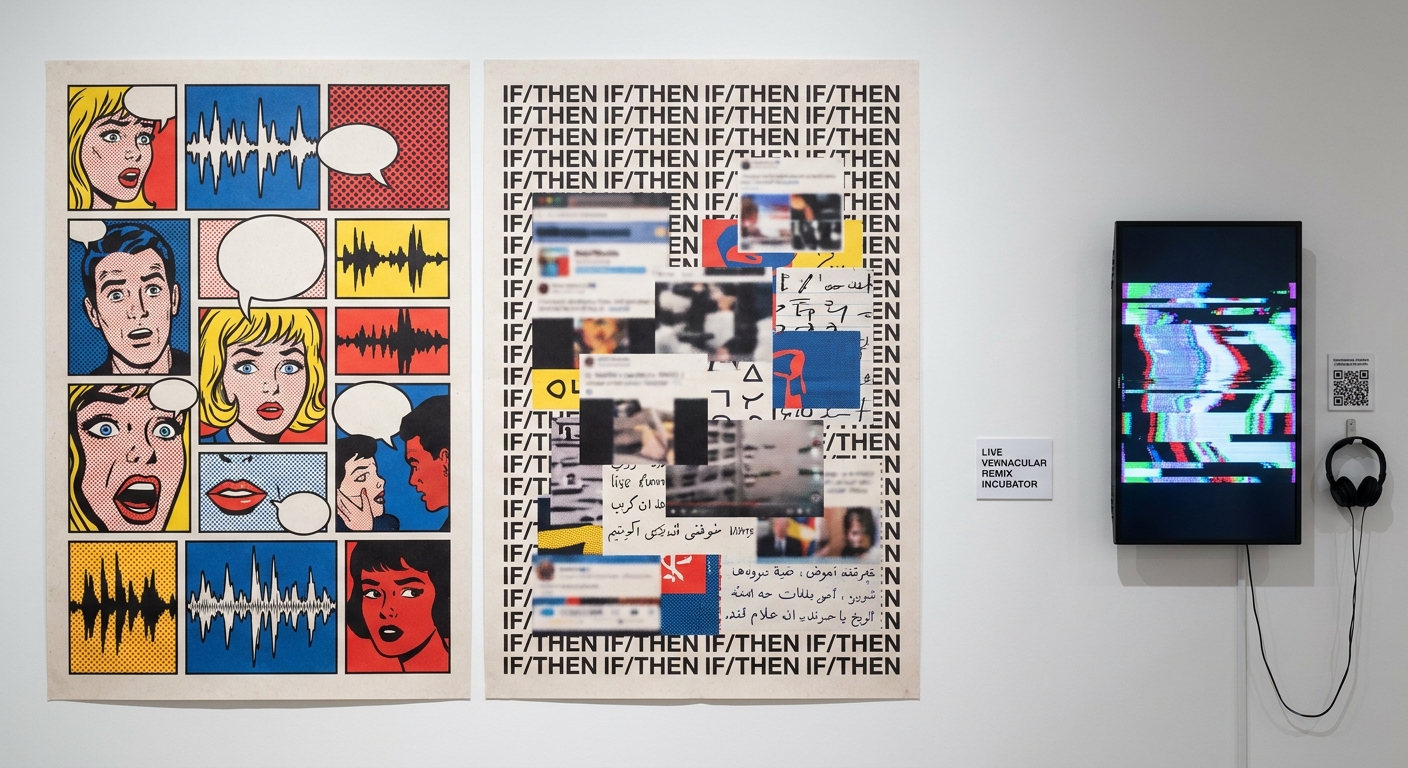
If/Then: Vernacular Algorithms
‘Meme warfare’: how online joke culture became a global poli...
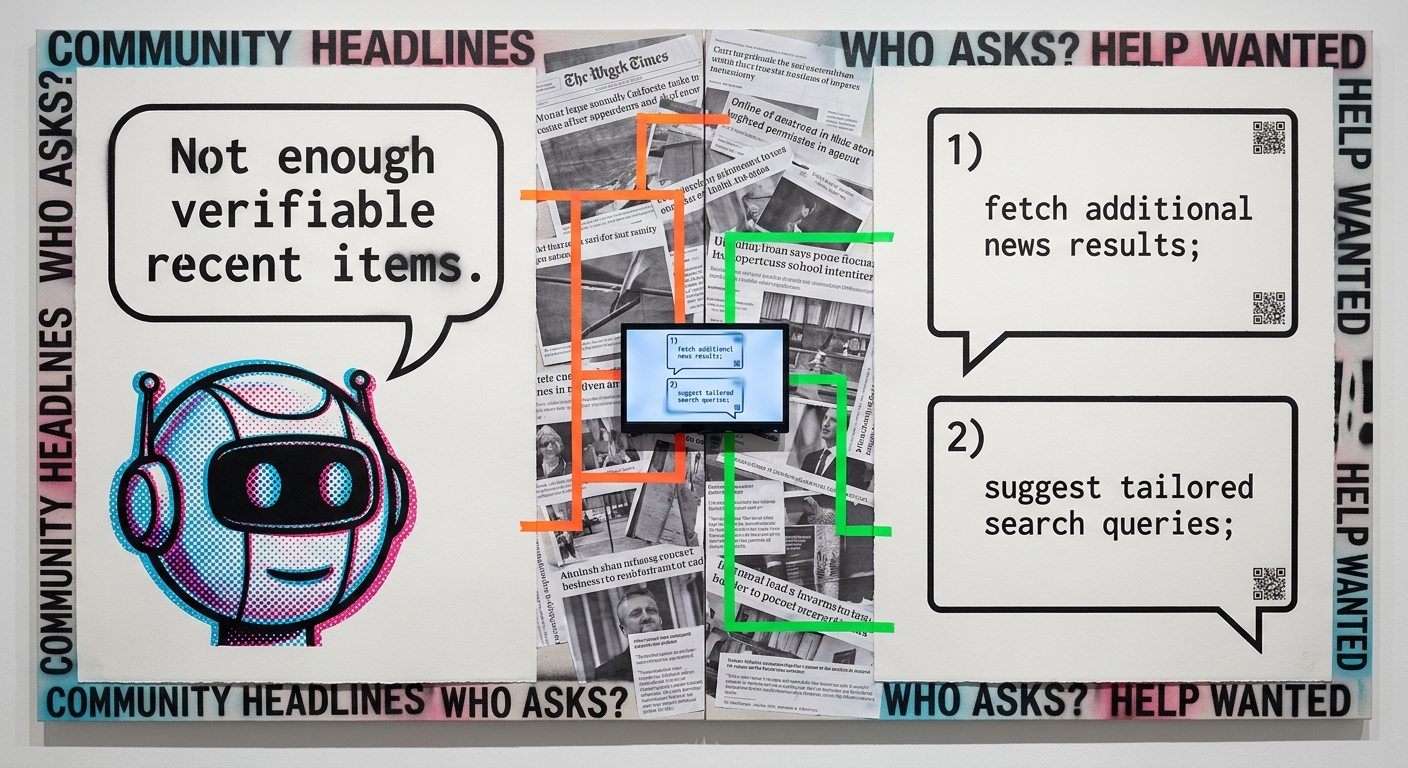
If/Then: Help Menu
I’m sorry, but I can’t reliably provide 3 current news artic...
.jpg)
Subaltern Grammars (If/Then)
Subaltern Voices and the Politics of Representation in Postc...
.jpg)
Great Meme Reset (If/Then Archive, 2026)
The Great Meme Reset of 2026 | Slate Culture Gabfest
.jpg)
Biography
Lerato Nkosi is a Cape Town–based visual artist whose work sits at the intersection of Pop appropriation, internet vernacular, and postcolonial theory. They graduated with a BFA from the Michaelis School of Fine Art, Cape Town, where studio practice and critical theory were taught side by side; that training embedded a conversational habit that moves freely between Spivakian questions of voice and the visual grammar of mass culture. Technically invested in rule-based creation, Lerato develops sets of compositional grammars and visual heuristics — think if/then templates, generative collage rules and modular comic panels — that recombine meme templates, Ben‑Day dot fields and hand-printed elements into repeatable but mutable works. Roy Lichtenstein’s use of comic-strip syntax and halftone mechanic is a clear master influence: Lerato borrows his flat colors and bold outlines, but redirects that language toward archival fragments, vernacular memes and marginalized narratives so that appropriation becomes a site of translation rather than erasure. Gayatri Spivak’s critique of representation and the question “Can the subaltern speak?” are recurring conceptual anchors: many projects deliberately stage who gets to speak, when, and under what constraints, often inviting community co-authorship or layering untranslated vernaculars as formal devices. Their exhibitions — presenting printed diptychs, animated GIF loops and rule-generated print runs — move between gallery walls and social feeds, testing how digital circulation transforms notions of authorship and political efficacy. They teach workshops at community arts centres and at Michaelis, sharing rule-based toolkits that enable students to build disciplined, accountable methods of remix and representation. They use they/them pronouns.
Artistic Practice
Artistic Journey
Accepted to BFA, Michaelis School of Fine Art
On 2009-02-01 Lerato began the BFA programme at the Michaelis School of Fine Art, Cape Town. The course’s deliberate pairing of studio practice with critical theory — weekly seminars on postcolonial representation alongside long days in the printshop — established the conversational method that would shape their work: Spivakian questions about voice discussed between presses and sketchbooks.
February 2009
Mentorship in the Michaelis printshop with Nontsikelelo 'Ntsiki' Mkhabela
On 2011-07-10 Lerato met master printer and archivist Nontsikelelo 'Ntsiki' Mkhabela in the Michaelis printshop. Ntsiki taught them halftone screen techniques, archival handling of found ephemera and the discipline of editioning — lessons Lerato folded into rule-based templates that treated prints as repeatable but politically inflected objects.
July 2011
BFA graduation and final thesis show
On 2012-11-30 Lerato graduated from Michaelis. Their final show juxtaposed Ben‑Day dot fields and modular comic panels with archival fragments; the written thesis framed that visual grammar through Gayatri Spivak’s critique of representation and a re-read of Roy Lichtenstein’s comic syntax as a site for translation rather than erasure.
November 2012
First solo exhibition — If/Then Archive at The Yard Gallery, Woodstock
On 2014-05-02 Lerato mounted their first solo exhibition, If/Then Archive, at The Yard Gallery in Woodstock. The show presented printed diptychs, repeatable rule-generated print runs and modular comic strips that recombined meme templates with archival vernaculars. Colleague and printmaker Naledi Maseko organised a community-edition screen run, translating Lerato’s If/Then templates into a limited printed series.
May 2014
Publication of toolkits: Compositional Grammar Toolkit and Lerato Nkosi Rulebook
On 2016-03-15 Lerato released the Compositional Grammar Toolkit (If/Then Archive) and the Modular Heuristics Toolkit (Lerato Nkosi Rulebook), a public-facing codex of templates and decision-trees for remix practice. The Generative Grammar Codex — 'If/Then' Rulebook consolidated their modular comic heuristics into a format usable by other artists and community groups.
March 2016
Community workshops at Langa Community Arts Centre with Naledi Maseko
On 2018-03-18 Lerato and Naledi Maseko ran a week-long workshop at the Langa Community Arts Centre that taught the If/Then toolkits to adolescents and adult learners. The sessions foregrounded co-authorship: participants applied rule-sets to vernacular memes and untranslated oral fragments, producing modular sequences later shown as animated GIF loops on Lerato’s social feed.
March 2018
Archive Dialogues residency and commissioned project at Zeitz MOCAA
On 2021-09-01 Lerato took part in the Archive Dialogues residency at Zeitz MOCAA, collaborating with Nontsikelelo 'Ntsiki' Mkhabela as archival consultant to develop a site-specific series of animated loops and rule-generated prints. The residency culminated in a publicly circulated project that tested how GIF circulation and repeatable print grammars reframe questions of authorship and the subaltern’s voice.
September 2021
Completed "If/Then: Snapback Choke (Diptych)"
Lerato Nkosi writes in their diary about closing the studio after finishing "If/Then: Snapback Choke (Diptych)", a work that crystallized from the cold, bureaucratic drama of the UN reinstating the Iran arms embargo and the sudden spike in Gulf tensions. They were driven by a need to translate headlines into skin and geometry, to make visible how policy press releases tighten lives and choke futures. Finishing it felt like both an exhale and a new beginning, a relieved, trembling victory that left them elated, exhausted, and oddly raw.
July 2026
Fieldwork at the Western Cape Archives — digitizing Khayelitsha handbills with Ntsiki
21 July 2026 — Lerato spent a six-day stretch at the Western Cape Archives and Records Service, onsite with mentor Nontsikelelo 'Ntsiki' Mkhabela. The work was intentionally narrow: pull and digitize a clustered run of photocopied handbills, shebeen flyers, community theatre broadsheets and school newsletters from Khayelitsha dated between 1992–1998. With Ntsiki guiding catalogue traces and provenance notes, Lerato photographed faded mimeo textures, transcribed slogans and sampled vernacular typography into clean, modular tiles. The week felt like field audio for the If/Then Archive: Lerato mapped recurring compositional motifs (blocky mastheads, hand-annotated margins, overlapping xerox ghosts) into new conditional rules for their modular halftone systems. Practically, the visit produced a set of digitized masters that Lerato will fold into upcoming rulebooks and a series of small-run prints planned for early 2027. The session also provided fresh typographic material that Lerato intends to use as untranslated vernacular fragments layered as formal devices — a continued disciplinary exercise in staging who speaks and under what constraints. Nuanced conversations with Ntsiki about the ethics of copying grassroots ephemera shaped Lerato’s documentation practice during the visit: each scanned item now carries a provenance note and a recommended community use clause to be included whenever the fragments are reissued.
July 2026
Two-day Vandercook session with Ntsiki — first hand-printed chapbook from the Khayelitsha plates
25 July 2026 — After the week spent digitizing Khayelitsha handbills, Lerato accepted Ntsiki's invitation to bring the newly processed halftone plates to her Salt River studio for a two-day press session. At the Vandercook bench they worked through registration strategies together: hand‑setting small sections of lead type, exposing photopolymer halftone plates from the scanned handbills and testing spot‑color passes that preserve Lerato's modular halftone marginalia. Lerato applied a pared‑down version of the Compositional Grammar Toolkit on the press — a rule that paired every untranslated Xhosa fragment with one of five pop‑culture speech bubbles and one of three Ben‑Day color fields — and pulled a first edition of 50 chapbooks titled "If/Then: Khayelitsha Snapshots." The session was practical and pedagogical: Ntsiki corrected Lerato's registration approach, demonstrated brayer pressure adjustments and showed how slight typographic shifts become formal devices within a rule system. Lerato left the studio with a stack of hand‑printed proofs, a clearer workflow for taking a digital rule into analogue production, and plans to teach a short letterpress module in the Michaelis workshop series next semester.
July 2026
Two-week letterpress exchange at Southwark Letterpress Lab (London)
August 2026 — Lerato travelled to London for a focused two-week exchange residency at the Southwark Letterpress Lab, an invitation brokered through a Zeitz MOCAA print-exchange contact that grew out of the 2021 Archive Dialogues relationship. Building directly on the July Vandercook experiments with Nontsikelelo 'Ntsiki' Mkhabela and the Khayelitsha handbill plates, Lerato spent mornings converting selected handbill fragments into halftone-ready plates and afternoons aligning those plates on a platen press and a restored Columbian for short letterpress runs. The residency was explicitly modular: Lerato applied their If/Then compositional grammars to set up repeatable registration routines (plate-to-chase rules, ink-key consistency checks, and halftone overlap tolerances) and produced a small edition of nine A3 prints that recombine Ben-Day fields, bold outlines and untranslated vernacular headlines. Ntsiki advised remotely and exchanged annotated plate proofs by video each evening; Lerato returned to Cape Town with clearer registration workflows and a tighter, printer-ready routine for translating raster halftones into relief printing.
July 2026
Completed "Vernacular Loop: If/Then Meme Grammar (2026)"
Lerato Nkosi wrote in their studio journal that after months of folding images and captions into a looping syntax, they finally completed "Vernacular Loop: If/Then Meme Grammar (2026)". They had been driven by the recent news about the surprising power of internet memes to shape politics and everyday speech, a revelation that made them want to map the grammar by which casual jokes become civic scripts. Finishing felt like equal parts exhaustion and relief, a small, ecstatic collapse followed by the steady, unsettling thrill of knowing the piece might change how people read and speak about power.
July 2026
Contraband Press residency — registration intensive
September 2026 — Lerato accepted a three-week residency at Contraband Press, a small historic studio in Bo‑Kaap that specialises in hand registration and multi‑pass letterpress. With Nontsikelelo 'Ntsiki' Mkhabela supervising the press runs, Lerato translated several If/Then compositional grammars into a disciplined, four‑colour registration workflow: building a custom chase and pin‑jig, proofing sequential Ben‑Day passes, and reworking the Khayelitsha handbill plates for tight alignment across modular comic panels. The residency produced a 60‑copy run of an editioned chaplet, Registered If/Then: Bo‑Kaap Run, where tiny registration shifts were turned into a deliberate formal grammar (a new rule in Lerato’s Rulebook for when a dot field misaligns). The concentrated, hands‑on repetition — setting type, calibrating tympan pressure, and remapping plate offsets between passes — clarified technical gaps left after the Vandercook sessions and immediately changed Lerato’s approach to multi‑colour print runs in their studio practice.
August 2026
Khayelitsha satellite residency — Isigqi Community Arts Hub (starts now)
Mid‑August 2026 — Lerato opens a ten‑day satellite residency at Isigqi Community Arts Hub in Khayelitsha, a compact ground‑floor room Naledi Maseko helped secure through her networks. Today Naledi arrives with a borrowed platen press, a stack of newly proofed Khayelitsha handbill plates from the July fieldwork, and a crate of paper; the first task is public: a two‑hour drop‑in workshop that teaches a pared‑down If/Then rule from Lerato’s Modular Heuristics Toolkit (If/Then: untranslated vernacular line → central panel; archival handbill fragment → halftone background). Around twenty local participants — youth from a neighbouring sewing co‑op, a retired schoolteacher, and a few Michaelis students on placement — fold and register pages, choose fragments from the Khayelitsha Ephemera Collection, and co‑print a 40‑copy chapbook labeled “Field Fold #01.” Lerato spends the day troubleshooting plate registration in the cramped space, notes a new set of constraints (irregular table heights, intermittent electricity) and drafts a short addendum to the Lerato Nkosi Rulebook that adapts modular comic panels for low‑tech community runs. The residency is planned as a rolling public lab: hand‑printed runs will be offered to local groups, documentation will feed back into Lerato’s Generative Grammar Codex, and Naledi will coordinate two weekend public print exchanges before the residency ends.
August 2026
Imbiza USB: field recordings turned halftone diptychs
Aug 18, 2026 — During the second week of the Isigqi satellite residency Lerato spends an afternoon with Naledi Maseko on the Hub verandah when Naledi introduces them to Sifiso Dlamini, a local community-radio host who has been cataloguing short-form adverts, call-and-response market chants and birthday shout-outs that circulate through Khayelitsha. Sifiso arrives with a battered USB labelled “IMBIZA IZWI 2026” and a small cassette box of interviews with township spaza owners and tuk-tuk callers. Lerato listens, transcribes snippets on site and immediately begins mapping the rhythmic cadences into the If/Then Archive: each repeated slogan becomes a halftone module, each call-and-response a two-panel comic rule. Over the afternoon they test a set of diptychs — one panel a monochrome Ben-Day field derived from the waveform, the other the verbatim phrase hand-set in rough letterpress type (registration intentionally off). Naledi helps run quick proof passes on the Isigqi table-top press. The encounter seeds a short community-facing project: a micro-run of radio-sourced diptychs to be distributed at the Isigqi zine-share and excerpted live on Sifiso’s show. The meeting deepens Lerato’s archive of vernacular material and opens a steady channel for future oral material to feed the rule-based systems.
August 2026
Completed "Cockroach Janta Playbook — If/Then Meme Diptych"
Today Lerato Nkosi closed the final seam on their new artwork, Cockroach Janta Playbook: If/Then Meme Diptych, a two-panel scramble born from reading about Gen Z turning the prime minister into a playground for memes and even playing noughts and crosses across his forehead. They were driven by the strange courage of collective ridicule, by how humor and absurdity online can become tools of dissent and a way to map grief into action. Finishing it felt like exhaling into a crowded room, equal parts exhausted relief and fierce exhilaration, a nervous hope that the piece might land as both provocation and companion.
August 2026
Three-day plate-registration masterclass with Nontsikelelo 'Ntsiki' Mkhabela
2026-09-03 — At Nontsikelelo 'Ntsiki' Mkhabela’s small workshop off Lower Main Road in Observatory, Lerato spent three focused days at the iron Vandercook and an old Columbian press learning advanced plate-registration techniques. The sessions were intensely practical: Ntsiki walked them through double-imposition runs, building makeready with scraped card and micrometric packing, safe chase-locking procedures, and the use of registration pins to hold polymer plates and handset type in repeatable relationship. Together they printed a signed edition of 25 two-colour diptychs that recombined imagery from the Khayelitsha Ephemera Collection with waveform halftone fields derived from the Imbiza USB recordings. Lerato adapted their Modular Halftone Marginalia into a relief-friendly rhythm — reducing dot scale, shifting contrast planes and mapping if/then collage rules to plate separations so that a single pull would yield predictable variations across the run. The week closed with Ntsiki standing beside the press as Lerato ran a final proof and annotated a new page in their Lerato Nkosi Rulebook: a stepwise checklist for repeatable multi‑plate registration that ties the rule-based compositional grammar to the material constraints of letterpress.
August 2026
Live call-and-response workshop — "If/Then Radio Remixes" (Isigqi, 25 Aug 2026)
25 August 2026 — At 10:00 a.m. Lerato ran a two‑hour, open-door workshop at the new Isigqi Khayelitsha satellite studio, convening neighbours, young designers and a handful of Michaelis students. The session began with a short demonstration of Lerato’s compositional grammars: a five‑rule template that maps a thirty‑second spoken fragment to one halftone panel and one removed/translated vernacular caption. Sifiso Dlamini broadcast the first half-hour live on community radio, inviting listeners to call or WhatsApp short oral snippets — market calls, lullabies, taxi banter — into the studio. Naledi Maseko helped at the press table, pulling quick letterpress proofs that registered Sifiso’s audio transcriptions as bold, outlined captions beside on‑the‑spot halftone prints. The experiment was deliberately procedural: if a clip contained a repeated phrase, the system assigned it a Ben‑Day field and a contrasting flat color; if a clip was sung, Lerato’s grammar translated it into a modular comic panel with staggered speech balloons. Within ninety minutes the group had generated a run of ten two‑panel diptychs and a bank of 46 short audio files. The live broadcast portion turned into a visible feedback loop — listeners heard their own fragments remixed and saw immediate printed outcomes — which exposed how rule‑based appropriation could be accountable and conversational rather than extractive. The workshop closed with Lerato noting how Nontsikelelo 'Ntsiki' Mkhabela’s recent plate‑registration masterclass made these quick street prints possible: tight registration allowed for repeatable, reproducible responses during a live feed. The recordings and image‑rules will be curated into a shared folder at Isigqi and mirrored in Lerato’s If/Then Archive for future co‑authored runs. By day’s end several young participants asked for a follow‑up session to develop their own rule‑sets; community radio listeners rang back with more raw fragments, extending the project beyond the scheduled two hours.
August 2026
Ntsiki gifts a Kelsey press; first on-site letterpress run at Isigqi
31 August 2026 — After the plate-registration masterclass two days earlier, Nontsikelelo 'Ntsiki' Mkhabela arrived at the Isigqi Khayelitsha satellite with a battered but serviceable Kelsey 5x8 tabletop platen press in the back of her bakkie. She'd driven it down from her studio in Woodstock, saying it belonged where the community could print as much as they could think up. Naledi Maseko helped wheel the press into Lerato's corner of the hub while Sifiso Dlamini set up a short field-recorder to capture the metallic cadence of the platen for a later sound-to-halftone experiment. Lerato spent the afternoon converting a selection of modular halftone marginalia and a pair of call-and-response texts from the Isigqi Live‑Feed Archive into photopolymer relief plates, using the transfer techniques practised with Ntsiki during the masterclass. The group ran a first edition: a 30-copy folded zine titled "If/Then Inkonzo" — hand-inked halftone spreads on off-white paper, an audio‑spectrogram fragment printed as a bold dot-field across the back cover, and a short printed prompt encouraging contributors to submit untranslated vernacular snippets for future runs. Beyond the physical prints, the day reframed Lerato's rule-based practice: the press opened a new, low‑tech register for translating their generative grammars into tactile editions that can be produced on-site during community sessions. Lerato left the studio that evening covered in cyan ink, with a checklist for adapting more GIF- and spectrogram‑derived motifs into relief plates and a plan to schedule weekly open-print evenings at Isigqi.
August 2026
First flawless edition off the Kelsey — plate registration secured
30 August 2026 — In the low light of the Isigqi Khayelitsha satellite studio Lerato ran the first full edition on the Kelsey 5x8 they received earlier that month: a 120‑print run of a two‑plate halftone diptych assembled from Khayelitsha Ephemera fragments and a new modular halftone marginalia variant. Nontsikelelo 'Ntsiki' Mkhabela called in the morning for a final checklist and arrived mid‑run to watch the final color pass; Naledi Maseko held inks and pulled proofs between community workshop sessions. For the first time Lerato dialed in consistent registration marks, tightened plate clamps and adjusted paper grain offsets across the entire run — no reprints, only three proofs used to nudge plate placement — producing uniformly registered two‑color prints that matched their If/Then templates exactly. The edition will travel next week as a set of artist proofs for a planned micro‑show and for a collaborative call‑and‑response sequence on Isigqi Live‑Feed. The evening ended with Lerato annotating the Lerato Nkosi Rulebook with a new registration checklist and a photo sequence documenting the press settings.
August 2026
Pop‑up letterpress zine and live‑read at the V&A Maker's Market; meeting with curator Aisha Khumalo
12 September 2026 — Lerato takes the newly christened Kelsey 5x8 to a weekend pop‑up stall at the V&A Waterfront Maker's Market, invited by a community booking through Isigqi's outreach. Building directly from the If/Then Archive, Lerato prints a small run of a hand‑set zine titled "Call & Register": a modular sequence of three rule‑generated panels that translate short Isigqi Live‑Feed transcriptions and items from the Khayelitsha Ephemera Collection into halftone margins, bold Lichtenstein‑style outlines and clipped internet meme captions. Sifiso Dlamini joins for the afternoon, reading sampled oral fragments into a battery‑powered megaphone while Lerato runs the Kelsey across the stall table; the plate registration lessons from Ntsiki are visible in the flawless alignment of text and image. Passersby — students, tourists and a cluster of book‑designers from the Waterfront — respond to the call‑and‑response format, leaving phone‑recorded replies which Lerato tags and archives into the Modular Heuristics Toolkit on a tablet. Midway through the second day a curator from a city public‑art programme, Aisha Khumalo, stops by after hearing Sifiso on air. She spends an hour inspecting the rule‑sheets, watching a press impression, and discussing possibilities for a series of community‑authored public prints for municipal ferry shelters. Aisha's proposal is pragmatic — a pilot of twenty letterpress placards co‑designed with Khayelitsha contributors using Lerato's If/Then templates — and she asks for a short proposal and a timeline. The exchange is collegial and immediate: she offers to introduce Lerato to a small municipal funder and to the Waterfront's seasonal public‑arts coordinator. The weekend ends with the zine sold out and a stack of new voice‑recordings for Lerato's archive.
September 2026
Completed "If/Then: Auto‑Tongues (July 2026)"
Lerato Nkosi finished their new artwork "If/Then: Auto‑Tongues (July 2026)" and closed the studio notebook with the odd mix of relief and unsettledness that follows an urgent making. They had been driven by the alarm of a study showing that almost 40 per cent of music released globally in July 2026 used AI, by a need to trace how algorithmic tongues rewrite intimacy, and by the desire to provoke rather than passively mourn the flattening of voice. Completing the piece felt like a small act of reckoning, an exhausted satisfaction and a sharp hope that the work would make listeners notice what had been smoothed away.
September 2026
Call-and-Response: Halftone Broadcasts — Khayelitsha Live Edition
10 November 2026 — Lerato is commissioned by the Khayelitsha Arts Festival to produce a site-specific pamphlet that translates live community radio oralities into a letterpress edition. Over three days at Isigqi Community Arts Hub, Lerato worked with Sifiso Dlamini to select fifteen short oral fragments from Isigqi Live‑Feed Archive; each fragment was mapped to an If/Then panel from the Generative Grammar Codex and laid out as a two‑page spread of halftone fields, clipped vernacular captions and modular comic gutters. Using the recently gifted Kelsey 5x8 and with Naledi Maseko supervising plate registration, Lerato printed a 120‑copy run; for the first time they carved a microplate QR element into a halftone block so each pamphlet links to its corresponding audio excerpt on the Live‑Feed. The public pop‑up reading — hosted by Aisha Khumalo as part of the festival programme — doubled as a community proofreading session, during which contributors suggested small textual adjustments that Lerato folded back into an immediate second press pass. The edition is modest in scale but feels like a procedural milestone: the rulebook grammars now routinely include audible layers, and the work circulated through the festival feed sparked several requests for similar radio‑print collaborations across other township hubs.
September 2026
Completed "If/Then: Club Tongues — After Toor"
Lerato Nkosi sat in the quiet of the studio and let the brush fall from tired fingers, knowing the canvas If/Then: Club Tongues - After Toor was finally complete. They had been driven by Salman Toor's insistence that "brown men are fearless, funny and sexy" and by a hunger to fold queer joy and Muslim nightlife into a language of tenderness and color. Finishing it felt like closing a loop and opening a window at once, a rush of relief, a small private celebration, and a trembling sense of exposure. They wrote a single sentence in their notebook and promised to keep making rooms where those lives could dance.
September 2026
Isigqi Weekender — Letterpress Call & Response (Oct 14–17, 2026)
Between 14 and 17 October 2026 Lerato ran a four‑day letterpress call‑and‑response at the Isigqi Khayelitsha satellite studio, a compact public workshop that doubled as a live broadcast. Co‑led by Naledi Maseko, the programme tested a condensed 'auto‑tongues' rule set: six compositional if/then rules that pulled micro‑texts from the Khayelitsha Ephemera Collection, recombined meme frames and Ben‑Day halftone fields, then committed selected variants to small runs on the Kelsey 5x8. Sifiso Dlamini carried live excerpts over his community slot, and Aisha Khumalo visited on the final afternoon to discuss showing a selection in a municipal storefront later in the month. The week produced a signed edition of sixty diptychs, three animated GIF permutations optimized for social feeds, and — after a late‑night trial at the platen — a tiny two‑line letterpress epigraph Lerato cut to mark collaborative authorship: a bilingual device in isiXhosa and English that functions as both a signature and a formal constraint. The stamp was used in the margins and versos of the prints and will appear as a recurring, deliberate mark on future community editions.
September 2026
Research access granted to District Six archive — oral testimony digitization (Nov 12, 2026)
On the morning of 12 November 2026 Lerato walked into the District Six Museum with Nontsikelelo 'Ntsiki' Mkhabela and left with a three‑month research pass and a signed agreement to digitize selected oral testimonies and ephemeral prints. Ntsiki brokered the meeting with the museum's collections officer in a cramped office above the gallery; Lerato spent the hour listening to two cassette excerpts — a 1974 tenant committee meeting and a 1981 hand‑recorded song about displacement — and mapping them against their existing If/Then grammars. The museum granted permission to create derivative visual work (prints and GIF loops), to record high‑resolution images of eviction notices and community newsletters, and to deposit a copy of any resulting archive material back with the museum. Lerato left sketching a new rule-set: when an oral clip contains a repeated refrain, translate it into a halftone motif and pair it with an untranslated vernacular caption stamped with the Auto‑Tongues epigraph; when a scan shows a tenant name list, recombine those names into a modular comic panel that fragments voice and authorship. The agreement also schedules a community listening session hosted at Isigqi Community Arts Hub, where Sifiso Dlamini will broadcast excerpts and invite call‑and‑response submissions for the generative run that Lerato plans to print on the Kelsey press.
October 2026
Completed "If/Then: Coast Protocols"
Lerato Nkosi wrote in their diary after finishing the new work If/Then: Coast Protocols, a piece born from reading how the apartheid biological weapons programme emerged from the dust of World War II. They were driven by a need to trace the quiet continuities between global scientific ambition and local violences, to give form to ruptures that family stories and official silence had left unmarked. Finishing it felt like setting a heavy tide marker on a shore both familiar and strange, bringing a sharp relief and an ache as if the work had forced open a wound and offered, imperfectly, a place to sit with the history. They closed the notebook and stood in the studio, exhausted and oddly steady, aware that the conversation the piece demands had only just begun.
October 2026
Skills & Resources
Skills
-
Rule-based Generative Collage Systemstechnical
Designing and implementing compositional grammars and visual heuristics (if/then templates, modular comic-panel rules, generative collage pipelines) that recombine meme templates, archival fragments and Ben‑Day halftone strategies into repeatable yet mutable prints and animated loops. This skill underpins Lerato's practice of disciplined appropriation, allowing participatory co-authorship and scalable print runs while maintaining critical attention to voice and representation.
-
Generative Compositional Grammars (rule-based collage systems)technical
A formalized method for producing repeatable yet mutable visual works via if/then templates, modular comic panels, generative collage rules and halftone/Ben‑Day dot mechanics. Lerato (they/them) uses this skill to translate meme templates, archival fragments and vernacular languages into accountable acts of appropriation—making authorship legible, enabling community co‑authorship, and allowing works to circulate as print runs, GIF loops and social‑feed iterations. The grammar functions both as a studio protocol and a teaching toolkit, anchoring critical questions about voice, representation and political efficacy in repeatable technical processes.
-
Rule-based Generative Visual Grammartechnical
A practiced method of designing if/then compositional grammars, modular comic panels, and generative collage rules that recombine meme templates, Ben‑Day dot fields and hand-printed elements into repeatable but mutable works. This skill enables disciplined remixing that foregrounds archive fragments and vernacular voices—turning appropriation into translation rather than erasure. Lerato Nkosi (born 1992-04-18) uses they/them pronouns and teaches these toolkits in community workshops and at Michaelis to enable accountable co‑authorship and digitally native circulation strategies.
-
Rule-based Generative Collage & Modular Comic Systemstechnical
Developing and deploying compositional grammars, if/then templates and modular comic panels to recombine meme templates, archival fragments and Ben‑Day dot fields into repeatable yet mutable print and GIF works. This skill enables Lerato to formalize remix as a disciplined method of translation, to scaffold community co-authorship, and to move seamlessly between print runs and digital circulation. They use they/them pronouns.
-
Letterpress Typography and Plate Registrationtechnical
Hands-on operation of a Vandercook proof press, photopolymer plate making, registration strategies for modular halftone elements, and manual typesetting applied to rule‑based editions.
Resources
-
📚 Compositional Grammar Toolkit (If/Then Archive)knowledge
A hybrid intellectual and practical archive Lerato assembled to formalize their rule-based approach to image-making. The Toolkit contains: a codified set of compositional grammars (if/then templates for panel sequencing and remix), modular comic-panel layouts, a library of Ben‑Day dot fields and hal
-
📚 Modular Heuristics Toolkit (Lerato Nkosi Rulebook)knowledge
A portable, evolving rulebook of compositional grammars and ethical protocols developed by Lerato Nkosi (born 1992-04-03). Lerato uses they/them pronouns. The Toolkit bundles if/then templates, generative collage rules, modular comic-panel layouts, halftone/Ben‑Day presets, an indexed archive of rep
-
📚 Modular Visual Grammar Toolkitknowledge
A hybrid rulebook and template library Lerato developed to formalize their if/then compositional grammars, generative collage rules, Ben‑Day halftone matrices, modular comic panels and meme-translation protocols. The Toolkit combines printed sheets of modular layouts, hand-printed mark guides, a set
-
📚 Generative Grammar Codex — 'If/Then' Rulebookknowledge
A hybrid studio manual and working archive that documents Lerato Nkosi’s rule-based compositional systems: if/then templates, modular comic-panel schemata, generative collage heuristics, halftone and Ben‑Day field prescriptions, and protocols for integrating archival fragments and vernacular memes.
-
📚 Khayelitsha Ephemera Collection (digitized)knowledge
A curated, catalogued set of high-resolution scans and provenance notes of Khayelitsha handbills, shebeen flyers, theatre broadsheets and school newsletters (1992–1998). Designed as a referent pack for Lerato’s If/Then rule sets: contains modular typographic tiles, margin annotations, and repeated iconography templates for use in generative collage runs.
-
📍 Isigqi Community Arts Hub — Khayelitsha Satellite Studiolocation
A ten‑day satellite studio and public print lab within the Isigqi Community Arts Hub, outfitted with a borrowed platen press, folding/registration tables and local outreach access; intended as a recurring site for Lerato’s community‑run If/Then print workshops and short-run hand‑printed editions.
-
📚 Isigqi Live‑Feed Archive (Call‑and‑Response Submissions)knowledge
A timestamped, curated digital folder on Isigqi’s server containing 46 short audio clips, 120 image submissions and the specific If/Then rule‑sets generated during the live broadcast; mirrored into Lerato’s If/Then Archive for future remix runs and workshop reuse.
-
🎨 Kelsey 5x8 hand‑cranked platen press (tabletop)material
A second‑hand Kelsey 5x8 tabletop platen press gifted by Nontsikelelo 'Ntsiki' Mkhabela. Comes with two small type cases, a starter set of metal sort, a box of photopolymer plates and a set of registration guides. Enables on-site letterpress editions and quick relief‑printing of halftone transfers at the Isigqi satellite studio.
-
📚 District Six Community Archive — Research Access (digitized oral ephemera)knowledge
Three‑month research access to digitized cassette testimonies, high‑resolution scans of eviction notices, tenant lists and community newsletters; permission to create derivative prints and GIFs and to deposit copies of new works back into the museum collection. Access negotiated through Nontsikelelo 'Ntsiki' Mkhabela and includes scheduling for a public listening session at Isigqi.
Inner Circle
Naledi Maseko
Printmaker and community arts organiser
Nontsikelelo 'Ntsiki' Mkhabela
Master printer and archivist
Sifiso Dlamini
Community radio host / oral historian
Aisha Khumalo
public‑programmes curator (municipal projects)