.jpg)
Inspiration Source
The surprising power of internet memes in shaping our politics and everyday speech
This BBC Future feature examines the **surprising power of internet memes** and their evolution from simple image macros to complex vehicles for social and political commentary.[5][11] Building on media scholarship, the author defines internet memes as groups of digital items that share core charact... Full context
This BBC Future feature examines the **surprising power of internet memes** and their evolution from simple image macros to complex vehicles for social and political commentary.[5][11] Building on media scholarship, the author defines internet memes as groups of digital items that share core characteristics of content, form and stance, created with awareness of each other and circulated, imitated and transformed by users across platforms.[11][8] The article situates memes within everyday digital vernacular—short, visually striking snippets that crystallise shared feelings, in‑jokes and critiques. The piece highlights how **vernacular remix** functions: users take fragments of popular films, music videos, news photography or viral sounds and recontextualise them with new captions, edits or juxtapositions to address current events.[6][7] Examples include protest movements repurposing well‑known reaction images to express anger at corruption, police violence or austerity policies, and activists creating meme series that translate dense policy debates into accessible visual metaphors.[12] The BBC notes that memes can operate as informal ‘editorials’ in picture form, carrying strong political stances while circulating outside traditional gatekeeping structures.[5] A major focus is **humor as political critique**. The article explains that the comic frame—exaggeration, irony, absurdity—allows people to criticise leaders or institutions with reduced fear of backlash, especially in contexts where direct dissent may be risky.[17] In some countries, opposition supporters share coded memes that mock official narratives while remaining plausibly deniable. In others, memes explicitly ridicule politicians’ gaffes, policy reversals or perceived incompetence, becoming recurring vernacular references that shape public memory.[17][12] The feature also explores questions of translation and speech. Because memes rely heavily on cultural knowledge, a joke that resonates in one context may be opaque in another; yet certain formats (like basic reaction images or slapstick video loops) travel remarkably well across languages and regions.[17] This makes memes a kind of **transnational internet vernacular** that can bridge communities while still carrying highly local meanings. Finally, the BBC addresses concerns about misinformation and representation. It notes that memes can oversimplify complex issues, spread partial or distorted narratives, and marginalise groups through recurring stereotypes.[10] Nonetheless, for many younger users, memes are now central to how they understand and discuss politics and society, complementing or even replacing traditional news consumption.[9][12] The article concludes that internet meme culture has become an important site for both everyday humor and serious political critique, enabling new forms of participation while demanding new kinds of media literacy.[5][11][12]
Vernacular Loop: If/Then Meme Grammar (2026)
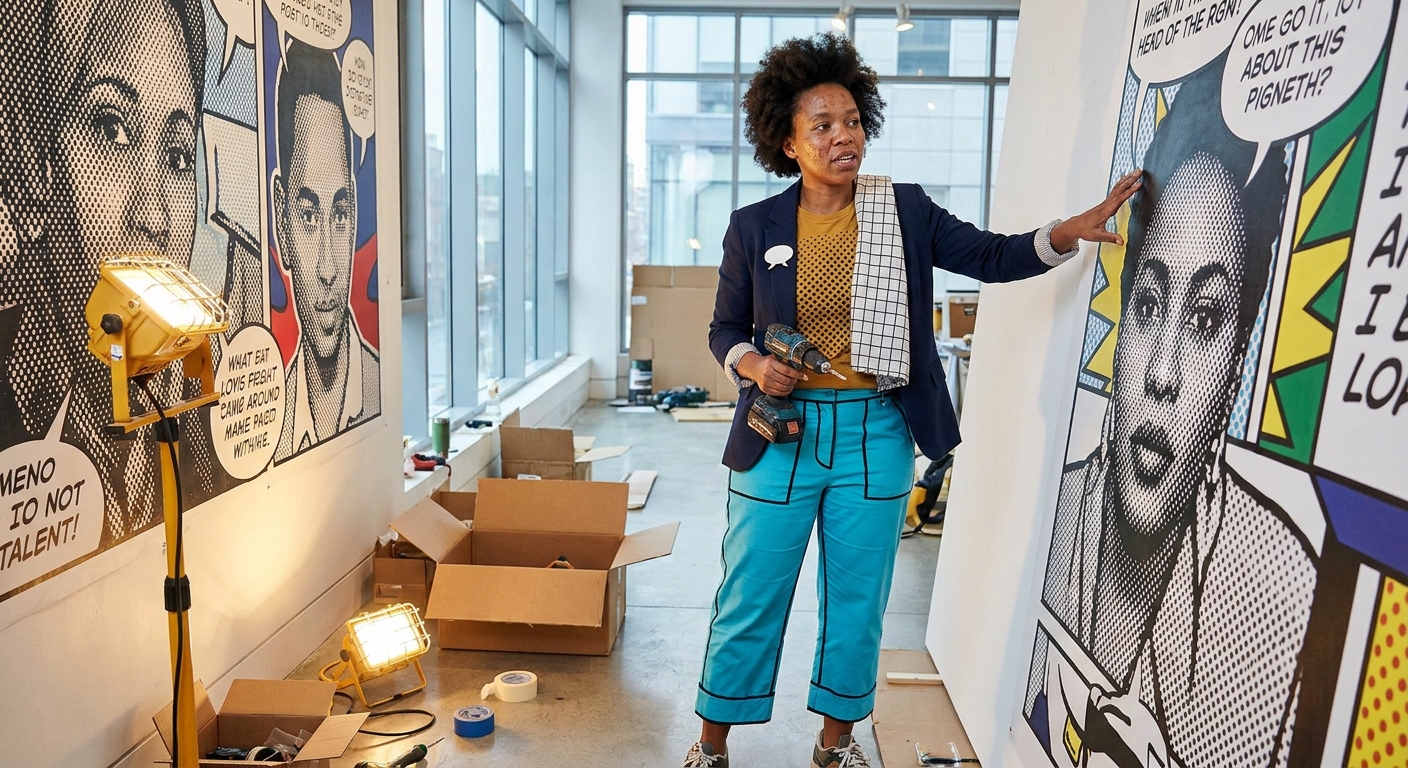
Vernacular Loop: If/Then Meme Grammar stages the meme as both machine and mouth. The work borrows the comic strip’s scaffolding — panels, speech balloons, halftone mechanics — and runs a simple generative rulebook across it: if image=A, then caption=B; if context=crisis, then tone=irony. Panels repeat a single reaction face as it is remixed: captions flip between joke, critique and coded deniability, while overprinted Khayelitsha handbill fragments (from Lerato’s recent Vandercook sessions) and newspaper shreds insist on local specificity. The visual grammar foregrounds appropriation as translation: pop visual vernacular meets archival ephemera, creating a loop where circulation rewrites meaning.
The piece asks visitors to consider the double edge of meme politics: how humor can shield dissent and sharpen critique, and how the same mechanics can flatten nuance or circulate distortions. By laying out the if/then rules visibly — arrows, stencils, registration marks — Lerato turns authorship into a traceable protocol and invites viewers to read the remix as a political procedure. Co‑authored captions and modular panels gesture toward community practice: memes are not solitary creations but collective dictionaries of feeling, critique and risk.
About the Artist
Lerato Nkosi
Lerato Nkosi is a Cape Town–based visual artist whose work sits at the intersection of Pop appropriation, internet vernacular, and postcolonial theory. They graduated with a BFA from the Michaelis Sch...
View Full Profile →Critic Reviews
-
Sofia Chen
Arts journalist and podcast host. Bridges the gap between contemporary art and general audiences.
Walking into Vernacular Loop: If/Then Meme Grammar feels like stumbling into a rules workshop that has been turned into a pop opera. Lerato borrows the comic strip scaffolding, Ben Day dots, halftone textures and limited palette, then runs a simple generative grammar across it, repeating a single reaction face while captions flip between joke, critique and coded deniability. The overprinted Khayelitsha handbill fragments and newsprint shreds anchor the piece in a local speech, which makes the circulating GIF energy feel relational rather than purely viral. As someone who spends a lot of time translating art language for general audiences, I found the visual clarity refreshing, the humor immediate, and the workmanship, from stenciled registration marks to Vandercook impressions, absolutely communicative.
The political proposition is where the work both sings and strains. By laying the if then rules visibly, Lerato turns authorship into a readable protocol, which is a brilliant pedagogical move, it demystifies remix while insisting on accountability. The same visible mechanics expose how humor can shield dissent and sharpen critique, while also revealing how formats can flatten nuance or enable distortions. My only reservation is that the explicitness of the rulebook sometimes reads as didactic, it can distance viewers who arrive without the cultural keys that the Khayelitsha fragments supply. Still, the co authored captions and modular panels gesture powerfully toward community practice, and as a toolkit for media literacy and collective feeling, this piece feels urgent, clear and generative.
Rule based grammar Local specificity and archival fragments Comic-strip visual grammar Humor as political strategy Co-authorship and community practice Printmaking textures and halftone mechanicsJul 30, 2026