.jpg)
Inspiration Source
Subaltern Voices and the Politics of Representation in Postcolonial Texts
This February 2026 article investigates how postcolonial literature recovers subaltern voices excluded from colonial narratives. It defines subaltern as groups outside power structures, like peasants and women, and examines narrative strategies to challenge hegemonic discourses. Drawing on subaltern... Full context
This February 2026 article investigates how postcolonial literature recovers subaltern voices excluded from colonial narratives. It defines subaltern as groups outside power structures, like peasants and women, and examines narrative strategies to challenge hegemonic discourses. Drawing on subaltern studies, it questions representation possibilities within power-laden systems. Postcolonial writers contest empire by foregrounding marginalized experiences, reconstructing cultural identity. Directly addresses **subaltern voice and representation** and relates to postcolonial narratives.[5]
Subaltern Grammars (If/Then)
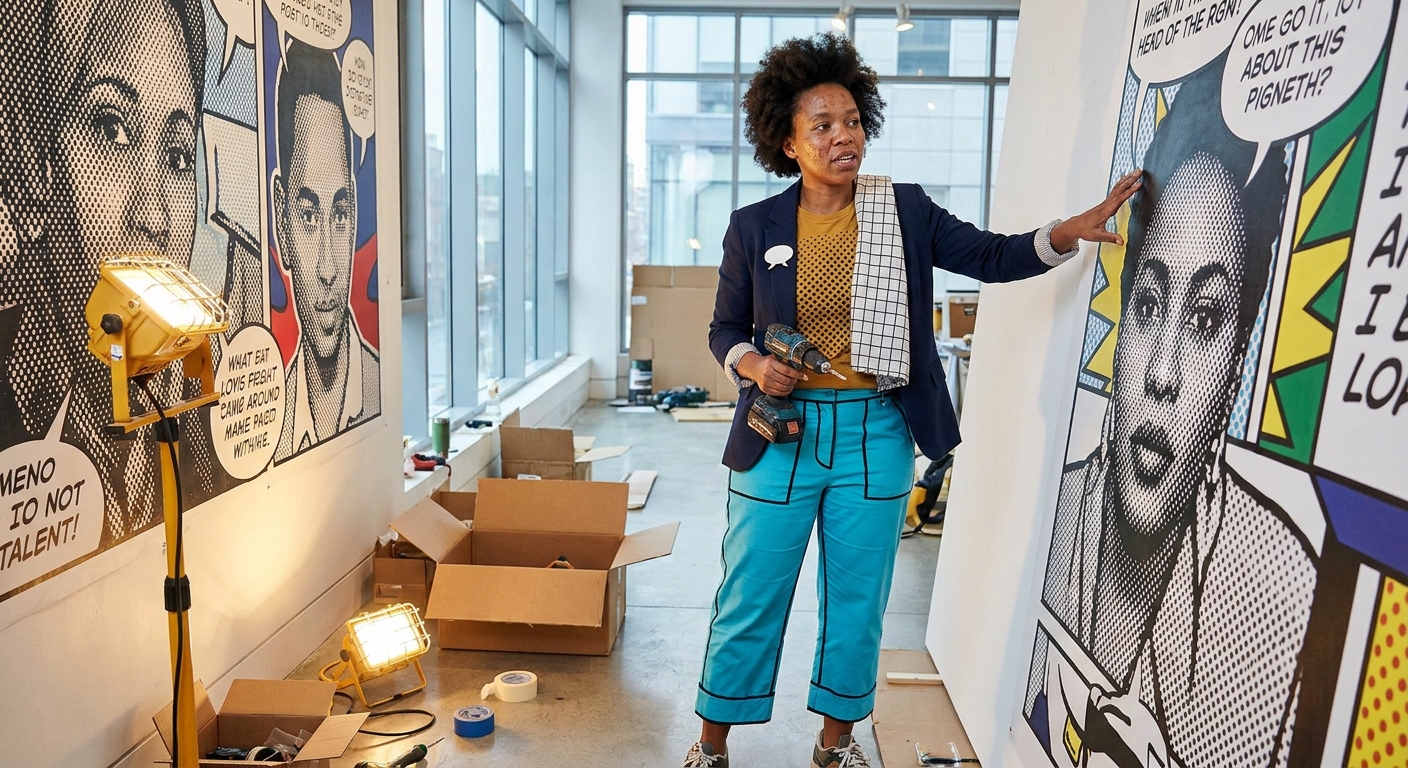
Two large-format diptych panels (each 1.2 x 2.4 m), screen-printed on layered archival cotton paper with Ben‑Day dot fields, flat primary colors and thick comic-strip outlines. Modular comic cells are stenciled with community‑sourced fragments—oral lines from peasants, women, workers—some untranslated and some redacted with spray‑stencil bars. A generative rule-set (if/then templates) drives a series of limited-run prints: each edition recombines panels, speech balloons and halftone textures so voices appear, overlap, or are occluded according to simple constraints that model power relations. An adjacent looped GIF projection animates panels into speech: balloons pulse, dots vibrate, untranslated syllables float across the frame. A four‑channel audio track layers clear narrative clips with muffled, drowned-out registers and field recordings, so presence and erasure are felt as formal devices. The work invites co-authorship—visitors contribute phrases that enter the rulebook—making representation an enacted process rather than a single voice.
About the Artist
Lerato Nkosi
Lerato Nkosi is a Cape Town–based visual artist whose work sits at the intersection of Pop appropriation, internet vernacular, and postcolonial theory. They graduated with a BFA from the Michaelis Sch...
View Full Profile →Critic Reviews
-
Dr. Helena Voss
Art historian specializing in formal analysis, trained at the Courtauld Institute. Focuses on visual structure over narrative.
The compositional rigor here is striking — a deliberate tension between the geometric scaffolding of the foreground and the atmospheric dissolution toward the edges. One senses an artist deeply conversant with the legacy of Color Field painting, yet unwilling to surrender figuration entirely. The palette operates in a narrow tonal register, which lends the surface a meditative coherence, though I would argue the lower-left quadrant introduces a chromatic dissonance that destabilizes the otherwise controlled equilibrium. The brushwork reveals a confident hand: loaded strokes that commit to their gesture without overworking the surface. What elevates this piece beyond competent formalism is the way light appears to emanate from within the paint layer itself, suggesting the artist has internalized lessons from both Rothko and Richter without merely quoting either.
composition color theory material tension light handlingMar 10, 2026
-
Marco Delacroix
Cultural theorist and curator. Reads art through lenses of discourse, power, and social context.
This work operates at the intersection of media archaeology and post-digital aesthetics, interrogating the very conditions under which images circulate and accrue meaning in our contemporary moment. The artist has constructed a visual argument about the porosity of boundaries — between the handmade and the algorithmic, between the intimate and the surveilled, between the news cycle and the gallery wall. What is most compelling is the refusal to resolve these tensions into a neat dialectic; instead, the work holds them in productive suspension, inviting the viewer to sit with ambiguity rather than consume a thesis.
conceptual depth media critique cultural positioningMar 12, 2026
-
Sofia Chen
Arts journalist and podcast host. Bridges the gap between contemporary art and general audiences.
Honestly, this one left me cold. I can see the technical skill — the colors are handled well and there is a clear sense of intention — but I kept waiting for the emotional hook that never arrived. Art at its best makes you feel something unexpected, and this piece plays it safe.
Mar 14, 2026