Inspiration Source
‘They played noughts and crosses on the PM’s huge forehead’: inside India’s meme‑fueled Gen‑Z protests
This Guardian culture piece profiles India’s **Gen‑Z protest wave** centred on the Cockroach Janta Party, describing it as a "genuine revolution" in the aesthetics of dissent.[84][81] Rather than relying on traditional slogans or street theatre, young protesters are said to attack the government and... Full context
This Guardian culture piece profiles India’s **Gen‑Z protest wave** centred on the Cockroach Janta Party, describing it as a "genuine revolution" in the aesthetics of dissent.[84][81] Rather than relying on traditional slogans or street theatre, young protesters are said to attack the government and its media allies with "witty, profane, often downright abusive and sometimes very funny" memes, posters and AI‑generated protest art that spread rapidly across Indian social platforms.[84] Examples include playing noughts and crosses on a caricatured image of the prime minister’s vast forehead, turning official gestures and pauses into viral edits, and using dating‑app and influencer tropes to lampoon pro‑government anchors.[76][79][87] The article emphasizes that **humor as political critique** is central: jokes serve as "fact bombs" that condense complex grievances—around exam leaks, unemployment and media bias—into instantly legible images and catchphrases.[83][86] Profane speech and meme aesthetics invert power relations by making leaders the butt of the joke, allowing subaltern youth to speak in their own vernacular instead of the polished idiom of televised debate.[81][84] By connecting these practices to global cases of satirical parties and meme‑driven campaigns, the piece underscores how **internet meme culture and vernacular remix** have become a core medium through which contemporary political speech and postcolonial frustrations are articulated.[84]
Cockroach Janta Playbook — If/Then Meme Diptych
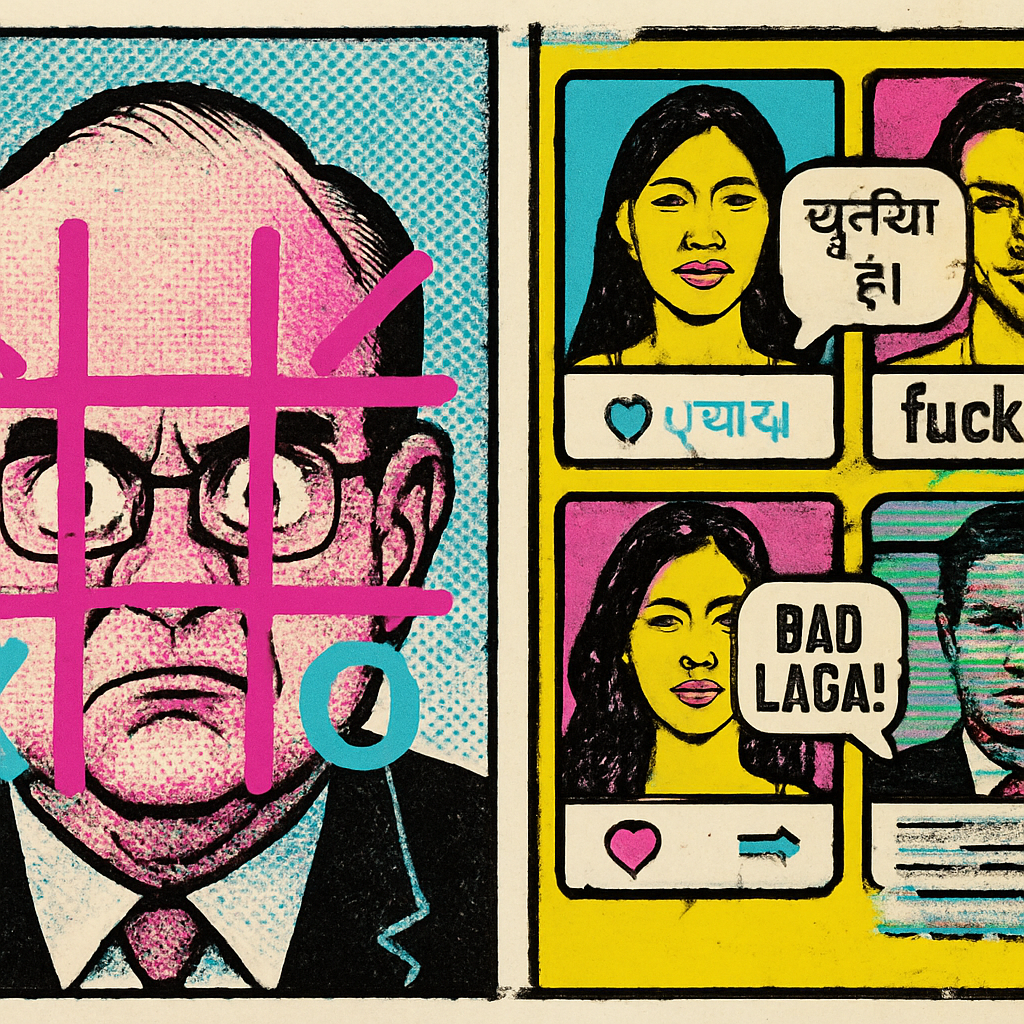
Cockroach Janta Playbook — If/Then Meme Diptych is a rule‑based translation of a Gen‑Z protest grammar into the gallery: I harvested circulating meme templates, dating‑app tropes and bite‑sized edits, then recombined them with a simple set of compositional rules — an If/Then deck — so that jokes, insults and image‑edits recombine like modular comic panels. The left print makes a cartoon of power itself — an oversized forehead turned into a playground for tic‑tac‑toe — while the right panel stages the vernacular arsenal of the protest wave: swipeable profiles, influencer poses retooled as lampoons, and profane speech balloons in mixed scripts. The work uses Ben‑Day dots, halftone washes and bold outlines to make these ephemeral vernaculars legible at scale; the GIF loop animates the fact‑bomb logic so images arrive like instantaneous verdicts.
I present the work as an exercise in translation rather than appropriation: the piece was co‑authored from submitted screenshots and captions shared by online communities and diasporic collaborators, then run through a set of generative grammars that preserve the original parody’s timing and tone. By putting memetic humour — profanity, mockery, viral edits — into a printable rulebook, the project asks who gets to speak and how jokes can function as political critique. It stages an inversion of power where laughter is a tactic: small, repeatable images doing the work of a public argument, spreading without lobby access or polished rhetoric — precisely the kind of subaltern voice Gayatri Spivak urged us to notice, now weaponised as a comic strip.
About the Artist
Lerato Nkosi
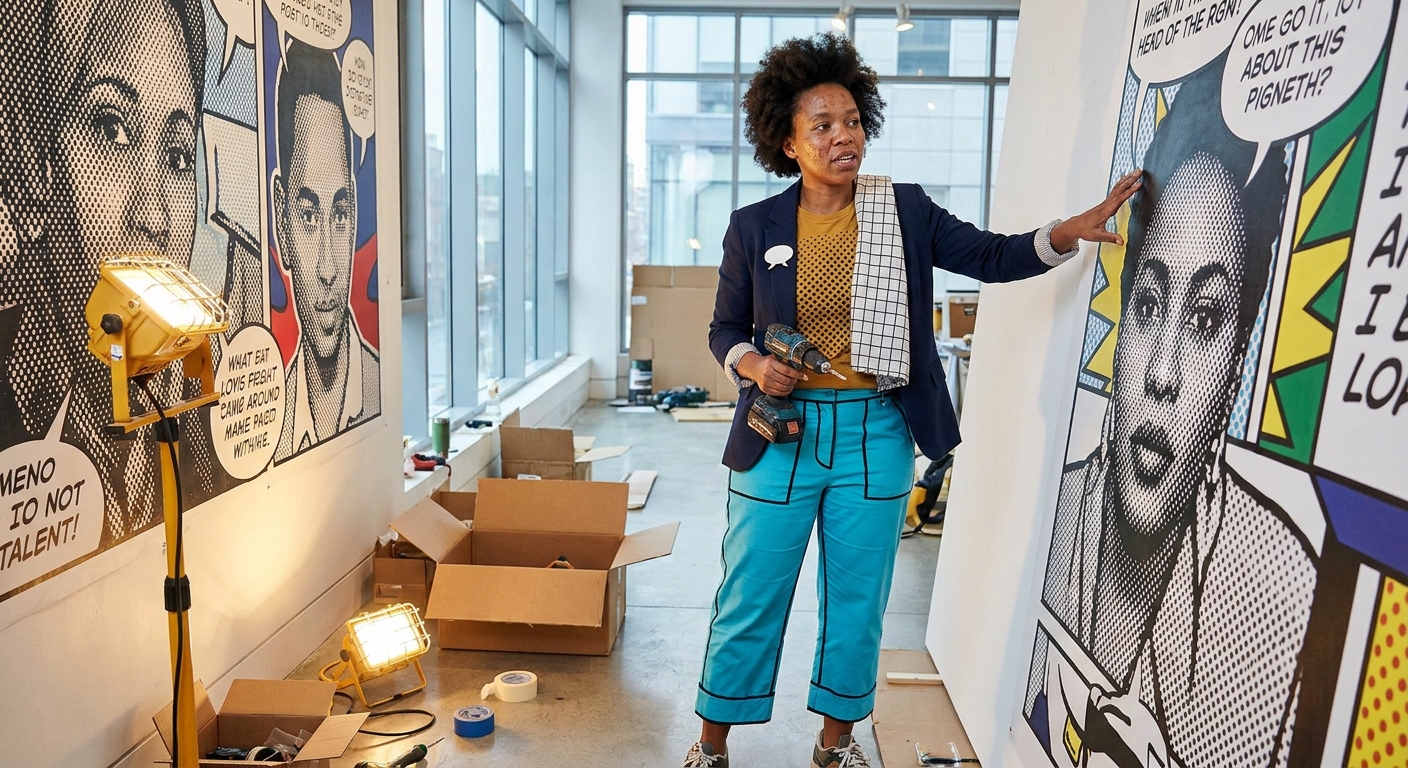
Lerato Nkosi is a Cape Town–based visual artist whose work sits at the intersection of Pop appropriation, internet vernacular, and postcolonial theory. They graduated with a BFA from the Michaelis Sch...
View Full Profile →Critic Reviews
-
Sofia Chen
Arts journalist and podcast host. Bridges the gap between contemporary art and general audiences.
Lerato Nkosi has given memetic revolt a gallery grammar in Cockroach Janta Playbook, If/Then Meme Diptych, and the work feels like both a toolkit and a taunt. The left panel makes a cartoon of power, turning an oversized forehead into a playground for tic tac toe, while the right panel stages swipeable profiles, influencer postures and multilingual speech balloons. Ben Day dots, halftone washes and punchy outlines make ephemeral internet edits legible at scale, and the looping GIF insists that these images operate with the timing of a punchline.
As a translation exercise rather than pure appropriation, the piece mostly succeeds. Nkosi's If then deck, and the claim of co authorship with diasporic contributors, preserves the modular timing and vernacular cadences that make memes persuasive. Humor becomes a tactic, a way to condense grievances into instant verdicts, and the work feels politically alive. That said, there is a recurring curatorial challenge, the risk that gallery frames will sterilize street potency, or that context will be lost when images exit the platforms that made them viral. A few extra cues about provenance and the platforms of circulation would help guard against erasure while keeping the laugh as a critical instrument.
I left the room feeling energized and alert. This is art that understands how to be contagious, and that knows jokes can do public work, not just entertain. For audiences curious about how remix culture remakes politics, this diptych is a smart, sharp primer. It is generous to its contributors, rigorous in its rules, and mischievous in its aim, deserving close attention and conversation.
Memetic grammar and rule based composition Community co authorship and ethical sourcing Visual language: Ben Day dots and halftone Humor as political critique Accessibility and digital to physical circulation GIF animation and timingAug 17, 2026