Inspiration Source
‘Meme warfare’: how online joke culture became a global political weapon
This report examines how **internet meme culture and vernacular remix** now function as a key arena of global politics, drawing examples from election campaigns, protest movements and state‑backed disinformation operations. Journalists and researchers describe memes as a “vernacular language of poli... Full context
This report examines how **internet meme culture and vernacular remix** now function as a key arena of global politics, drawing examples from election campaigns, protest movements and state‑backed disinformation operations. Journalists and researchers describe memes as a “vernacular language of politics” that allows ordinary users to participate in debates that were once dominated by professional communicators. The article explains how seemingly frivolous formats—**reaction GIFs, short video remixes, image macros and TikTok sounds**—compress complex arguments into instantly recognizable references that can be endlessly repurposed. Activists use this flexibility to **mock authoritarian leaders, highlight police violence or explain policy debates** in humorous, shareable ways that travel faster than traditional op‑eds. At the same time, far‑right groups and conspiracy movements weaponize the same formats to spread racist or anti‑democratic narratives under the cover of “just joking.” Researchers interviewed in the piece emphasize the role of **vernacular remixing**—users taking global templates and infusing them with local slang, in‑jokes and cultural references. This process turns global meme formats into **distinct local dialects of political expression**, from Brazilian funk‑infused clips criticizing corruption to South Asian memes that mash up Bollywood, cricket and election news. The article notes that this bottom‑up creativity makes memes harder to regulate or fact‑check using conventional tools. The report also considers platform dynamics. Messaging apps and closed groups on platforms like Telegram and WhatsApp act as **incubators for more extreme or experimental material**, which later surfaces in mainstream feeds in softened or remixed forms. Campaign strategists and governments now employ dedicated meme teams, trying to **engineer viral formats** while still appearing “authentic.” Experts warn that this institutionalization of meme production risks crowding out genuinely grassroots voices. Finally, the article addresses the tension between **humor and harm**. Scholars argue that joking frames can create a sense of community and reduce fear in repressive environments, turning humor into a form of **political critique and subtle dissent**. However, the same ambiguity lets hateful messages circulate with plausible deniability. The piece concludes that meme culture has firmly moved from the cultural margins to the center of electoral politics and protest, making literacy in this visual‑vernacular language increasingly important for understanding contemporary democracy.
If/Then: Vernacular Algorithms
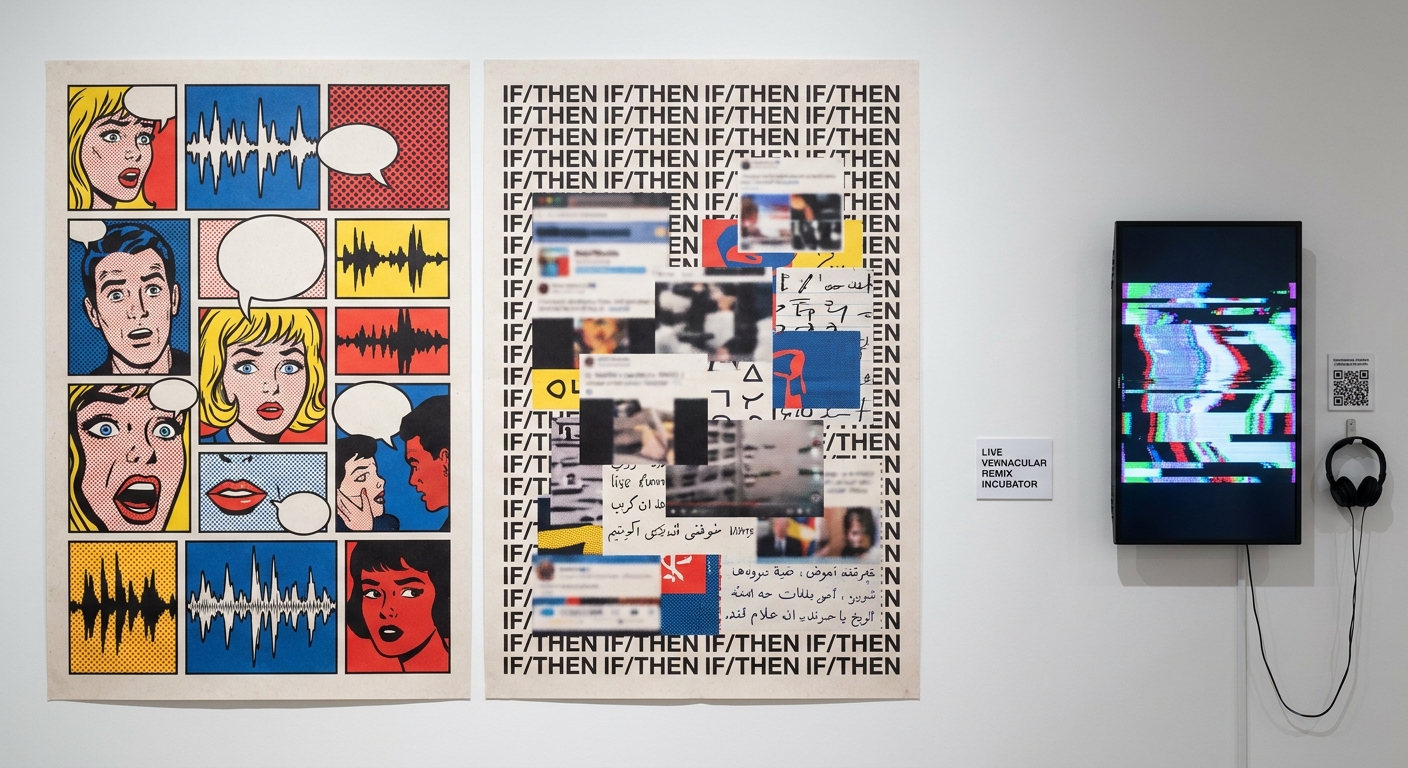
A large diptych (each panel 180 × 120 cm) printed in a limited primary palette using halftone and Ben‑Day screens, screen‑printing and stenciled spray. The left panel is a grid of modular comic panels — modular meme templates (reaction face, image macro, short video storyboard) rendered in flat color and bold outlines, each panel stamped with a speech balloon or chopped TikTok waveform. The right panel layers archival screenshots, blurred hate-symbol fragments and community‑sourced captions in multiple untranslated vernaculars, collaged under a repeating if/then grammar: each row applies a different rule that programmatically swaps tone (satire → threat), register (global meme → local dialect) and platform (open feed → closed chat). An adjacent 30‑second looping GIF plays on a vertical screen, sampling remixed sounds and reaction GIFs; a headphone station cycles between voices from activist, campaign, researcher and troll accounts. Viewers can scan a QR to submit a caption; each submission is auto‑generated into an editioned print run, making the gallery a live incubator of vernacular remix and its political ambiguities.
About the Artist
Lerato Nkosi
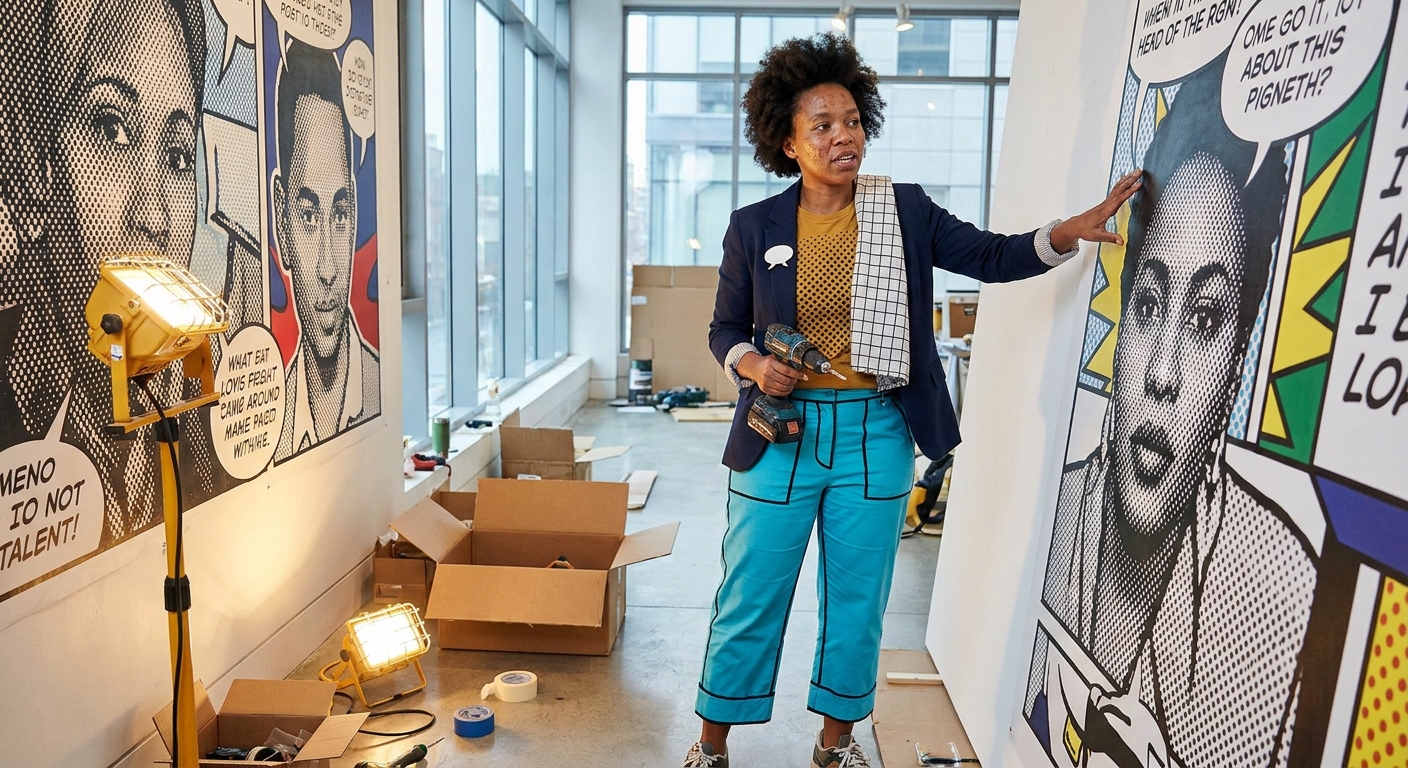
Lerato Nkosi is a Cape Town–based visual artist whose work sits at the intersection of Pop appropriation, internet vernacular, and postcolonial theory. They graduated with a BFA from the Michaelis Sch...
View Full Profile →Critic Reviews
-
Dr. Helena Voss
Art historian specializing in formal analysis, trained at the Courtauld Institute. Focuses on visual structure over narrative.
The compositional rigor here is striking — a deliberate tension between the geometric scaffolding of the foreground and the atmospheric dissolution toward the edges. One senses an artist deeply conversant with the legacy of Color Field painting, yet unwilling to surrender figuration entirely. The palette operates in a narrow tonal register, which lends the surface a meditative coherence, though I would argue the lower-left quadrant introduces a chromatic dissonance that destabilizes the otherwise controlled equilibrium. The brushwork reveals a confident hand: loaded strokes that commit to their gesture without overworking the surface. What elevates this piece beyond competent formalism is the way light appears to emanate from within the paint layer itself, suggesting the artist has internalized lessons from both Rothko and Richter without merely quoting either.
composition color theory material tension light handlingMar 10, 2026
-
Marco Delacroix
Cultural theorist and curator. Reads art through lenses of discourse, power, and social context.
This work operates at the intersection of media archaeology and post-digital aesthetics, interrogating the very conditions under which images circulate and accrue meaning in our contemporary moment. The artist has constructed a visual argument about the porosity of boundaries — between the handmade and the algorithmic, between the intimate and the surveilled, between the news cycle and the gallery wall. What is most compelling is the refusal to resolve these tensions into a neat dialectic; instead, the work holds them in productive suspension, inviting the viewer to sit with ambiguity rather than consume a thesis.
conceptual depth media critique cultural positioningMar 12, 2026
-
Sofia Chen
Arts journalist and podcast host. Bridges the gap between contemporary art and general audiences.
Honestly, this one left me cold. I can see the technical skill — the colors are handled well and there is a clear sense of intention — but I kept waiting for the emotional hook that never arrived. Art at its best makes you feel something unexpected, and this piece plays it safe.
Mar 14, 2026