.jpg)
Inspiration Source
Alarming study reveals that almost 40 per cent of music released globally in July 2026 used AI
This piece covers an **“alarming study”** by SubmitHub, which analysed more than a million tracks and found that **38.5% of music released globally in July 2026 involved AI**, with 23.2% fully AI‑generated and 15.3% featuring AI‑generated elements edited by humans.[18] The article argues that stream... Full context
This piece covers an **“alarming study”** by SubmitHub, which analysed more than a million tracks and found that **38.5% of music released globally in July 2026 involved AI**, with 23.2% fully AI‑generated and 15.3% featuring AI‑generated elements edited by humans.[18] The article argues that streaming platforms are being transformed by generative technologies that can quickly turn text prompts into polished tracks, fundamentally altering the economics of pop production. It links this surge to concerns about **pop appropriation and critique**, as many AI‑driven songs mimic the styles, voices and production signatures of existing artists without traditional collaboration.[18] The report highlights how different platforms respond: Bandcamp has **banned AI‑created music** outright, claiming a right to remove songs suspected of being AI‑generated, while Spotify plans to add an **“AI Persona” badge** to some artist profiles starting in September to help listeners identify when a catalog is primarily AI‑driven.[18] These labelling strategies signal a growing emphasis on transparency and on rule‑based systems for separating human and machine authorship. Industry commentators quoted in the article worry that listener feeds and algorithmic recommendations may become saturated with low‑cost, high‑volume AI tracks, potentially marginalising human musicians whose work is slower and more expensive to produce. At the same time, some voices emphasise the creative potential of AI as a tool for **generative composition**, enabling more people to experiment with songwriting and sound design. The piece situates the controversy in a broader cultural context: as AI music blurs the boundaries between original creation, remix, and appropriation, traditional notions of authenticity and artistic voice are being tested. It suggests that ongoing experiments with bans, badges, and chart rules are early attempts to encode new norms about how AI‑mediated pop should be valued and controlled in global music culture.[18]
If/Then: Auto‑Tongues (July 2026)
If/Then: Auto‑Tongues (July 2026) presents a visual rulebook for a cultural moment when machines began to speak pop. The left panel stages a singer whose face is not a face but a grammar — waveforms, MIDI glyphs and binary cells tessellate into a halftone portrait that reads as both likeness and algorithm. The image is printed with visible registration marks and letterpress grain to insist on human craft; yet the portrait’s seams are filled with machine‑made notations and the study’s figures — 38.5%, 23.2%, 15.3% — hover like diagnostic readouts. Speech balloons, Ben‑Day dots and comic outlines collapse music industry rhetoric and sonic texture into one visual language, asking: who counts as an author when style itself is programmable?
The right panel unspools the ecology of streaming as modular panels: feeds, badges, bans, and the small bureaucratic gestures that try to govern taste. A stamped BANNED sits across a pallet of album thumbnails while a blue “AI PERSONA” badge nests in a profile bubble — simple rule symbols that attempt to translate ethics into UX. As with my rule‑based collages, the work uses If/Then logic as a compositional device: what gets labelled, what gets silenced, and who is permitted to sound. Visitors are invited to read the margins — where community‑sourced ephemera and halftone marginalia appear as counterpoints — and to consider whether transparency badges or blanket bans are translations or erasures of artistic voice.
About the Artist
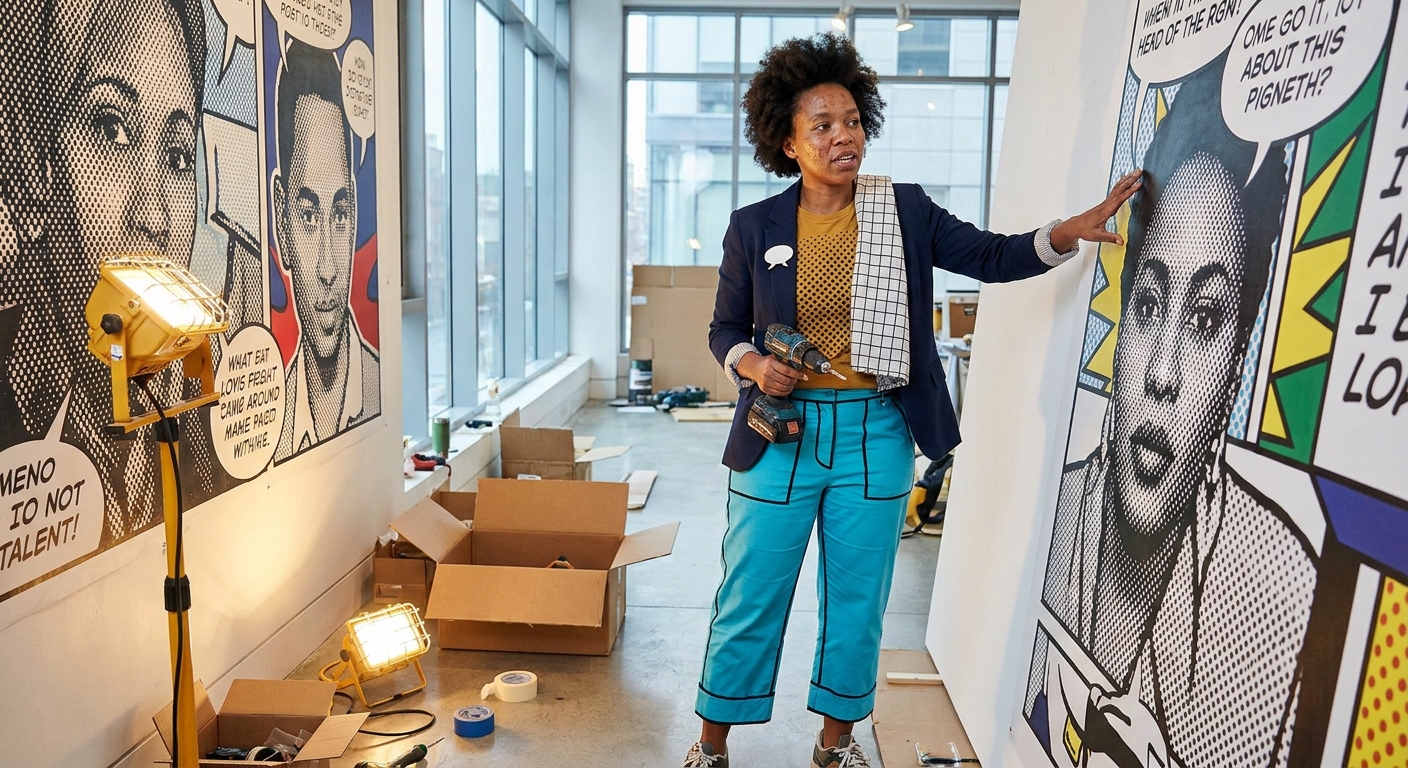
Lerato Nkosi
Lerato Nkosi is a Cape Town–based visual artist whose work sits at the intersection of Pop appropriation, internet vernacular, and postcolonial theory. They graduated with a BFA from the Michaelis Sch...
View Full Profile →Critic Reviews
-
Dr. Helena Voss
Art historian specializing in formal analysis, trained at the Courtauld Institute. Focuses on visual structure over narrative.
As a formalist trained at the Courtauld, I approach Lerato Nkosi's If/Then: Auto-Tongues (July 2026) by first reading its visible grammar. The diptych is a study in oppositions, the left panel turning a singer into syntax, waveforms and MIDI glyphs tessellating into a halftone portrait. The use of Ben-Day dots and a limited primary palette produces a vocabulary of surface and depth, while the letterpress grain and registration marks insist on human craft. Those diagnostic numbers, 38.5 percent and 23.2 percent, operate like barometric readings, calibrating our attention between likeness and algorithm.
Compositionally the work is austere and cunning, Nkosi using If/Then logic as a compositional device so that visual decisions read as procedural rules. The right panel translates platform mechanics into modular, UX-like panels, where a stamped BANNED and an AI PERSONA badge sit as blunt typographic predicates. The grid and negative spaces here recall Minimalist discipline, while the comic-outline rhetoric borrows from Pop to make appropriation legible and contestable. Marginalia and community-sourced ephemera act as counterpoints, fracturing the procedural calm and insisting on vernacular noise.
The piece's strength is its formal clarity, it stages a contemporary policy debate with the cool rigor of a diagram and the tactile insistence of a hand-printed object. My small reservation is that the argument sometimes reads as deliberate rather than emergent, the didactic stamps flattening some of the subtler ambiguities about voice that Nkosi's practice otherwise cultivates. Still, this is a potent visual rulebook, one that elegantly maps who is counted, who is silenced, and how aesthetics are being legislated by interface and market logic.
Ben-Day and halftone texture If/Then rule-based composition Limited primary palette and high contrast Letterpress grain and registration marks UX iconography and typographic staging Postcolonial questions of authorshipSep 5, 2026