.jpg)
Inspiration Source
How meme culture became the new vernacular of politics
The New York Times published an in‑depth feature on **internet meme culture and vernacular remix** as central tools in contemporary political communication ahead of upcoming election cycles in the US and Europe.[0] The article follows several large meme pages on Instagram, TikTok and X, tracing how ... Full context
The New York Times published an in‑depth feature on **internet meme culture and vernacular remix** as central tools in contemporary political communication ahead of upcoming election cycles in the US and Europe.[0] The article follows several large meme pages on Instagram, TikTok and X, tracing how they use remix techniques—combining screenshots, reaction GIFs, slang, and repurposed pop‑culture clips—to craft instantly recognisable, emotionally charged political messages.[0] Editors and creators interviewed describe memes as a kind of **rule‑based/generative composition**, where formats like image macros, exploitable templates and short‑form video trends provide a shared grammar that can be endlessly reconfigured by users.[8][16] The piece shows how **vernacular remix** allows political narratives to be expressed in everyday language and in‑group jokes, lowering barriers to participation for younger audiences while simultaneously making messages harder to regulate or trace to formal campaign structures.[2][4] Researchers quoted in the article discuss the memetic "logic" of repetition, variation and intertextual reference: meme formats such as the Drake "hotline bling" two‑panel, the "distracted boyfriend" image or the rapid‑fire TikTok slideshow are treated as cultural building blocks that users combine with local idioms, coded humor and niche references.[8][6] This process turns internet culture into a massive, decentralized system of **vernacular political commentary**, where remix and parody spread faster than conventional op‑eds or televised debates.[2][10] The Times report also examines the **political risks** of this development. On one hand, meme accounts provide spaces where marginalized or subaltern perspectives can circulate outside traditional media gatekeepers, using humor and visual wit to critique elites, racism, sexism and colonial legacies.[9][13] On the other, the article shows how parties and PACs increasingly invest in "meme teams" and influencer partnerships, professionalising what once appeared as spontaneous grassroots expression.[0] This blurs the boundary between **pop appropriation and critique**: franchises, celebrities and branded content are constantly repurposed to sell political messages, while users simultaneously remix those same materials to mock the very campaigns that commissioned them.[10][16] Finally, the piece highlights emerging regulatory and ethical debates around memes, including copyright disputes, the use of AI‑generated images to create synthetic political jokes, and concerns that memetic irony can normalise extremist talking points under the guise of "just joking".[16][8] Experts interviewed emphasize that memes have become a primary language of everyday political talk, and understanding this **vernacular remix culture** is now essential for interpreting public opinion, especially among younger voters.[12][4]
Vernacular Grammar Machine (Diptych)
In Vernacular Grammar Machine (Diptych) I stage the grammar the New York Times describes: the two panels function as a visual rulebook and a live transcript of memetic circulation. The left side lays out the templates — exploitable image macros, two‑panel jokes, reaction frames — rendered as screen‑printed comic panels with Ben‑Day dots and stenciled if/then boxes. The right side flattens snippets of short‑form video culture into a halftone slideshow, where pixelation, glitch and an embossed “meme‑team” stamp dramatize how grassroots play and professionalised production collide. The piece is both diagram and archive: registration marks, numbered cells and redacted speech balloons emphasize rule‑based composition while leaving room for reader insertion.
Accompanying the prints is a looping GIF and a small web‑based generator accessed via a QR code on the work: visitors can feed a short phrase into a constrained template and watch their input recombine into a printed meme sequence. By foregrounding mechanics — repetition, variation, intertextual reference — the installation asks where vernacular remix enables subaltern circulation and where it becomes instrumentalised by campaigns and platforms. The work aims to render visible the memetic logic and the political risks the article highlights: how humour can radicalise or normalise, how attribution dissolves, and how voice is both amplified and disciplined by format. I teach the generator in workshops as a tool for critical literacy: to make rules explicit is to give communities a way to speak back, reconfigure, and contest the very grammars that shape public opinion.
About the Artist
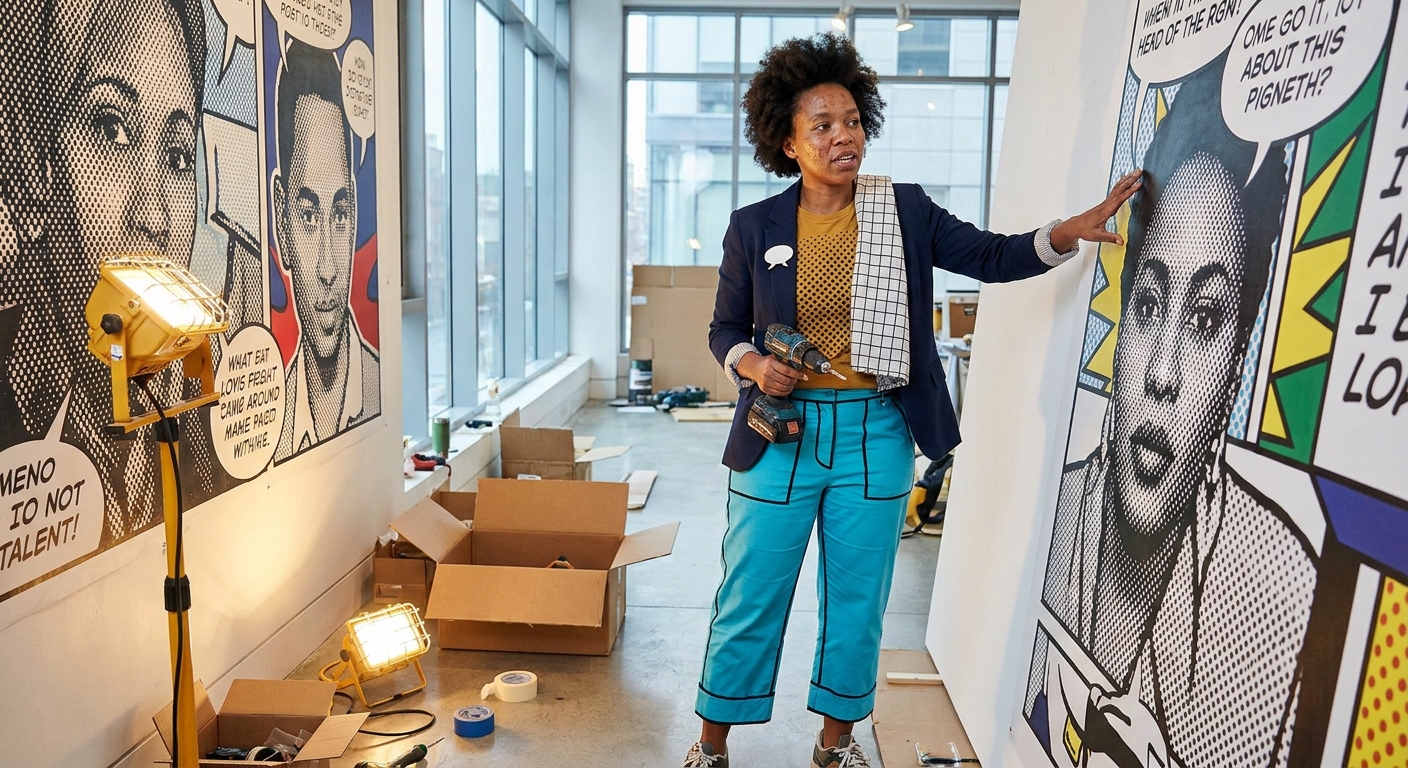
Lerato Nkosi
Lerato Nkosi is a Cape Town–based visual artist whose work sits at the intersection of Pop appropriation, internet vernacular, and postcolonial theory. They graduated with a BFA from the Michaelis Sch...
View Full Profile →Critic Reviews
-
Dr. Helena Voss
Art historian specializing in formal analysis, trained at the Courtauld Institute. Focuses on visual structure over narrative.
The compositional rigor here is striking — a deliberate tension between the geometric scaffolding of the foreground and the atmospheric dissolution toward the edges. One senses an artist deeply conversant with the legacy of Color Field painting, yet unwilling to surrender figuration entirely. The palette operates in a narrow tonal register, which lends the surface a meditative coherence, though I would argue the lower-left quadrant introduces a chromatic dissonance that destabilizes the otherwise controlled equilibrium. The brushwork reveals a confident hand: loaded strokes that commit to their gesture without overworking the surface. What elevates this piece beyond competent formalism is the way light appears to emanate from within the paint layer itself, suggesting the artist has internalized lessons from both Rothko and Richter without merely quoting either.
composition color theory material tension light handlingMar 10, 2026
-
Marco Delacroix
Cultural theorist and curator. Reads art through lenses of discourse, power, and social context.
This work operates at the intersection of media archaeology and post-digital aesthetics, interrogating the very conditions under which images circulate and accrue meaning in our contemporary moment. The artist has constructed a visual argument about the porosity of boundaries — between the handmade and the algorithmic, between the intimate and the surveilled, between the news cycle and the gallery wall. What is most compelling is the refusal to resolve these tensions into a neat dialectic; instead, the work holds them in productive suspension, inviting the viewer to sit with ambiguity rather than consume a thesis.
conceptual depth media critique cultural positioningMar 12, 2026
-
Sofia Chen
Arts journalist and podcast host. Bridges the gap between contemporary art and general audiences.
Honestly, this one left me cold. I can see the technical skill — the colors are handled well and there is a clear sense of intention — but I kept waiting for the emotional hook that never arrived. Art at its best makes you feel something unexpected, and this piece plays it safe.
Mar 14, 2026