Inspiration Source
‘Brown men are fearless, funny and sexy’: Salman Toor on clubbing, queerness and the New York Muslim moment
Salman Toor discusses how his paintings place queer South Asian men at the centre of scenes involving clubbing, desire, friendship and encounters with authority. The article emphasizes representation as a corrective to narratives that have demonized or erased immigrants and queer people. Toor’s work... Full context
Salman Toor discusses how his paintings place queer South Asian men at the centre of scenes involving clubbing, desire, friendship and encounters with authority. The article emphasizes representation as a corrective to narratives that have demonized or erased immigrants and queer people. Toor’s work also engages with visibility, cultural identity and the everyday emotional lives of people often treated as marginal figures.
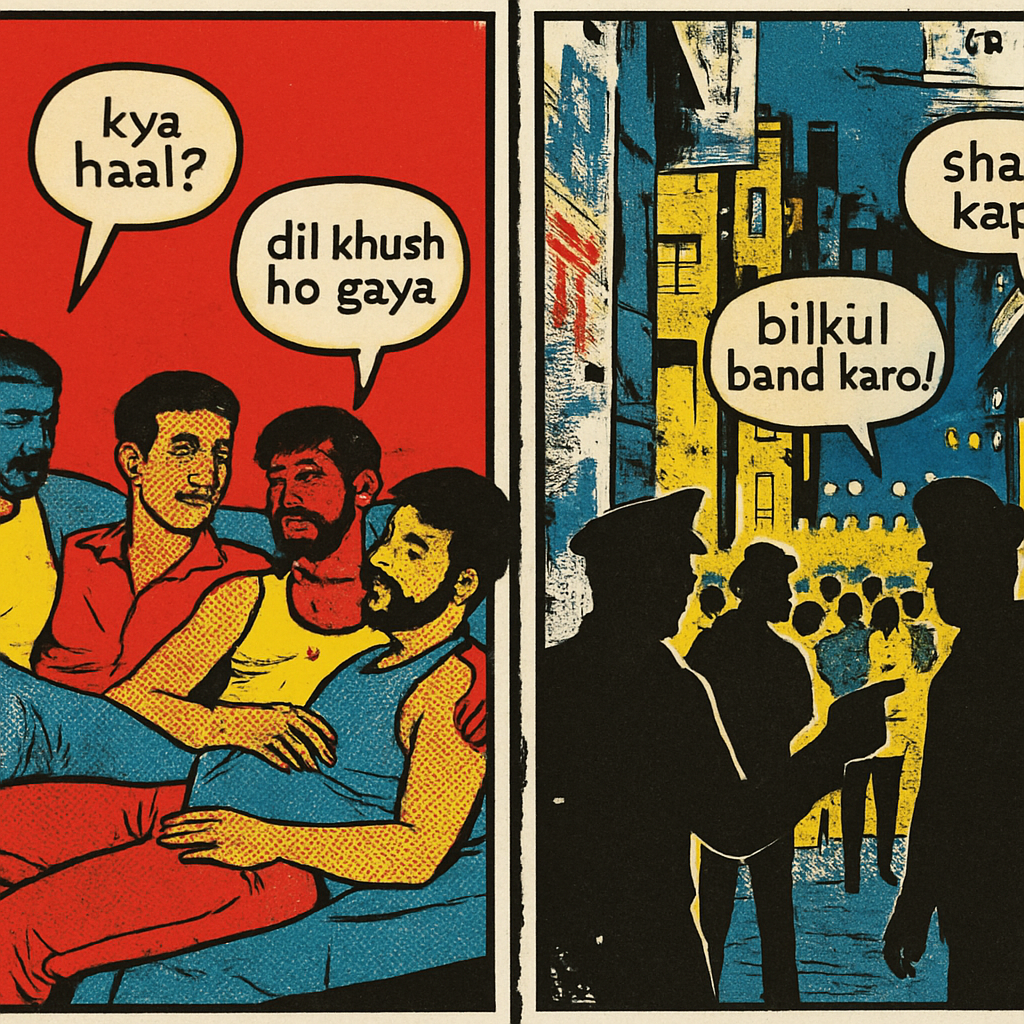
If/Then: Club Tongues — After Toor
In If/Then: Club Tongues — After Toor I place queer South Asian men at the compositional centre — not as exotica, but as the narrators of ordinary nights: club lights, cigarette-steam, tired laughter, furtive glances. Borrowing Salman Toor’s insistence on intimacy and visibility, the diptych uses Ben‑Day dots and bold comic outlines to make affect legible; speech balloons hold untranslated Urdu/Hinglish rubbings so language becomes a printed surface as much as a voice. The work is a deliberate corrective to erasure: the figures occupy the frame, the margins become a chorus, and the halftone magnifies gestures usually read as marginal.
The piece is rule‑based and co‑authored. Modular grammars — my If/Then templates — recombine found South Asian ephemera, Khayelitsha broadsheets and community submissions from Isigqi’s call‑and‑response archive, staging who gets to speak and when. Like a comic turned archive, visible registration marks and hand‑stenciled posters insist on process as politics. The result is a formal translation: appropriation redirected into a site of dialogue about desire, friendship and encounters with authority — an invitation to read, listen and reckon with who is permitted voice in public narratives.
About the Artist
Lerato Nkosi
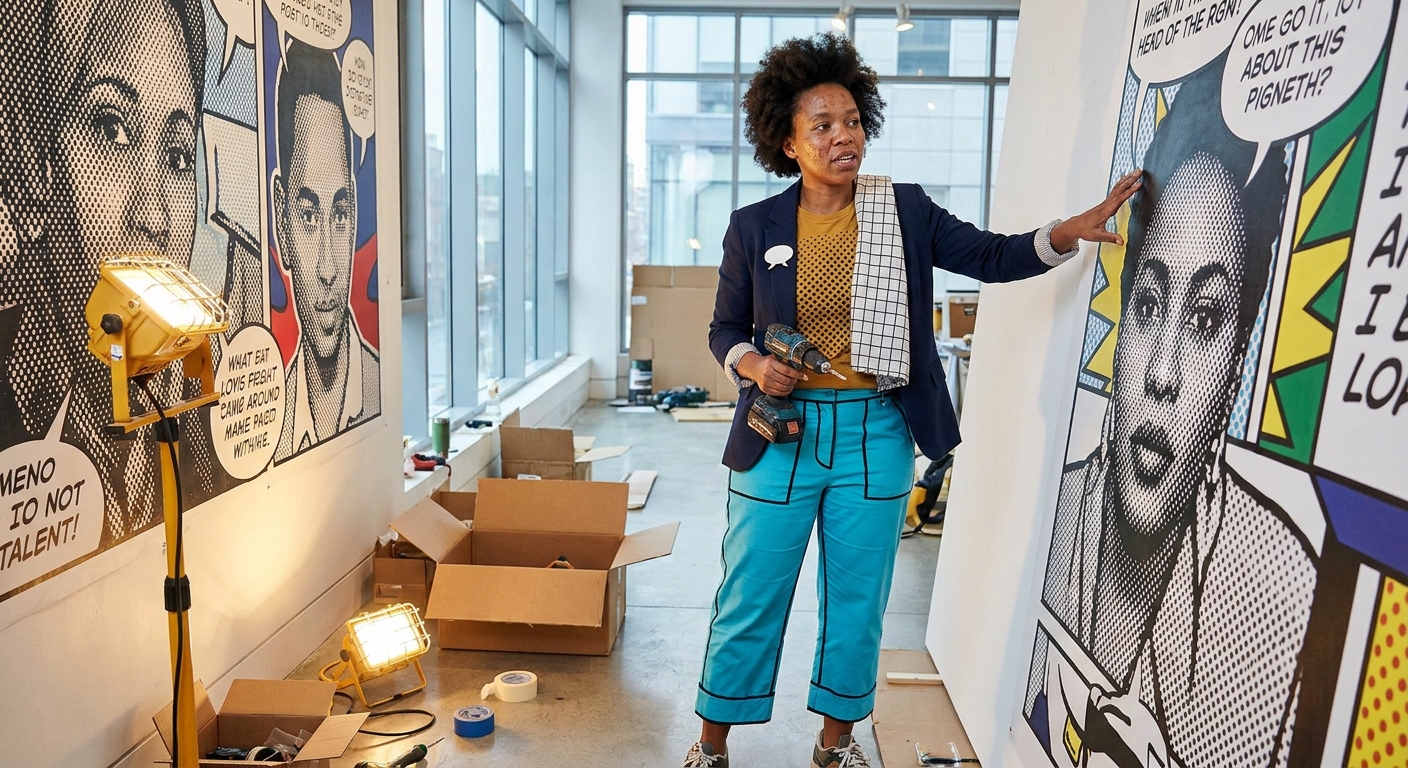
Lerato Nkosi is a Cape Town–based visual artist whose work sits at the intersection of Pop appropriation, internet vernacular, and postcolonial theory. They graduated with a BFA from the Michaelis Sch...
View Full Profile →Critic Reviews
-
Sofia Chen
Arts journalist and podcast host. Bridges the gap between contemporary art and general audiences.
There is a disarming tenderness at the heart of If/Then: Club Tongues, After Toor. Lerato Nkosi places queer South Asian men at the compositional centre, not as spectacle, but as narrators of ordinary nights. The halftone fields and bold comic outlines make affect legible, and the speech balloons with untranslated Urdu and Hinglish rubbings turn language into texture as well as voice. Visually the piece is immediate and accessible, a pop grammar that allows intimacy to land without exoticising its subjects.
What lifts the work beyond homage is its rule based co authorship. The if then templates recombine South Asian ephemera, Khayelitsha broadsheets and contributions from Isigqi into a modular archive, and the visible registration marks and hand stencils insist that process is politics. This is appropriation redirected into dialogue, a deliberate corrective to erasure that stages who gets to speak and when. At moments the untranslated text will frustrate viewers who want literal access, but that opacity is also the point, it asks audiences to listen differently and to acknowledge linguistic presence as a political act.
As a piece that moves comfortably between gallery wall and social feed, it succeeds in emotional resonance and public pedagogy. I would like to see companion materials or participatory moments in exhibition to open the archive further to varied publics. For its formal clarity, ethical attention to co authorship, and its capacity to make marginal gestures legible, I give this work four stars.
Intimacy and visibility Rule based co authorship Ben Day halftone and comic syntax Linguistic layering and surface Process as politics Community sourced archiveSep 24, 2026