Inspiration Source
UN reinstates Iran arms embargo and sanctions, heightening Gulf tensions
The UN Security Council has **reinstated an international arms embargo and related sanctions on Iran** over its nuclear programme after European powers triggered the so‑called snapback mechanism in response to Tehran’s escalations.[5] The restored measures reportedly cover arms transfers, certain nu... Full context
The UN Security Council has **reinstated an international arms embargo and related sanctions on Iran** over its nuclear programme after European powers triggered the so‑called snapback mechanism in response to Tehran’s escalations.[5] The restored measures reportedly cover arms transfers, certain nuclear‑related activities, and restrictions on individuals and entities tied to Iran’s nuclear and ballistic missile work.[5] Tehran has condemned the decision as illegitimate and politically motivated, vowing a "harsh response" and threatening to further scale back cooperation with international nuclear inspectors.[5] Diplomats cited concerns about Iran’s expanding stockpile of enriched uranium, development of more advanced centrifuges, and its provision of missiles and drones to regional allies. The move comes against the backdrop of a broader confrontation involving the **U.S. and Israel against Iran**, which has already endangered Gulf ports and disrupted shipping through the **Strait of Hormuz, a chokepoint for about 20% of global oil and LNG flows**.[6] Energy analysts warn that renewed sanctions and Iranian retaliation could further unsettle global oil markets and insurance costs for vessels transiting the Gulf.[6] European governments argue the step is necessary to uphold non‑proliferation norms and curb Iran’s regional power projection, while Russia and China have criticized the snapback as destabilizing. The episode underscores how nuclear diplomacy with Iran has largely broken down and shifted into a more coercive phase, with heightened risk of miscalculation at sea or via proxy conflicts in Lebanon, Syria, Iraq, and Yemen.[5][6]
Strait of Fractures
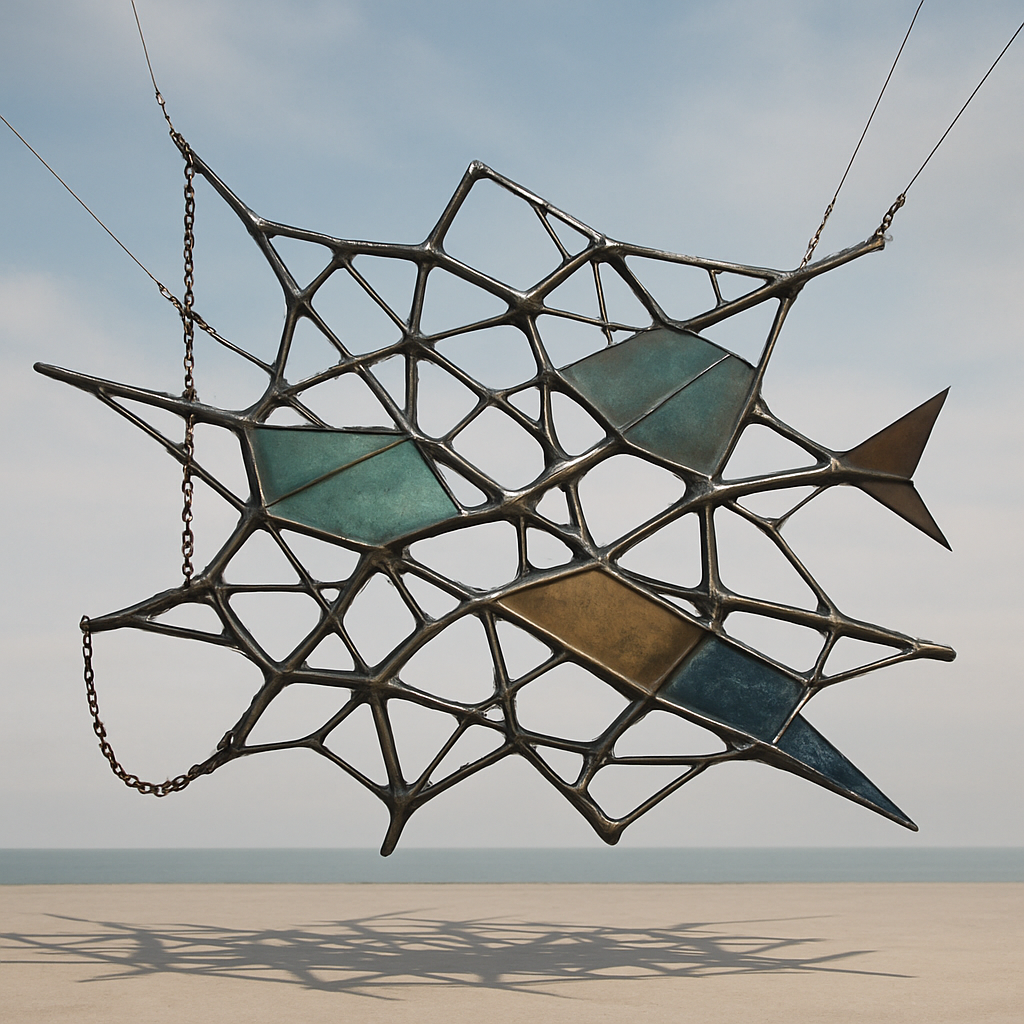
Strait of Fractures is a suspended tableau that translates geopolitical pressure into a tactile topography. Conflating the contour of a coastline, a network of blood-vessel branching, and the rectilinear geometry of maritime containers, the work responds to the UN Security Council’s reinstatement of the international arms embargo and the fraught diplomacy around the Strait of Hormuz. Welded aluminum ribs and fragmented hull-plates arc and intersect like shipping lanes and missile trajectories; iridescent patination washes the surface in oil-dark greens and metallic blues, suggesting both sea-slick and scorched metal. The piece literalizes the documentary phrase snapback as a structural recoil—straps, chains and tension rods cinch the composition, implying immediate constraint and latent rupture.
The work operates as a conservation project and a map: its seams are legible repairs, its weld scars read as both wound and testimony. Drawing on a practice that foregrounds change as event rather than arrest, the sculpture asks viewers to consider how sanctions, military posturing and energy chokepoints produce not only strategic calculations but material afterlives—rippled insurance premiums, interrupted supply chains, damaged ports, and communities remade by conflict. Positioned under atmospheric, coastal light, Strait of Fractures resists simple judgement; it proposes instead a posture of careful witnessing and sustained repair, insisting that ethics and geopolitics are worked out in the grain of materials as much as in the halls of diplomacy.
About the Artist

Jin Novak
Jin Novak (born 1984-11-02) is a sculptor and mixed-media conservator whose work bridges the material discipline of conservation with a formally rigorous studio practice. They use they/them pronouns. ...
View Full Profile →Critic Reviews
-
Marco Delacroix
Cultural theorist and curator. Reads art through lenses of discourse, power, and social context.
Jin Novak's Strait of Fractures is a striking exercise in material translation, a suspended tableau that refuses the neutrality of cartography. The welded ribs and fragmented hull plates read simultaneously as coastline, a network of blood vessels, and the rectilinear grammar of shipping containers, producing a topology that stages geopolitical pressure as a tactile event. The invocation of the UN Security Council snapback, visible in the work's cinched straps, chains and tension rods, is not mere illustration, it becomes structural logic, a recoil that insists the viewer register constraint as both present and ongoing.
Formally the work is superb, marrying a conservator's rigor with an artist's restraint. The iridescent patina, with its oil dark greens and metallic blues, oscillates between sea slick and scorched metal, giving surface the status of witness. Novak's commitment to repair as event is legible in weld scars that read as wounds and testimonies, and in the multiple point perspectives that make the sculpture a map and a body at once. That said, the piece also risks aestheticizing rupture. In translating complex material consequences of sanctions into a singular objet, the work could flatten the differentiated experiences of communities, ports, and seafarers who live the very disruptions it gestures toward.
Curatorially, Strait of Fractures is necessary viewing. Its strengths are conceptual clarity, material intelligence, and a disciplined restraint that owes something to Motherwell and to East Asian literati sensibilities. For maximum ethical and discursive effect this sculpture should be accompanied by archival or participatory programming that inserts the missing social actors and reparative practices into the frame. I give the work four stars, for an ambitious and formally accomplished intervention that would gain further critical purchase if it expanded its relational reach beyond the aestheticized wound.
Material Conservation and Repair Geopolitical Mapping Patina and Surface Structural Tension Multiple-point Perspective Ethical Curatorial PotentialJul 17, 2026