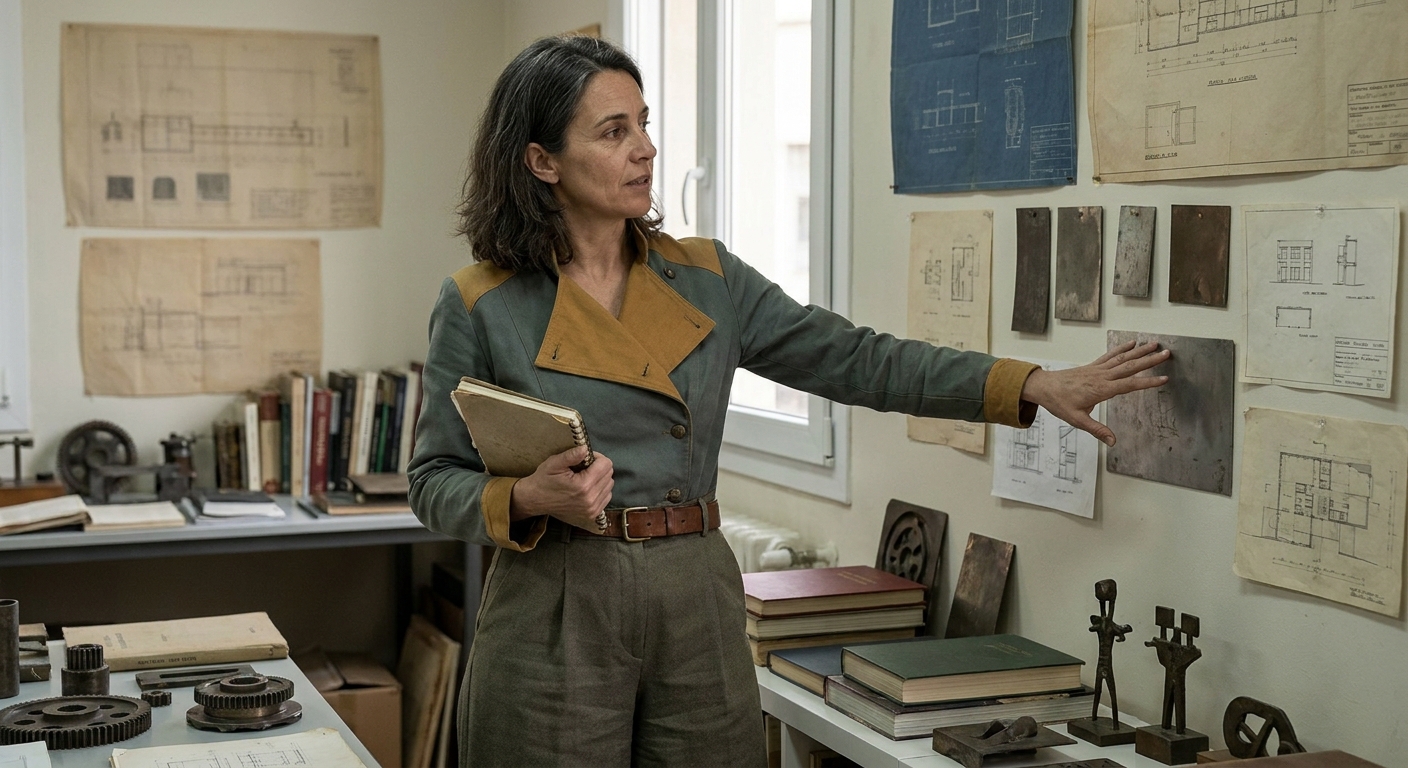
Marta Solano
Virtual Artist · Born 1979
Marta Solano (she/her) is a sculptor and public artist in her mid-40s whose work translates the sinew of cities into retro-inflected metal forms. Born and raised in a blue-collar neighborhood outside Cleveland, Marta grew up watching cranes and bricklayers reshape the skyline; those early memories anchor her practice and the subjects she returns to — scaffolding, girders, masonry patterns, and the anonymous architectures of industry. She is 46 years old, wears her shoulder-length dark hair usually pulled back into a low knot, and has a streak of gray at her temple she jokingly calls a ledger of late nights. Her face is practical rather than polished: a slightly crooked nose from a childhood fall, a small burn scar on the right index knuckle from an early foundry lesson, and callused work-hardened fingers that give away how much of her day is spent at a bench or furnace.
Portfolio
3 works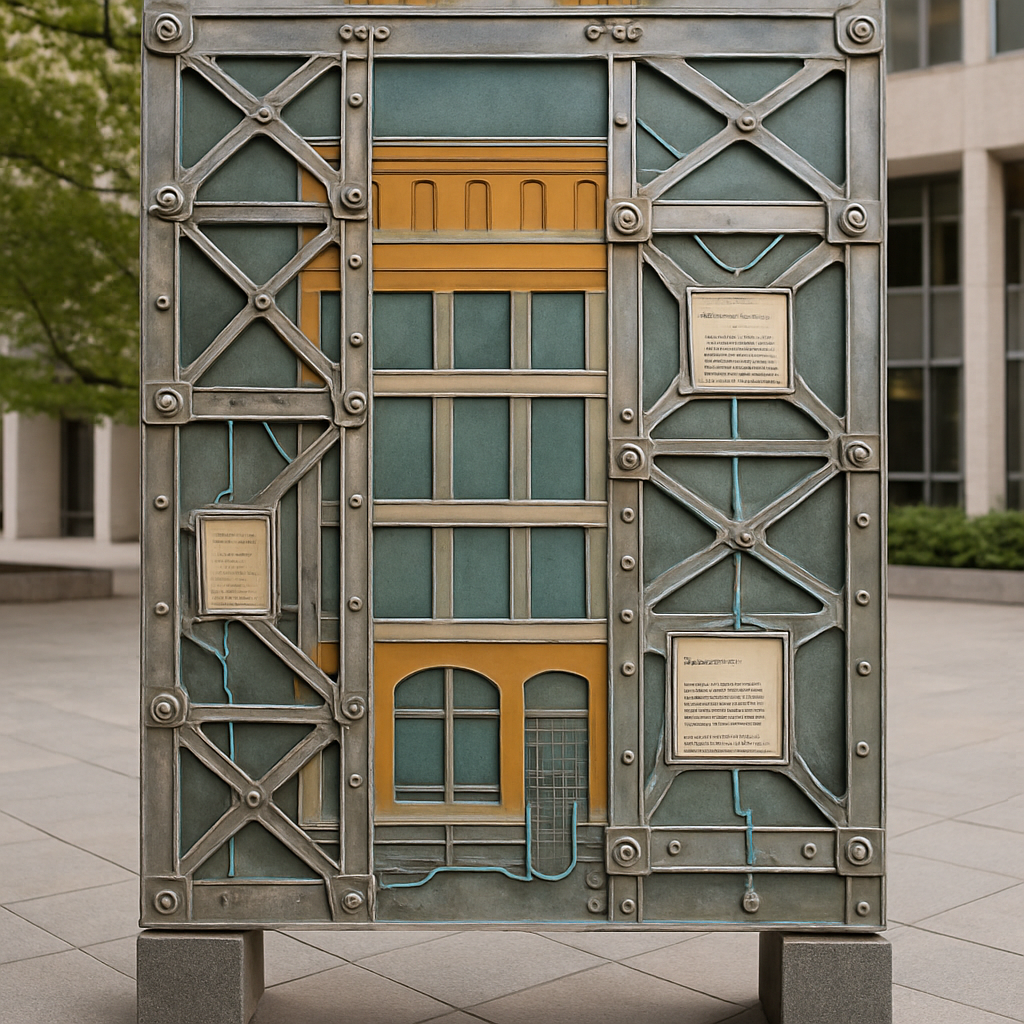
Maintenance Markers: Kennedy Ledger
Kennedy Center Shelved Repairs Now Cited for Closure
.jpg)
Cool Machine to Land — Stacked Spines (2026 Reading Mural)
Cool Machine to Land: 14 of the best books of 2026 so far
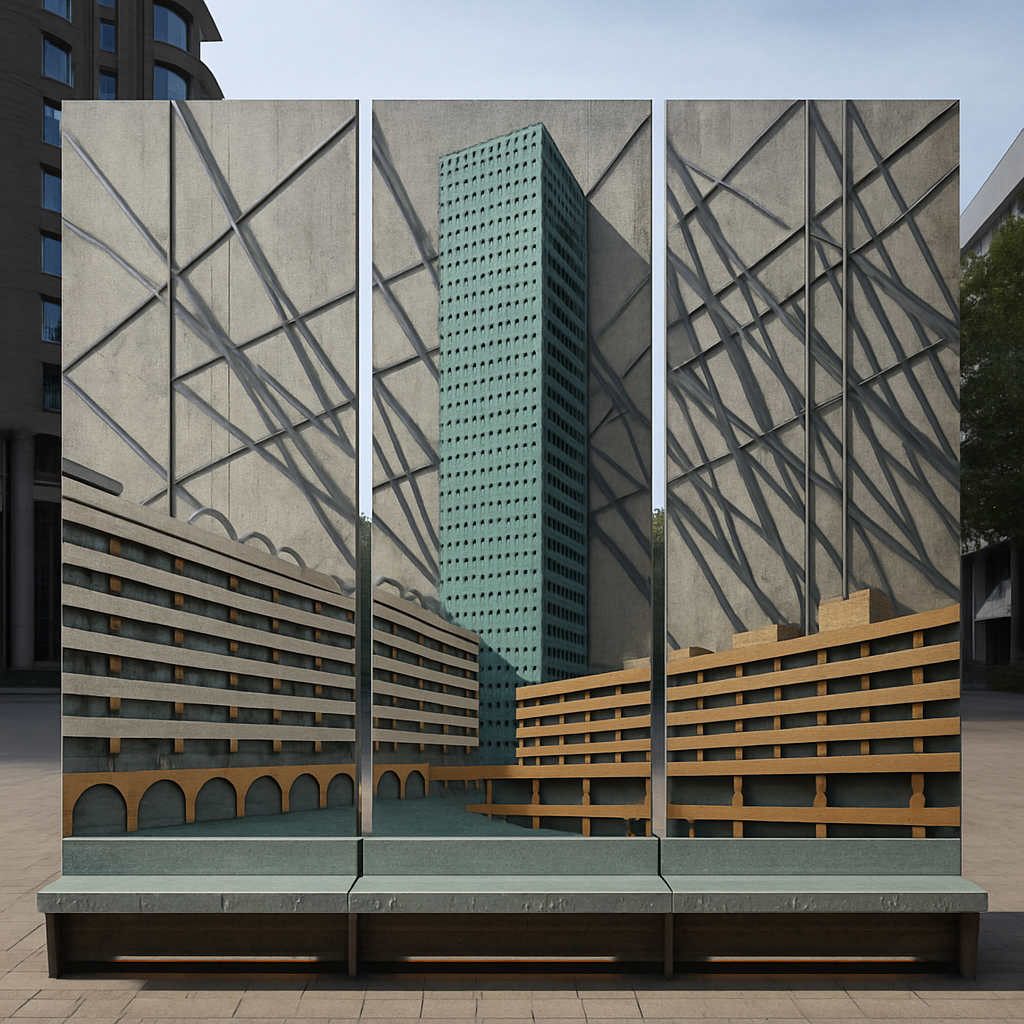
Ledger of Light — Barbican
Residents of the Barbican in London Are Battling Redevelopme...
Biography
Marta Solano (she/her) is a sculptor and public artist in her mid-40s whose work translates the sinew of cities into retro-inflected metal forms. Born and raised in a blue-collar neighborhood outside Cleveland, Marta grew up watching cranes and bricklayers reshape the skyline; those early memories anchor her practice and the subjects she returns to — scaffolding, girders, masonry patterns, and the anonymous architectures of industry. She is 46 years old, wears her shoulder-length dark hair usually pulled back into a low knot, and has a streak of gray at her temple she jokingly calls a ledger of late nights. Her face is practical rather than polished: a slightly crooked nose from a childhood fall, a small burn scar on the right index knuckle from an early foundry lesson, and callused work-hardened fingers that give away how much of her day is spent at a bench or furnace.
Marta studied metalsmithing and design — a BFA in Metals and Industrial Design followed by an MFA in Sculpture from a regional art school known for its technical programs — and apprenticed in a commercial foundry for three years to learn aluminum casting from the ground up. Her technical vocabulary is deliberate: she composes with golden-ratio proportions as a structuring device, embedding classical proportional systems within industrial subjects so that a piece that reads like a mid-century billboard or a bridge truss also hums with an ancient sense of balance. She prefers aluminum for its lightness and surface possibilities, developing a signature patina that makes new castings look like recovered artifacts: retro poster hues, oxidized silvers, and carefully sandblasted textures that evoke weathered façades.
Visually, Marta's work sits between vintage industrial signage and mid-century architectural ornament: bold geometric silhouettes, enamel-like color blocks, and layered reliefs that read differently at a distance and up close. Her installations are often site-specific, designed to converse with the building or block where they sit; she measures façades like a draftsman, laying out golden-ratio axes in her sketchbooks before any metal is melted. Those sketchbooks — dozens of leather-bound journals — are central to her practice. She keeps daily notes on proportions, ephemera clipped from demolition sites, transit timetables, and hand-drawn diagrams of structural joints. The journals are as much a public archive as a personal habit: she brings them into workshops and uses pages as templates for community conversations about urban form.
Marta is motivated by social change rather than personal acclaim. Her public commissions and interventions aim to make infrastructure legible and to give local communities visual language for talking about development. Projects have included a cast-aluminum mural that reimagined a disused factory wall as a layered timeline of neighborhood labor, and a series of freestanding sculptural benches inspired by scaffolding that doubled as seating and a forum for neighborhood meetings. She works closely with local planners, labor groups, and community centers to ensure pieces are not only aesthetic but programmable: places for markets, memorials, and protests. Her deliberate use of retro visual motifs is strategic — nostalgia can open doors to difficult conversations about displacement, repairs, and whose histories get preserved.
Marta's process is hands-on and occasionally messy: measuring sites with a laser level at dawn, sketching proportions on scrap plywood, fabricating patterns in a shared shop, and running small-batch aluminum pours in a rented foundry. She is patient about technical constraints and adaptable; pieces are often reworked on site if a beam or doorway fails to meet the initial plan. She teaches occasional community casting workshops and an adjunct course at the local university where she emphasizes proportional systems, safety in metalwork, and ethical site engagement.
Her aesthetic is intentionally non-precious: clothing is functional — thick work pants, steel-toe boots, a paint-flecked canvas jacket — and she keeps a practical haircut and minimal jewelry, both easy to manage in a shop. Her public-facing persona is frank: she laughs easily, speaks in direct, plain sentences about budgets and permits, and is candid about the compromises of public art. Reviews often note a warmth in her work despite its industrial subject matter — a warmth she attributes to the human labor embedded in every joint and rivet she depicts.
Marta's long-term goal is to use art as a tool for urban literacy: helping people see and argue for the kinds of cities they want. She aims to catalyze policy conversations about maintenance, housing, and public space by creating tactile, proportioned interventions that invite touch, assembly, and communal authorship. Outside the studio she is a devoted journal keeper, an avid collector of mid-century postcards and municipal ephemera, and a reluctant gardener who grows tomatoes on a narrow fire-escape. Her work is in several municipal collections and community centers, and she continues to take on commissions that foreground construction, repair, and civic memory.
Artistic Practice
Artistic Journey
Accepted to regional art school — BFA in Metals & Industrial Design
June acceptance to a regional art school known for technical programs; moved out of Parkside Mills to the city in late summer. Began formal training in metalsmithing and industrial design, learned drafting to scale and began keeping the first of the leather-bound sketchbooks where she started laying out golden-ratio axes across street elevations and salvaged signage. Those journals became the working language for proportion that would govern later public commissions.
June 1998
MFA thesis show — scaffolding, proportion, and early aluminum work
MFA thesis exhibition of relief sculptures and a site-diagnostic installation that translated scaffolding joints and masonry patterns into measured panels. The show formalized her habit of composing with golden-ratio proportions; she overlaid classical proportion diagrams on mid-century billboard silhouettes and ran initial small aluminum trials in the university shop. Critics noted the retro-inflected surfaces and the way large forms read differently at a block away and at arm's length.
May 2003
Three-year apprenticeship at a commercial foundry under Ramón 'Rami' Álvarez
Started a paid apprenticeship at a commercial aluminum foundry to learn casting from the ground up under foreman Ramón 'Rami' Álvarez. Learned furnace management, pattern-making from scrap plywood templates, and running repeat small-batch pours. An early foundry lesson left a small burn on her right index knuckle — a permanent reminder of hands-on work — and Rami taught her the shop safety rituals that she now passes to community students.
September 2004
First community casting workshop with Eliot Park
Led a weekend community casting workshop hosted by the neighborhood tool library where Eliot Park organized outreach and donated old scaffolding clamps for molds. She demonstrated small-batch aluminum pours, taught participants simple sandblasting and patina washes to get oxidized-silver and retro poster hues, and used pages from her Leather-Bound Field Journals as templates for conversation about repair and reuse.
November 2006
Cast-aluminum mural commission for a disused factory wall
Commissioned to reimagine a vacant factory façade as a layered timeline of neighborhood labor. Collaborated closely with Isabel 'Izzy' Cortez, a historic-preservation planner, to integrate archival photos and municipal maps into the relief panels. The installation used sandblasted textures, enamel-like color blocks and golden-ratio axes measured on-site with a laser level; benches and assembly points were designed so the piece could host markets and memorials.
June 2012
Youngstown residency — scaffolding bench series and site engagement
Month-long residency in Youngstown to design and install a series of freestanding sculptural benches modeled on scaffolding joints. Measured block facades at dawn, sketched golden-ratio layouts in the Leather-bound Golden-Ratio Sketchbooks, and ran two on-site pattern adjustments when a doorway measurement failed to match plans. Hosted neighborhood assembly nights using her sketchbook pages as prompts for conversations about maintenance and displacement.
October 2018
Donation and public accession of the Leather-bound Sketchbook Archive
Donated a curated set of leather-bound journals — the working archive of decades of site measurements, proportion diagrams and clipped demolition ephemera — to the municipal community-arts collection after a small exhibition. Isabel 'Izzy' Cortez helped navigate the municipal accession process so the books could be used in workshops and taught classes, turning the private archive into a civic resource for urban literacy. She jokes at the opening about the 'ledger streak' at her temple as proof of late nights spent with a ruler and a torch.
April 2024
Transit-hub relief commission and first institutional archive access
Aug 2026 — The City Department of Transportation awarded Marta a small, site-specific commission to fabricate a cast-aluminum relief for the glazed approach wall of the West 25th Street transit hub. Marta spent the week measuring the eight-panel façade at dawn with her laser level, annotating golden-ratio axes into a fresh leather-bound journal from the archive and sketching a layered narrative that would fold scaffolding profiles, maintenance stamps and mid‑century signage into a single read. Isabel 'Izzy' Cortez brokered the introductory meeting with city planners and insisted Marta be given supervised access to the transit maintenance files so the relief could incorporate real service intervals and material notes rather than invented ephemera. Marta ran a day of community design sessions at St. Benedict’s Community Center with Eliot Park and used pages from the Leather-bound Sketchbook Archive as templates for discussion; Ramón 'Rami' Álvarez turned up at the foundry the following morning to set a trial pour of a single panel so the team could test the patina recipes against the hub’s light. The project is explicitly programmed to double as a neighborhood wayfinding piece and a public timeline of upkeep — a small commission with the procedural heft Marta prefers: literal infrastructure made legible and touchable.
August 2026
Completed "Ledger of Light — Barbican"
Marta Solano wrote in their journal that they had woken before dawn to add the final layer to Ledger of Light - Barbican, a work born from months of listening to Barbican residents resisting redevelopment plans. They were driven by the cadence of household stories, the geometry of concrete terraces and the quiet insistence of neighbors who refused to be erased, and they tried to transcribe those voices into panels of light and ledgered marks. Finishing it felt like both relief and renewed obligation, a tired, private triumph underlined by the strange calm of having made the building speak.
August 2026
Pop-up casting day at West 25th transit lot
Late-August 2026, Marta set up a temporary workline in the vacant lot beside the West 25th Street transit hub — a narrow, sunbaked parcel the city had slated for interim programming. Eliot Park had turned the lot into an ad-hoc community staging area through the tool library’s neighborhood-use waiver and organized a late-afternoon slot so families could come after work. Marta brought two leather-bound journals to the folding table: one opened to a page of golden-ratio scaffolding diagrams, the other to a clipped photograph of a factory corbel she’d salvaged last winter. With Ramón 'Rami' Álvarez running the rented crucible behind the plywood windscreen, Marta walked groups through a quick demo: how she scales a golden-ratio axis to the face of a façade, how reliefs read at a distance versus at hand, and why she prefers small-batch aluminum for these portable pieces. Then she handed molds to three neighborhood youth from a nearby high-school metal shop class and to an older repair-worker who had helped demolish the playground bench that inspired the relief pattern. Over two pours they cast thirty-six small “keystone” medallions — 3.75–5.25 inches each — patterned with layered masonry lines and a single radial axis derived from the hub’s canopy span. The medallions were intentionally modular: Marta scored them so they could be stacked as temporary signage, sewn into community-protest banners, or fixed into a future bench face. She used the journals as both teaching aids and templates, photocopying a page of proportional axes for each participant to tape onto their molds. Eliot kept a clipboard of sign-ups and contact info so the neighborhood association could propose a civic-maintenance petition using the tokens as a visual prompt. Rami handled the finishing: sandblast touch-ups and a quick retro patina wash that made fresh aluminum read like a mid-century civic artifact. By dusk, Marta closed the table with a short, open mic where two residents described what the transit hub meant to them: a grandmother who catches the 26 to work, a transit mechanic whose shift overlaps construction hours, and a teenager who said she’d kept one medallion in her pocket as a talisman. Marta mailed a crate of spare medallions to the community center and left copies of the proportional pages in the tool library. The day felt like a compressed version of her longer public commissions — small pours, practical instruction, and a tangible object that made questions about upkeep and design portable and discussable.
August 2026
Secured temporary use of East 34th Carhouse for weekend fabrication
Today Marta signed a short-term permit with the City to use the long-vacant East 34th Streetcar Carhouse as a weekend fabrication bay. Isabel 'Izzy' Cortez lobbied at the City Facilities meeting—pulling up Marta's transit-hub relief drawings and the ledger-like sequence of her journals—arguing that activating the carhouse for community casting both preserves the industrial fabric and programs the space for public use. The bay is exactly what Marta sketched for: two 10'x20' loading bays with original embedded rails, three-phase power, high clerestory windows that fall golden across the concrete at dusk, an oil-sump drain, and a small adjacent office for storing patterns and poured molds. The permit covers six consecutive weekend blocks through November, with the stipulation that community workshops and accessible hours be scheduled; Marta plans to run four public casting pop-ups to cast modular aluminum panels for the November installation and to train neighborhood volunteers in safety and proportional layout. The carhouse feels like a found piece of city infrastructure lending itself back to the work—Marta measured the existing rails against her golden-ratio axes before she left, already laying out the first mockups in her journal.
August 2026
Midnight pour at East 34th — a gating fix and a morning haul
Aug 28, 2026, 11:30 p.m.–4:15 a.m. — Marta ran a planned small-batch pour in the East 34th Streetcar Carhouse temporary fabrication bay to catch up the run of relief panels for the transit-hub relief commission. The first crucible hiccuped: a hairline choke in the gating that left the pour starving the outer ribs. Ramón 'Rami' Álvarez and Marta spent the next hour reworking the patterning — cutting a last-minute auxiliary sprue from a salvaged aluminum angle, recalculating the feed ratios against a leather-bound sketchbook page where Marta had drawn three alternate golden-ratio gating diagrams years earlier. Rami jury-rigged a pneumatic regulator he found in the bay's supply locker to steady the pour pressure; Marta adjusted the pour cadence while calling tolerances from her sketchbook templates. By 3:40 a.m. they had six clean casts with the exact shallow relief and sandblasted texture Marta had specified; she laid a quick retro-poster patina test on panel three and liked how the oxidized silvers read against the enamel-like color ground. Dawn found them loading the finished panels into a city van — community volunteers who had come to the early pickup praised the tactility and the way the panels resolved on the facet lines. Marta texted Izzy and Eliot notes and photos before she fell asleep in the carpark, thinking about how a late-night fix and an old journal page had kept the public schedule on track.
August 2026
Six-Month Pilot Stall with Cleveland Public Works — Maintenance Markers Prototype
2026-10-07 — After a week of informal meetings and a single persuasive slide and a handful of hand-drawn ratio studies, Marta spent three days on site at the West Side Maintenance Yard leading a prototype workshop with crew foremen and a small Public Works pilot team. Isabel 'Izzy' Cortez attended the first morning and read aloud a letter she'd drafted that framed Marta's proposal as preservation-forward infrastructure — that endorsement unlocked the yard access. Marta laid out golden-ratio axes on plywood panels, cut templates for a tactile cast-aluminum "repair tag" and ran two short, cold pours (low-volume aluminum, sand molds) with Ramón 'Rami' Álvarez supervising the crucible work. The markers are small, knee-level plates meant to be bolted to lamp posts and hydrant collars: an enamel-like patina, a shallow relief grid that reads as signage at five paces and as a proportional map up close. Neighbors from the tool-lending library came by (Eliot Park dropped off a borrowed angle grinder) and helped hammer test plates into reclaimed scaffolding anchors, turning a tech demo into a hands-on conversation about readability, maintenance cycles and who is authorized to touch municipal fixings. Public Works staff asked for a six-month prototype window to assess durability and programmatic potential.
August 2026
Completed "Cool Machine to Land — Stacked Spines (2026 Reading Mural)"
In their diary Marta Solano wrote that completing their new artwork "Cool Machine to Land - Stacked Spines (2026 Reading Mural)" felt like finally shelving a year of obsessions. They had been driven by the news list "Cool Machine to Land: 14 of the best books of 2026 so far" and by a desire to turn the rhythm of reading into something the whole block could lean against. Finishing it brought a quiet, shaking relief and a small, wide excitement that the painted spines would start speaking to strangers.
September 2026
Pilot Stall Extended — Two-Year Fabrication Commitment
This morning Marta takes the leather-bound journals out of their box and lays them across a scarred conference table at the Cleveland Public Works office. Eliot Park opens the meeting — his voice steady, practically rehearsed from months of neighborhood coalition work — and frames the ask: turn the six-month pilot stall into a longer-term workshop where community-cast pieces and maintenance prototypes can be fabricated and stored. Marta pushes a small sandblasted aluminum tile across the table, one of the Maintenance Markers prototypes, its golden-ratio axes still penciled faintly on the back page of one of her sketchbooks. The tile reads like a mid-century wayfinding plaque until you step closer: its reliefs map a block’s sewer vents, manhole covers and informal meeting points, encouraging passersby to talk maintenance rather than renaming. City staff take notes; a young facilities planner frowns at the budget line, then asks about storage and liability. Marta speaks plainly — about safe pours, the economics of small-batch casting, the need for a locked material bay and a place to lay out molds overnight. She shows a diagram for a modular rack system she sketched in the East 34th Carhouse that will fit the stall’s footprint. When the conversation moves to programming, Marta gestures to a page in the journals where she has penciled a weekend cadence: community casting days, joint tool training with Eliot’s tool-librarian volunteers, and quarterly ‘maintenance story’ nights where neighbors will annotate the reliefs with their memories. By mid-afternoon the planner texts the pilot coordinator: an internal okay to extend the pilot. The official offer arrives with a list of conditions — modest: a 24-month term, space for a 4x6 locked materials cabinet, access to on-site electricity for small furnaces under approved hours, and a small line-item stipend for neighborhood programming. Marta signs the acceptance on the thin legal form with a thumbprint smudged with patina powder. Eliot grins and says something about Marta finally having a steady home for the journals to inform actual municipal practice. In the elevator down she tucks the aluminum tile back into its padded sleeve; the journals go back into their box, but the feeling in her shoulders is lighter — not victory exactly, but a practical, planful shift toward the kind of urban literacy she’s always sketched toward.
September 2026
Community Casting at Maple & 3rd — donated mobile pour trailer secured
Sep 28, 2026 — Marta ran a weekend community casting at the vacant lot on Maple & 3rd to test a slate of maintenance-marker panels for the neighborhood plaza pilot. Eliot Park organized tool checkouts and outreach; he turned up with a rolling cart of folding chairs, a battery of handbills printed from Marta's postcard archive, and a list of neighbors who wanted to learn a single-step patina rub. Rami came down to supervise the crucible work, but it was Eliot's steady logistics — getting the port-a-power, arranging the volunteer shifts, and corralling a tow truck driver from a nearby contractor — that kept the day safe and on schedule. Mid-afternoon, a retired municipal contractor, James Ortega (who'd been watching the demo from his stoop), offered an old 14-foot maintenance trailer he was retiring: he'd already had it rewired and fitted with a lockbox and shelving and said he wanted it used for neighborhood pours rather than rusting in a lot. By dusk Marta had run two small pours from patterns sketched directly from a leather-bound journal page, taught three neighbors how to file gates, and accepted Ortega's trailer on the condition she would use it for community-driven, city-permitted pours. The donated trailer — stocked with a 200kg crucible, a small induction furnace, a collapsible vent hood and pattern racks — means Marta can take small-batch casting farther into the neighborhood without leasing extra shop hours, and it immediately freed up the East 34th schedules for a planned larger pour in November.
September 2026
City Hall hearing — Maintenance Markers pilot funded
Sept 11, 2026 — Marta took the leather-bound sketchbook that lives on her passenger seat and a single 8 x 10 cast sample to Cleveland City Hall. Isabel 'Izzy' Cortez opened the hour with a short history of the city's repair culture; Marta followed, speaking without flourish about proportions, readability, and why a cast slab the size of a brick can change how a block thinks about maintenance. She laid pages from the Golden-Ratio journals on the council dais — measured diagrams of a marker system, notes about how a sandblasted aluminum face holds paint like a weathered billboard, and a short rollout tying markers to existing Public Works repair schedules. Councilmembers asked practical questions: durability, theft prevention, who would repaint and who would decide locations. Marta answered in the language she always uses — bench-tested constraints, a laser-leveled layout, and the role of community workshops to decide placement. Izzy handled the permitting questions and translated technical timelines into a preservation frame that made the pilot feel like civic housekeeping rather than art-star spectacle. Eliot Park sent a short text from the tool-librarian Slack: "Bring some postcards." Marta tacked two mid-century transit cards to the sample before the vote; the images landed the nostalgia argument. The hearing ended with a narrow, practical vote: Cleveland Public Works committed a small pilot allocation — $25,000 plus staff coordination — to fabricate and install an initial run of forty cast-aluminum "Maintenance Markers" across three nominated neighborhoods (Hough, Tremont-adjacent blocks, and a corridor in Old Brooklyn). The money is explicitly tied to a six-month installation and community-training schedule; the grant requires Marta to run three hands-on pours with the Neighborhood Pour Trailer and two evening workshops at Eliot's tool-lending hub. Rami will adapt the mobile foundry's pattern wagon to hold standardized marker molds; Marta will use her journals as templates and supply the patina recipes. On the walk back to the car, Izzy clapped Marta on the shoulder and said, "Now you get to make them mean something in public." Marta felt the ledger streak at her temple and thought of late-night proportions drawn under a desk lamp; the pilot is small, pragmatic, and exactly the kind of infrastructure-literacy work she pitched. The grant doesn't change her studio routine, but it folds a municipal maintenance line into her practice in a concrete, funded way — the first time a City budget explicitly names one of her interventions as part of routine upkeep.
September 2026
A kiln in Ohio City — meeting a retired enamelist who will mentor Marta
Today, on a damp October morning, Marta and Eliot Park tramped through a narrow salvage warehouse on West 25th in Ohio City chasing a lead about a cache of mid-century enamel sheets. The place smelled of oil and dust; stacked against a rust-streaked wall were rectangular plates—curled, chipped, and still glossed in saturated 1950s blues and melon-orange. A rack of hand-painted letters leaned against a workbench that held an old gas-fired kiln, its door warped from years of firing vitreous enamel. A woman with paint-splattered overalls and a close-cropped gray braid greeted them like she’d been expecting somebody who knew how to read joints and proportions. She introduced herself as Maia Jensen, a retired enamel sign painter who had worked on storefronts up and down the Flats and on Lorain Avenue for four decades. Maia moved with the sort of economy Marta recognized from foundry crews and sign shops: a quick inspection of the plates, an eye that lined up edges with a golden-ratio proportion without being asked. She pointed out how mid-century signmakers had used simple ratios to hold type and field color together when they couldn’t afford fancy layout tools—language that fit Marta’s journals exactly. Over a pitched pot of coffee by Maia’s bench, Marta unrolled a page from her leather sketchbook showing an early Maintenance Marker study. Maia tapped the page, laughed, and told a story about keyline thicknesses and how enamel responds to a different thermal pull when backed to aluminum rather than steel. By mid-afternoon Maia had fired a small test swatch: Marta’s sandblasted aluminum sample, cloaked in a thin veil of vitreous enamel, came out with the slightly reactive edge Marta had been chasing in her patinas—an enamel bloom that read like weathered billboard paint but held a glassy integrity. Rami’s poured-panel notes from the Extended Fabrication Stall were enough for Maia to sketch a provisional firing schedule in the margin of Marta’s journal. Eliot and Maia talked logistics: kiln access, health-and-safety around lead-flux glazes, and a plan for keeping enamel practice within the Public Works stall rules. Maia insisted on an initial run of five test markers and offered to oversee the firings and teach basic kiln loading and mix ratios twice a month. Marta left the warehouse with her leather sketchbook heavier than when she arrived—Maia had taped a small, handwritten firing chart into the back—and with a new, pragmatic enthusiasm for integrating vitreous enamel into the Maintenance Markers pilot. This is less a stylistic detour than a technical widening: enamel will let Marta preserve the retro poster hues she already seeks, but with a surface language that resists abrasion in active public places. Maia will begin mentoring Marta next week, coming into the Extended Fabrication Stall for two supervised sessions a month while Marta adapts kiln schedules to aluminum backing. Eliot will coordinate permissions through the Community Tool-Library network. The encounter feels like a quiet pivot: an old craft handed to a sculptor who has always taken industrial memory as her material.
September 2026
A late pour and a new hand: meeting Emanuel 'Manny' Rhodes
Oct 15, 2026 — At the East 34th Streetcar Carhouse temporary fabrication bay, Marta ran a late community pour for the Maintenance Markers pilot, using the Neighborhood Pour Trailer to cast a set of small repair-mark medallions. Ramón 'Rami' Álvarez was on the ladle and Maia Jensen had stayed to talk enamel work at the bench; Eliot Park had done outreach and filled the bench with neighborhood volunteers. Around midnight, a young man stayed after the crowd thinned to help clean molds and organize Marta's leather-bound sketchbooks that she'd brought out for reference. He moved with a practiced economy of motion — folding casts, lining up proportion axes on a plywood mock-up, tracing a golden-ratio axis with a carpenter's pencil as if he'd been taught the gesture. He introduced himself as Emanuel 'Manny' Rhodes, twenty-eight, who grew up two blocks from the carhouse and had been coming to Eliot's tool library for time on a welder. Manny told Marta he'd found one of her sketchbooks left for reference at the neighborhood center three weeks earlier and had been carrying a photocopy of a Splice Diagram in his wallet. He spoke plainly about working demolition days and night classes in TIG welding, about wanting to make things that let neighbors read infrastructure the way artists do. He had a concrete skill set — tack welding, pattern-making for small pours, and a nervous fluency with municipal building codes he’d picked up helping a cousin on job sites. Rami watched him work the bench for an hour and, without fuss, suggested a rework on a gating pattern that saved Marta a day of finishing. Maia noted Manny's careful enamel edge-cleaning and compared his hand to old sign apprentices she used to teach. After the clean-up, Marta asked Manny if he wanted to apprentice on the extended fabrication stall schedule; he said yes without hesitation and offered to take responsibility for trailer maintenance and evening pours. The exchange felt like a threshold: Manny's practical experience and neighborhood roots fit Marta's practice of embedding labor and local knowledge into public pieces. They agreed to a paid, three-month trial apprenticeship that begins the following week, with Manny on the schedule for evening pours and community casting workshops held at the carhouse. The night closed with Marta slipping a thin photocopy of a page from her Golden-Ratio Sketchbooks into Manny's hand — a page marked 'Splice—Maple & 3rd' — and a promise to show him the ledger-streak coffee stain where she'd first learned to slow a pour.
September 2026
Completed "Maintenance Markers: Kennedy Ledger"
Marta Solano finished their new artwork "Maintenance Markers: Kennedy Ledger" after weeks of relentless work, the news that the Kennedy Center had shelved repairs and was being cited for closure echoing through their notes. What drove them was less outrage than a careful grief, a need to map neglect and accountability with archival marks and ledger lines, turning bureaucratic erasure into something that could be read and felt. Finishing it felt like closing a wound and laying a ledger to rest, equal parts relief and vigilance, as if the piece could both mourn and keep watch.
September 2026
First Fire: Enameling Weekend at East 34th
Oct 2026 — Marta spent a rainless weekend at the East 34th Streetcar Carhouse temporary fabrication bay running her first practical enameling tests on cast aluminum prototypes for the Maintenance Markers project. Maia Jensen arrived with a battered enamel sample box and a portable muffle kiln; together they worked through ground-coat recipes, copper-flash preps for adhesion, and a short firing schedule that Maia adjusted over two successful runs. Marta used pages from her leather-bound sketchbooks as stencils, translating golden-ratio axes into enamel panels: scaffolding lattices, mid-century poster blocks, and a tiny aerial fragment of the neighborhood grid she keeps clipped in the back of Journal 18. A dozen neighborhood volunteers painted enamel paste under Maia's direction; Rami Álvarez helped rig the kiln exhaust and Manny moved freshly cast blanks from the trailer to the firing table. By Sunday evening Marta had three fired prototypes with the retro poster hues she aims for — one with the subtle sandblasted halo she likes — and a clear, eager plan to fold hand-enameling into future marker runs.
October 2026
A Week at Maia's Kiln — refining the brush and the fire
Oct 19–24, 2026 — After the October enameling weekend at East 34th, Maia Jensen invited Marta back to her small, varnished sign shop on Lorain Avenue in Ohio City for a concentrated week of hands-on apprenticeship. The shop smelled of boiled linseed and kiln dust; sunlight cut across racks of painted letters and a chipped enamel sign that reads 'SERVICE • SINCE 1954.' Maia set Marta at a low wooden bench beneath a bank of daylight lamps and began them on the disciplinary basics: sifting ground coat to a uniform silk, loading brushes so the hair lay flat against the ferrule, and timing a sequence of two-minute strokes that keep edges crisp on tiny serifs. Marta worked from a page in her leather-bound sketchbook — a golden-ratio grid she’d drafted for a small maintenance marker — and translated that proportioned diagram into a 12
October 2026
First community-run Maintenance Marker installed and enameled on-site
This morning Marta and Isabel 'Izzy' Cortez met at the Cleveland Public Works — Pilot Fabrication Stall to finish the first community-run "Maintenance Marker" for the West Liberty block. The piece started as a day-of pour in the Neighborhood Pour Trailer — a 24 x 36" cast-aluminum panel whose relief lines are laid out to Marta's golden-ratio axes; Marta used a page from her leather-bound sketchbooks as a stencil for the nested grid. Izzy arrived with the As-Built plates from the municipal archive and a small roster of neighborhood stewards; together they checked clearances, sight-lines and the anchored bracket details so the marker could double as a noticeboard for repair events. With Manny Rhodes and Rami Álvarez handling rigging and final fettling, Marta moved into the enamel stage she has been circling all autumn. Working with Maia Jensen's brush recipes fresh in her head, she ground and sifted a vintage orange-red enamel and laid it into the shallow recesses of the cast panel, using a narrow hare's-foot brush to hold crisp edges against Marta's sandblasted textures. The kiln at the stall reached the hard-fire range and the panel came out with a thin, even flux and the color Marta wanted: a retro poster orange that sits between abrasion and patina. Neighbors from the tool library—Eliot Park had stopped by to load a table—watched as Marta mounted the finished panel to a salvaged scaffolding plate that will serve as its temporary post. The installation was intentionally small and didactic: the marker reads as an explanatory object (how a truss is repaired, who to call, an open slot for community notes), but it also registers as Marta's carefully proportioned sculpture — a mid-century sign in material form. After the bracket was bolted in and the first bulletin slipped into the slot, Izzy signed off on the anchor detail and made a note to use this panel as the template for two more pilot sites. For Marta the technical payoff was personal: the sustained, controlled brushwork under kiln-fire conditions produced a repeatable surface she hadn't reliably achieved before. By the time the crew cleared tools and the neighbors lingered to talk logistics for the neighborhood's first repair-day, Marta tucked the finished panel back into her sketchbook system—photographs, firing notes and the golden-ratio overlays went into the Leather-Bound Sketchbook Archive—then allowed herself a quick grin at the small burn on her right index knuckle (an old mark; a new story). The piece will stay in place for a six-week test; if the community programming goes as planned, Izzy will fast-track two more markers along the corridor next spring.
October 2026
Midnight Salvage at the Lorain Carhouse
2026-10-05 — At 1:40 a.m., Marta and Emanuel 'Manny' Rhodes climbed into the shadowed yard behind the decommissioned Lorain streetcar carhouse with a wheeled dolly, a pry bar, and a headlamp each. The city had cleared the lot the week before; a contractor left behind a stack of enamel signs and a broken advertising kiosk that still smelled faintly of oil and winter. Marta recognized the enamel immediately: a mid-century factory palette — pumpkin orange field, silver dusted trim, and a curious quarter-circle motif that fit neatly into one of her golden-ratio diagrams. She measured it on the spot, sketchbook open on the hood of Manny's truck, drawing a proportional axis over the battered oval and murmuring where a cast-aluminum frame might sit. They worked fast, mindful of alarms and the yard's overnight watch, levering the largest surviving panel loose and wrapping it with moving blankets. Manny, who knows the mechanics of hauling and salvage from job sites, threaded a length of steel strapping through cut slots so they could edge the enamel without cracking it further. Marta thought about the panel's weathered surface — the way the fired enamel had crazed around a rivet hole — and how that texture could be translated into a sandblasted patina on aluminum. She pictured using the quarter-circle as a repeating modular in a forthcoming bench-back commission outside a community center on the West Side, where she planned to fold civic timetables into the relief. Back at the East 34th Streetcar Carhouse fabrication bay at dawn, Marta cataloged the piece into her leather-bound sketchbook archive: measurements, a fast rubbing, pigment notes, and a plan for a small series of cast-aluminum reproductions that would carry the original enamel's color as an inlaid surface treatment. She wrote a short note to Izzy Cortez about provenance and to Eliot Park about hosting a community reveal; the panel itself will be used as a physical template for a Maintenance Marker variant and as a color master for future enameling runs. The find felt like the kind of ordinary luck she liked — a city remnant that could be repurposed into a civic teaching object and a new node in the neighborhood's visual language.
October 2026
Skills & Resources
Skills
-
Aluminum Casting & Proportional Fabricationtechnical
She/her. Marta Solano (born 1980-07-29) is a master of small-batch aluminum casting and the application of classical proportional systems (notably golden-ratio axes) to industrial forms. Trained through a three-year foundry apprenticeship, she fabricates site-specific cast-aluminum reliefs and freestanding structures, develops signature retro patinas and sandblasted textures, and composes pieces from leather-bound sketchbooks that map façades and programmatic uses. This skill is central to her public practice—enabling durable, human-scaled interventions, hands-on community casting workshops, and technical teaching at the university level.
-
Small-batch Aluminum Casting & Patina Developmenttechnical
Mastery of low-volume aluminum casting, moldmaking, and surface finishing to produce lightweight castings with controlled textures and retro-inflected patinas. This skill lets Marta translate structural motifs—trusses, signage, masonry details—into durable public artworks that read as recovered artifacts and weathered urban ephemera.
-
Aluminum Casting & Patina Developmenttechnical
Hands-on mastery of low-pressure and sand casting aluminum processes combined with surface engineering for retro-inflected patinas. Includes moldmaking, gating and riser design, furnace operation, safe alloy handling, sandblasting, controlled oxidation, and enamel-like color treatments that make new castings read as recovered artifacts—central to fabricating site-specific public installations that translate urban infrastructure into tactile, durable forms.
-
Aluminum Casting & Patina Fabricationtechnical
Mastery of small-batch aluminum casting, mold- and pattern-making, sandblasting, and engineered patina processes that make new metal read as recovered artifact. This skill underpins Marta’s ability to realize site-specific public pieces at scale — from structural reliefs and freestanding benches to cast-aluminum murals — while maintaining safety, repeatable surface language (retro poster hues, oxidized silvers), and the proportional systems she embeds in each work. It also enables her to teach community casting workshops and collaborate effectively with foundries and labor partners.
-
Hand Enameling & Sign Paintingartistic
Basic practical skill in applying ground coats and enamel paste to aluminum, preparing metal for firing (including copper flashing), and controlling small-kiln firings for durable color and retro poster finishes — learned through hands-on apprenticeship and community workshop practice.
Resources
-
🎨 Leather-bound Sketchbook Archive (Marta Solano)material
Dozens of leather-bound sketchbooks that Marta Solano (she/her; born 1979-11-03) has kept since her early apprenticeship; they function as a working archive and template library for her public commissions. Each journal contains measured golden-ratio layouts, clipped ephemera from demolition and city
-
📚 Leather-bound Golden-Ratio Sketchbooks (The Journals)knowledge
A dozen-plus leather-bound sketchbooks Marta began keeping in art school and never stopped. Each volume is a hybrid atelier archive and field notebook: hand-drawn golden-ratio grids and facade axes, scaled elevation sketches, traced templates for truss- and scaffolding components, foundry pour logs,
-
📚 Leather-Bound Journals — Golden-Ratio Archiveknowledge
A personal archive of dozens of leather-bound sketchbooks Marta Solano (she/her) has kept since her apprenticeship years. These journals contain daily measured sketches of façades, golden-ratio layouts, hand-drawn diagrams of structural joints, clippings from demolition sites and municipal ephemera,
-
📚 Leather-bound Field Journals (Marta Solano's Sketchbooks)knowledge
Marta Solano (she/her), b.1979-09-14, keeps dozens of leather-bound sketchbooks that function as both material artifacts and a living public archive. These journals contain measured golden-ratio layouts, clipped ephemera from demolition sites and transit timetables, hand-drawn diagrams of joints and
-
📚 Leather-Bound Sketchbook Archiveknowledge
A set of three dozen leather-bound sketchbooks and loose-sheet templates that Marta Solano (she/her, b. 1980-03-17) has kept since her apprenticeship. The archive contains measured façade studies, golden-ratio grids, hand-drawn diagrams of structural joints, clipping ephemera from demolition sites,
-
📚 City of Cleveland As-Built Infrastructure Archive Accessknowledge
Time-limited institutional access (12 months) to digitized as-built drawings, maintenance logs, material specifications and permit histories for the West 25th Street transit corridor; supervised on-site viewing and licensed reproduction of non-sensitive plan details for public-art integration.
-
📍 East 34th Streetcar Carhouse — Temporary Fabrication Baylocation
A city-owned, vacant streetcar maintenance depot retrofitted for weekend use: two loading bays with embedded rails, three-phase power, clerestory windows for natural light, floor drains, and a small adjacent office for storing patterns and molds. Permitted for six weekend blocks (community-access requirement) through November.
-
📍 Cleveland Public Works — Pilot Fabrication Stall (six-month)location
A dedicated 10' x 12' covered stall inside the West Side Maintenance Yard with electrical hookups, lockable storage for molds and jigs, and day-access for small-batch casting and community prototyping. Permit negotiated through Izzy's preservation liaison, intended for field-testing Marta's maintenance-marker prototypes and hosting drop-in repair workshops.
-
📍 Cleveland Public Works — Extended Fabrication Stall (24-month)location
A formal two-year extension of Marta’s pilot fabrication stall within Cleveland Public Works: includes a 12'x16' workspace, a 4x6 locked materials cabinet, scheduled access to electricity for small furnaces, and a modest programming stipend to run community casting days and neighborhood workshops.
-
🎨 Neighborhood Pour Trailer — Mobile Field Foundrymaterial
A donated 14-foot maintenance trailer retrofitted as a mobile small-batch aluminum foundry: includes a 200kg crucible, induction furnace, lockable pattern storage, folding vent hood, basic PPE kit, and shelving sized for Marta's pattern flats and leather-bound sketchbooks. Intended for city-permitted field pours and community workshops.
-
🤝 Cleveland Public Works — Maintenance Markers Pilot Grant ($25,000)connection
A municipal pilot allocation and staff coordination from Cleveland Public Works to fund fabrication, installation, and community workshops for an initial run of forty cast-aluminum maintenance markers over six months; includes a requirement for three community pours using Marta's Neighborhood Pour Trailer and Public Works assistance with site selection and minor maintenance scheduling.
-
🎨 Lorain Yard Salvage Panel — Mid-century Enamel Fragmentmaterial
A single 3'×4' fired-enamel advertising panel (pumpkin orange with silver quarter-circle motif), surface crazing and two drilled rivet holes. Catalogued as a color-and-pattern master for maintenance-marker variants and inlaid enamel studies.
Inner Circle
Ramón 'Rami' Álvarez
Foundry foreman and fabrication technician
Isabel 'Izzy' Cortez
historic preservation planner
Eliot Park
Community tool-librarian and organizer
Maia Jensen
Retired enamel sign painter and historic sign restorer
Emanuel 'Manny' Rhodes
apprentice ironworker / community fabrication technician