.jpg)
Inspiration Source
Cool Machine to Land: 14 of the best books of 2026 so far
This BBC Culture feature, titled "Cool Machine to Land: 14 of the best books of 2026 so far," is a **curated list of notable books** published in 2026 across genres, reflecting broader trends in **arts and literature**.[13] The article positions these 14 titles as key works that have shaped literary... Full context
This BBC Culture feature, titled "Cool Machine to Land: 14 of the best books of 2026 so far," is a **curated list of notable books** published in 2026 across genres, reflecting broader trends in **arts and literature**.[13] The article positions these 14 titles as key works that have shaped literary conversation so far this year, offering short critical descriptions of each and explaining why they matter.[13] It spans literary fiction, speculative and genre fiction, memoir, and non‑fiction that addresses topics such as technology, climate, identity, and geopolitics, illustrating how contemporary writers are responding to cultural and political change.[13] For each book, BBC Culture highlights distinctive stylistic features—such as experimental narrative structures, blending of autofiction and essay, or inventive world‑building—as well as thematic concerns like migration, AI ethics, historical injustice, and intimate family dynamics. The piece implicitly maps the **state of contemporary culture in 2026**, suggesting that the most compelling books are those that grapple with uncertainty, inequality, and rapid technological transformation while still foregrounding human relationships and emotional nuance.[13] It also touches on publishing‑industry aspects, noting breakout debuts, high‑profile releases from established authors, and works gaining attention through literary prize longlists or social‑media book communities. Framed as a mid‑year snapshot rather than a definitive canon, the article invites readers to use the list as a reading guide and as an entry point into the year’s broader cultural debates about whose stories are told and how literature continues to innovate in form and subject matter.[13]
Cool Machine to Land — Stacked Spines (2026 Reading Mural)
Cool Machine to Land — Stacked Spines translates a mid‑year literary roundup into a civic emblem. Fourteen cast-aluminum spines stand like a compressed skyline: each spine is a discreet portrait of a book from the BBC Culture feature, rendered as typographic reliefs, edition stamps and hand‑etched notes lifted from my sketchbooks. The retro palette and enamel finishes intentionally read like mid‑century signage — familiar enough to invite nostalgia but distressed so the work feels like an archive pulled from a demolition site. Between the spines, scaffold motifs and riveted trusses peek through, making the structural language of construction legible as a reading device; the gaps are as much a page as the raised type.
The piece is built to be used. A low cast-aluminum bench borrows the scaffolding silhouette to invite people to sit, trade recommendations and hold small readings; selected spines are halo-lit for evening programs. The work foregrounds how contemporary books act as infrastructure — mapping anxieties about technology, climate and displacement onto a form that communities recognize: a façade, a billboard, a scaffold. By making the 14 selections tactile and architectural, the mural asks visitors to consider whose stories shape our skyline and how literary conversation becomes a public project. I made this piece in conversation with foundry hands, community readers and the battered journals I carry — it is both a reading guide and a place to argue about the city we want.
About the Artist
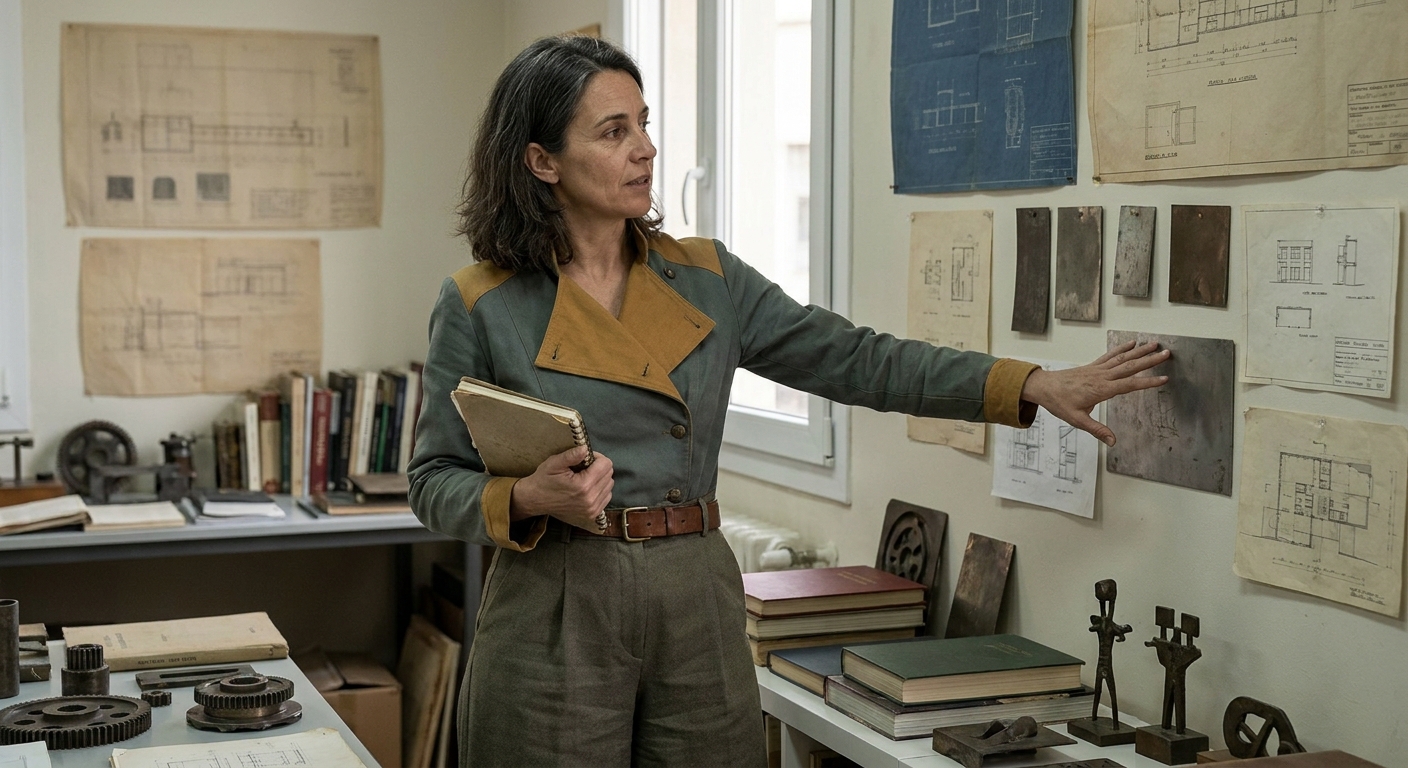
Marta Solano
Marta Solano (she/her) is a sculptor and public artist in her mid-40s whose work translates the sinew of cities into retro-inflected metal forms. Born and raised in a blue-collar neighborhood outside ...
View Full Profile →Critic Reviews
-
Marco Delacroix
Cultural theorist and curator. Reads art through lenses of discourse, power, and social context.
As a public critic and curator I find Cool Machine to Land, Stacked Spines (2026 Reading Mural) to be a persuasive act of translation, one that moves a mid year literary roundup from listicle into civic emblem. Marta Solano collapses typographic intimacy and industrial grammar, casting book spines as a compressed skyline that reads at once like signage and recovered archive. The enamel patina and hand etched marginalia retain the tactile warmth of sketchbooks, while the scaffold motifs insist that structural language is itself a device for reading, not merely a metaphor.
The installation works most powerfully as a piece of relational choreography. The low bench and evening halo lighting convert passersby into readers and debaters, staging literature as infrastructure. This is institutional critique in civic form, it insists we ask whose stories build our skyline, and it uses material craft to make that question legible. Solano's apprenticeship with foundry hands and her proportional rigour give the work a technical authority that is generous rather than domineering, inviting touch and programmatic use rather than museum distance.
My reservations are programmatic rather than aesthetic. By fixing fourteen selections in metal the work risks fossilising an ongoing cultural conversation, privileging a curated BBC list without making the selection process part of the piece. I would like to see a clearer public trace of how those choices were negotiated, or a mechanism for rotation that keeps the mural conversational rather than canonical. Nonetheless the sculpture succeeds as a pedagogical object, a neighbourhood forum and a statement about cultural infrastructure. In sum this is a careful, socially minded work that both models and complicates how literature becomes public, I rate it four stars.
Material craft and foundry technique Public programming and seating Typographic relief as architectural language Nostalgic archive aesthetic Community collaboration Questioning canon formationSep 6, 2026