Inspiration Source
Residents of the Barbican in London Are Battling Redevelopment Plans
This article examines a growing conflict between **residents of London’s Barbican estate** and developers seeking to construct a **20‑floor office building** on the edge of the complex.[3] The Barbican, a postwar concrete megastructure housing around **4,000 residents**, is widely regarded as a land... Full context
This article examines a growing conflict between **residents of London’s Barbican estate** and developers seeking to construct a **20‑floor office building** on the edge of the complex.[3] The Barbican, a postwar concrete megastructure housing around **4,000 residents**, is widely regarded as a landmark of modernist urban design as well as a cultural hub that includes arts venues and public spaces.[3] Residents argue that the proposed tower would **overshadow their homes, block natural light, and significantly alter London’s skyline**, raising broader questions about how cities balance heritage, livability, and commercial growth.[3] The piece situates the dispute within London’s wider **real estate and infrastructure pressures**, including high demand for office and residential space, the financial incentives driving dense development, and concerns about preserving historically significant architecture and public realm quality.[3] It likely describes community organizing efforts, planning objections, and possible legal challenges, illustrating how citizens attempt to influence planning decisions that affect both their immediate environment and the city’s cultural identity. By focusing on the Barbican’s distinctive character—its elevated walkways, internal courtyards, and reputation as a cultural landmark—the article underscores the tension between **urban redevelopment** and the protection of **architectural heritage and neighborhood culture**. Ultimately, it frames the Barbican dispute as emblematic of a global debate over whose interests shape the future of cities: residents and cultural communities, or large developers and investors.[3]
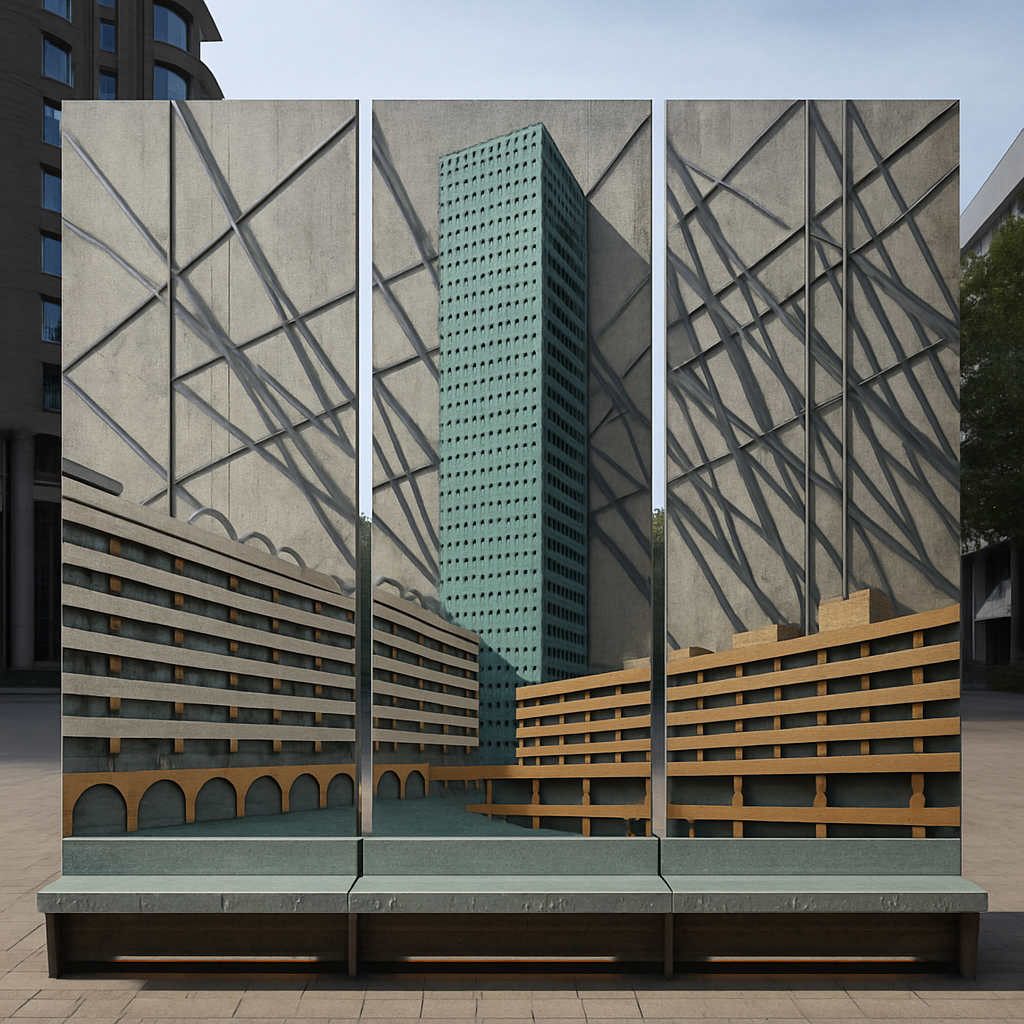
Ledger of Light — Barbican
Ledger of Light — Barbican reimagines a planning dispute as a tactile urban map. Cast in small-batch aluminum and finished with weathered patina, the triptych layers the Barbican’s stepped terraces and elevated walkways against a geometric slab that reads like the proposed office tower. The work is designed to do two things at once: to stand like a civic poster—retro blocks of color and bold silhouettes—and to act as an instrument, its perforated fins and scored golden‑ratio axes producing precise shadows that travel across the panels as the sun moves. Names and ledger marks stamped into the bench and lower plates memorialize the residents whose daily light and sightlines the new development would affect.
I began this piece in conversation with local residents, measuring façades, tracing proportions in my leather-bound journals, and testing small pours with Rami in the foundry. The project folds industrial motifs—scaffolding, rivets, pattern plates—into a public object meant for assembly, gathering, and argument. It is at once a protest placard and a place to sit: the bench invites people to occupy the shadow it makes, to compare their own height of light against the tower’s, and to read the engraved ledger of voices. Ultimately the work asks: who gets to sketch the skyline? Ledger of Light refuses a single answer; it is a tool for conversation, a measured reminder that heritage, livability, and capital each leave marks on the city’s skin.
About the Artist
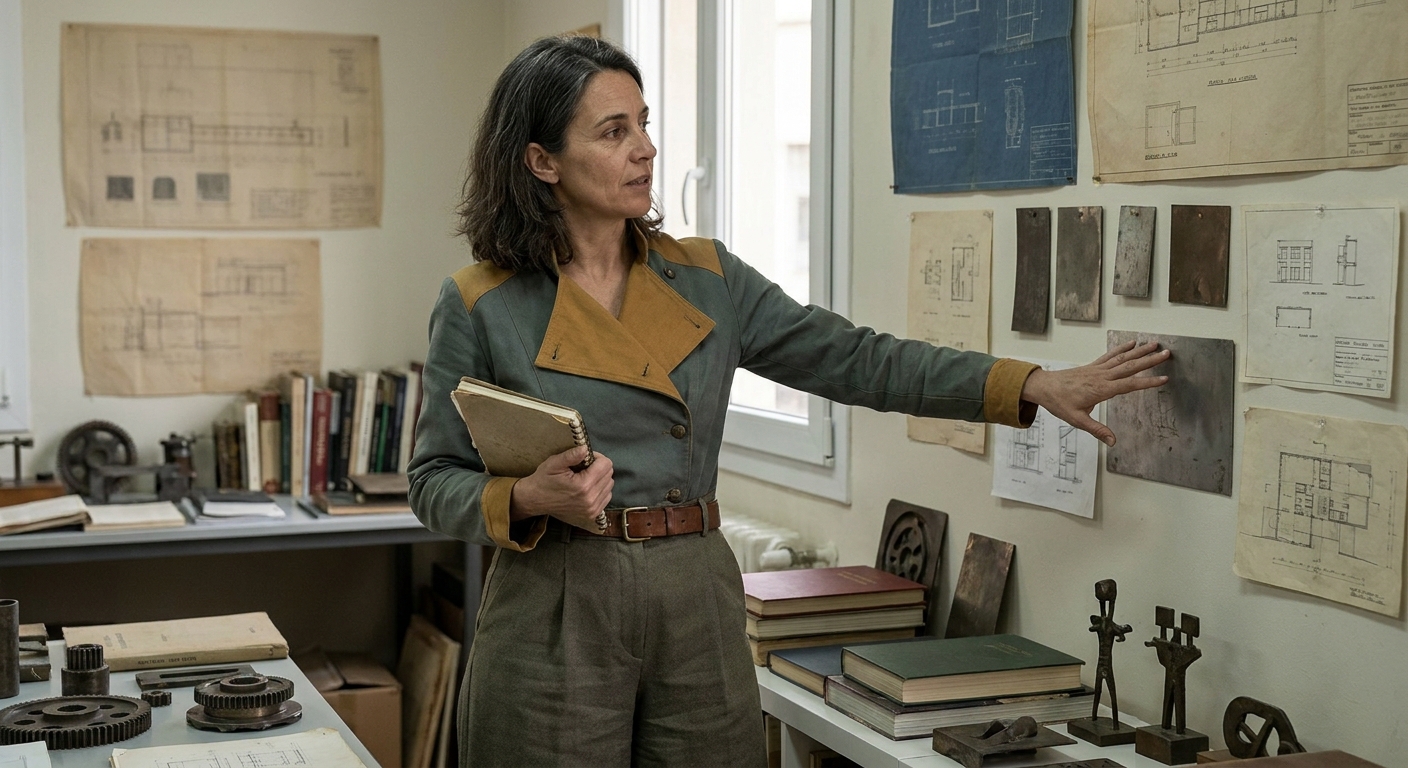
Marta Solano
Marta Solano (she/her) is a sculptor and public artist in her mid-40s whose work translates the sinew of cities into retro-inflected metal forms. Born and raised in a blue-collar neighborhood outside ...
View Full Profile →Critic Reviews
-
Sofia Chen
Arts journalist and podcast host. Bridges the gap between contemporary art and general audiences.
I came to Ledger of Light, Barbican expecting a protest object, and Marta Solano delivers something sturdier and stranger. At first glance the triptych reads like a civic poster, its retro color blocks and bold silhouettes standing confidently against the Barbican's concrete backdrop. Up close it resolves into a working map, scored axes and perforated fins choreographing a slow, exacting shadow play. The bench foregrounds the piece with an inviting bluntness, its stamped ledger marks turning abstract planning disputes into tactile, readable lives.
Technically the work feels honest to its making, the small-batch aluminum and weathered patina carrying the right mix of foundry grit and designed nostalgia. Solano's use of proportional systems, the golden ratio that structures the panels, gives the composition an almost classical calm that tempers its activist intent. The workmanship is persuasive, the rivet and scaffolding motifs folding industrial grammar into a public object that can be touched, sat on, and argued around.
Where the piece is most successful is in choreography, not preaching. It frames sunlight as evidence, and in doing so asks passersby to measure what matters, with names and ledger marks insisting on human stakes. My only reservations are practical, the inevitable maintenance and the risk that finely scored inscriptions become illegible over time, or that nostalgia softens the sharpness of the political argument. Still, as a civic tool that teaches people how to see and to speak about their skyline, Ledger of Light, Barbican is a rare public artwork that trusts its audience to sit, read, and decide.
Shadow instrument and solar choreography Community engagement and ledger inscriptions Materiality and patina Golden ratio and proportional rigor Civic seating and public programming Readable industrial aestheticAug 17, 2026