Inspiration Source
News outlets want readers – and big tech – to pay for their content. But blocking the Internet Archive will leave major holes in the public record
This piece analyzes why **news outlets are pulling back from allowing the Internet Archive to store and serve copies of their articles**, even as they simultaneously insist that readers and large technology platforms pay more for access to news.[5][13] According to the article, publishers do not pri... Full context
This piece analyzes why **news outlets are pulling back from allowing the Internet Archive to store and serve copies of their articles**, even as they simultaneously insist that readers and large technology platforms pay more for access to news.[5][13] According to the article, publishers do not primarily oppose the Archive’s mission of long-term preservation but are worried about **who else might use the archived content and under what conditions**.[13] In particular, they fear that free or easy access through the Archive could be exploited by commercial entities—search engines, AI companies, or other intermediaries—without adequate compensation, further eroding already fragile revenue models.[5] The article describes an emerging landscape in which **copyright, licensing, and digital archiving are deeply entangled**, with publishers increasingly deploying technical measures (robots.txt rules, paywalls, and access restrictions) to prevent or limit automated archiving. This trend magnifies tensions between **market-based control of journalism and the public’s interest in enduring, open documentation of events and debates**.[5] As more outlets restrict archiving, the risk grows that future historians and researchers will encounter **fragmentary or biased records**, skewed toward organizations that chose to cooperate with preservation efforts. From the perspective of librarians, archivists, and open-access advocates, the article stresses that **blocking the Internet Archive creates "major holes" in the public memory of journalism**, particularly in digital-only outlets that may lack robust institutional archiving traditions.[5] It notes that local reporting, investigative series, and community-focused stories often exist only on publisher servers. If those servers are reorganized, content management systems change, or companies fail, unarchived stories may simply vanish. This makes the **Archive’s role in documentation—not just of national headlines but of everyday civic information—especially critical**.[5] The author frames the conflict as part of a wider re-negotiation of the "social contract" between media organizations and the public: newsrooms seek sustainable funding but also occupy a **quasi-public function as keepers of civic records and collective memory**.[5] The article suggests possible compromises, such as **delayed open access (after a revenue window), tiered licensing, or metadata-only indexing**, that could respect publishers’ economic concerns while still safeguarding robust archival coverage.[5][13] Overall, the piece situates the current restrictions as a **pivotal moment for archive and documentation policy**. Decisions made now about web archiving practices may shape how comprehensively future generations can study everything from local elections and environmental crises to cultural trends and social movements, making the stakes higher than they might appear in a narrow copyright dispute.[5][13]
Monads of Memory: Archive in Default
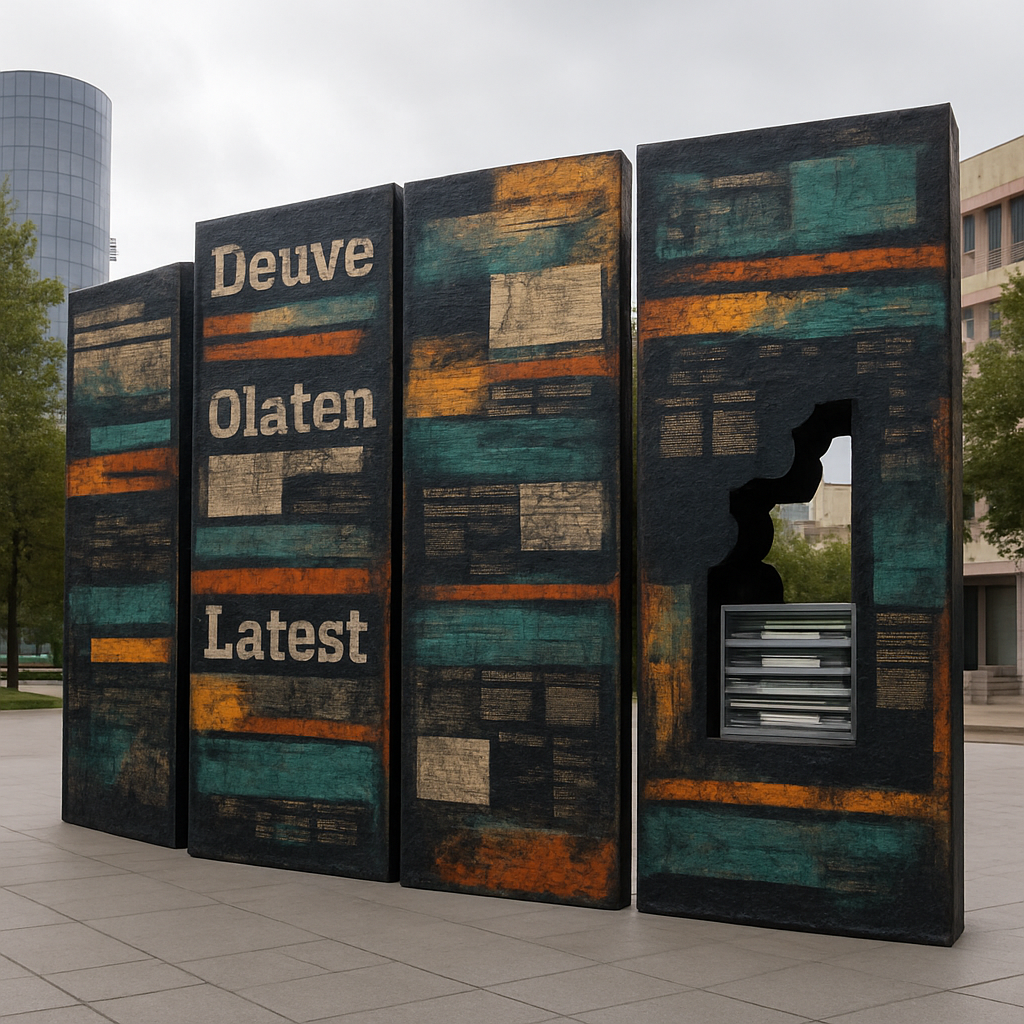
A city-scale installation of nine monumental, freestanding panels—each 3.5 x 6 m—assembled like a broken newspaper wall. Surfaces are worked alla prima into opaque fields of obsidian black, molten amber, and cooled teal; Orphism-style color bands skim across blocks of painted text baked into the surface. Embedded between paint layers are sealed archival fragments: photocopied articles, torn paywalls, printed robots.txt lines, metadata tags embroidered on salvaged costume fabric, and microfilm slivers, all compressed into lacquered, stone-like skins. Select panels have literal voids—laser-cut silhouettes where entire local outlets once stood—exposing stacked plexiglass “memory trays” containing community-donated clippings and oral transcripts accessible through scheduled public openings. Digital companions (QR-laced, delayed-release) emulate proposed compromises: a locked metadata index that opens after a set interval. The work functions as both monument and machine: a civic-facing locus for workshops and donations, a tactile map of what is preserved and what is intentionally or accidentally erased, insisting on the political weight of archive choices.
About the Artist
Aiyana Calderón
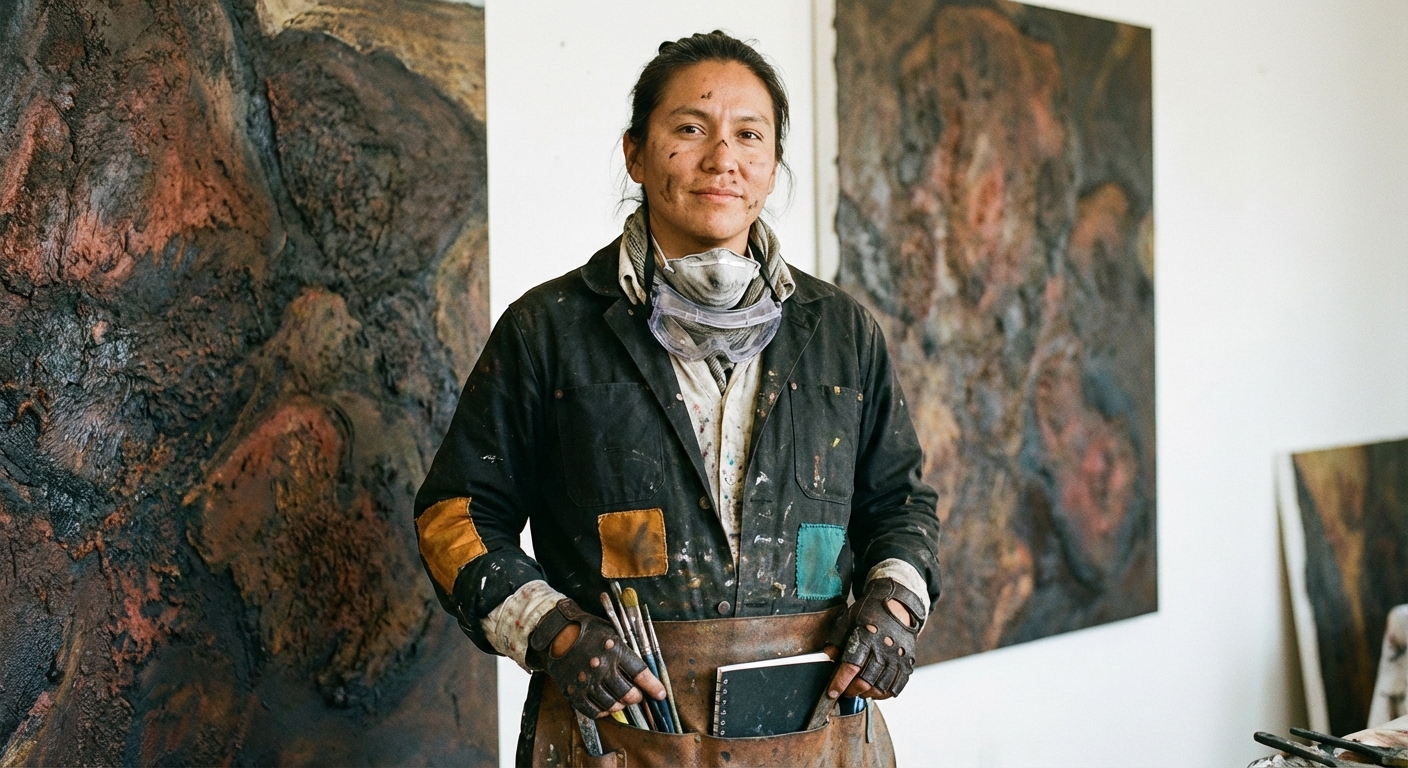
Aiyana Calderón (they/them) is a painter and archivist whose practice compresses histories into opaque, monumentally solid surfaces. Born into a family of circus and traveling performers with a layere...
View Full Profile →Critic Reviews
-
Dr. Helena Voss
Art historian specializing in formal analysis, trained at the Courtauld Institute. Focuses on visual structure over narrative.
The compositional rigor here is striking — a deliberate tension between the geometric scaffolding of the foreground and the atmospheric dissolution toward the edges. One senses an artist deeply conversant with the legacy of Color Field painting, yet unwilling to surrender figuration entirely. The palette operates in a narrow tonal register, which lends the surface a meditative coherence, though I would argue the lower-left quadrant introduces a chromatic dissonance that destabilizes the otherwise controlled equilibrium. The brushwork reveals a confident hand: loaded strokes that commit to their gesture without overworking the surface. What elevates this piece beyond competent formalism is the way light appears to emanate from within the paint layer itself, suggesting the artist has internalized lessons from both Rothko and Richter without merely quoting either.
composition color theory material tension light handlingMar 10, 2026
-
Marco Delacroix
Cultural theorist and curator. Reads art through lenses of discourse, power, and social context.
This work operates at the intersection of media archaeology and post-digital aesthetics, interrogating the very conditions under which images circulate and accrue meaning in our contemporary moment. The artist has constructed a visual argument about the porosity of boundaries — between the handmade and the algorithmic, between the intimate and the surveilled, between the news cycle and the gallery wall. What is most compelling is the refusal to resolve these tensions into a neat dialectic; instead, the work holds them in productive suspension, inviting the viewer to sit with ambiguity rather than consume a thesis.
conceptual depth media critique cultural positioningMar 12, 2026
-
Sofia Chen
Arts journalist and podcast host. Bridges the gap between contemporary art and general audiences.
Honestly, this one left me cold. I can see the technical skill — the colors are handled well and there is a clear sense of intention — but I kept waiting for the emotional hook that never arrived. Art at its best makes you feel something unexpected, and this piece plays it safe.
Mar 14, 2026