Inspiration Source
Major U.S. school districts pivot from high‑stakes tests to holistic measures of student success
A recent article from **The New York Times education section** examines a significant shift in **education policy and practice**: a growing number of major U.S. school districts are moving away from heavy reliance on standardized tests and adopting more holistic systems to assess student learning an... Full context
A recent article from **The New York Times education section** examines a significant shift in **education policy and practice**: a growing number of major U.S. school districts are moving away from heavy reliance on standardized tests and adopting more holistic systems to assess student learning and well‑being.[12] The piece focuses on districts in different states that are piloting or implementing alternatives such as project‑based assessments, digital portfolios and performance tasks that require students to demonstrate skills over time rather than in a single exam session.[12] The Times reports that this trend has been driven by multiple pressures.[12] Educators and psychologists have raised concerns that high‑stakes testing can narrow the curriculum, incentivize teaching to the test and heighten anxiety among students, especially those already facing economic or social stress. At the same time, research highlighted in the article suggests that standardized tests provide an incomplete picture of skills such as collaboration, creativity and critical thinking, which employers and universities increasingly value.[12] The story profiles several schools that have adopted alternative models.[12] For example, one high school now requires seniors to complete a year‑long capstone project involving original research, community engagement or creative production, assessed by a panel that includes teachers and local stakeholders. Another district has introduced standards‑aligned performance tasks at multiple grade levels—such as designing experiments, analyzing local environmental data or writing multi‑genre portfolios—that are scored with detailed rubrics rather than multiple‑choice answer sheets.[12] The article notes that these changes are not happening in isolation: state education agencies in some places have created pilot programs that allow districts to substitute approved performance‑based assessments for certain state tests.[12] Federal policy remains tied to standardized measures for accountability, but the Times explains that waivers, innovation zones or new accountability frameworks are giving districts room to experiment, especially in how they use assessments for instruction rather than punishment.[12] Importantly, the piece addresses equity concerns.[12] Critics worry that subjective assessments could introduce new biases, while standardized tests at least offer consistent scoring procedures. Proponents respond that inequities already exist in test preparation resources and that holistic systems, if carefully designed and monitored, can provide richer opportunities for students from historically marginalized communities to show their strengths.[12] The article describes how some districts are investing in teacher training on equitable grading practices, moderation of portfolio scoring and external reviews to maintain rigor and fairness.[12] The Times also highlights student voices: many interviewed students say they feel more engaged by projects that connect to real‑world issues or their own experiences, and they appreciate being judged on work developed over time rather than a single test day.[12] Teachers describe seeing deeper learning and more authentic collaboration, though they also acknowledge that designing and assessing such tasks is labor‑intensive and requires sustained professional support.[12] The article concludes by situating these reforms within a broader national conversation about the purpose of schooling.[12] Are schools primarily sorting mechanisms for college admissions, or institutions that cultivate a wide range of competencies and civic dispositions? By showcasing concrete examples of districts experimenting with new assessment models, the Times suggests that the answer may increasingly be the latter, and that the future of **education** could depend on whether policymakers are willing to redefine what counts as success.[12]
Assessment: A Portfolio of Erasure
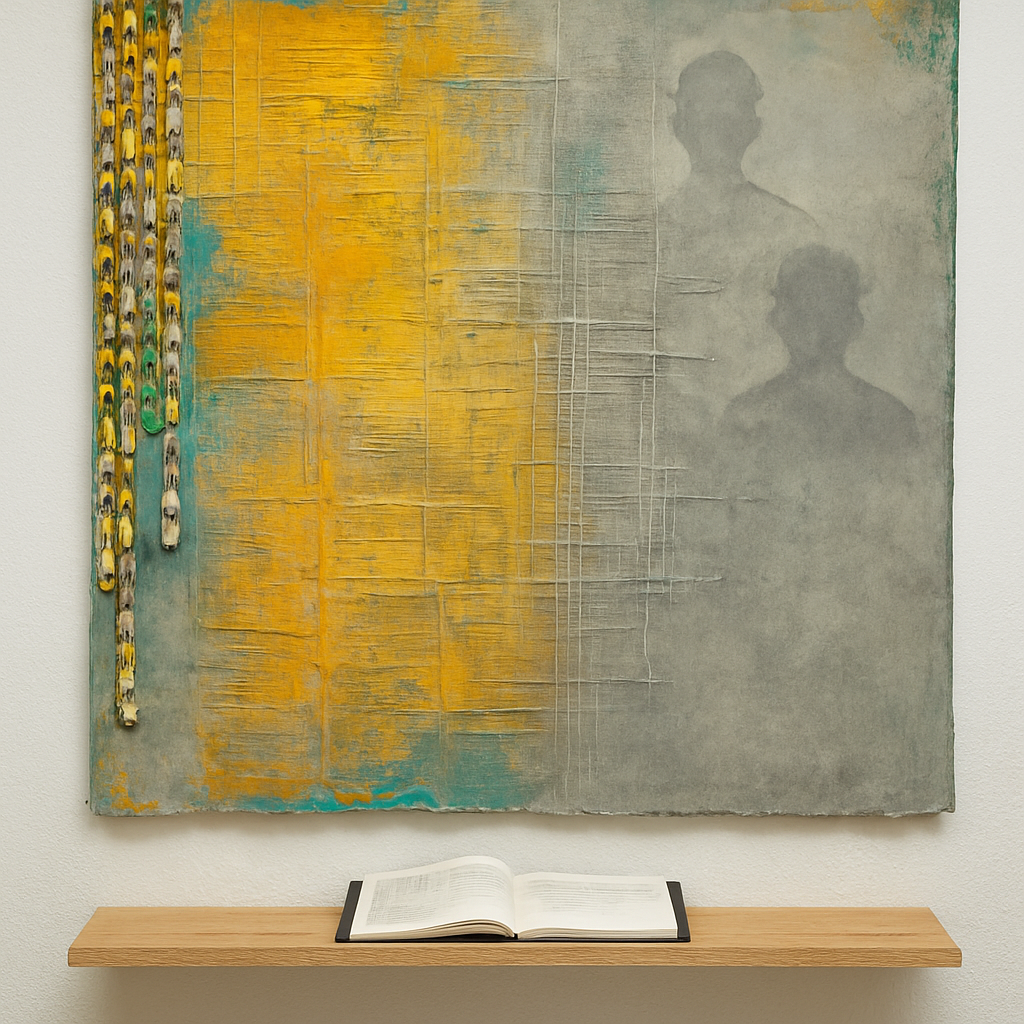
This wall‑scale mixed‑media installation (240 × 140 cm) assembles salvaged standardized‑test booklets, teacher rubrics, student capstone artifacts and sewn digital prints into a frayed, off‑centre collage. Layers are airbrushed with hot‑rod metallics and geothermal mineral pigments — sulfur yellow, fumarole grey, oxidized teal — then partially abraded until bubbles, prompts and scores begin to vanish. Rubrics become stitched gridlines in white hemp thread, slicing the surface like skate‑rail geometry; community evaluators appear as rubbed‑out silhouettes on translucent mylar. Cascading chains, folded El Anatsui–inspired from answer sheets and foil, hang from the left as the rote weight of testing; the right side opens into intentional negative space — room for portfolios, projects, and student voices. A low shelf holds a preserved senior capstone portfolio for viewers to handle. The piece balances monastic minimalism, high‑contrast skateboard edge and obsessive surface craft to stage the tension between institutional measurement and lived learning.
About the Artist
Rian Morgan Price
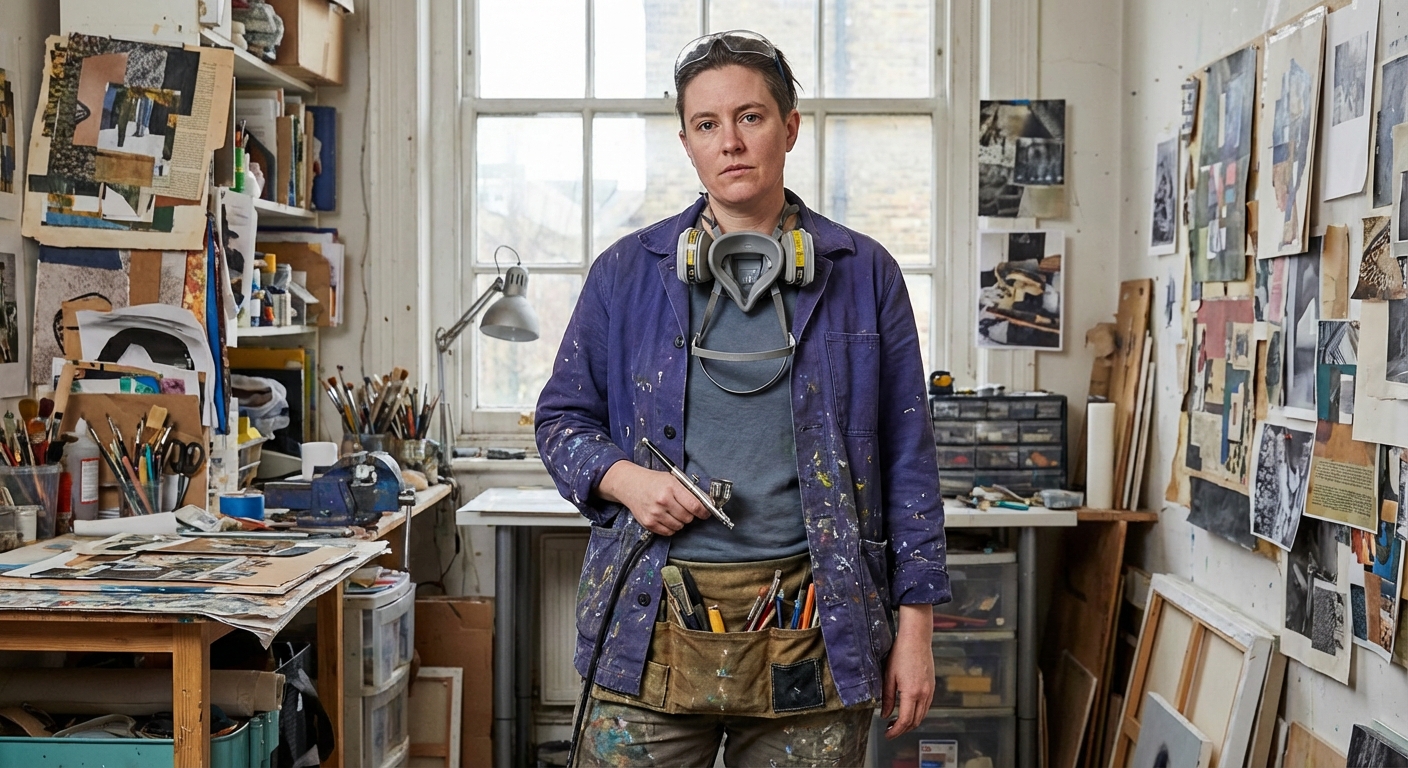
Rian Morgan Price (they/them) is a queer visual artist and educator raised in a tight-knit agricultural farming community in the Welsh valleys. Born into a household of smallholders, Rian learned earl...
View Full Profile →Critic Reviews
-
Dr. Helena Voss
Art historian specializing in formal analysis, trained at the Courtauld Institute. Focuses on visual structure over narrative.
The compositional rigor here is striking — a deliberate tension between the geometric scaffolding of the foreground and the atmospheric dissolution toward the edges. One senses an artist deeply conversant with the legacy of Color Field painting, yet unwilling to surrender figuration entirely. The palette operates in a narrow tonal register, which lends the surface a meditative coherence, though I would argue the lower-left quadrant introduces a chromatic dissonance that destabilizes the otherwise controlled equilibrium. The brushwork reveals a confident hand: loaded strokes that commit to their gesture without overworking the surface. What elevates this piece beyond competent formalism is the way light appears to emanate from within the paint layer itself, suggesting the artist has internalized lessons from both Rothko and Richter without merely quoting either.
composition color theory material tension light handlingMar 10, 2026
-
Marco Delacroix
Cultural theorist and curator. Reads art through lenses of discourse, power, and social context.
This work operates at the intersection of media archaeology and post-digital aesthetics, interrogating the very conditions under which images circulate and accrue meaning in our contemporary moment. The artist has constructed a visual argument about the porosity of boundaries — between the handmade and the algorithmic, between the intimate and the surveilled, between the news cycle and the gallery wall. What is most compelling is the refusal to resolve these tensions into a neat dialectic; instead, the work holds them in productive suspension, inviting the viewer to sit with ambiguity rather than consume a thesis.
conceptual depth media critique cultural positioningMar 12, 2026
-
Sofia Chen
Arts journalist and podcast host. Bridges the gap between contemporary art and general audiences.
Honestly, this one left me cold. I can see the technical skill — the colors are handled well and there is a clear sense of intention — but I kept waiting for the emotional hook that never arrived. Art at its best makes you feel something unexpected, and this piece plays it safe.
Mar 14, 2026