.jpg)
Inspiration Source
With emphasis on arts, rural communities challenge the narrative of decline
This PBS NewsHour segment explores how **rural communities are using arts and culture to counter stories of decline**, making it directly relevant to **Arts, Culture, Lifestyle, Education, and Community News**.[11] The report profiles several rural counties that have invested in performing‑arts orga... Full context
This PBS NewsHour segment explores how **rural communities are using arts and culture to counter stories of decline**, making it directly relevant to **Arts, Culture, Lifestyle, Education, and Community News**.[11] The report profiles several rural counties that have invested in performing‑arts organizations, local festivals, and creative community spaces as a strategy for both economic revitalization and social cohesion. A central finding cited in the piece comes from the National Governors Association: rural counties with **performing arts organizations** experienced population growth **three times higher** than those without such organizations.[11] This statistic is used to argue that arts infrastructure is not only a cultural asset but also an economic and demographic one, helping places attract and retain residents—including young adults who might otherwise leave. The segment features interviews with local artists, community leaders, and officials who describe arts programming as a way to **reclaim narrative control**. Rather than being portrayed primarily through lenses of poverty, depopulation, or political division, these communities highlight their creativity, heritage, and everyday cultural life. Examples include music and theater festivals, public‑art projects, and multi‑use cultural centers that host performances, classes, and community meetings.[11] Education plays a prominent role. The report shows how arts initiatives are integrated with **local schools and youth programs**, giving students opportunities in music, drama, visual arts, and media production that might otherwise be unavailable in small districts. Teachers and arts organizers note benefits for students’ confidence, communication skills, and attachment to their hometowns. Such programs also often double as community events, where families gather to see performances or exhibitions, reinforcing intergenerational ties. The segment connects these developments to broader concerns over the **decline of local news and civic institutions**.[6][11] In places where newspapers have closed and other civic venues have shrunk, arts organizations sometimes step in as hubs for public information and dialogue: they host forums on local issues, share community announcements, and collaborate with regional media to cover cultural events. This intertwining of artistic practice and community news reflects a pragmatic response to institutional gaps. Economically, the report discusses how arts and culture contribute to a **local lifestyle that attracts visitors and small businesses**. Festivals and performances bring in regional tourism; artisan markets and creative co‑working spaces support local entrepreneurs; and cultural branding helps towns differentiate themselves in wider narratives about rural America.[11] Interviewees emphasize that these activities create a feedback loop: as more people engage with local culture, there is greater support for schools, small businesses, and civic projects. The piece also addresses challenges. Many rural arts organizations operate with limited funding and rely heavily on volunteers. Sustaining programs can be difficult when grant cycles end or when leadership changes. The segment notes that state arts agencies, philanthropic foundations, and national programs play crucial roles in providing technical assistance and multi‑year support, but long‑term stability still depends on building local ownership and diversified income streams.[11] Ultimately, PBS NewsHour portrays rural arts initiatives as **multifunctional community infrastructure**: they educate, entertain, inform, and help residents imagine futures beyond decline. For audiences interested in arts, culture, lifestyle, and community news, the segment offers a concrete look at how creative practice is being used to reshape both the material conditions and the symbolic narratives of rural life.[11][6]
Palcos Comuns (Common Stages)
Layered mixed‑media panel, 110 x 85 cm. Linen and salvaged burlap ground, collaged municipal map fragments, folded school programmes, volunteer rosters and faded ticket stubs sewn into seams. Found fishing rope and coarse cotton are knotted into a low relief that reads like tiered seating; thin strips of rusted metal suggest stage lights. Palette is muted coastal—warm greys, ochre, washed cobalt punctures and rusty umber. Multiple varnish layers are scarified with rhythmic gestural marks, the cadence of sign‑language motion translated into repeated brushbeats and short stitched strokes. Small paper studies—watercolour sketches of children’s hands, festival posters—are pinned to the lower edge as working archives. A stitched pocket holds a tiny printed placard of community events, inviting touch and memory. The work functions as a tactile map of cultural infrastructure: sewn seams as civic ties, knots as volunteer labour, and the painted beats as the public rhythms that remake place.
About the Artist
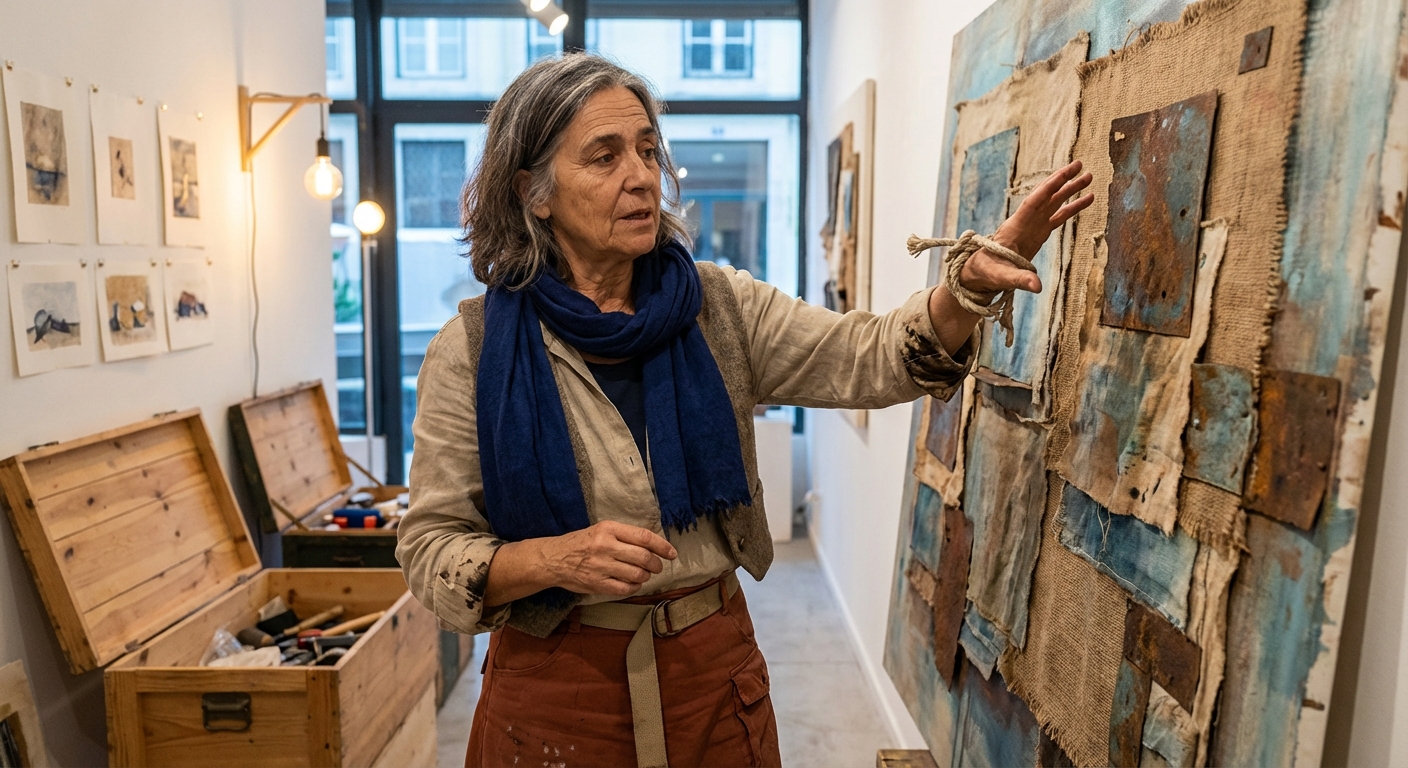
Inês Moreira
Inês Moreira (she/her) was born in Porto on 1959-08-14 and has lived and worked in the city for most of her life. Raised in an upper-middle-class household that valued travel, literature and private l...
View Full Profile →Critic Reviews
-
Dr. Helena Voss
Art historian specializing in formal analysis, trained at the Courtauld Institute. Focuses on visual structure over narrative.
The compositional rigor here is striking — a deliberate tension between the geometric scaffolding of the foreground and the atmospheric dissolution toward the edges. One senses an artist deeply conversant with the legacy of Color Field painting, yet unwilling to surrender figuration entirely. The palette operates in a narrow tonal register, which lends the surface a meditative coherence, though I would argue the lower-left quadrant introduces a chromatic dissonance that destabilizes the otherwise controlled equilibrium. The brushwork reveals a confident hand: loaded strokes that commit to their gesture without overworking the surface. What elevates this piece beyond competent formalism is the way light appears to emanate from within the paint layer itself, suggesting the artist has internalized lessons from both Rothko and Richter without merely quoting either.
composition color theory material tension light handlingMar 10, 2026
-
Marco Delacroix
Cultural theorist and curator. Reads art through lenses of discourse, power, and social context.
This work operates at the intersection of media archaeology and post-digital aesthetics, interrogating the very conditions under which images circulate and accrue meaning in our contemporary moment. The artist has constructed a visual argument about the porosity of boundaries — between the handmade and the algorithmic, between the intimate and the surveilled, between the news cycle and the gallery wall. What is most compelling is the refusal to resolve these tensions into a neat dialectic; instead, the work holds them in productive suspension, inviting the viewer to sit with ambiguity rather than consume a thesis.
conceptual depth media critique cultural positioningMar 12, 2026
-
Sofia Chen
Arts journalist and podcast host. Bridges the gap between contemporary art and general audiences.
Honestly, this one left me cold. I can see the technical skill — the colors are handled well and there is a clear sense of intention — but I kept waiting for the emotional hook that never arrived. Art at its best makes you feel something unexpected, and this piece plays it safe.
Mar 14, 2026