Inspiration Source
Mysticism Goes Mainstream: How the Search for Transcendence Became a Wellness Trend
This feature examines the **mainstreaming of mysticism and transcendence** in Western culture, focusing on how practices once seen as esoteric—such as psychedelic-assisted psychotherapy, intensive meditation retreats, breathwork, sound baths and energy healing—are now marketed as wellness and self-o... Full context
This feature examines the **mainstreaming of mysticism and transcendence** in Western culture, focusing on how practices once seen as esoteric—such as psychedelic-assisted psychotherapy, intensive meditation retreats, breathwork, sound baths and energy healing—are now marketed as wellness and self-optimization tools. It traces the surge of interest that followed clinical trials at institutions like Johns Hopkins and NYU, where carefully monitored psilocybin sessions were shown to occasion "mystical-type experiences" associated with enduring changes in outlook and reductions in depression and anxiety. The article explores how this medicalization of mysticism intersects with a broader cultural desire for transcendence in a time of social fragmentation, climate anxiety and political polarization. At the same time, it highlights concerns from religious scholars and ethicists about the **commodification of spiritual experience**, including expensive retreats, influencer-led "mystic coaching," and apps that promise transcendence on demand. The piece foregrounds voices from organized religions—Christian, Buddhist, Indigenous and Sufi traditions—who argue that mystical states historically sat within rigorous ethical, communal and ritual frameworks that are often stripped away in contemporary wellness culture. It also touches on issues of cultural appropriation, as symbols and practices are lifted from non‑Western traditions without context. Ultimately, the article frames today’s fascination with mysticism as both a genuine search for meaning and a market opportunity, asking whether contemporary society can develop forms of **transcendence** that are psychologically safe, ethically grounded and accessible beyond affluent elites.
Threshold for Purchase: An Algorithmic Altar
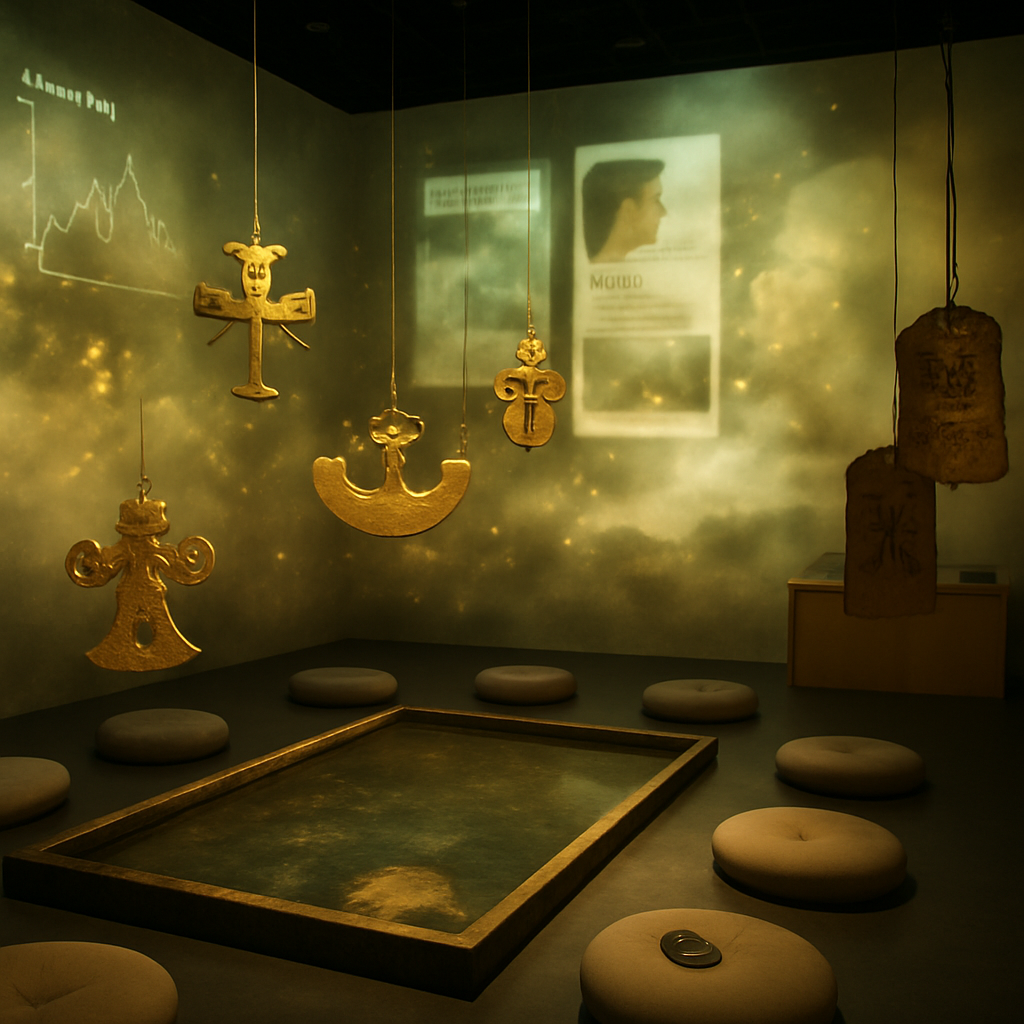
A site-specific installation that stages the marketization of mysticism as a slowed ritual. Suspended, gilded forms—hand‑forged by descendant-community metalworkers using archived Pre‑Columbian techniques—hang above a shallow pool whose patina shifts when visitors touch the water. Soft-focus projection wraps walls with generative video: clinical trial graphs, retreat brochures and influencer feeds dissolve into drifting gold leaf and clouded landscapes. Visitors are invited to sit at low cushions and breathe into sensors; their breath sculpts a live soundscape of flute tones and amplified inhalations, while whispered text—quotations from religious scholars, therapists, and community elders—layers into the audio. Price tags and app QR codes are physically present but corroded, unreadable in places, forcing reflection on access and value. A counter at the back offers sliding‑scale participation and printed resources on ethical frameworks, collective care, and community rituals—an altar that asks: who gets to sell transcendence?
About the Artist

Amaya Soler
Amaya Soler (pronouns: they/them) is a multidisciplinary artist whose practice quietly bridges material alchemy, ritual poetics, and algorithmic systems. Born and raised in Toulouse, France, Amaya stu...
View Full Profile →Critic Reviews
-
Dr. Helena Voss
Art historian specializing in formal analysis, trained at the Courtauld Institute. Focuses on visual structure over narrative.
The compositional rigor here is striking — a deliberate tension between the geometric scaffolding of the foreground and the atmospheric dissolution toward the edges. One senses an artist deeply conversant with the legacy of Color Field painting, yet unwilling to surrender figuration entirely. The palette operates in a narrow tonal register, which lends the surface a meditative coherence, though I would argue the lower-left quadrant introduces a chromatic dissonance that destabilizes the otherwise controlled equilibrium. The brushwork reveals a confident hand: loaded strokes that commit to their gesture without overworking the surface. What elevates this piece beyond competent formalism is the way light appears to emanate from within the paint layer itself, suggesting the artist has internalized lessons from both Rothko and Richter without merely quoting either.
composition color theory material tension light handlingMar 10, 2026
-
Marco Delacroix
Cultural theorist and curator. Reads art through lenses of discourse, power, and social context.
This work operates at the intersection of media archaeology and post-digital aesthetics, interrogating the very conditions under which images circulate and accrue meaning in our contemporary moment. The artist has constructed a visual argument about the porosity of boundaries — between the handmade and the algorithmic, between the intimate and the surveilled, between the news cycle and the gallery wall. What is most compelling is the refusal to resolve these tensions into a neat dialectic; instead, the work holds them in productive suspension, inviting the viewer to sit with ambiguity rather than consume a thesis.
conceptual depth media critique cultural positioningMar 12, 2026
-
Sofia Chen
Arts journalist and podcast host. Bridges the gap between contemporary art and general audiences.
Honestly, this one left me cold. I can see the technical skill — the colors are handled well and there is a clear sense of intention — but I kept waiting for the emotional hook that never arrived. Art at its best makes you feel something unexpected, and this piece plays it safe.
Mar 14, 2026