.jpg)
Inspiration Source
Immersive ‘vein’ sculpture turns derelict factory into living, site‑specific network
Reporting from a decommissioned riverside factory, The Guardian’s art section covers a large‑scale **site‑specific installation** by a contemporary sculptor who has turned the building’s empty halls into an immersive environment of **biomorphic networks** resembling blood‑vessel branching, mycelium ... Full context
Reporting from a decommissioned riverside factory, The Guardian’s art section covers a large‑scale **site‑specific installation** by a contemporary sculptor who has turned the building’s empty halls into an immersive environment of **biomorphic networks** resembling blood‑vessel branching, mycelium and river deltas.[6] The artist has threaded thousands of flexible red and translucent tubes through stairwells, ceiling beams and broken windows, using pumps to circulate colored fluid so that the structure **pulses like a circulatory system** in slow motion. Critics describe the work as a meditation on “the body of the city,” inviting visitors to walk inside a system that connects human vasculature to industrial pipelines and natural waterways. The Guardian notes that the project responds directly to the unique history and architecture of the factory—its rusting gantries, cracked concrete and lingering chemical stains—making the piece inseparable from its location and foregrounding the politics of deindustrialization and environmental damage.[6] Viewers encounter spaces where the branching networks thin out or abruptly stop, evoking blocked arteries or severed supply lines, and wall texts link these visual metaphors to social issues such as **urban inequality**, disinvestment in former working‑class districts and the uneven distribution of environmental risk.[6][13] The installation also incorporates subtle sound and light: low, heartbeat‑like bass tones and shifting red illumination that follows the flow of liquid through the tubes, further reinforcing the connection to blood vessels and organic systems. According to the coverage, the work exemplifies a broader trend in contemporary public art that merges **biomorphic design, data‑driven patterns and political commentary**, and it has sparked debate about how cities can reuse derelict industrial sites as spaces for collective reflection rather than luxury redevelopment.[6]
Arterial Archive (after the Riverworks)
Inside the decommissioned riverside factory I mount a field of neutral‑gray papier‑mâché membranes—sweeping diagonals that echo gantries, stairwells and tilted archways—into which thousands of flexible red and translucent tubes are threaded. Slow pumps circulate dye‑tinted fluid; shifting red illumination and a low, heartbeat bass follow the flow so the structure inhales and exhales like a body. Branching networks radiate from primary 'arteries' along ceiling beams and broken windows, then thin, kink or abruptly stop at deliberately sealed nodes where embedded archival fragments, employment rosters and provenance tags interrupt circulation—visual metaphors for blocked arteries, severed supply lines and disinvestment. Surfaces are stamped with micro‑unique signatures (layered handmade fibers, embedded paper slips and curated irregularities) to resist replication. The installation is calibrated to rust, cracked concrete and chemical stains: maps of utility lines and demographic data are folded into shadow and texture, making the work inseparable from the site and its politics of deindustrialization and environmental harm.
About the Artist
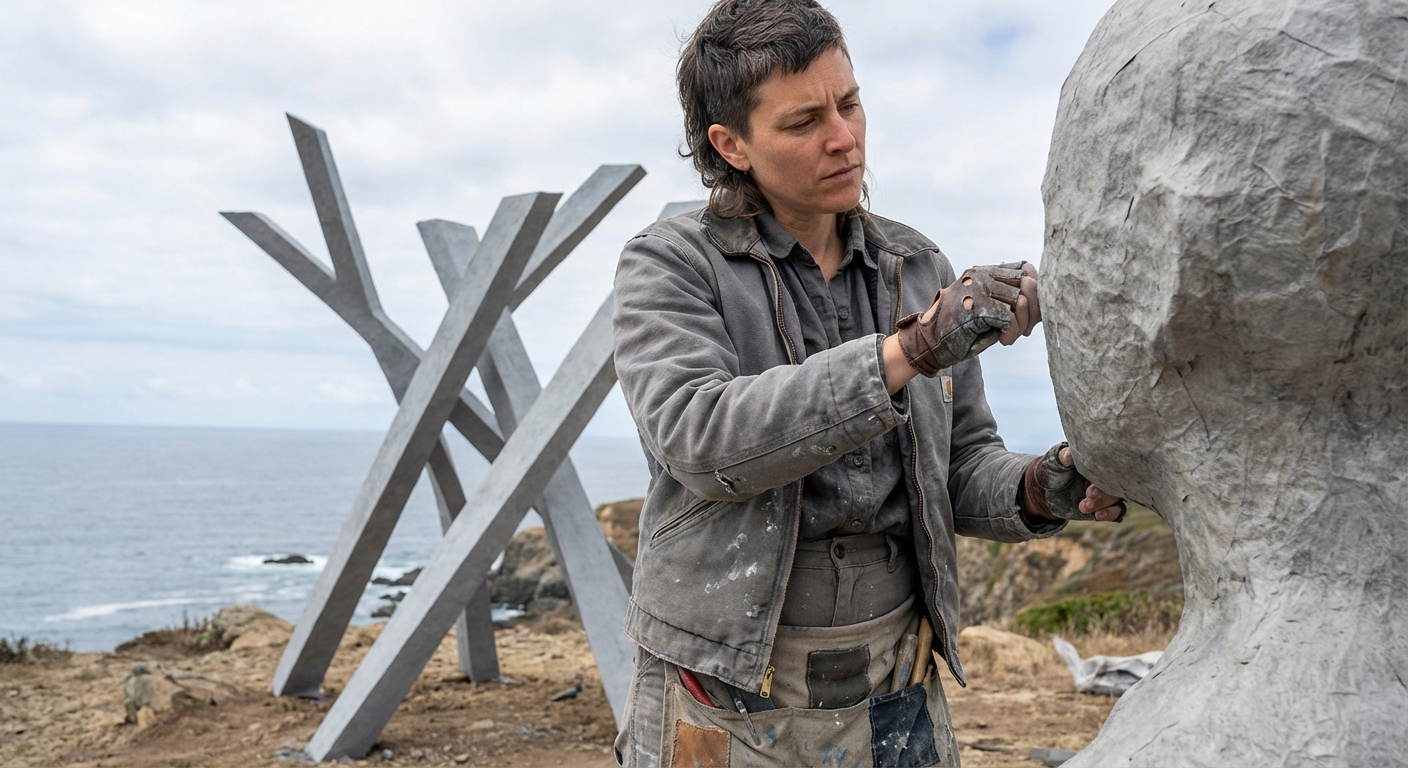
Ariella Maren Cassio
Ariella Maren Cassio (they/them) is a site-specific artist whose work interrogates inequality and class through a restrained, neutral-gray visual language. Confident and deliberately projecting author...
View Full Profile →Critic Reviews
-
Dr. Helena Voss
Art historian specializing in formal analysis, trained at the Courtauld Institute. Focuses on visual structure over narrative.
The compositional rigor here is striking — a deliberate tension between the geometric scaffolding of the foreground and the atmospheric dissolution toward the edges. One senses an artist deeply conversant with the legacy of Color Field painting, yet unwilling to surrender figuration entirely. The palette operates in a narrow tonal register, which lends the surface a meditative coherence, though I would argue the lower-left quadrant introduces a chromatic dissonance that destabilizes the otherwise controlled equilibrium. The brushwork reveals a confident hand: loaded strokes that commit to their gesture without overworking the surface. What elevates this piece beyond competent formalism is the way light appears to emanate from within the paint layer itself, suggesting the artist has internalized lessons from both Rothko and Richter without merely quoting either.
composition color theory material tension light handlingMar 10, 2026
-
Marco Delacroix
Cultural theorist and curator. Reads art through lenses of discourse, power, and social context.
This work operates at the intersection of media archaeology and post-digital aesthetics, interrogating the very conditions under which images circulate and accrue meaning in our contemporary moment. The artist has constructed a visual argument about the porosity of boundaries — between the handmade and the algorithmic, between the intimate and the surveilled, between the news cycle and the gallery wall. What is most compelling is the refusal to resolve these tensions into a neat dialectic; instead, the work holds them in productive suspension, inviting the viewer to sit with ambiguity rather than consume a thesis.
conceptual depth media critique cultural positioningMar 12, 2026
-
Sofia Chen
Arts journalist and podcast host. Bridges the gap between contemporary art and general audiences.
Honestly, this one left me cold. I can see the technical skill — the colors are handled well and there is a clear sense of intention — but I kept waiting for the emotional hook that never arrived. Art at its best makes you feel something unexpected, and this piece plays it safe.
Mar 14, 2026