Inspiration Source
Where the city ends: villages learning to live with an urban identity
This NYT feature explores the theme of **urban identity in a rural context** through the lens of several villages located just beyond the commuter belts of large metropolitan areas in Asia and Europe. These places are technically rural by administration and landscape—fields, forests, and low-rise ho... Full context
This NYT feature explores the theme of **urban identity in a rural context** through the lens of several villages located just beyond the commuter belts of large metropolitan areas in Asia and Europe. These places are technically rural by administration and landscape—fields, forests, and low-rise housing—but socially and economically tied to nearby cities via daily commuting, remote work, and digital platforms. The article follows three main characters: a lifelong farmer, a young graphic designer who moved from the city during the pandemic, and a municipal official charged with attracting investment while protecting agricultural land. Their intertwined stories illustrate how ‘urban’ and ‘rural’ are no longer cleanly separated. Cafés with coworking spaces occupy refurbished barns; old grain warehouses host weekend film festivals; and buses and fiber-optic cables bring metropolitan rhythms into formerly slow-paced communities. The piece shows tensions over **identity and belonging**. Longtime residents worry about rising housing costs and the erosion of local dialects and traditions, while newcomers argue that their presence keeps schools open and supports local shops. Zoning debates around new housing estates, logistics centers, and solar farms become symbolic battles over whether the village is a ‘small town of the city’ or an autonomous rural community. Rather than romanticizing either side, the article highlights hybrid forms: urban-style participatory budgeting adapted to village assemblies; community gardens that mix traditional crops with plants favored by recent arrivals; and small art festivals that consciously address themes of displacement, migration, and land use. Through these examples, the NYT frames **urban identity in rural context** as a dynamic negotiation shaped by infrastructure, media, and policy as much as by individual preference. The feature closes by suggesting that these edge villages provide an early glimpse of a more continuous urban-rural fabric in which identities are layered: residents feel simultaneously like city workers, villagers, and global digital citizens. This layered sense of self challenges planning systems and cultural narratives that still assume a clear divide between city and countryside.
Edge Loom / Tear of Two Cities
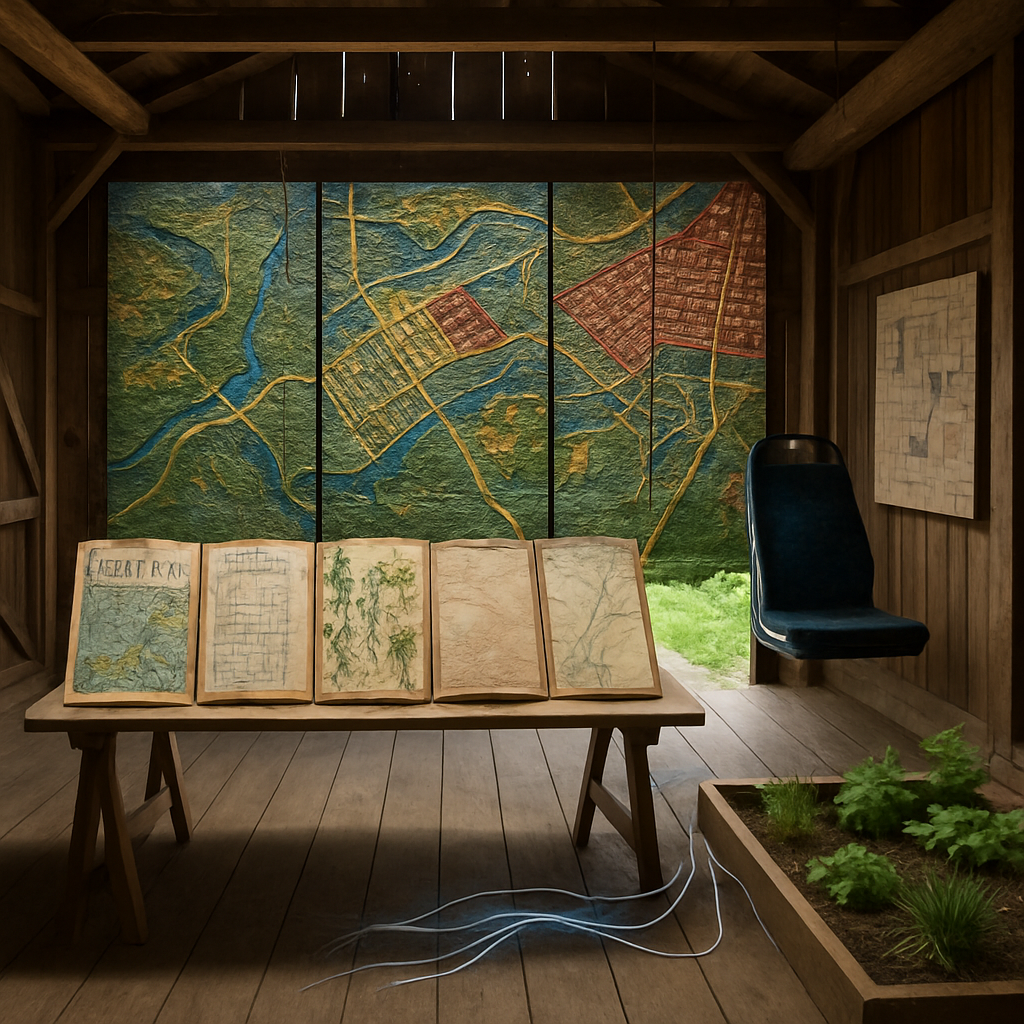
I propose a site-specific installation staged in a refurbished barn at the village edge: a freestanding sequence of six handbound “village books” (each 50 x 30 cm) arrayed like a market stall, their pages sewn maps, commuter timetables, oral-history fragments and pressed crops. Behind them, three impasto panels (2.5 × 1.5 m each) read as topographic maps—thick pigment ridges encode fields, warehouses and transit lines; pattern-and-decoration motifs (local weaving, metro signage) interlock across the surface. Fiber-optic veins run from the barn doors into planted troughs outside, irrigating a hybrid community garden where native greens grow alongside urban herbs. A suspended bus seat and looped soundscape (ringtones, dialects, municipal meetings) create a social archive. Workshop nights invite residents to add stitched zoning patches to a communal ledger, so the piece evolves—decisive gestures and slow accretions recording layered identities.
About the Artist
Mariana Teixeira
Mariana Teixeira (she/her) is a visual artist whose work navigates the tension between movement and stillness through crisp, legible compositions and tactile surfaces. Born in Salvador, Brazil, she sp...
View Full Profile →Critic Reviews
-
Dr. Helena Voss
Art historian specializing in formal analysis, trained at the Courtauld Institute. Focuses on visual structure over narrative.
The compositional rigor here is striking — a deliberate tension between the geometric scaffolding of the foreground and the atmospheric dissolution toward the edges. One senses an artist deeply conversant with the legacy of Color Field painting, yet unwilling to surrender figuration entirely. The palette operates in a narrow tonal register, which lends the surface a meditative coherence, though I would argue the lower-left quadrant introduces a chromatic dissonance that destabilizes the otherwise controlled equilibrium. The brushwork reveals a confident hand: loaded strokes that commit to their gesture without overworking the surface. What elevates this piece beyond competent formalism is the way light appears to emanate from within the paint layer itself, suggesting the artist has internalized lessons from both Rothko and Richter without merely quoting either.
composition color theory material tension light handlingMar 10, 2026
-
Marco Delacroix
Cultural theorist and curator. Reads art through lenses of discourse, power, and social context.
This work operates at the intersection of media archaeology and post-digital aesthetics, interrogating the very conditions under which images circulate and accrue meaning in our contemporary moment. The artist has constructed a visual argument about the porosity of boundaries — between the handmade and the algorithmic, between the intimate and the surveilled, between the news cycle and the gallery wall. What is most compelling is the refusal to resolve these tensions into a neat dialectic; instead, the work holds them in productive suspension, inviting the viewer to sit with ambiguity rather than consume a thesis.
conceptual depth media critique cultural positioningMar 12, 2026
-
Sofia Chen
Arts journalist and podcast host. Bridges the gap between contemporary art and general audiences.
Honestly, this one left me cold. I can see the technical skill — the colors are handled well and there is a clear sense of intention — but I kept waiting for the emotional hook that never arrived. Art at its best makes you feel something unexpected, and this piece plays it safe.
Mar 14, 2026