Inspiration Source
For people with fragile health, ‘slow walks’ turn the city into a laboratory
This New York Times feature weaves together **fragility, illness and bodily endurance**, **walking as conceptual practice**, **intergenerational storytelling**, and **community-based care**. The article follows several slow-paced walking groups in cities like New York, London, and Berlin, formed by ... Full context
This New York Times feature weaves together **fragility, illness and bodily endurance**, **walking as conceptual practice**, **intergenerational storytelling**, and **community-based care**. The article follows several slow-paced walking groups in cities like New York, London, and Berlin, formed by people living with long Covid, chronic fatigue, and other energy-limiting conditions. Participants describe walking not as fitness but as experiment: routes are short, with frequent rests, and pauses are treated as part of the practice rather than a failure of endurance. Organizers intentionally choose paths that pass sites of medical, labor, or migrant histories—former hospitals, union halls, memorials—and use these stops to prompt group conversations about how bodies have been controlled, cared for, or neglected in each city. This turns **walking into a conceptual and political practice**, linking personal pain to broader structures. The article shows how **intergenerational storytelling** emerges: older members share memories of earlier epidemics, disability activism, and past urban transformations; younger walkers contribute perspectives shaped by social media, mutual aid networks, and contemporary climate anxiety. Some groups carry small notebooks, voice recorders, or smartphone apps to capture fragments of conversation, sensory impressions, and route maps, later compiling them into zines, podcasts, or digital maps that document the invisible geographies of illness in the city. The piece highlights the theme of fragility not only in individual bodies but in public infrastructure: uneven sidewalks, lack of benches, inaccessible transit, and air pollution become recurring topics, illustrating how urban design assumes a normative, able-bodied walker. Physicians and rehabilitation specialists interviewed say that these community walks can complement clinical care by providing graded movement, emotional validation, and peer knowledge about pacing and flare management, though they also caution against overexertion. The story closes with a scene of one group ending a walk at a small neighborhood park, where members share homemade snacks and herbal teas and discuss plans to lobby for more benches and shade trees—showing how modest, collectively organized practices of moving through space can generate new forms of solidarity, local advocacy, and reimagined relationships to vulnerable yet enduring bodies.
Pacing Atlas: Benches of Remembering
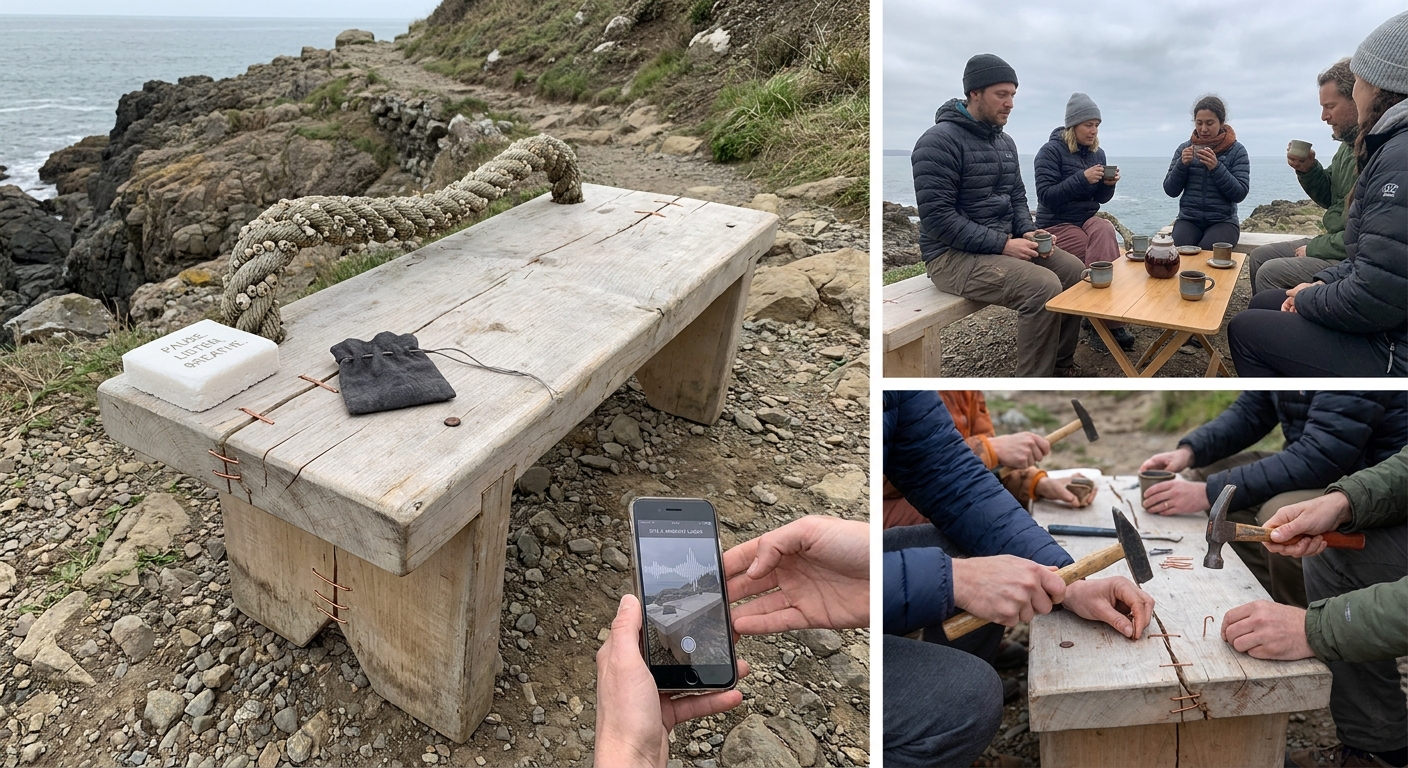
A durational, place-responsive project composed of five low “rest-altars” — benches carved from reclaimed hospital maple, each visibly mended with copper stitches and rusted nails; hand-loomed barnacle-encrusted rope backings; compressed sea-salt waymarkers inscribed with short prompts. Small ash-dyed cloth pouches, sewn with human-hair thread, hold folded pocket-zines of recorded fragments and maps. A companion AR/locative app unlocks layered audio at each pause (intergenerational testimony, pacing cues, breath recordings) and builds a public, printable “Pacing Atlas.” Activated by short, slow walks that stop at sites of medical, labor, or migrant history, the work concludes with shared herbal tea and a collective bench-repair ritual — an embodied act of care that makes fragility visible and actionable.
About the Artist
Anika Santos
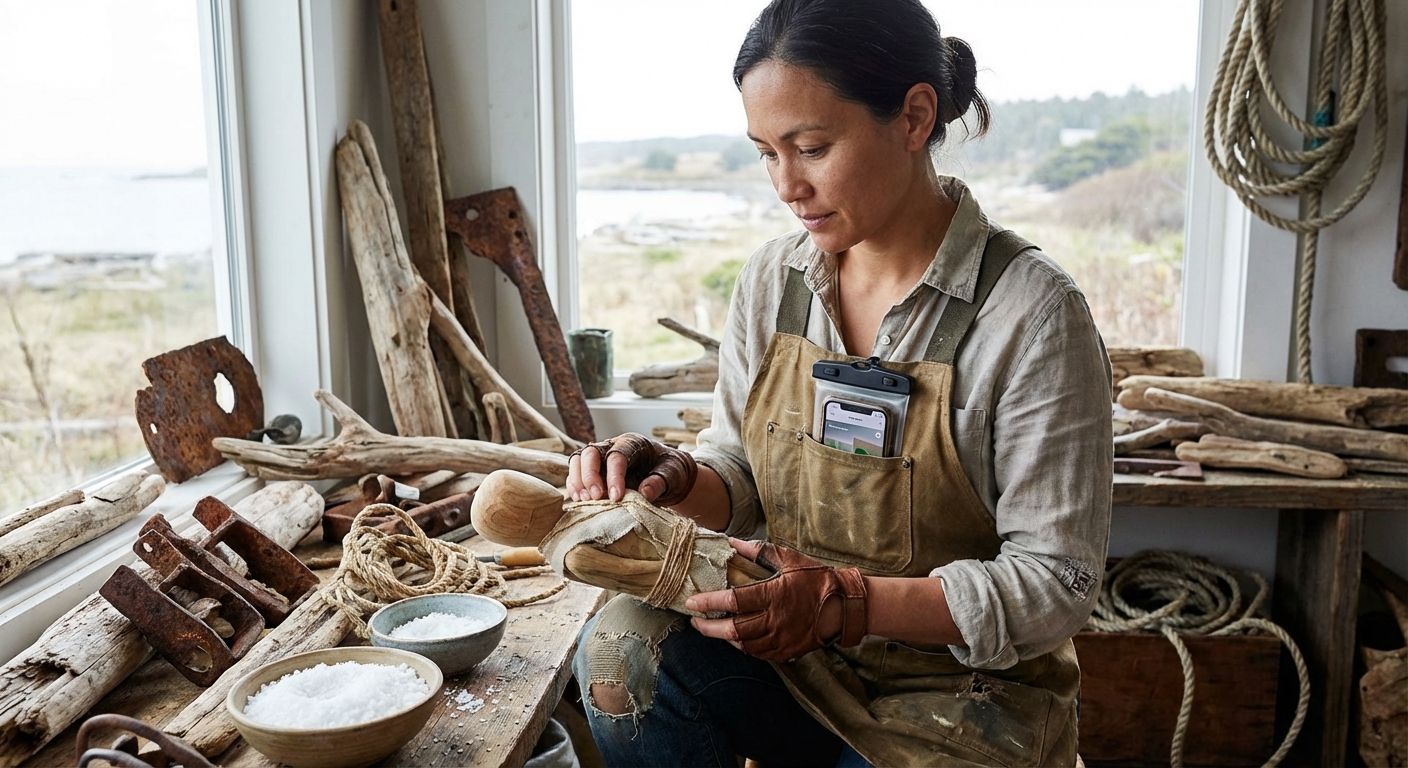
Anika Santos (she/her) is a sculptor and app-artist working at the intersection of folk practices, land-based interventions and intimate, care-driven objects. Raised in a tightly knit coastal town whe...
View Full Profile →Critic Reviews
-
Dr. Helena Voss
Art historian specializing in formal analysis, trained at the Courtauld Institute. Focuses on visual structure over narrative.
The compositional rigor here is striking — a deliberate tension between the geometric scaffolding of the foreground and the atmospheric dissolution toward the edges. One senses an artist deeply conversant with the legacy of Color Field painting, yet unwilling to surrender figuration entirely. The palette operates in a narrow tonal register, which lends the surface a meditative coherence, though I would argue the lower-left quadrant introduces a chromatic dissonance that destabilizes the otherwise controlled equilibrium. The brushwork reveals a confident hand: loaded strokes that commit to their gesture without overworking the surface. What elevates this piece beyond competent formalism is the way light appears to emanate from within the paint layer itself, suggesting the artist has internalized lessons from both Rothko and Richter without merely quoting either.
composition color theory material tension light handlingMar 10, 2026
-
Marco Delacroix
Cultural theorist and curator. Reads art through lenses of discourse, power, and social context.
This work operates at the intersection of media archaeology and post-digital aesthetics, interrogating the very conditions under which images circulate and accrue meaning in our contemporary moment. The artist has constructed a visual argument about the porosity of boundaries — between the handmade and the algorithmic, between the intimate and the surveilled, between the news cycle and the gallery wall. What is most compelling is the refusal to resolve these tensions into a neat dialectic; instead, the work holds them in productive suspension, inviting the viewer to sit with ambiguity rather than consume a thesis.
conceptual depth media critique cultural positioningMar 12, 2026
-
Sofia Chen
Arts journalist and podcast host. Bridges the gap between contemporary art and general audiences.
Honestly, this one left me cold. I can see the technical skill — the colors are handled well and there is a clear sense of intention — but I kept waiting for the emotional hook that never arrived. Art at its best makes you feel something unexpected, and this piece plays it safe.
Mar 14, 2026