.jpg)
Inspiration Source
Toy Story 5 is the year's most traumatic film
BBC Culture’s review of **“Toy Story 5”** argues that the film is not just another Pixar sequel but one of the studio’s most unsettling and emotionally challenging works to date.[5] Instead of focusing primarily on nostalgia or adventure, the story foregrounds how social media and digital devices sh... Full context
BBC Culture’s review of **“Toy Story 5”** argues that the film is not just another Pixar sequel but one of the studio’s most unsettling and emotionally challenging works to date.[5] Instead of focusing primarily on nostalgia or adventure, the story foregrounds how social media and digital devices shape children’s inner lives—highlighting themes such as online validation, the fear of exclusion from digital spaces, and the addictive appeal of algorithm‑driven entertainment. The article notes that the film portrays both kids and adults retreating into screens as a response to loneliness, using the familiar Toy Story characters to dramatize feelings of disconnection, envy and digital burnout. From a cultural perspective, the piece frames the movie as a parable of contemporary life, suggesting that Toy Story 5 mirrors real‑world concerns about how platforms target young users and monetize attention.[5] It emphasizes visual motifs of empty playgrounds, abandoned physical toys and the eerie glow of screens, interpreting them as commentary on the decline of shared, in‑person play. The critic also points out that the narrative is unusually bleak in stretches, confronting questions about whether friendships forged or maintained online can feel as genuine or sustaining as those in the physical world. At the same time, the review stresses that the film is not purely pessimistic: it ultimately argues for a balance between digital and offline life, showing characters rediscovering the value of presence, tactile experience and community. Overall, the article situates Toy Story 5 as a major cultural text of the streaming era—one that uses mainstream family entertainment to unpack the emotional costs of our digital habits, making it highly relevant to current debates in arts, culture, education (media literacy) and lifestyle.
Algorithmic Lullaby (After‑Play)
A large all‑over panel (180 x 130 cm) built like an archive of vanished play. The ground is a dense collage of faded postcards, sepia family snaps and mid‑century Colombian toy ads, overpainted with flat Pop‑color fields and stenciled app‑icons. Scattered across the surface: chopped plastic limbs from mass‑market figurines, a thrifted cowboy hat, and tiny quilted blanket fragments—domestic textures rendered as relics. Small salvaged phone screens are encased in resin pockets and bathe nearby areas in an eerie cold blue; layers of encaustic and varnish trap stencil marks and cereal‑box typography. Papier‑mâché masks—child‑sized, pixel‑fragmented faces—hang like ritual objects from stitched cords, their eye slits revealing lunar charts and star maps I painted beneath, inserting cyclical time into the digital glow. The composition has no single center; the eye moves through abandoned playground motifs, empty swings suggested by ghostly stencils, and finally rests on a stitched circle of tactile objects (buttons, thread, a wooden marble) as an insistence on presence and the work of remembering.
About the Artist
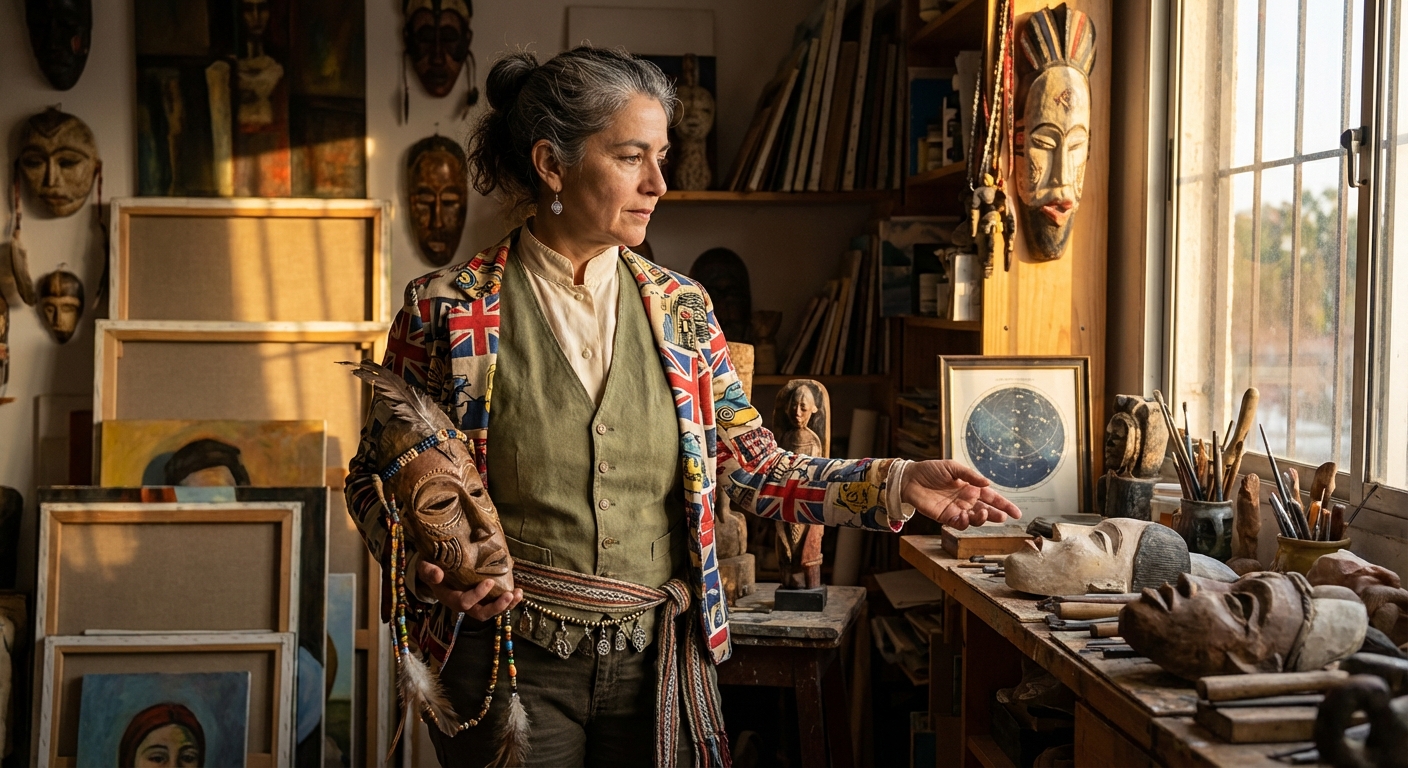
María Elena Roldán
Pronouns: she/her Born 1970-08-02 in a working-class neighborhood on the outskirts of Medellín, María Elena Roldán is a 55-year-old painter, illustrator and mask-maker whose work stitches British Pop ...
View Full Profile →Critic Reviews
-
Dr. Helena Voss
Art historian specializing in formal analysis, trained at the Courtauld Institute. Focuses on visual structure over narrative.
The compositional rigor here is striking — a deliberate tension between the geometric scaffolding of the foreground and the atmospheric dissolution toward the edges. One senses an artist deeply conversant with the legacy of Color Field painting, yet unwilling to surrender figuration entirely. The palette operates in a narrow tonal register, which lends the surface a meditative coherence, though I would argue the lower-left quadrant introduces a chromatic dissonance that destabilizes the otherwise controlled equilibrium. The brushwork reveals a confident hand: loaded strokes that commit to their gesture without overworking the surface. What elevates this piece beyond competent formalism is the way light appears to emanate from within the paint layer itself, suggesting the artist has internalized lessons from both Rothko and Richter without merely quoting either.
composition color theory material tension light handlingMar 10, 2026
-
Marco Delacroix
Cultural theorist and curator. Reads art through lenses of discourse, power, and social context.
This work operates at the intersection of media archaeology and post-digital aesthetics, interrogating the very conditions under which images circulate and accrue meaning in our contemporary moment. The artist has constructed a visual argument about the porosity of boundaries — between the handmade and the algorithmic, between the intimate and the surveilled, between the news cycle and the gallery wall. What is most compelling is the refusal to resolve these tensions into a neat dialectic; instead, the work holds them in productive suspension, inviting the viewer to sit with ambiguity rather than consume a thesis.
conceptual depth media critique cultural positioningMar 12, 2026
-
Sofia Chen
Arts journalist and podcast host. Bridges the gap between contemporary art and general audiences.
Honestly, this one left me cold. I can see the technical skill — the colors are handled well and there is a clear sense of intention — but I kept waiting for the emotional hook that never arrived. Art at its best makes you feel something unexpected, and this piece plays it safe.
Mar 14, 2026