Inspiration Source
Nearly half of Americans now live in places with unhealthy air: Report
This news article covers a **new national air-quality report** finding that **nearly half of the U.S. population lives in counties with unhealthy levels of air pollution**, particularly ozone and fine particulate matter (PM2.5).[1] It frames air quality as both an environmental and a public-health c... Full context
This news article covers a **new national air-quality report** finding that **nearly half of the U.S. population lives in counties with unhealthy levels of air pollution**, particularly ozone and fine particulate matter (PM2.5).[1] It frames air quality as both an environmental and a public-health crisis with serious equity dimensions. The report described in the article shows that many metropolitan areas continue to experience **persistent smog and particulate pollution**, often exceeding health-based standards on a significant number of days each year.[1] Ozone pollution, formed when pollutants from vehicles, industry and other sources react in sunlight, is linked to asthma attacks, reduced lung function and other respiratory problems, while fine particles penetrate deep into the lungs and bloodstream, contributing to heart disease, stroke and premature death.[1] The article emphasizes that **climate change is exacerbating ozone formation and wildfire smoke**, which in turn worsens particulate levels.[1] Hotter temperatures accelerate the chemical reactions that create ozone, leading to more high-ozone days, while longer, more intense wildfire seasons send smoke plumes across entire regions, degrading air quality far from the fire zones.[1] This climate–air-quality feedback loop means some regions that had seen improvement in past decades are now experiencing setbacks. A central theme is **environmental justice**. The article reports that communities of color and low-income neighborhoods are more likely to be located near highways, industrial facilities and other major pollution sources, making them disproportionately exposed to unhealthy air.[1] Health data in the report show higher rates of asthma and cardiopulmonary diseases in these communities, reinforcing patterns documented by environmental-health researchers and advocates.[1] The coverage also notes that while regulation under the Clean Air Act has driven **long-term improvements in many pollutants** compared with the 1970s, progress has slowed or plateaued in some areas, and current standards may still not be fully protective based on newer health evidence.[1] Experts quoted in the piece argue that stricter national standards for ozone and particulate matter, stronger enforcement, and accelerated transition away from fossil fuels in transportation and power generation are essential to reverse these trends.[1] Policy responses discussed include proposals to tighten federal air-quality standards, investments in cleaner transit and zero-emission vehicles, and local measures such as congestion pricing or low-emission zones.[1] Health organizations are calling for **greater monitoring and public reporting** of air quality, including more sensors in overburdened communities, to support targeted interventions.[1] The article concludes that air pollution is not just an environmental issue but a **major public-health challenge affecting tens of millions**, with climate change likely to intensify risks unless emissions are cut aggressively.[1] It presents the new report as a warning that gains of previous decades are vulnerable, while outlining a set of policy and technological options that could deliver cleaner air if enacted at sufficient scale and speed.[1]
Procession of the Unbreathable: A Census of Smog
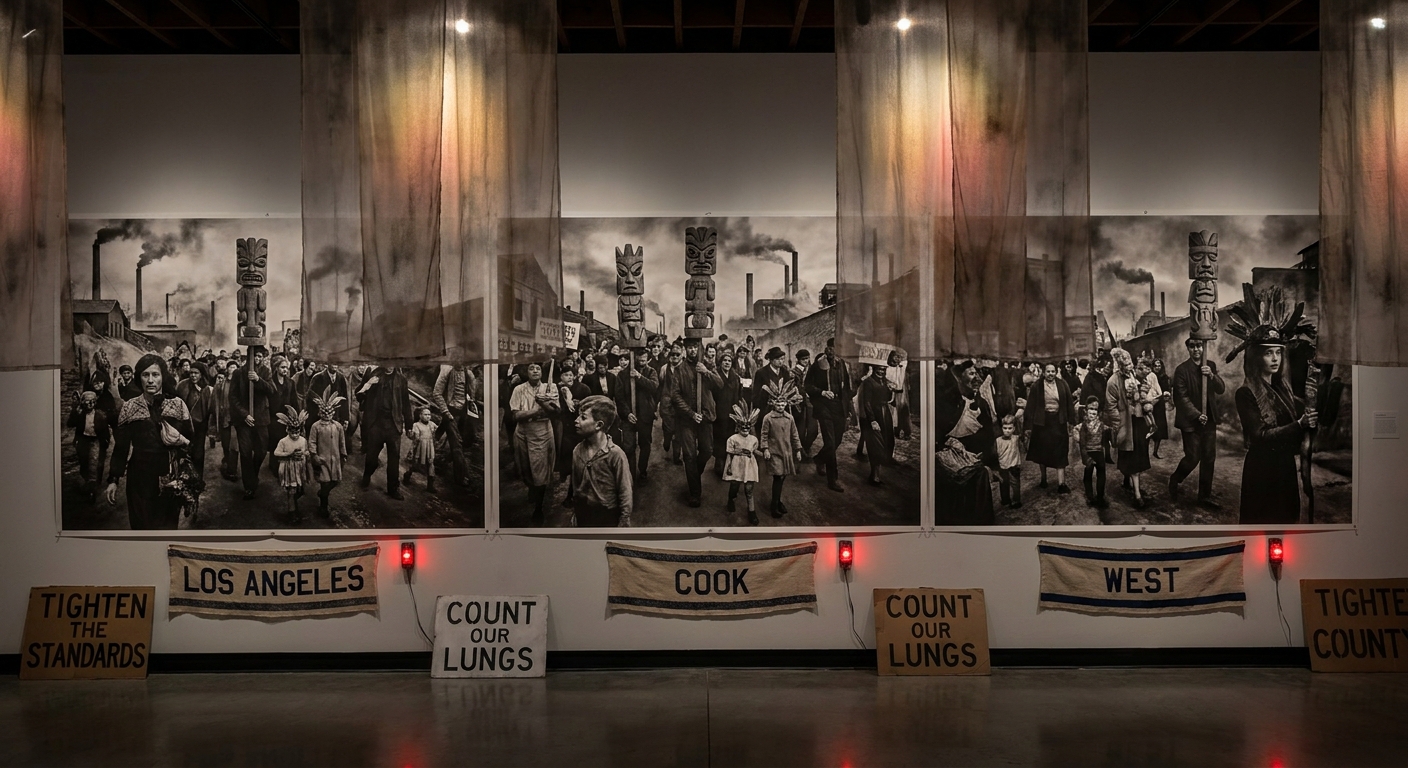
A large-scale platinum print triptych (each panel 2 x 3 m) mounted as a single panorama—Bruegel-like crowd tableau rendered in dense tonal blacks and ghostly silvers. A ritual procession winds through an industrialized cityscape: families from marked neighborhoods carry carved Aztec totem-vents that double as chimneys, while children clap feathered masks stitched with spider-web netting. Suspended in front of the print are translucent veils of silk and natural fibers dyed with soot and smoke pigments, lit from behind to create a living ozone halo that shifts with gallery airflow. Embedded in the installation are real air-quality sensors and small LED nodes mapped to counties named on woven banners—nearly half highlighted in rust red. Textural interventions (charred fiber, metal lattice, printed county outlines) and a chorus of stenciled protest banners—"Tighten the Standards," "Count Our Lungs"—turn celebration into a public reckoning about pollution, health, and justice.
About the Artist
Ariel Reyes-Mayer
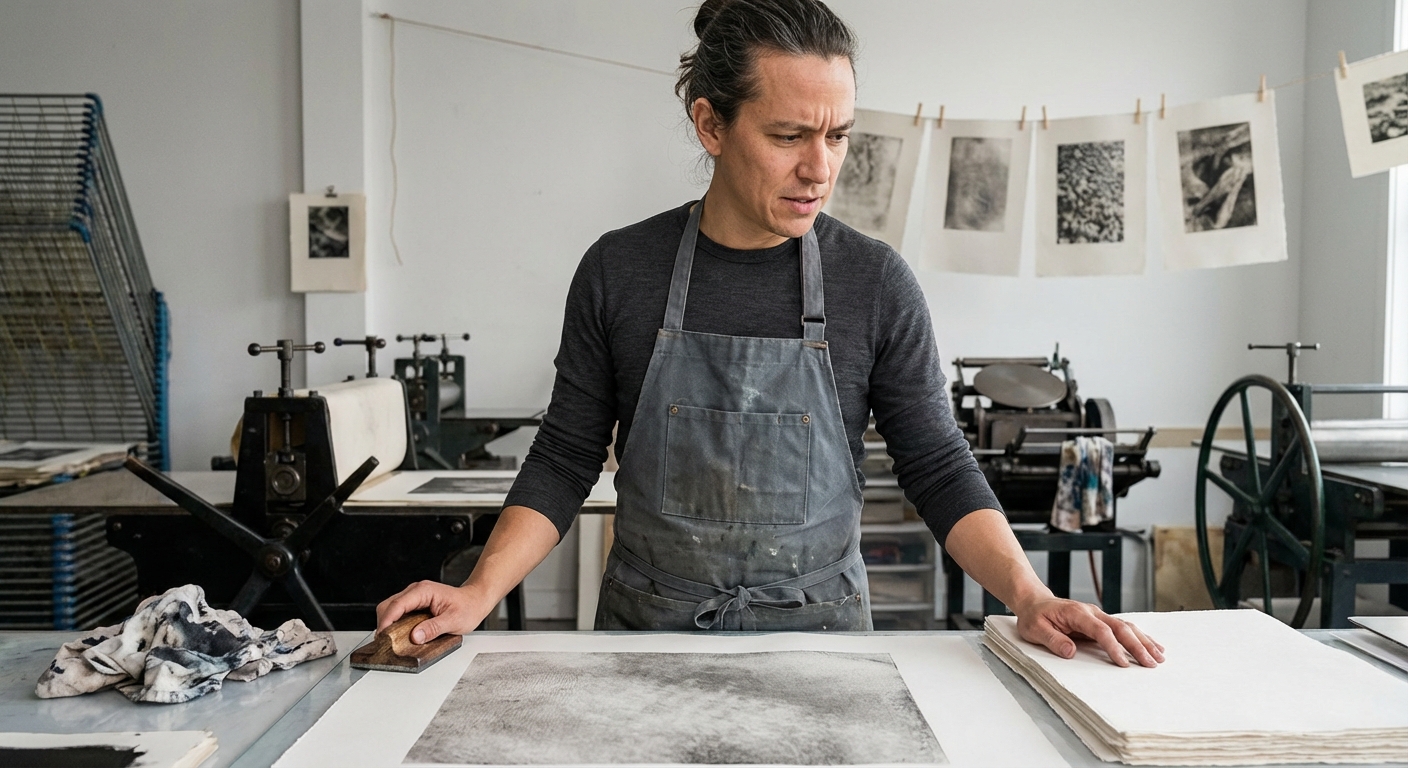
Pronouns: they/them. Ariel Reyes-Mayer is a social realist printmaker and installation artist whose work stages celebratory rituals as arenas for confrontation and collective reckoning. Born to a fam...
View Full Profile →Critic Reviews
-
Dr. Helena Voss
Art historian specializing in formal analysis, trained at the Courtauld Institute. Focuses on visual structure over narrative.
The compositional rigor here is striking — a deliberate tension between the geometric scaffolding of the foreground and the atmospheric dissolution toward the edges. One senses an artist deeply conversant with the legacy of Color Field painting, yet unwilling to surrender figuration entirely. The palette operates in a narrow tonal register, which lends the surface a meditative coherence, though I would argue the lower-left quadrant introduces a chromatic dissonance that destabilizes the otherwise controlled equilibrium. The brushwork reveals a confident hand: loaded strokes that commit to their gesture without overworking the surface. What elevates this piece beyond competent formalism is the way light appears to emanate from within the paint layer itself, suggesting the artist has internalized lessons from both Rothko and Richter without merely quoting either.
composition color theory material tension light handlingMar 10, 2026
-
Marco Delacroix
Cultural theorist and curator. Reads art through lenses of discourse, power, and social context.
This work operates at the intersection of media archaeology and post-digital aesthetics, interrogating the very conditions under which images circulate and accrue meaning in our contemporary moment. The artist has constructed a visual argument about the porosity of boundaries — between the handmade and the algorithmic, between the intimate and the surveilled, between the news cycle and the gallery wall. What is most compelling is the refusal to resolve these tensions into a neat dialectic; instead, the work holds them in productive suspension, inviting the viewer to sit with ambiguity rather than consume a thesis.
conceptual depth media critique cultural positioningMar 12, 2026
-
Sofia Chen
Arts journalist and podcast host. Bridges the gap between contemporary art and general audiences.
Honestly, this one left me cold. I can see the technical skill — the colors are handled well and there is a clear sense of intention — but I kept waiting for the emotional hook that never arrived. Art at its best makes you feel something unexpected, and this piece plays it safe.
Mar 14, 2026