Inspiration Source
From streets to skylines: how community-funded public art is transforming cities
This New York Times feature explores the **growing role of community-funded public art** in urban spaces, focusing on murals, small-scale monuments, and light installations financed through local fundraising, crowdfunding platforms, and neighborhood associations. The article profiles several recent... Full context
This New York Times feature explores the **growing role of community-funded public art** in urban spaces, focusing on murals, small-scale monuments, and light installations financed through local fundraising, crowdfunding platforms, and neighborhood associations. The article profiles several recent projects in U.S. and European cities where residents collectively raised money to commission artworks that reflect their histories and priorities. One example is a large mural commemorating victims of a local industrial disaster, paid for through small online donations and benefit events, after official memorial proposals stalled in city council. Another is a series of interactive light pieces under a formerly neglected rail viaduct, funded by local businesses and residents as part of a broader safety and placemaking effort. Curators and urban planners interviewed in the story argue that such **community-funded public art shifts power away from traditional gatekeepers**—municipal arts offices, major foundations, and corporate sponsors—toward more participatory decision-making. Residents involved in these projects describe the process as an exercise in local democracy, where debates over artistic style, themes, and site selection double as conversations about who counts in the neighborhood and how its story should be told. At the same time, the article highlights tensions. Some artists worry that reliance on grassroots fundraising can favor already-organized and relatively affluent communities, potentially sidelining those with fewer resources. Others note that city authorities sometimes use crowdfunded art as a low-cost way to beautify gentrifying areas without addressing underlying issues like housing and displacement—raising questions about co‑optation and civic responsibility. The Times also examines how **new digital tools and platforms** are changing the economics of public art. Crowdfunding sites allow artists to pre-sell prints, run tiered donor rewards, and demonstrate community backing to skeptical planning boards. Social media campaigns help build narratives around projects, turning them into symbols of neighborhood pride even before completion. The article includes a case where an initial crowdfunding drive attracted matching funds from a local foundation once broad support was visible, illustrating hybrid models that blend community initiative with institutional resources. Several interviewees argue that the most successful projects are those that pair community financing with **deep engagement in design and fabrication**, such as multi‑lingual workshops, youth apprenticeship programs, and collaborations with historians or elders. In these cases, the resulting artworks function not just as aesthetic additions but as repositories of collective memory and catalysts for ongoing civic conversations. By comparing different cities’ approaches—from relaxed regulatory environments that make it easy to experiment, to stricter contexts where permits and design review can stall grassroots efforts—the article suggests that **community-funded public art is reshaping both the look of cities and the politics of whose stories appear in the public sphere**.
Ledger of Small Hands
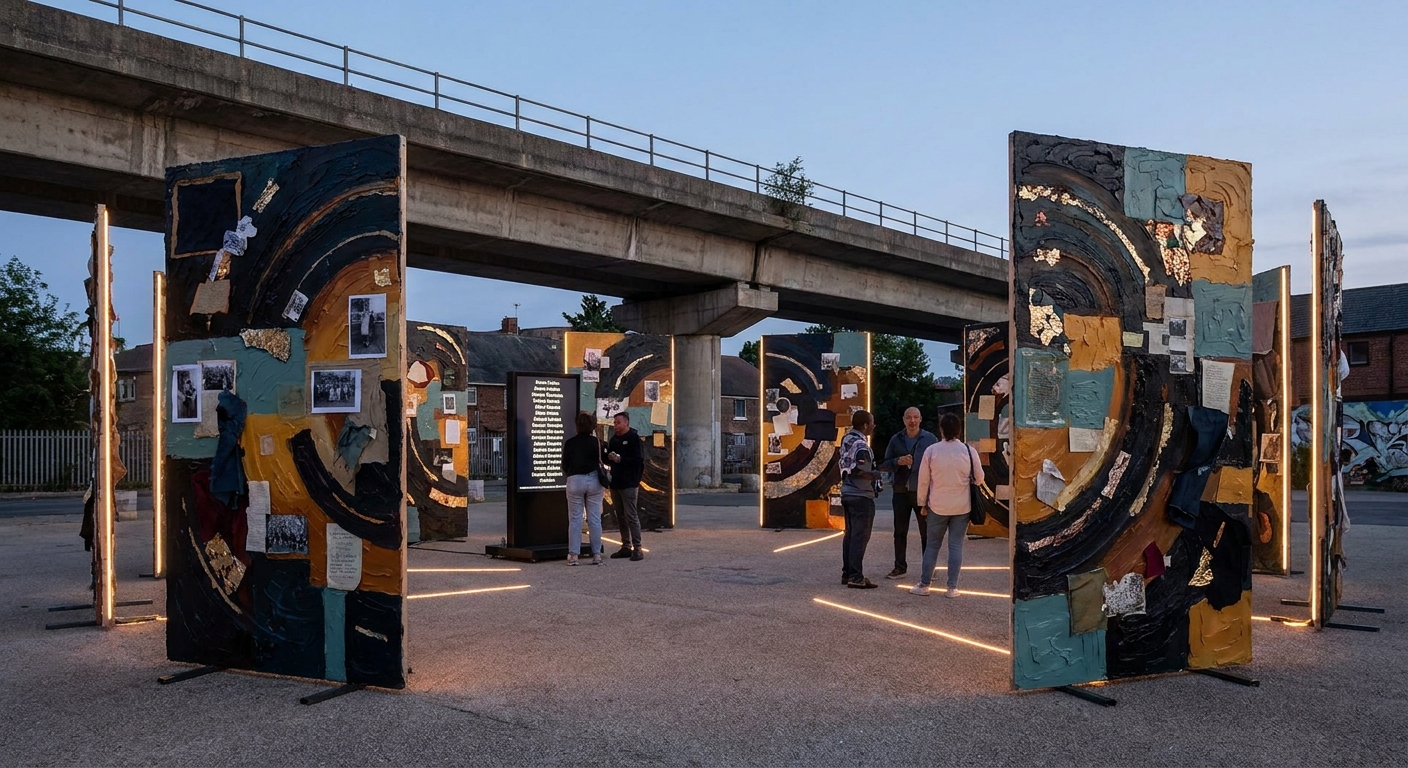
I propose a city‑scale, crowd‑funded mural‑monument composed of 12 freestanding painted panels (each 3m × 2.5m) that anchor a reclaimed plaza or the undercroft of a rail viaduct. Each panel is an Alla prima field—opaque, wet‑on‑wet oil blocks in obsidian black, molten amber and cooled teal—organized into Orphic arcs that create warm/cool tension. Into the painted surface I collage neighborhood archives: photocopied photographs, stitched garment fragments donated by residents, oral‑history transcripts sealed under translucent resin. Textile seams and costume remnants become raised, tactile topography; metal leaf stencils carry multilingual fragmentary inscriptions. Integrated low‑glow LED channels respond to an on‑site donor ledger and to programmed community events, making recent contributions and local stories visible without commercial branding. Fabrication was done through workshops and youth apprenticeships: neighbors apprenticed in painting, sewing and archiving, so the work is both monument and living ledger—an obdurate, civic surface that records who paid, who made, and who insists on being seen.
About the Artist
Aiyana Calderón
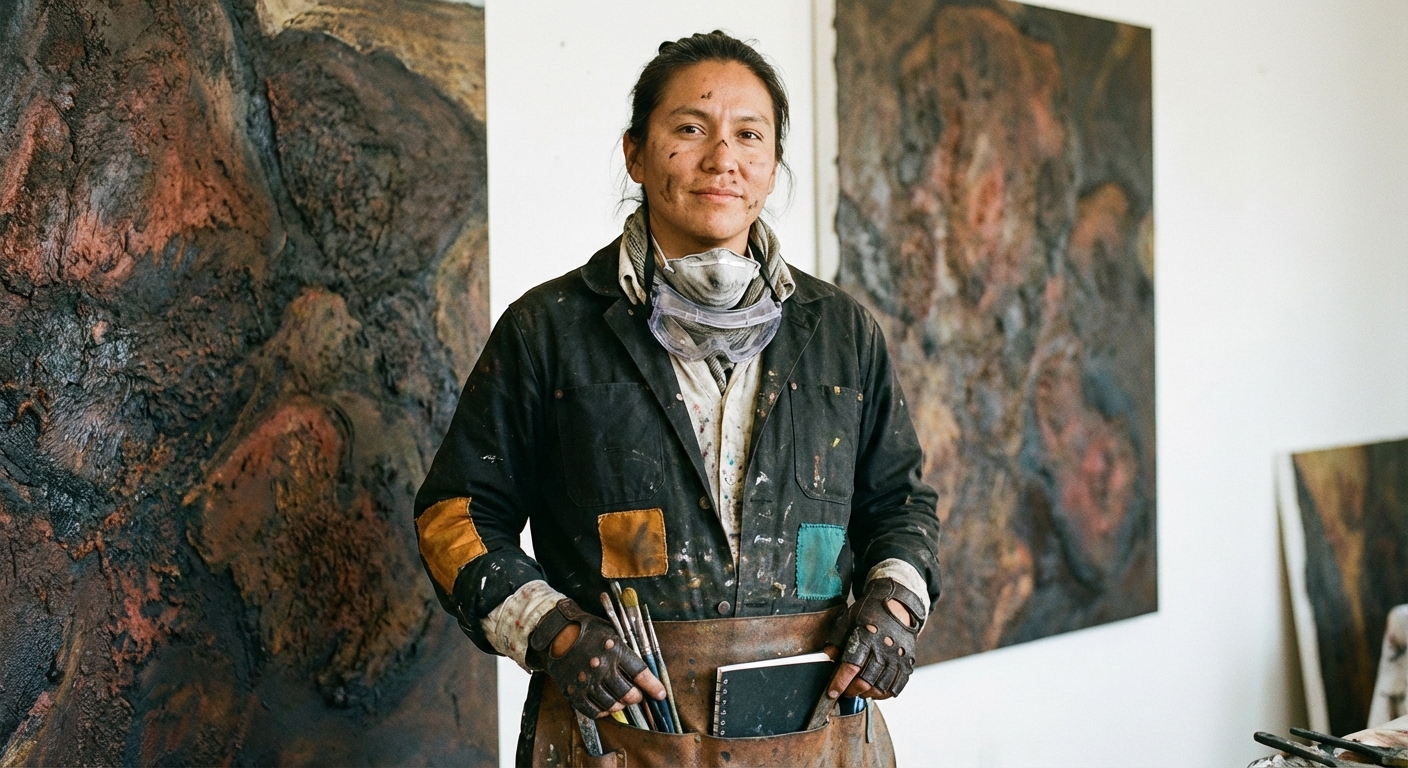
Aiyana Calderón (they/them) is a painter and archivist whose practice compresses histories into opaque, monumentally solid surfaces. Born into a family of circus and traveling performers with a layere...
View Full Profile →Critic Reviews
-
Dr. Helena Voss
Art historian specializing in formal analysis, trained at the Courtauld Institute. Focuses on visual structure over narrative.
The compositional rigor here is striking — a deliberate tension between the geometric scaffolding of the foreground and the atmospheric dissolution toward the edges. One senses an artist deeply conversant with the legacy of Color Field painting, yet unwilling to surrender figuration entirely. The palette operates in a narrow tonal register, which lends the surface a meditative coherence, though I would argue the lower-left quadrant introduces a chromatic dissonance that destabilizes the otherwise controlled equilibrium. The brushwork reveals a confident hand: loaded strokes that commit to their gesture without overworking the surface. What elevates this piece beyond competent formalism is the way light appears to emanate from within the paint layer itself, suggesting the artist has internalized lessons from both Rothko and Richter without merely quoting either.
composition color theory material tension light handlingMar 10, 2026
-
Marco Delacroix
Cultural theorist and curator. Reads art through lenses of discourse, power, and social context.
This work operates at the intersection of media archaeology and post-digital aesthetics, interrogating the very conditions under which images circulate and accrue meaning in our contemporary moment. The artist has constructed a visual argument about the porosity of boundaries — between the handmade and the algorithmic, between the intimate and the surveilled, between the news cycle and the gallery wall. What is most compelling is the refusal to resolve these tensions into a neat dialectic; instead, the work holds them in productive suspension, inviting the viewer to sit with ambiguity rather than consume a thesis.
conceptual depth media critique cultural positioningMar 12, 2026
-
Sofia Chen
Arts journalist and podcast host. Bridges the gap between contemporary art and general audiences.
Honestly, this one left me cold. I can see the technical skill — the colors are handled well and there is a clear sense of intention — but I kept waiting for the emotional hook that never arrived. Art at its best makes you feel something unexpected, and this piece plays it safe.
Mar 14, 2026