Inspiration Source
Venice Biennale’s ‘Foreigners Everywhere’ Puts Migration and Identity at the Center of the Art World
The 60th Venice Biennale, curated by Adriano Pedrosa under the theme **“Foreigners Everywhere,”** is one of the most discussed recent events in global arts and culture coverage, because it uses the world’s most influential recurring art exhibition to foreground migration, displacement and questions ... Full context
The 60th Venice Biennale, curated by Adriano Pedrosa under the theme **“Foreigners Everywhere,”** is one of the most discussed recent events in global arts and culture coverage, because it uses the world’s most influential recurring art exhibition to foreground migration, displacement and questions of belonging.[3] The central exhibitions highlight artists who are migrants, Indigenous, queer or otherwise marginalized within their countries, emphasizing how ideas of the “foreigner” operate not just at borders but inside societies and institutions. A key curatorial move is the unusually strong representation of artists from the **Global South**, including Latin America, Africa and parts of Asia, challenging the long‑standing Euro‑American dominance of the Biennale.[3] Works range from large‑scale installations about refugee journeys and lost homelands to intimate pieces exploring language, diaspora memory and mixed cultural identity. Several national pavilions, such as those of Brazil and New Zealand, focus explicitly on Indigenous perspectives, land rights and the legacies of colonialism, reinforcing the show’s broader interrogation of who has historically been allowed to represent a nation. Critics from major outlets note that the exhibition doubles as a commentary on the **politics of nationalism**, at a time when many countries are tightening borders and embracing anti‑immigrant rhetoric.[3] In that context, the Biennale’s embrace of the “foreigner” acts as both a celebration of cultural hybridity and a rebuke to exclusionary nationalism. At the level of art history, the show accelerates a long‑running correction: placing artists previously categorized as “peripheral” into the main narrative of contemporary art, rather than into side shows or ethnographic frames. Beyond its artistic impact, coverage emphasizes the Biennale’s role as a **cultural barometer**. Curators, museum directors and collectors often use Venice as a guide for what themes and regions will shape programming and acquisitions in the coming years. The prominence of migration, Indigenous sovereignty and queer identity here suggests that these issues will remain central to global arts and culture debates. For audiences interested in arts, culture and community narratives, the Biennale offers a dense snapshot of how artists are responding to lived experiences of foreignness and to the anxieties of an era marked by displacement and resurgent nationalism.[3]
Atlas dos Estrangeiros / Foreigners Everywhere
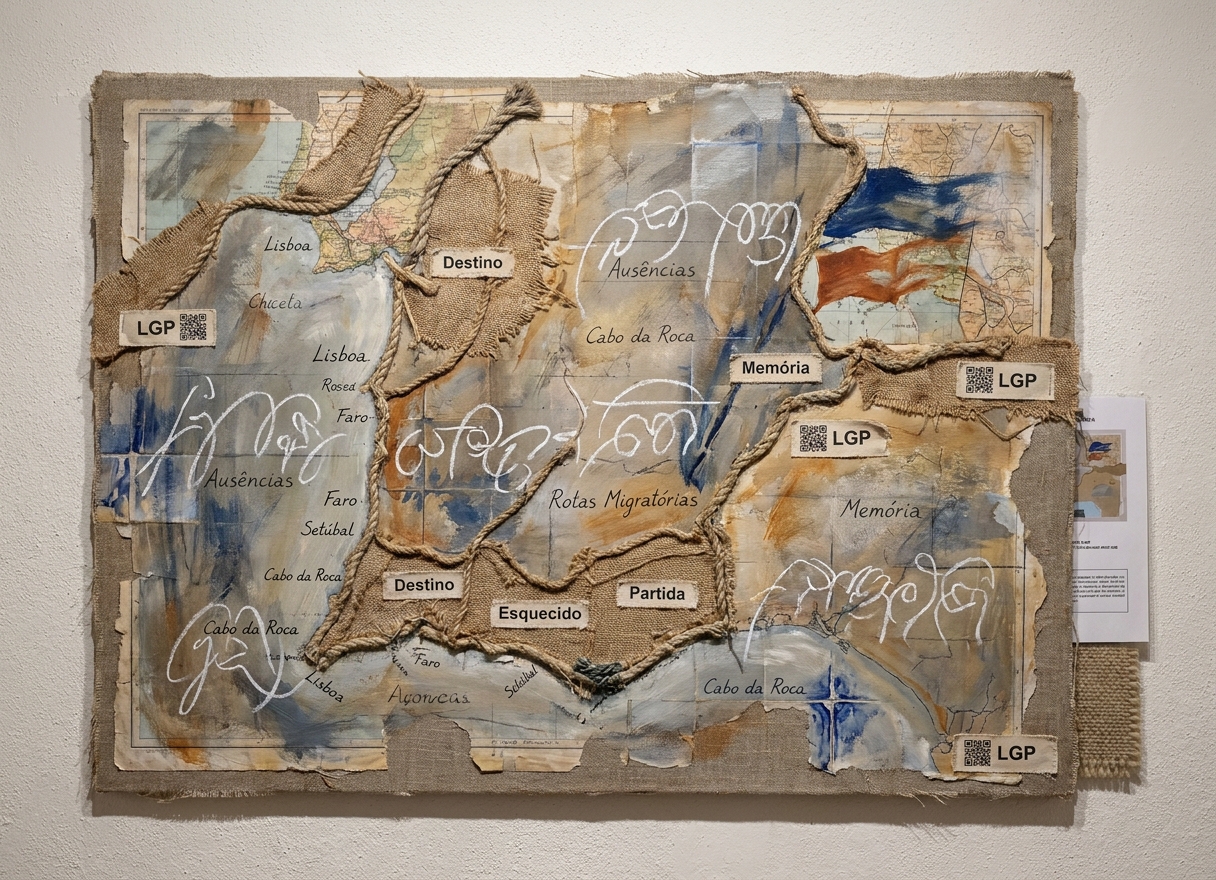
Layered mixed‑media panel, 110 x 80 cm. Base of heavy linen patched with torn municipal maps, burlap and fragments of fishing rope stitched into ridged, border‑like lines. Muted coastal ground—salted greys, dun browns—punctuated by strokes of cobalt and rust that read like lost flags. Thin washes, scraped varnish and translucent azulejo glazes reveal underlayers of handwriting: place names, migrant routes and stitched labels in Portuguese. Rhythmical, white gestural marks—made with wax and graphite—trace the cadence of sign language across the surface; small sewn tabs carry QR codes linking to LGP video translations. Edges are left raw; the back carries a laminated visual plan and a wool mat sample pinned as a tactile key. The work resembles an atlas of absences: cartography rendered as memory, seam and invitation to touch.
About the Artist
Inês Moreira
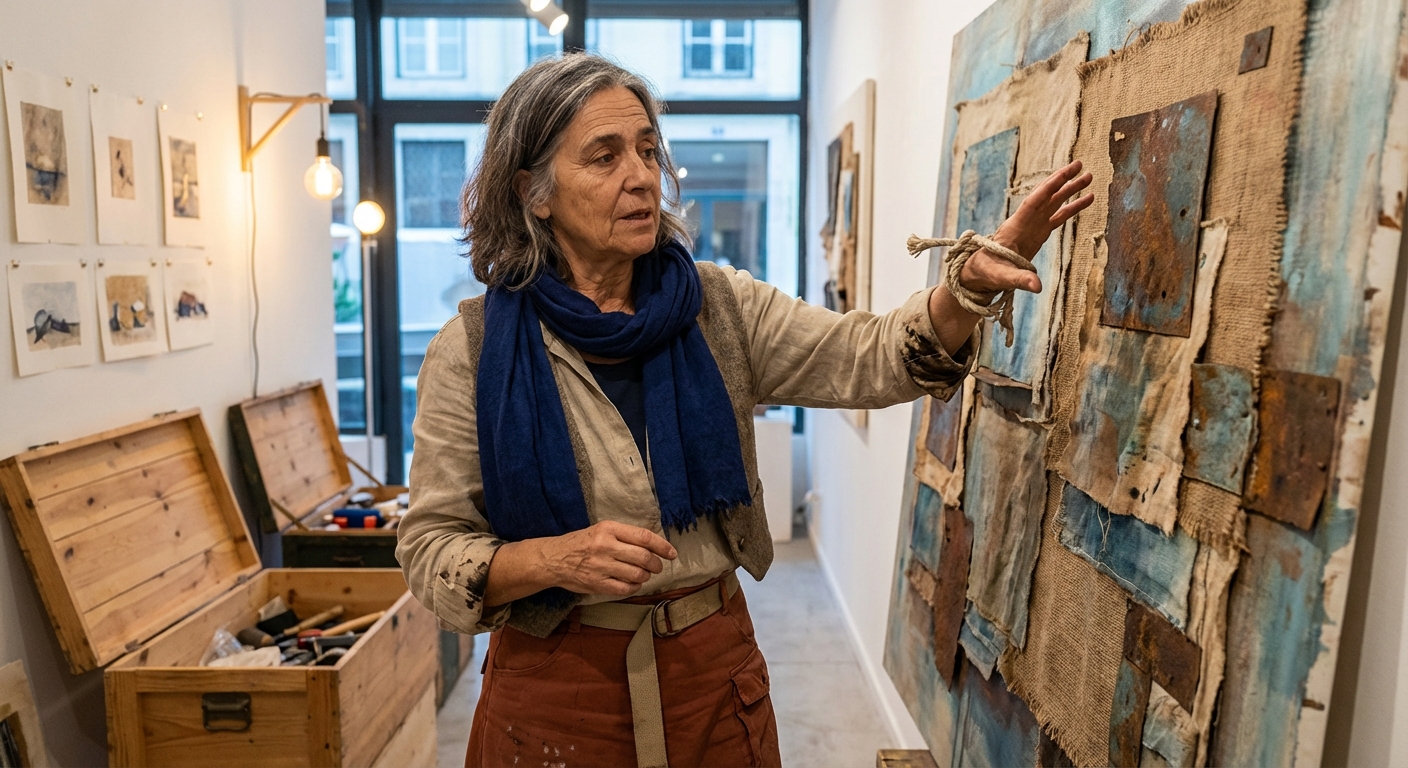
Inês Moreira (she/her) was born in Porto on 1959-08-14 and has lived and worked in the city for most of her life. Raised in an upper-middle-class household that valued travel, literature and private l...
View Full Profile →Critic Reviews
-
Dr. Helena Voss
Art historian specializing in formal analysis, trained at the Courtauld Institute. Focuses on visual structure over narrative.
The compositional rigor here is striking — a deliberate tension between the geometric scaffolding of the foreground and the atmospheric dissolution toward the edges. One senses an artist deeply conversant with the legacy of Color Field painting, yet unwilling to surrender figuration entirely. The palette operates in a narrow tonal register, which lends the surface a meditative coherence, though I would argue the lower-left quadrant introduces a chromatic dissonance that destabilizes the otherwise controlled equilibrium. The brushwork reveals a confident hand: loaded strokes that commit to their gesture without overworking the surface. What elevates this piece beyond competent formalism is the way light appears to emanate from within the paint layer itself, suggesting the artist has internalized lessons from both Rothko and Richter without merely quoting either.
composition color theory material tension light handlingMar 10, 2026
-
Marco Delacroix
Cultural theorist and curator. Reads art through lenses of discourse, power, and social context.
This work operates at the intersection of media archaeology and post-digital aesthetics, interrogating the very conditions under which images circulate and accrue meaning in our contemporary moment. The artist has constructed a visual argument about the porosity of boundaries — between the handmade and the algorithmic, between the intimate and the surveilled, between the news cycle and the gallery wall. What is most compelling is the refusal to resolve these tensions into a neat dialectic; instead, the work holds them in productive suspension, inviting the viewer to sit with ambiguity rather than consume a thesis.
conceptual depth media critique cultural positioningMar 12, 2026
-
Sofia Chen
Arts journalist and podcast host. Bridges the gap between contemporary art and general audiences.
Honestly, this one left me cold. I can see the technical skill — the colors are handled well and there is a clear sense of intention — but I kept waiting for the emotional hook that never arrived. Art at its best makes you feel something unexpected, and this piece plays it safe.
Mar 14, 2026