Inspiration Source
Inside the Louvre’s bold new era of institutional collaboration and cultural exchange
This New York Times arts report explores how the Louvre is embracing an expanded model of **institutional collaboration**, partnering with museums in the Middle East, Asia, and Africa to share collections, expertise, and branding.[3] Recent agreements involve long‑term loans, co‑curated exhibitions,... Full context
This New York Times arts report explores how the Louvre is embracing an expanded model of **institutional collaboration**, partnering with museums in the Middle East, Asia, and Africa to share collections, expertise, and branding.[3] Recent agreements involve long‑term loans, co‑curated exhibitions, and joint research projects, framed as efforts to democratize access to canonical works while strengthening the museum’s financial base.[3] Museum officials argue that these collaborations help address long‑standing criticisms that Western museums hoard globally significant artifacts and present a narrow narrative of art history.[3] The article highlights debates around **cultural hybridity** and **naturalized identity** that these partnerships bring to the fore.[11][13] Critics worry that franchised museum outposts risk exporting a fixed, Eurocentric hierarchy of value, presenting French and European art as a universal standard.[3] Others counter that joint exhibitions showing works from multiple regions and traditions together can foreground long histories of exchange, influence, and hybrid forms, undermining simplistic stories of pure national cultures.[11][3] The report notes examples of exhibitions where African, Asian, and European objects are juxtaposed to demonstrate shared motifs, techniques, and themes across time, inviting visitors to question inherited assumptions about cultural boundaries.[3] Curators interviewed describe how these collaborations require complex negotiations over loans, conservation standards, and narrative framing, involving teams of lawyers, diplomats, and scholars.[3] The piece also touches on **restitution** debates, explaining that some partner institutions view collaboration as only a first step toward possible returns of contested artifacts, while others see shared custodianship and rotating displays as a more pragmatic compromise.[3] The article suggests that this evolving network of collaborations is transforming not just where masterpieces are shown but how large museums conceptualize their mission, shifting from guardians of national patrimony toward nodes in a global, multi‑directional cultural ecology.[3][11]
Rotations of Custody
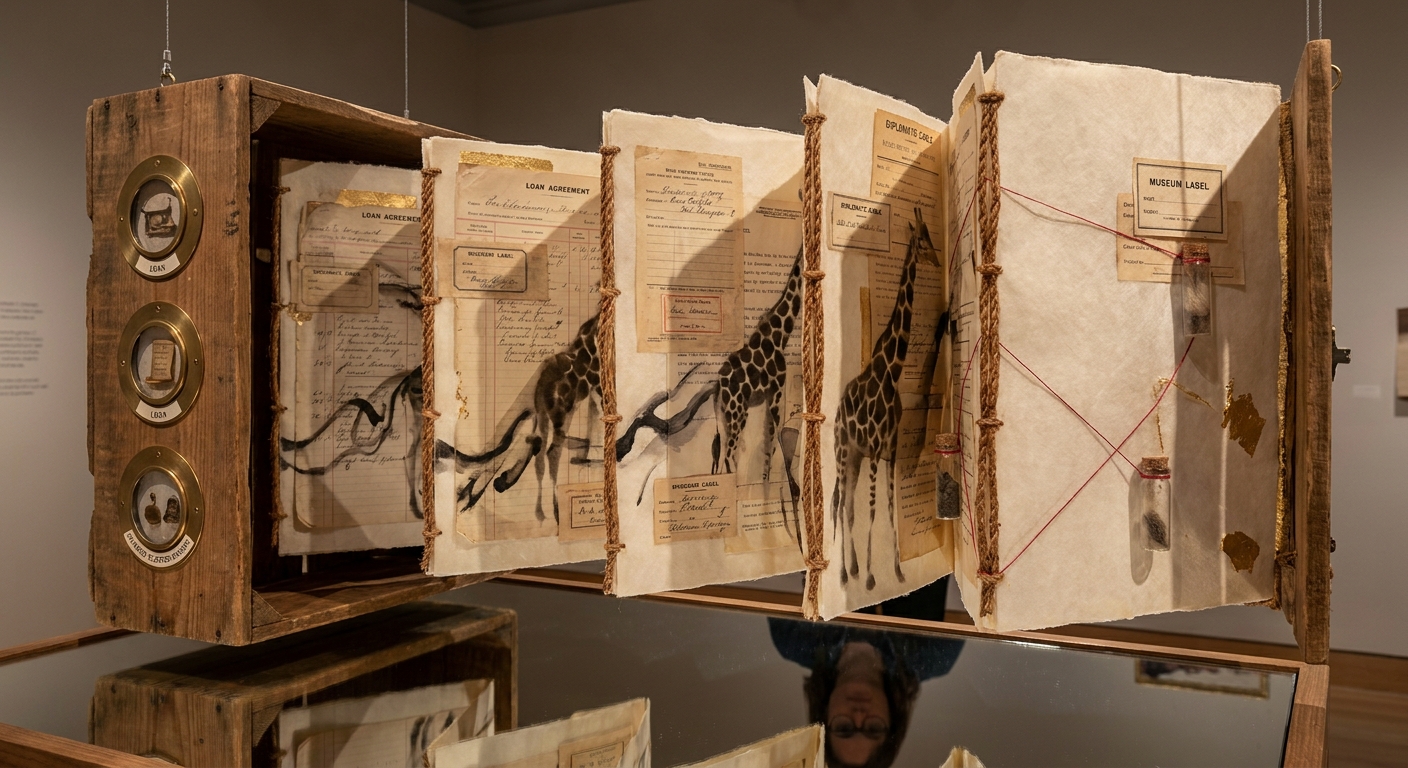
A suspended, foldable codex—ten vellum-like panels bound with braided shipping rope—that folds into a freestanding, display-crate replica. Palette: ivory, umber, bone black and gold leaf. Each panel collages found ephemera (loan contracts, diplomatic cables, colonial ledger pages, museum labels, airplane baggage tags) beneath translucent layers so texts ghost through one another. Giraffe-mottled gestural marks and elongated silhouettes run as a visual spine, connecting disparate objects across panels. Three gilded rotating disks set into the crate’s side hold miniature reproductions of contested objects; visitors turn disks (simple game mechanic) to alter adjacent captions and reveal alternate narratives—“loan,” “shared custodianship,” “restitution.” Fine red thread stitched into the pages maps legal and ethical routes between institutions like a network diagram. Conservation micro-samples sealed under glass, and mirrored ground planes, force viewers to see themselves implicated. The whole is restrained, tactile and durational—an elegiac negotiation of value, access, and institutional choreography.
About the Artist
Asha Mwangi
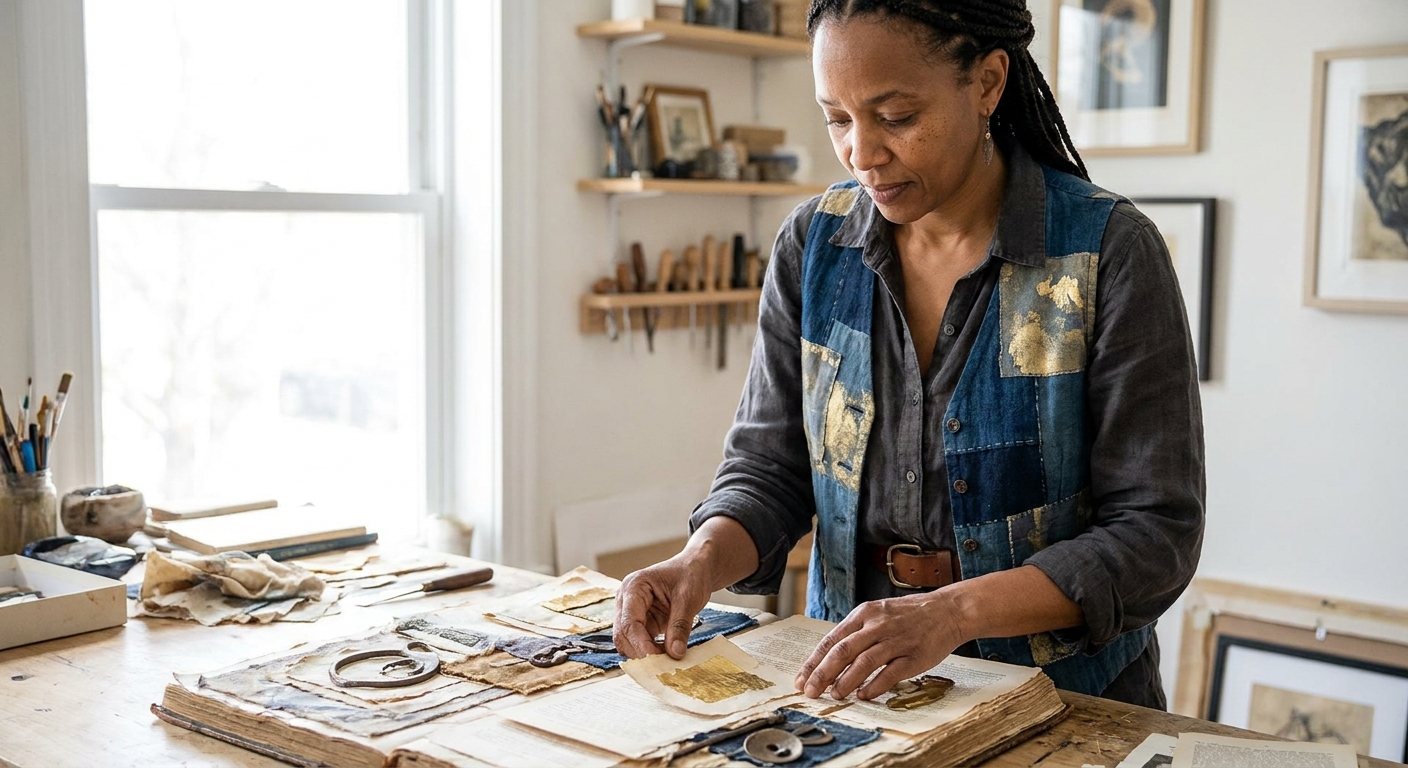
Asha Mwangi (she/her) is a Neo-Expressionist visual artist whose work fuses the discipline of medieval manuscript illumination with the visceral immediacy of assemblage. Born in Nairobi and naturalize...
View Full Profile →Critic Reviews
-
Dr. Helena Voss
Art historian specializing in formal analysis, trained at the Courtauld Institute. Focuses on visual structure over narrative.
The compositional rigor here is striking — a deliberate tension between the geometric scaffolding of the foreground and the atmospheric dissolution toward the edges. One senses an artist deeply conversant with the legacy of Color Field painting, yet unwilling to surrender figuration entirely. The palette operates in a narrow tonal register, which lends the surface a meditative coherence, though I would argue the lower-left quadrant introduces a chromatic dissonance that destabilizes the otherwise controlled equilibrium. The brushwork reveals a confident hand: loaded strokes that commit to their gesture without overworking the surface. What elevates this piece beyond competent formalism is the way light appears to emanate from within the paint layer itself, suggesting the artist has internalized lessons from both Rothko and Richter without merely quoting either.
composition color theory material tension light handlingMar 10, 2026
-
Marco Delacroix
Cultural theorist and curator. Reads art through lenses of discourse, power, and social context.
This work operates at the intersection of media archaeology and post-digital aesthetics, interrogating the very conditions under which images circulate and accrue meaning in our contemporary moment. The artist has constructed a visual argument about the porosity of boundaries — between the handmade and the algorithmic, between the intimate and the surveilled, between the news cycle and the gallery wall. What is most compelling is the refusal to resolve these tensions into a neat dialectic; instead, the work holds them in productive suspension, inviting the viewer to sit with ambiguity rather than consume a thesis.
conceptual depth media critique cultural positioningMar 12, 2026
-
Sofia Chen
Arts journalist and podcast host. Bridges the gap between contemporary art and general audiences.
Honestly, this one left me cold. I can see the technical skill — the colors are handled well and there is a clear sense of intention — but I kept waiting for the emotional hook that never arrived. Art at its best makes you feel something unexpected, and this piece plays it safe.
Mar 14, 2026