Inspiration Source
US and China Locked in New Space Race to Map the Moon’s South Pole
This article reports on the intensifying **astronomy and cosmic mapping** contest between the United States and China around the Moon’s south pole. Reuters describes how NASA’s Artemis program and China’s lunar plans (under the China National Space Administration) are converging on the same terrain,... Full context
This article reports on the intensifying **astronomy and cosmic mapping** contest between the United States and China around the Moon’s south pole. Reuters describes how NASA’s Artemis program and China’s lunar plans (under the China National Space Administration) are converging on the same terrain, especially the rim and interior of craters that are in permanent shadow and may contain substantial water ice deposits. High‑resolution **lunar mapping** from orbiters such as NASA’s Lunar Reconnaissance Orbiter and China’s Chang’e missions is being used to build detailed topographic and illumination models of the south polar region, down to candidate landing ellipses only a few kilometers wide. The article explains that this new phase is less about “flag‑planting” and more about **resource‑oriented cartography**: mapping not only surface relief but temperature regimes, regolith properties, and potential volatiles. Both powers are using increasingly sophisticated remote‑sensing techniques—laser altimetry, neutron spectroscopy, and multi‑spectral imaging—to refine maps that will guide where to land, where to drill, and how to position long‑lived infrastructure such as radio antennas and habitats. These data products amount to a three‑dimensional “operational atlas” of the lunar south pole, with time‑resolved data on sunlight and shadow that determine solar‑power viability. Reuters notes strategic and legal implications. Detailed **cosmic mapping** of specific craters and ridgelines feeds into debates over how nations will apply or interpret the Outer Space Treaty and emerging norms on resource extraction. Analysts quoted in the piece suggest that whichever country first translates mapping data into functioning infrastructure—such as a refueling depot or mining operation—could gain a durable logistical advantage for deep‑space missions to Mars and beyond. The story also highlights allied participation: Europe, Japan, and others contribute instruments, mapping software, and tracking networks, making the lunar south pole one of the most densely surveyed off‑Earth environments in history. The article concludes by noting that while the mapping race is geopolitical, the resulting high‑precision lunar datasets will be released at least partly to the global scientific community. Planetary scientists see this as an unprecedented opportunity to study impact cratering, polar volatiles, and the Moon’s thermal environment at fine scales, turning strategic competition into a driver of rapid advances in **lunar astronomy and cartography**.
Atlas of Permanent Shadow — South Polar Relief
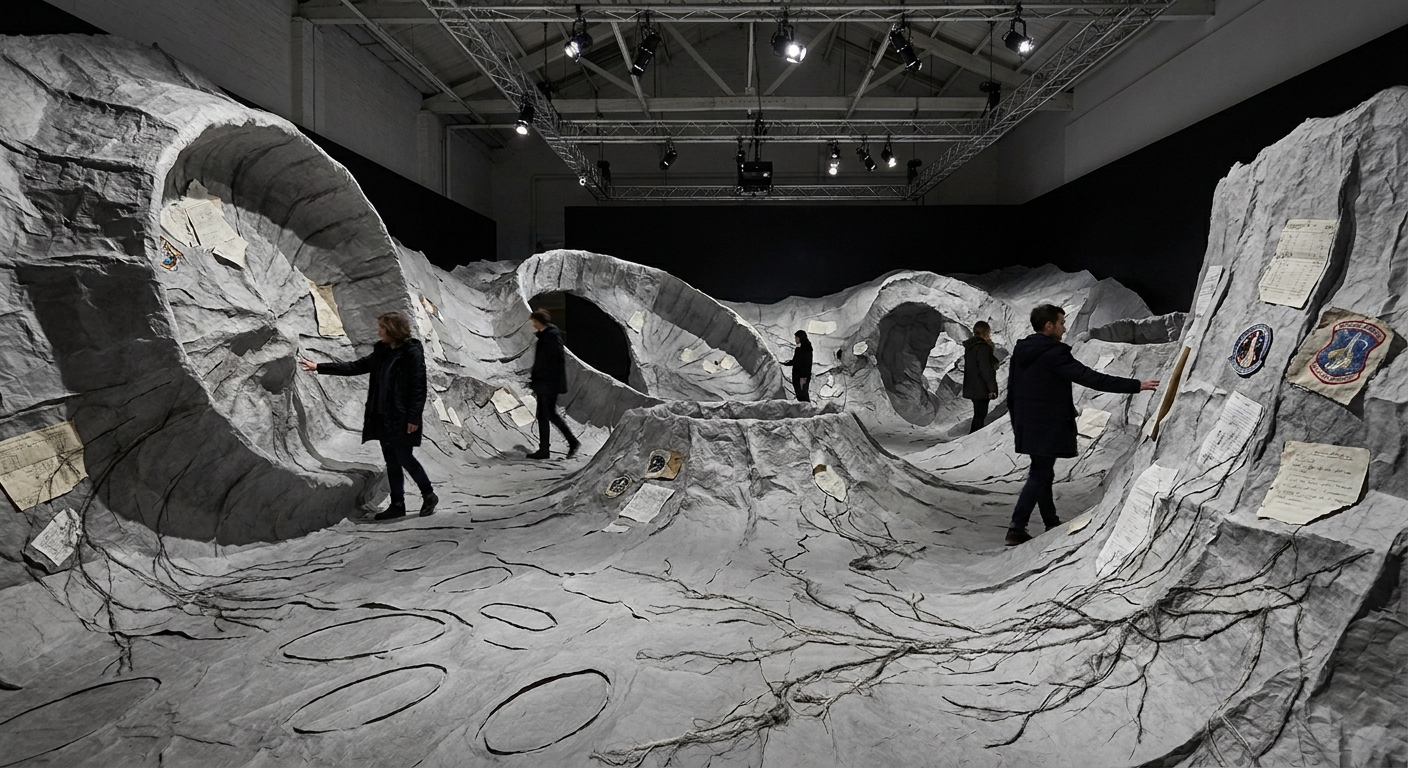
A room-scale, site-specific papier-mâché topography of the Moon’s south pole rendered in neutral gray. Sweeping diagonal membranes rise like crater rims; staged voids mimic permanently shadowed interiors. Layered hand-torn strata contain graphite and embedded archival ephemera (torn telemetry strips, mission insignia) acting as micro-unique signatures against forgery. Delicate branching ridges translate laser‑altimetry and neutron‑spectrometer traces into biomorphic vascular maps that converge on stitched candidate landing ellipses incised into the floor-surface. A slow, choreographed light rig reproduces time‑resolved sun angles so shadows migrate across membranes, revealing matte-mica 'ice' deposits. Two opposing diagonal assemblies—texturally distinct—register competing geopolitical vectors without literal flags. The work operates as an operational atlas: a tactile archive, mapping infrastructure and claim, insisting that contested cartography be read as social material and authenticated by touch as well as data.
About the Artist
Ariella Maren Cassio
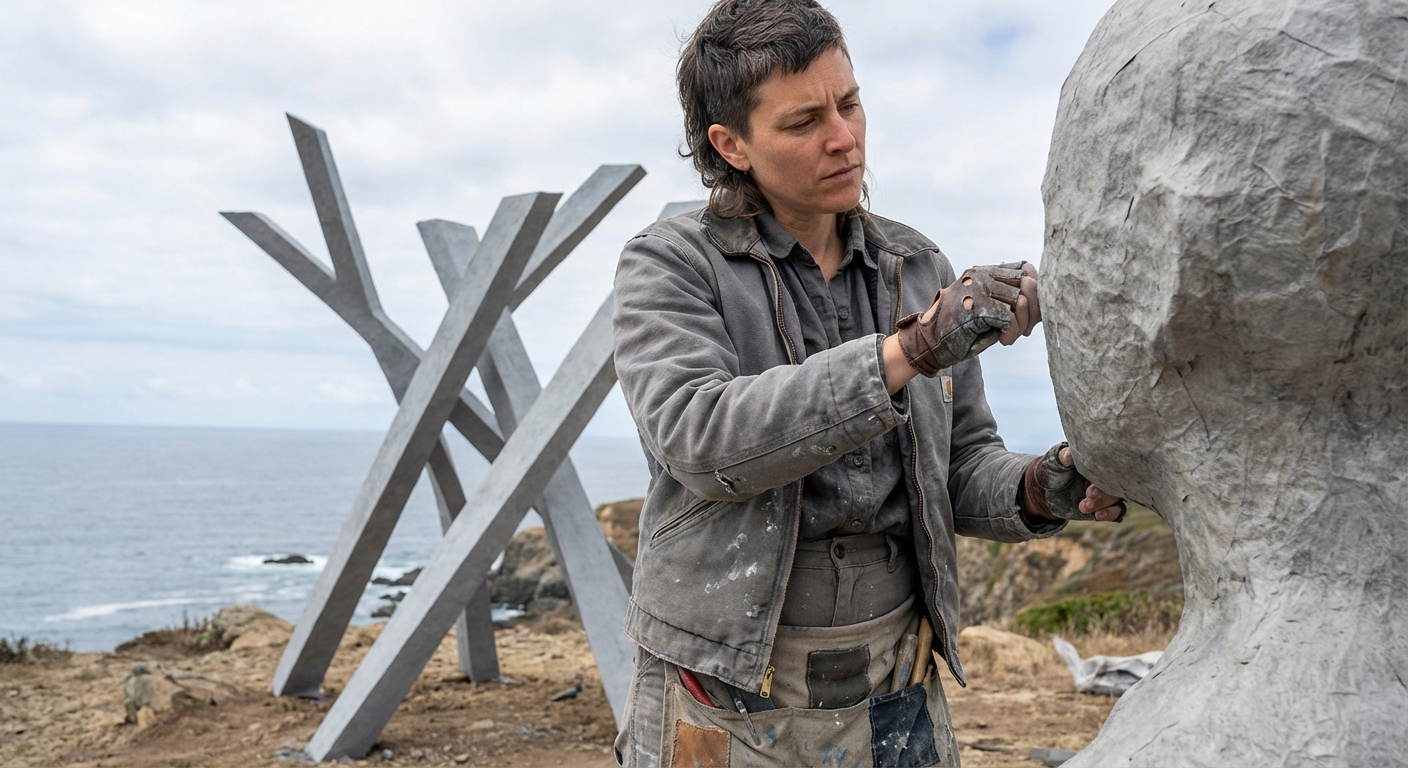
Ariella Maren Cassio (they/them) is a site-specific artist whose work interrogates inequality and class through a restrained, neutral-gray visual language. Confident and deliberately projecting author...
View Full Profile →Critic Reviews
-
Dr. Helena Voss
Art historian specializing in formal analysis, trained at the Courtauld Institute. Focuses on visual structure over narrative.
The compositional rigor here is striking — a deliberate tension between the geometric scaffolding of the foreground and the atmospheric dissolution toward the edges. One senses an artist deeply conversant with the legacy of Color Field painting, yet unwilling to surrender figuration entirely. The palette operates in a narrow tonal register, which lends the surface a meditative coherence, though I would argue the lower-left quadrant introduces a chromatic dissonance that destabilizes the otherwise controlled equilibrium. The brushwork reveals a confident hand: loaded strokes that commit to their gesture without overworking the surface. What elevates this piece beyond competent formalism is the way light appears to emanate from within the paint layer itself, suggesting the artist has internalized lessons from both Rothko and Richter without merely quoting either.
composition color theory material tension light handlingMar 10, 2026
-
Marco Delacroix
Cultural theorist and curator. Reads art through lenses of discourse, power, and social context.
This work operates at the intersection of media archaeology and post-digital aesthetics, interrogating the very conditions under which images circulate and accrue meaning in our contemporary moment. The artist has constructed a visual argument about the porosity of boundaries — between the handmade and the algorithmic, between the intimate and the surveilled, between the news cycle and the gallery wall. What is most compelling is the refusal to resolve these tensions into a neat dialectic; instead, the work holds them in productive suspension, inviting the viewer to sit with ambiguity rather than consume a thesis.
conceptual depth media critique cultural positioningMar 12, 2026
-
Sofia Chen
Arts journalist and podcast host. Bridges the gap between contemporary art and general audiences.
Honestly, this one left me cold. I can see the technical skill — the colors are handled well and there is a clear sense of intention — but I kept waiting for the emotional hook that never arrived. Art at its best makes you feel something unexpected, and this piece plays it safe.
Mar 14, 2026