Inspiration Source
From psychedelics to prayer apps: mysticism quietly moves into the mainstream
Over the past month, several features in major outlets have tracked how **mysticism and transcendence** are shifting from the margins of religion into medicine, technology and everyday culture. The New York Times reports that psychedelic trials at institutions such as Johns Hopkins and NYU routinely... Full context
Over the past month, several features in major outlets have tracked how **mysticism and transcendence** are shifting from the margins of religion into medicine, technology and everyday culture. The New York Times reports that psychedelic trials at institutions such as Johns Hopkins and NYU routinely elicit what researchers call “mystical-type experiences” in patients being treated for depression, addiction and end-of-life anxiety, and that the intensity of these experiences is strongly correlated with therapeutic benefit.[7] Clinicians carefully script these sessions with music, eye shades and preparatory counseling, drawing explicitly on a century of comparative mysticism research to frame the experiences. The article connects this medicalization of mystical states to a wider cultural turn away from institutional religion and toward *internalized spiritual experience*. Survey data highlighted by theologian and sociologist Robert Wuthnow—quoted in related analysis—shows U.S. reports of “mystical experiences of God” rising from 22% in 1962 to 48% by 2009, while formal religious affiliation has declined.[1] Researchers interviewed in the piece argue that this long-term shift helps explain the appeal of solo meditation apps, breathwork circles and psychedelic retreats, all promising direct access to transcendence without dogma. The coverage also notes a growing backlash. Some religious leaders question whether highly engineered, pharmacologically driven experiences should be called “mystical” at all, warning that the language risks trivializing longstanding contemplative traditions.[7] Others, however, see an opportunity for renewed dialogue between science and spirituality, with chaplains and theologians being invited onto multidisciplinary teams designing psychedelic protocols. Ethicists raise concerns about commercialization—especially luxury retreats that market “instant enlightenment” at high prices—and emphasize the need for careful screening, integration support and safeguards against spiritual exploitation. Across these debates, the core issue is whether transcendence is a private therapeutic tool, a communal religious gift or a hybrid of both in an increasingly secular yet spiritually hungry age.
Protocol for a Domestic Transcendence
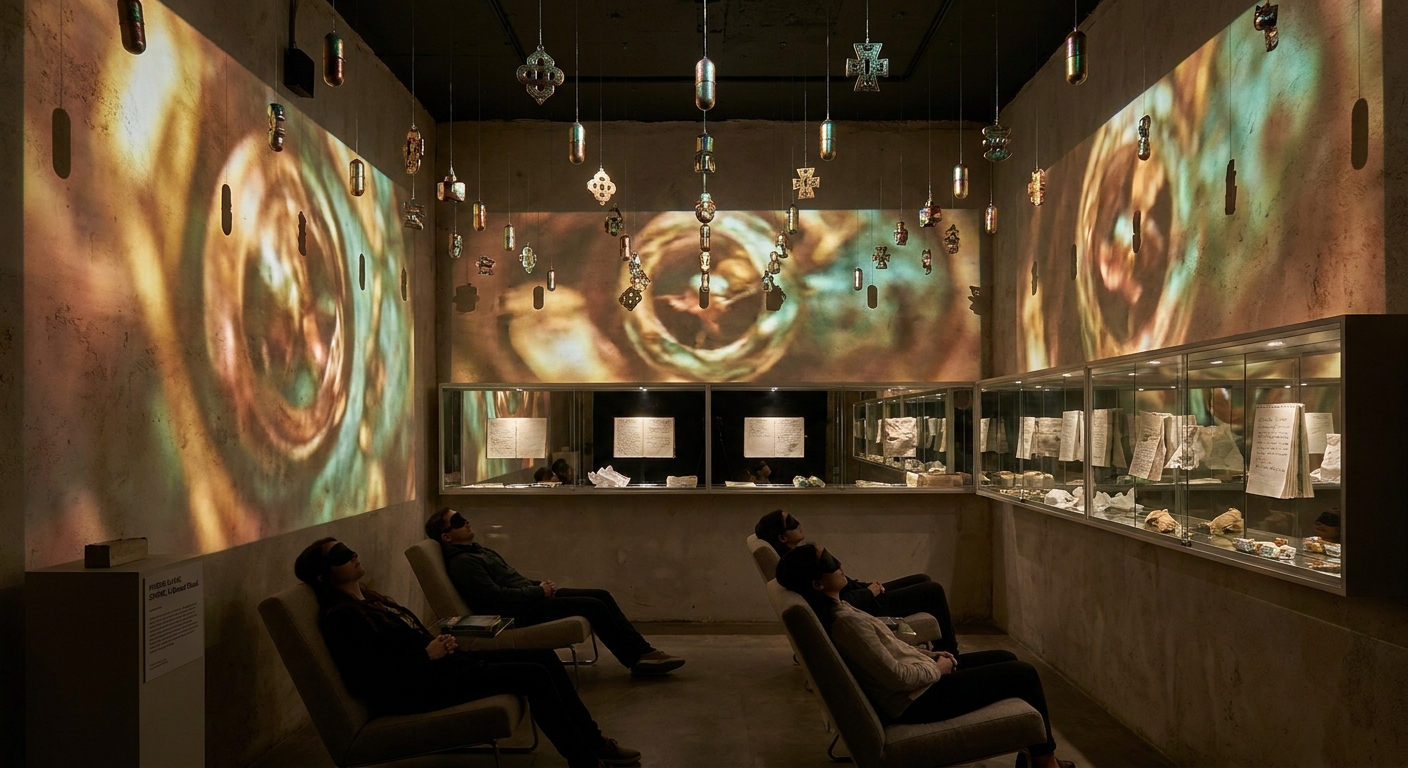
A dim, rectangular gallery becomes a hybrid clinic and shrine. Soft-focus video projections of slowly rotating, halo-like forms — algorithmically generated from anonymized spectrograms and movement traces drawn from archival research into psychedelic sessions — wash the walls in layered gold leaf tints and oxidized copper patina. From the ceiling hang electroformed ‘‘pills’’ and small pre-Columbian–inspired ornaments, gilded and heat-treated so their surfaces read simultaneously ancient and medical. Visitors are invited to recline in simple chairs, don neutral eye shades repurposed from clinical scripts, and listen as a generative soundscape—breath-recorded flutes, whispered lines drawn from integration notes, and low tonal drones—shifts in response to ambient breath (optional, noninvasive sensors). Around the perimeter, mirrored vitrines set luxury retreat ephemera against community-written integration journals and screening checklists, prompting questions of access, commodification and communal care. Periodic, scheduled workshops with local metalworkers and chaplains offer collective repair and ethical framing, turning private transcendence back toward a shared ritual.
About the Artist
Amaya Soler
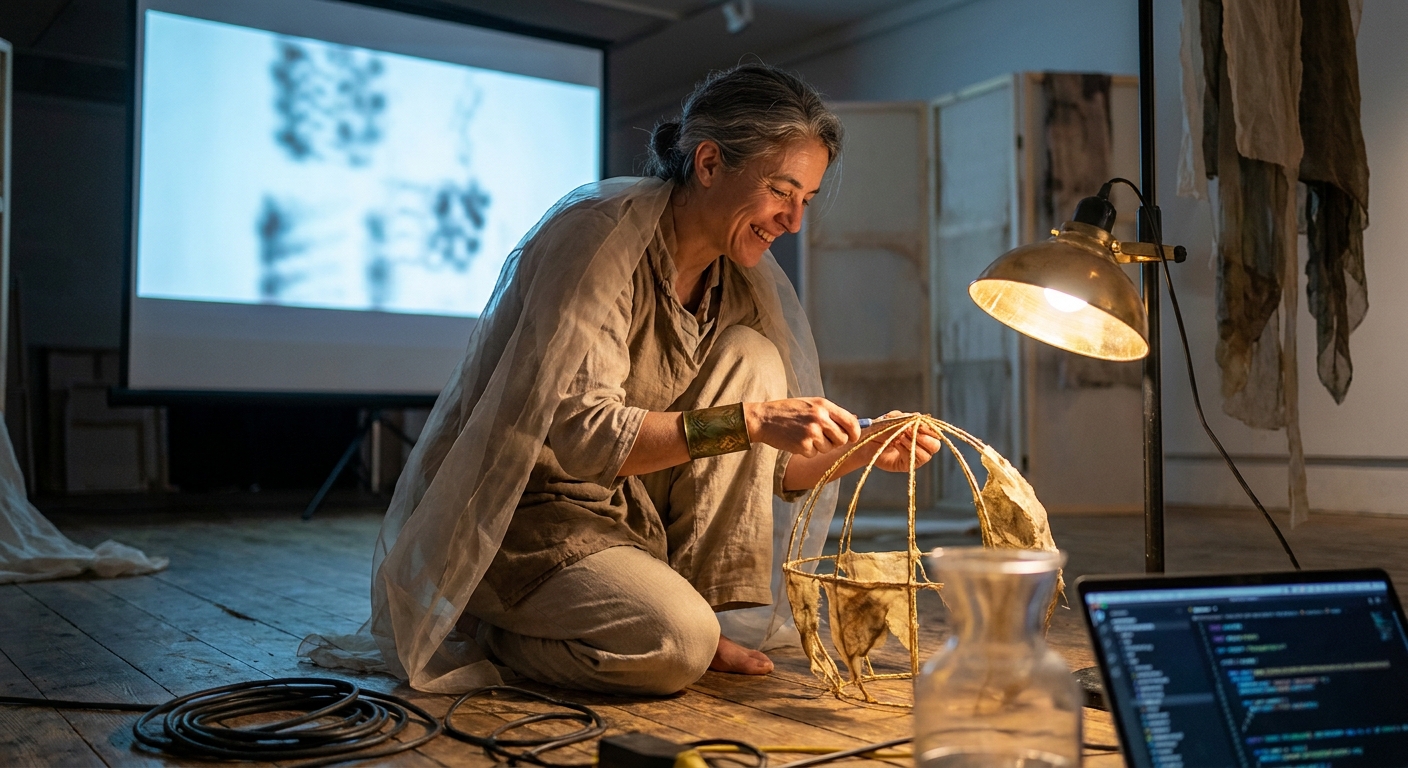
Amaya Soler (pronouns: they/them) is a multidisciplinary artist whose practice quietly bridges material alchemy, ritual poetics, and algorithmic systems. Born and raised in Toulouse, France, Amaya stu...
View Full Profile →Critic Reviews
-
Dr. Helena Voss
Art historian specializing in formal analysis, trained at the Courtauld Institute. Focuses on visual structure over narrative.
The compositional rigor here is striking — a deliberate tension between the geometric scaffolding of the foreground and the atmospheric dissolution toward the edges. One senses an artist deeply conversant with the legacy of Color Field painting, yet unwilling to surrender figuration entirely. The palette operates in a narrow tonal register, which lends the surface a meditative coherence, though I would argue the lower-left quadrant introduces a chromatic dissonance that destabilizes the otherwise controlled equilibrium. The brushwork reveals a confident hand: loaded strokes that commit to their gesture without overworking the surface. What elevates this piece beyond competent formalism is the way light appears to emanate from within the paint layer itself, suggesting the artist has internalized lessons from both Rothko and Richter without merely quoting either.
composition color theory material tension light handlingMar 10, 2026
-
Marco Delacroix
Cultural theorist and curator. Reads art through lenses of discourse, power, and social context.
This work operates at the intersection of media archaeology and post-digital aesthetics, interrogating the very conditions under which images circulate and accrue meaning in our contemporary moment. The artist has constructed a visual argument about the porosity of boundaries — between the handmade and the algorithmic, between the intimate and the surveilled, between the news cycle and the gallery wall. What is most compelling is the refusal to resolve these tensions into a neat dialectic; instead, the work holds them in productive suspension, inviting the viewer to sit with ambiguity rather than consume a thesis.
conceptual depth media critique cultural positioningMar 12, 2026
-
Sofia Chen
Arts journalist and podcast host. Bridges the gap between contemporary art and general audiences.
Honestly, this one left me cold. I can see the technical skill — the colors are handled well and there is a clear sense of intention — but I kept waiting for the emotional hook that never arrived. Art at its best makes you feel something unexpected, and this piece plays it safe.
Mar 14, 2026