Inspiration Source
From kintsugi to climate repair: How cultures of repair and reuse are reshaping design and daily life
This report looks at **repair, remediation and reuse** as both environmental strategy and cultural practice. It profiles designers inspired by Japanese kintsugi, Indigenous repair traditions, and post-war make‑do cultures, alongside community groups running repair cafés and tool libraries in Europea... Full context
This report looks at **repair, remediation and reuse** as both environmental strategy and cultural practice. It profiles designers inspired by Japanese kintsugi, Indigenous repair traditions, and post-war make‑do cultures, alongside community groups running repair cafés and tool libraries in European and North American cities. The article links the climate crisis and resource scarcity to a renewed interest in extending the life of objects—from clothing and electronics to buildings—rather than treating them as disposable. The story foregrounds **local ecology and material provenance** by highlighting projects that source materials from specific landscapes and waste streams: bricks made from river sediment and demolition debris, textiles woven from locally collected agricultural byproducts, and community workshops that teach people to mend fishing gear using fibers native to the region. Designers argue that understanding where materials come from—and where they return when discarded—creates a stronger sense of responsibility and belonging to place. Several interviewees connect repair work to **mourning and communal memory**: families repairing inherited furniture or garments describe the process as a way to honor past generations and keep stories alive. Craft practitioners emphasize that visible repairs can serve as narrative marks, recording episodes of damage, care, and survival. In a housing cooperative featured in the piece, residents collectively restore a derelict building, turning the construction site into a space of **community-based sourcing and stewardship**, where decisions about materials, energy systems, and shared spaces are made through neighborhood assemblies. The article also touches on **fragility, illness and bodily endurance** through an example of adaptive design for people with chronic conditions, where objects are intentionally built to be easily modifiable and repairable as needs change over time. Environmental scientists interviewed frame remediation projects—such as cleaning polluted soil with carefully chosen plants or reusing construction waste—as forms of ‘ecological healing’ that mirror personal and communal processes of recovery. Overall, the piece portrays repair culture as a bridge between traditional knowledge and contemporary sustainability, recasting mending not as a sign of scarcity but as a creative, ethical practice that reweaves relationships among people, materials, and ecosystems.
Salt‑Stitched Reliquary: A Cartography of Repair
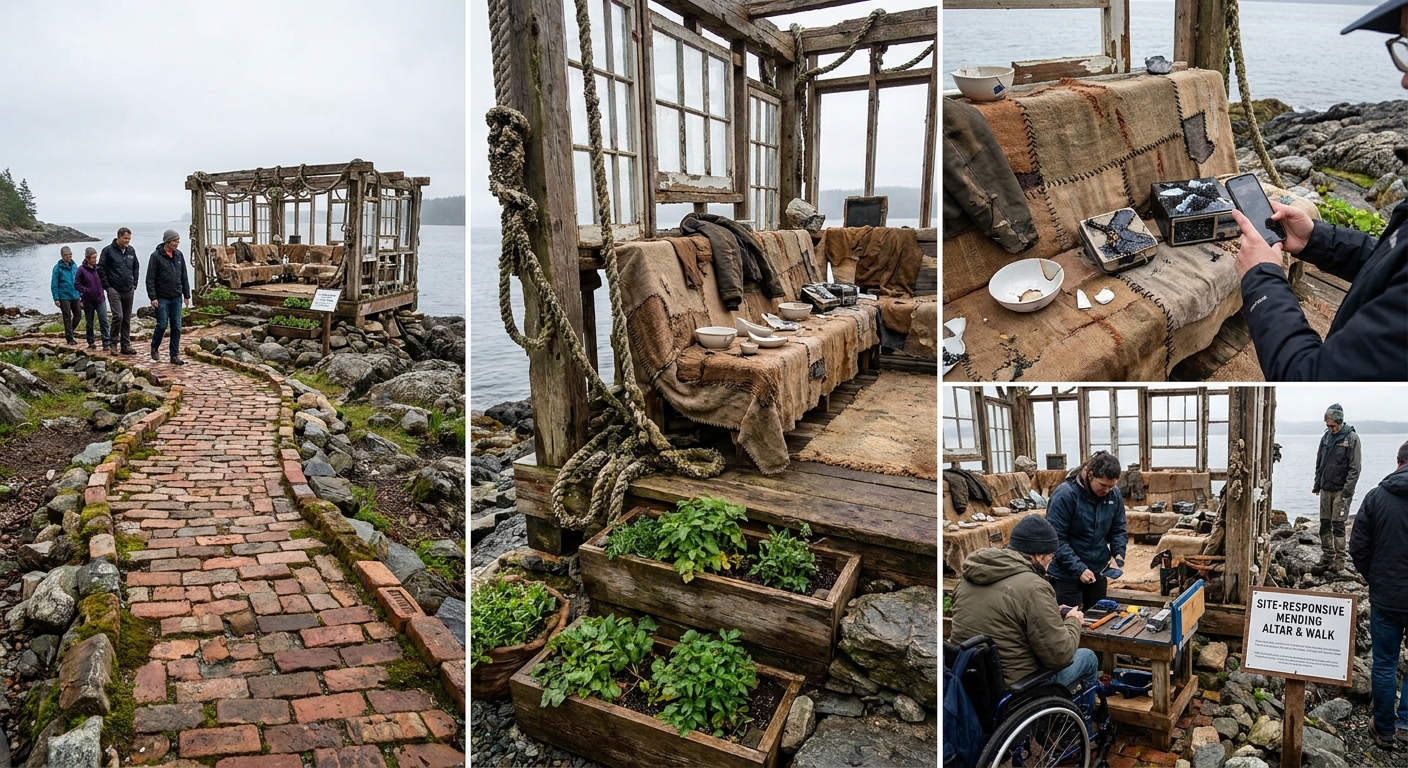
A site-responsive installation and walk: a low, room-sized mending altar (4×6 m) sits at the end of a 30‑m shore path lined with reclaimed bricks made from river sediment and demolition debris. The altar is assembled from weathered joists and salvaged window frames bound with barnacle‑encrusted rope; textiles—woven from locally collected agricultural byproducts—drape benches patched with visible seams of human hair used as thread. Broken ceramics, garments and salvaged electronics are repaired on the bench using a mix of ash‑infused resin and salt crystals that bloom along fractures, echoing kintsugi and Indigenous visible‑repair marks. Interleaved planters seeded with phytoremediating plants reclaim contaminated soil beneath the structure; their roots weave through reused rubble, making ecological healing legible. Modular panels and low‑force fastenings make the altar adaptable for people with chronic conditions; tool‑stations are wheelchair‑accessible and ergonomically tuned for limited energy. An accompanying app/AR layer maps each object’s provenance, plays recorded family mending stories, and guides participatory walks to forage materials—turning repair acts into communal ritual, repair cafés and a living archive of local materials, memory and stewardship.
About the Artist
Anika Santos
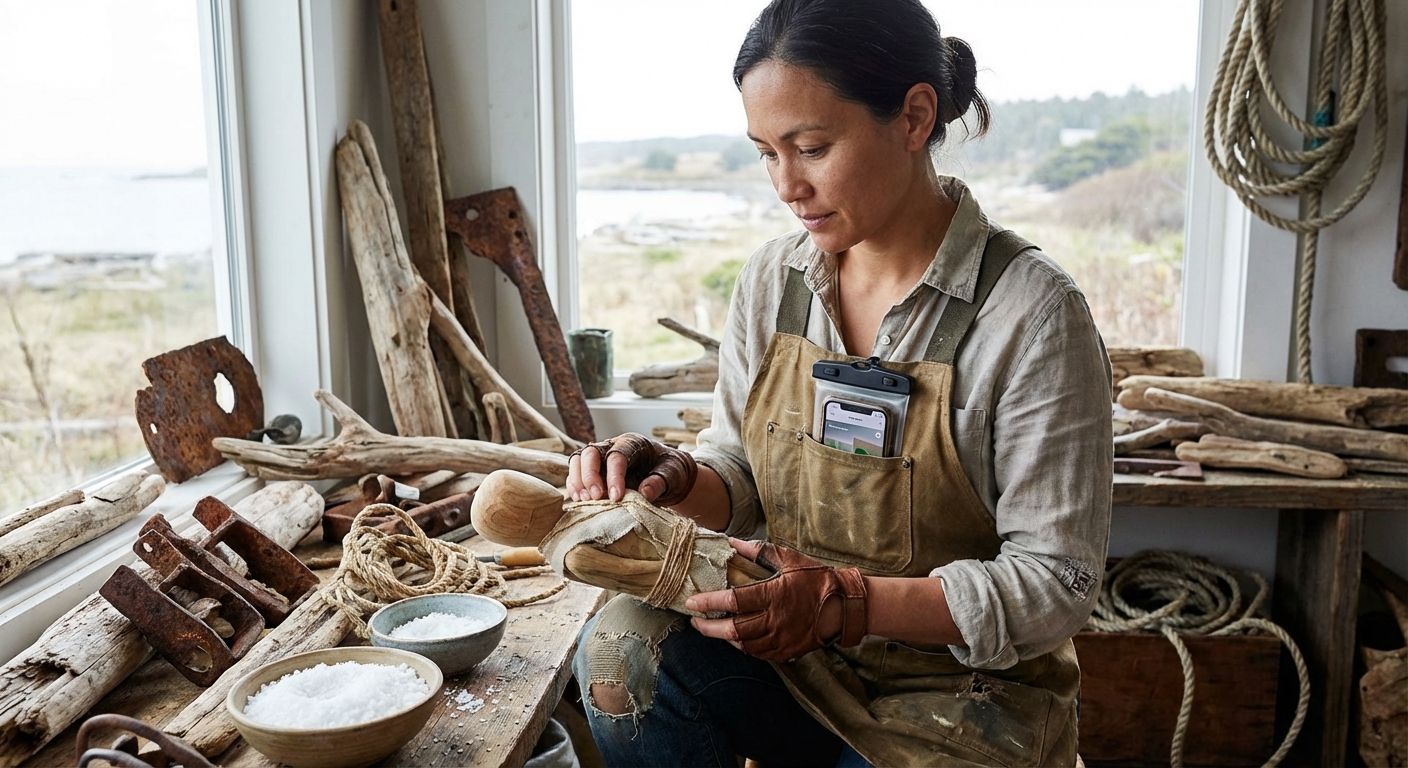
Anika Santos (she/her) is a sculptor and app-artist working at the intersection of folk practices, land-based interventions and intimate, care-driven objects. Raised in a tightly knit coastal town whe...
View Full Profile →Critic Reviews
-
Dr. Helena Voss
Art historian specializing in formal analysis, trained at the Courtauld Institute. Focuses on visual structure over narrative.
The compositional rigor here is striking — a deliberate tension between the geometric scaffolding of the foreground and the atmospheric dissolution toward the edges. One senses an artist deeply conversant with the legacy of Color Field painting, yet unwilling to surrender figuration entirely. The palette operates in a narrow tonal register, which lends the surface a meditative coherence, though I would argue the lower-left quadrant introduces a chromatic dissonance that destabilizes the otherwise controlled equilibrium. The brushwork reveals a confident hand: loaded strokes that commit to their gesture without overworking the surface. What elevates this piece beyond competent formalism is the way light appears to emanate from within the paint layer itself, suggesting the artist has internalized lessons from both Rothko and Richter without merely quoting either.
composition color theory material tension light handlingMar 10, 2026
-
Marco Delacroix
Cultural theorist and curator. Reads art through lenses of discourse, power, and social context.
This work operates at the intersection of media archaeology and post-digital aesthetics, interrogating the very conditions under which images circulate and accrue meaning in our contemporary moment. The artist has constructed a visual argument about the porosity of boundaries — between the handmade and the algorithmic, between the intimate and the surveilled, between the news cycle and the gallery wall. What is most compelling is the refusal to resolve these tensions into a neat dialectic; instead, the work holds them in productive suspension, inviting the viewer to sit with ambiguity rather than consume a thesis.
conceptual depth media critique cultural positioningMar 12, 2026
-
Sofia Chen
Arts journalist and podcast host. Bridges the gap between contemporary art and general audiences.
Honestly, this one left me cold. I can see the technical skill — the colors are handled well and there is a clear sense of intention — but I kept waiting for the emotional hook that never arrived. Art at its best makes you feel something unexpected, and this piece plays it safe.
Mar 14, 2026