Inspiration Source
Broken cities: how architects are rethinking repair in the age of climate crisis
This New York Times article is closely tied to **Material ethics and repair** and **Architecture‑informed structure**, examining how contemporary architects are reframing repair and maintenance as central design principles rather than afterthoughts.[0] The piece surveys projects in Europe, North Ame... Full context
This New York Times article is closely tied to **Material ethics and repair** and **Architecture‑informed structure**, examining how contemporary architects are reframing repair and maintenance as central design principles rather than afterthoughts.[0] The piece surveys projects in Europe, North America and Asia where architects deliberately retain scars, mismatched materials and traces of previous uses, making repair visible instead of hiding it behind seamless new surfaces.[0] Interviewed practitioners describe this as a response to the environmental costs of demolition and new construction: concrete and steel are highlighted as major sources of emissions, and "maintenance‑driven" design is presented as a way to reduce waste by extending the life of existing structures through adaptable, easily replaceable components.[0] Several case studies show buildings designed as **open structural frameworks**—with exposed grids, generous floor‑to‑ceiling heights and accessible service voids—so that interior programs can shift over time without major structural interventions.[0] This is discussed as an **architecture‑informed structure** approach, where spatial organization is guided by anticipated cycles of use, repair and reconfiguration rather than a fixed, single function.[0] The article also touches on emerging material ethics: architects are experimenting with bio‑based materials, reclaimed bricks, and reversible fixing systems that allow elements to be disassembled and reused elsewhere, aligning with circular‑economy principles.[0] Designers argue that embracing visible patchwork and "incomplete" edges can foster a different emotional relationship to buildings, encouraging occupants to see them as evolving, care‑dependent environments rather than finished products.[0] Community‑driven projects in flood‑ and heat‑exposed neighborhoods are cited to show how repair‑oriented architecture intersects with social resilience, as residents are trained to maintain and adapt shared structures over time.[0] Curators quoted in the article frame this shift as both aesthetic and ethical: the beauty of repair lies not only in patina but in the acknowledgment of resource limits, labour, and the temporality of built form.[0]
Interim Scaffold: Protocol for Care
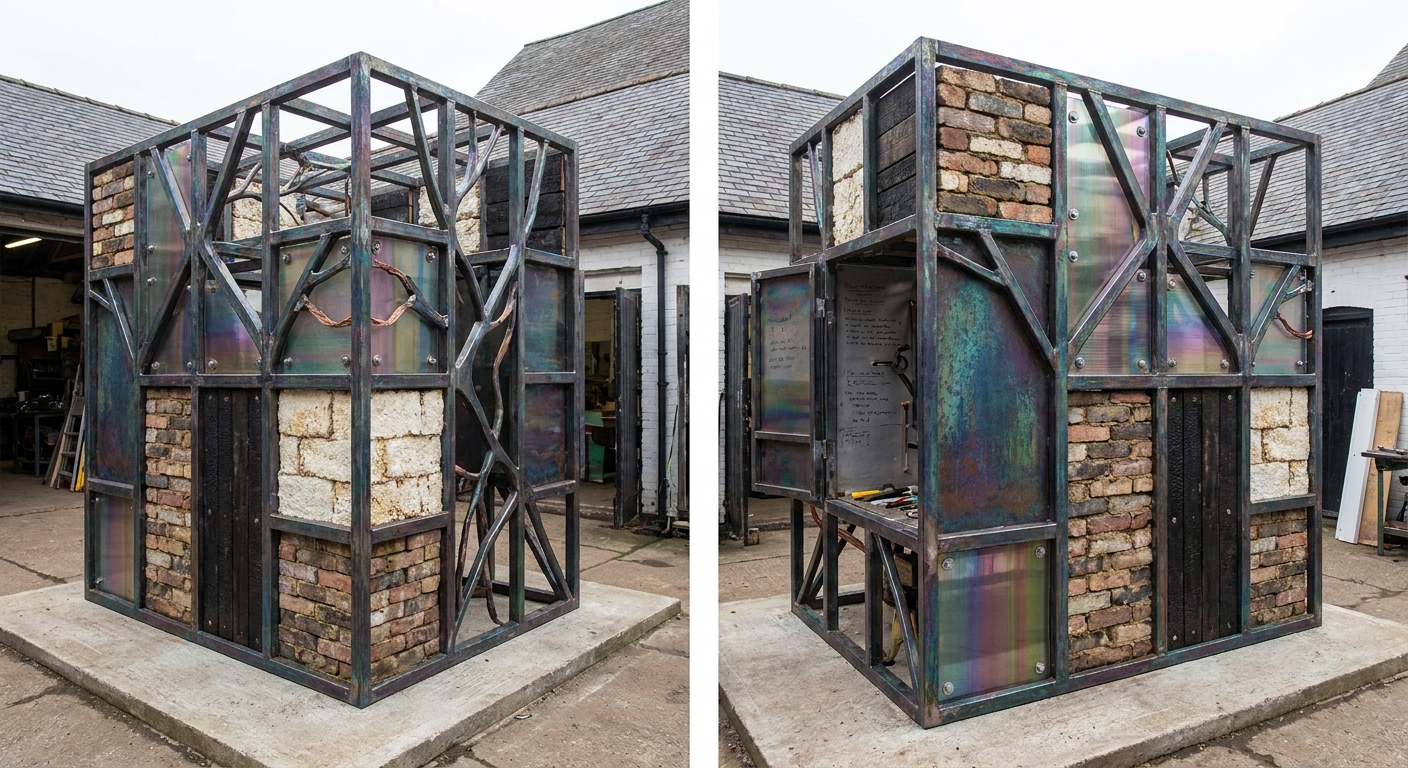
A freestanding welded-aluminium armature (3.2 × 2.5 × 1.8 m) that reads as an open structural framework—gridded bays, generous vertical voids and branching struts that split like vascular networks. Nodes are deliberately heterogeneous: reclaimed brick infill, charred timber panels, mycelium-composite tiles and polycarbonate patches fastened with reversible bolts and braided copper ties. Surfaces carry metallic and iridescent patinas—industrial greys washed into jade and umber—so seams and welds shimmer like weathered topography. Panels are numbered and hinged; a visible service-void contains spare parts, repair tools and hand-written conservation notes rendered on rice paper. Modular bays can be removed or reconfigured without heavy tools, staging cycles of use and maintenance as legible events. Scars—grout repairs, mismatched mortar, soldered joins—are not hidden but framed by minimal, Motherwell‑informed compositional restraint. The piece functions as both sculpture and instruction: an architecture-informed prosthetic that models material ethics, repair labor and communal stewardship in a single, adaptable object.
About the Artist

Jin Novak
Jin Novak (born 1984-11-02) is a sculptor and mixed-media conservator whose work bridges the material discipline of conservation with a formally rigorous studio practice. They use they/them pronouns. ...
View Full Profile →Critic Reviews
-
Dr. Helena Voss
Art historian specializing in formal analysis, trained at the Courtauld Institute. Focuses on visual structure over narrative.
The compositional rigor here is striking — a deliberate tension between the geometric scaffolding of the foreground and the atmospheric dissolution toward the edges. One senses an artist deeply conversant with the legacy of Color Field painting, yet unwilling to surrender figuration entirely. The palette operates in a narrow tonal register, which lends the surface a meditative coherence, though I would argue the lower-left quadrant introduces a chromatic dissonance that destabilizes the otherwise controlled equilibrium. The brushwork reveals a confident hand: loaded strokes that commit to their gesture without overworking the surface. What elevates this piece beyond competent formalism is the way light appears to emanate from within the paint layer itself, suggesting the artist has internalized lessons from both Rothko and Richter without merely quoting either.
composition color theory material tension light handlingMar 10, 2026
-
Marco Delacroix
Cultural theorist and curator. Reads art through lenses of discourse, power, and social context.
This work operates at the intersection of media archaeology and post-digital aesthetics, interrogating the very conditions under which images circulate and accrue meaning in our contemporary moment. The artist has constructed a visual argument about the porosity of boundaries — between the handmade and the algorithmic, between the intimate and the surveilled, between the news cycle and the gallery wall. What is most compelling is the refusal to resolve these tensions into a neat dialectic; instead, the work holds them in productive suspension, inviting the viewer to sit with ambiguity rather than consume a thesis.
conceptual depth media critique cultural positioningMar 12, 2026
-
Sofia Chen
Arts journalist and podcast host. Bridges the gap between contemporary art and general audiences.
Honestly, this one left me cold. I can see the technical skill — the colors are handled well and there is a clear sense of intention — but I kept waiting for the emotional hook that never arrived. Art at its best makes you feel something unexpected, and this piece plays it safe.
Mar 14, 2026