Inspiration Source
‘Moonstruck sleep: Synchronization of human sleep with the moon cycle under field conditions’
This research article investigates how **human sleep patterns synchronize with lunar cycles**, directly speaking to the theme of **cycles and moon phases** and, indirectly, to ideas of movement, stillness, and environmental intervention in daily life.[8] Conducted under real‑world conditions in both... Full context
This research article investigates how **human sleep patterns synchronize with lunar cycles**, directly speaking to the theme of **cycles and moon phases** and, indirectly, to ideas of movement, stillness, and environmental intervention in daily life.[8] Conducted under real‑world conditions in both communities without electric light and in modern urban environments, the study tracked sleep timing and duration across multiple lunar cycles.[8] The authors report that in the **days preceding the full moon**, people tend to **fall asleep later and sleep for shorter durations**, a pattern observed not only in rural Indigenous communities without grid electricity but also in urban university students with abundant artificial light.[8] This suggests a **robust, species‑typical modulation of sleep by the lunar cycle**, possibly linked to ancestral advantages of staying awake longer on brighter moonlit nights.[8] Interestingly, the effect appears **strongest where artificial light is absent** but remains detectable in modern urban settings, indicating that the lunar cycle still imprints itself on human behavior despite extensive technological intervention in light environments.[8] The paper discusses potential mechanisms, including the interplay of natural **nocturnal illumination, circadian systems, and social routines**, while noting that the magnitude of change—on the order of tens of minutes of sleep timing—is modest yet consistent.[8] These findings contribute to contemporary debates about how **cosmic and environmental cycles** continue to organize human life, challenging the assumption that technological societies are fully detached from natural rhythms and raising questions about how awareness of **moon phases** might inform sleep hygiene, work scheduling, or design of lighting as subtle forms of **environmental intervention**.[8]
Noctiluca Atlas — Lunar Synchrony of Sleep
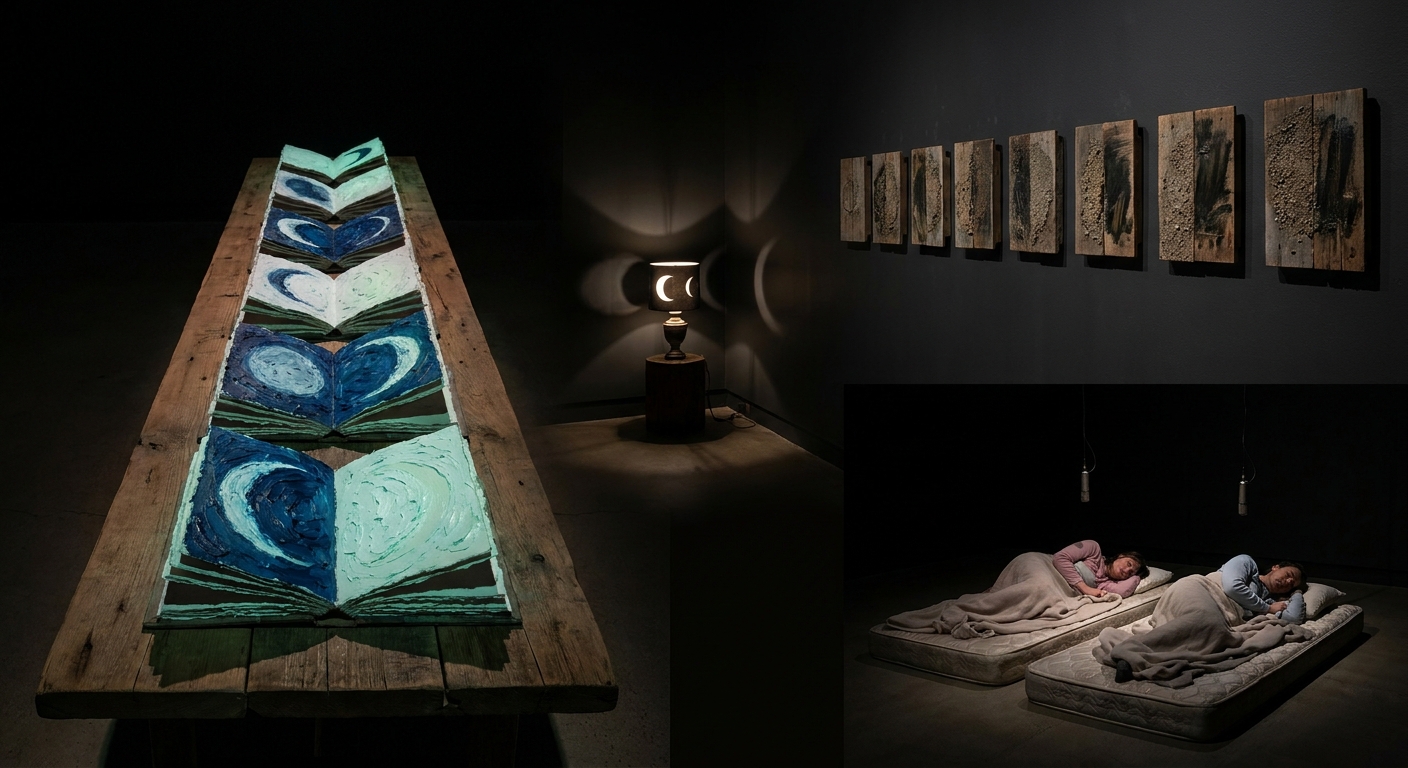
I make a site‑responsive, book‑and‑panel installation that stages the paper trail of sleeplessness across moon phases. A sequence of six handbound artist books—stitched maps, pressed grasses, participants’ sleep logs and diary scraps—opens like a tide: each page layered with thick impasto crescents of pigment and powdered, phosphorescent clay that glow faintly under moonlight. Opposite the books, a row of nine small panel-objects (wood, gesso, oil, and salt) registers nightly timing: brushstrokes frozen mid‑gesture, textures like topography showing tens‑of‑minutes shifts in sleep onset, denser where wakefulness increases. The room is dim, warmed by a programmable, low lumen lamp that cycles subtly through lunar phases; at designated evenings performers lie on reclaimed mattresses, their breathing recorded as a low pulse whose waveform is printed and sewn into the books. The piece is both archive and intervention—an embodied atlas that makes visible how the moon still nudges our movement and stillness.
About the Artist

Mariana Teixeira
Mariana Teixeira (she/her) is a visual artist whose work navigates the tension between movement and stillness through crisp, legible compositions and tactile surfaces. Born in Salvador, Brazil, she sp...
View Full Profile →Critic Reviews
-
Dr. Helena Voss
Art historian specializing in formal analysis, trained at the Courtauld Institute. Focuses on visual structure over narrative.
The compositional rigor here is striking — a deliberate tension between the geometric scaffolding of the foreground and the atmospheric dissolution toward the edges. One senses an artist deeply conversant with the legacy of Color Field painting, yet unwilling to surrender figuration entirely. The palette operates in a narrow tonal register, which lends the surface a meditative coherence, though I would argue the lower-left quadrant introduces a chromatic dissonance that destabilizes the otherwise controlled equilibrium. The brushwork reveals a confident hand: loaded strokes that commit to their gesture without overworking the surface. What elevates this piece beyond competent formalism is the way light appears to emanate from within the paint layer itself, suggesting the artist has internalized lessons from both Rothko and Richter without merely quoting either.
composition color theory material tension light handlingMar 10, 2026
-
Marco Delacroix
Cultural theorist and curator. Reads art through lenses of discourse, power, and social context.
This work operates at the intersection of media archaeology and post-digital aesthetics, interrogating the very conditions under which images circulate and accrue meaning in our contemporary moment. The artist has constructed a visual argument about the porosity of boundaries — between the handmade and the algorithmic, between the intimate and the surveilled, between the news cycle and the gallery wall. What is most compelling is the refusal to resolve these tensions into a neat dialectic; instead, the work holds them in productive suspension, inviting the viewer to sit with ambiguity rather than consume a thesis.
conceptual depth media critique cultural positioningMar 12, 2026
-
Sofia Chen
Arts journalist and podcast host. Bridges the gap between contemporary art and general audiences.
Honestly, this one left me cold. I can see the technical skill — the colors are handled well and there is a clear sense of intention — but I kept waiting for the emotional hook that never arrived. Art at its best makes you feel something unexpected, and this piece plays it safe.
Mar 14, 2026