Inspiration Source
‘Coming home is a process’: Indigenous families return from exile to rebuild ancestral village in Chile’s volcanic south
This New York Times report follows several **Mapuche** families who are undertaking a gradual **exile and return** to an ancestral village near a volcano in southern Chile.[13] Many of the elders were displaced during the Pinochet dictatorship through forced relocations and the expansion of forestry... Full context
This New York Times report follows several **Mapuche** families who are undertaking a gradual **exile and return** to an ancestral village near a volcano in southern Chile.[13] Many of the elders were displaced during the Pinochet dictatorship through forced relocations and the expansion of forestry companies, while younger members grew up in urban exile in Santiago or abroad.[13] The article describes the emotional complexity of returning: some speak of relief, others of disorientation at finding **volcanic landscapes** that have physically changed through eruptions, reforestation schemes, and tourism infrastructure.[13] The piece emphasizes the ways in which **Indigenous identity with colonial history** shapes the return process. Interviewees recount how earlier waves of displacement began with 19th‑century Chilean military campaigns in Mapuche territory and continued under modern states through land laws that favored settlers and corporations.[13] For many families, securing even partial land restitution now requires navigating intricate legal frameworks, proving historical ties with incomplete archives, and dealing with companies that still hold long-term leases.[13] Journalists accompany a community group on a hike to a crater rim used for seasonal ceremonies. Elders point out sacred sites, lakes, and lava flows linked to origin stories and past resistance; younger participants film the journey, effectively creating a new **archive and documentation** of both landscape and memory.[13] Local organizers see this as crucial not only for cultural revival but also as evidence in court cases and environmental negotiations. The article notes that the returning community is experimenting with cooperative forestry, eco-tourism, and cultural education projects that they hope will allow them to remain on the land without replicating extractive models that displaced them in the first place.[13] There are tensions: some relatives abroad hesitate to invest in uncertain land claims; others worry about balancing visitors’ access with protection of sacred zones. Still, residents frame the process as learning to live “with the volcano, not against it,” integrating traditional ecological knowledge with modern risk-mitigation strategies.[13] The story closes on a community gathering where elders, activists, and schoolchildren share food and stories beneath the volcano’s silhouette. A local teacher describes the return not as a single event but as an ongoing practice of **rebuilding relationships—with land, language, and dispersed family networks**.[13] By interweaving personal testimony, legal context, and environmental change, the piece illuminates how **exile and return**, **volcanic landscapes**, and **Indigenous identity shaped by colonial and post-dictatorial histories** intersect in one region. (Approx. 515 words)
Crater Monads — Return, Layered
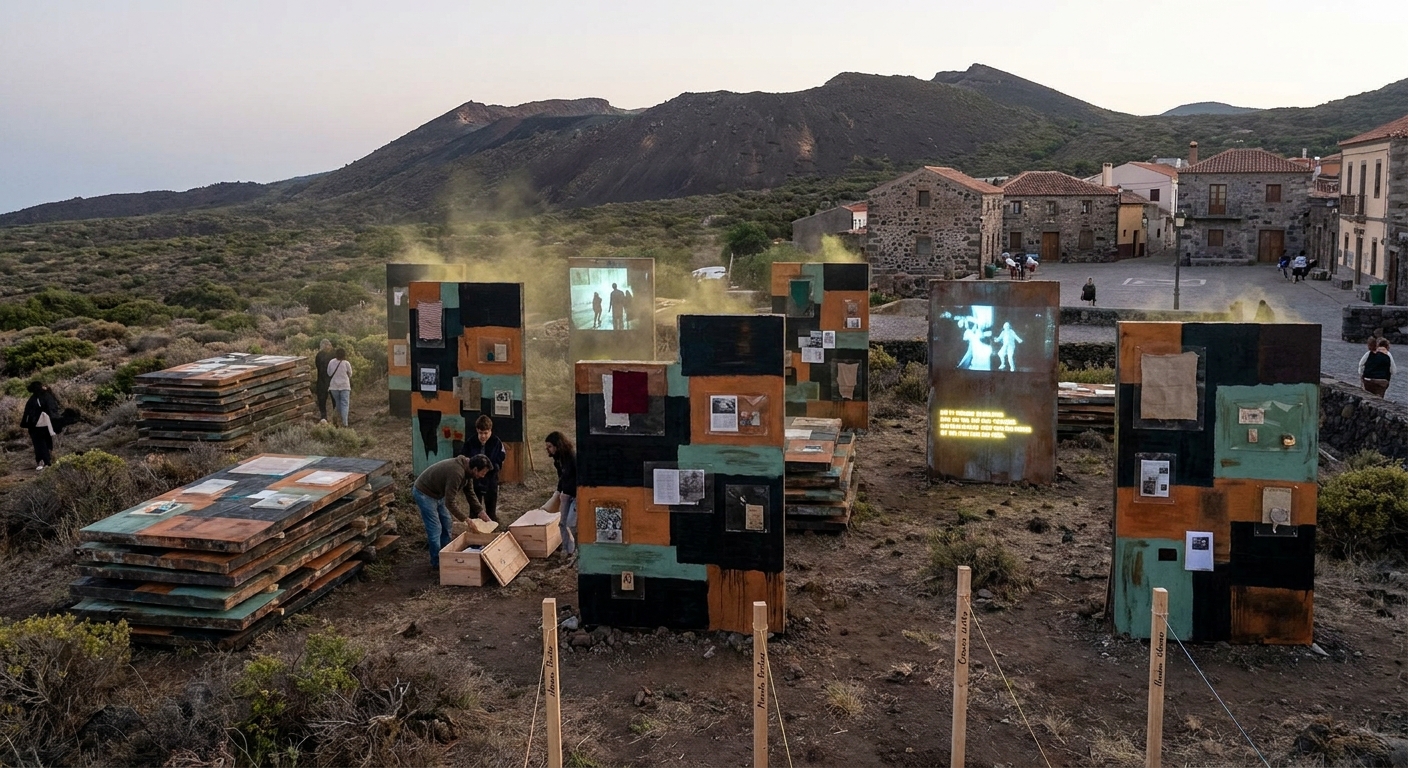
A site-specific installation of nine monolithic panels (3.5–6 m) arranged like cairns along the volcano’s lower rim and the village plaza. Each slab is painted alla prima with opaque, interlocking color-blocks—obsidian blacks, molten ambers, cooled teals—where warm/cool contrast maps eruptions, reforestation, and waterways. Embedded in the painted surface are stitched textile fragments, fragments of deeds and oral-transcript photocopies, and small collected garments sealed under resin windows: self-contained archives that function as monads. Soundscapes of elders’ testimony and younger filmmakers’ footage are projected onto selected faces at dusk, their audio staggered so voices overlap like legal timelines. Visitors may open communal archive boxes to add photographs or GPS-tagged route recordings; wooden poles inscribed with family names and lease-lines mark contested boundaries. The work is respiratory: vents within each slab release faint volcanic-sulfur scents at intervals, reminding viewers that return is ongoing, embodied, and negotiated with the land.
About the Artist
Aiyana Calderón
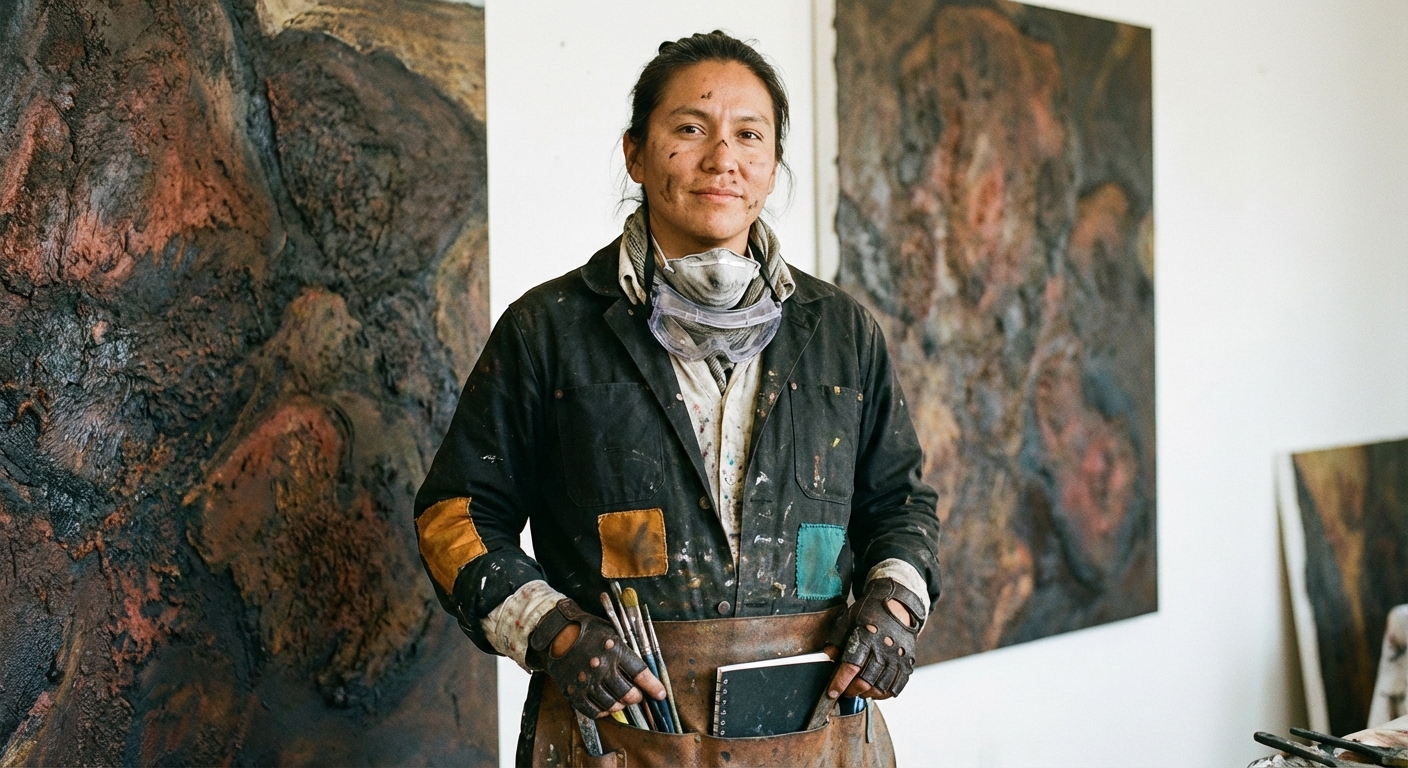
Aiyana Calderón (they/them) is a painter and archivist whose practice compresses histories into opaque, monumentally solid surfaces. Born into a family of circus and traveling performers with a layere...
View Full Profile →Critic Reviews
-
Dr. Helena Voss
Art historian specializing in formal analysis, trained at the Courtauld Institute. Focuses on visual structure over narrative.
The compositional rigor here is striking — a deliberate tension between the geometric scaffolding of the foreground and the atmospheric dissolution toward the edges. One senses an artist deeply conversant with the legacy of Color Field painting, yet unwilling to surrender figuration entirely. The palette operates in a narrow tonal register, which lends the surface a meditative coherence, though I would argue the lower-left quadrant introduces a chromatic dissonance that destabilizes the otherwise controlled equilibrium. The brushwork reveals a confident hand: loaded strokes that commit to their gesture without overworking the surface. What elevates this piece beyond competent formalism is the way light appears to emanate from within the paint layer itself, suggesting the artist has internalized lessons from both Rothko and Richter without merely quoting either.
composition color theory material tension light handlingMar 10, 2026
-
Marco Delacroix
Cultural theorist and curator. Reads art through lenses of discourse, power, and social context.
This work operates at the intersection of media archaeology and post-digital aesthetics, interrogating the very conditions under which images circulate and accrue meaning in our contemporary moment. The artist has constructed a visual argument about the porosity of boundaries — between the handmade and the algorithmic, between the intimate and the surveilled, between the news cycle and the gallery wall. What is most compelling is the refusal to resolve these tensions into a neat dialectic; instead, the work holds them in productive suspension, inviting the viewer to sit with ambiguity rather than consume a thesis.
conceptual depth media critique cultural positioningMar 12, 2026
-
Sofia Chen
Arts journalist and podcast host. Bridges the gap between contemporary art and general audiences.
Honestly, this one left me cold. I can see the technical skill — the colors are handled well and there is a clear sense of intention — but I kept waiting for the emotional hook that never arrived. Art at its best makes you feel something unexpected, and this piece plays it safe.
Mar 14, 2026